“NOT PCGS” Draped Bust $


By Jack D. Young

During a normal internet dumpster dive for counterfeits I spotted this listing on AliExpress–an obvious “Red Book Counterfeit”–due to the off-center bust design only used on a 1795 dated variety.

A “Red Book Counterfeit” refers to a fake coin that resembles a genuine U.S. coin as illustrated in the reference guide, “A Guide Book of United States Coins.” The Red Book serves as a comprehensive, annually updated price guide that provides detailed information on genuine U.S. coins. But counterfeiters, especially in China, use the volume as a design guide in manufacturing fakes.

As you might expect, AliExpress is owned by the Chinese company Alibaba Group, a multinational technology company that focuses on e-commerce, retail, internet, and technology (seemingly without a care about counterfeit coins).

Here is the AliExpress fake:

Past Ali listed 1796 PCGS draped bust dollar

Checking the PCGS cert number pulled this info up from their website:

PCGS on-line info for the labeled cert #

Not even close to the genuine one!

Comparison images to the genuine PCGS example for the cert #

So, considering a purchase I decided to message a question to the seller, “Lucy Coins Store,” which has been on Ali for several years. I was the first to report that this seller houses counterfeits in fake PCGS slabs!

And I sent the following note and received the following answer:


And another side note: I have purchased “coins” from the other sellers listed there and received refunds due to their being “not as described” and reported counterfeits.

I decided to purchase it and see what I would receive; and the fake did in fact look like the listed example.

Counterfeit received

Once in-hand, I started the return/ refund process through Ali; having talked with customer service there before they feign no tolerance for selling counterfeits on their venue. I was almost instantly informed my request was denied! So, I submitted another request:


A solution of “no refund” again. They called it “a new proposal.” So, I uploaded more in as much as they noted that I “rejected the solution of AliExpress”; well, yeah. …


And another rejection and so-called “solution”:


Actually, they do have a repeal process which I initiated and sent additional info:

In addition to the 2 side-by-side comparison images I sent this one trying to explain the issue!

Combination image of why this one is wrong!

And again, I was rejected; they did allow me to appeal again.

Appealed through their process

And rejected…


Best I can tell, they really didn’t care the coin is a counterfeit but that it was properly imaged in the listing.

Next step, take it to PayPal! There you can select that you received a counterfeit item and I sent all of the documents I had generated for the Ali report. Unfortunately, I received a pretty quick response that I hadn’t made my case adequately and had 3 days to add information or they would side with the seller.

So, I added some information about counterfeits, including how this bust design was only used for 1795 AND an image I had reported it through the Anti-Counterfeit Education Foundation.


And from there I waited, wondering if I would even get another response. And then:


And so, it ends with this one; it is interesting that when you click on the old sales link you get this, a similar but different counterfeit. But I am not willing to test me luck this time😎!


Latest Ali listing at same seller/ listing location as mine.

I realize that identifying this counterfeit took years of skill compounded by dogged persistence. Some collectors might not know how to identify fakes with die markers. But as Proxiblog’s Michael Bugeja often notes, the Chinese just can’t get the font right (nor understand how and when to use a hyphen [as in “off-center”].)


If you like posts like this, you can read more articles on counterfeit coins by Jack D. Young, Jack Riley and Michael Bugeja at this URL. Also, please subscribe so you can be informed whenever there is a new article or column.

Proxiblog also has thousands of followers on Facebook Coin Groups, YouTube and social media. To get the latest discussion and commentary, be sure to friend us by clicking here.

You can find more information about errors and varieties as well as buying and bidding on coins in Coin News Updated: The Essential Guide to Online Bidding. Please consider purchasing the work for yourself or a friend, as it underwrites this hobbyist website. Thank you.

New Counterfeit Discovery on 1921 Peace Dollar


By Jack Riley

In a previous article I discussed a large “family” of counterfeit Type A reverse Peace Dollars. The majority of the coins encountered were dated 1921. This article is about a counterfeit 1921 Peace Dollar with a B2 reverse! This reverse type wasn’t used until 1922.

Before diving into the specifics, let’s have a short review:

Let’s look at the two reverse for 1921 and 1922 Peace Dollars:

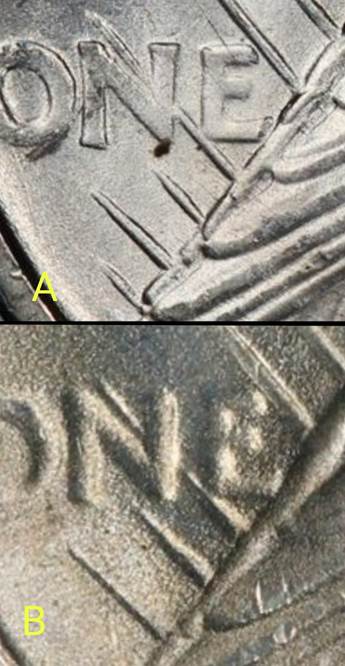
On the 1921 Type A reverse, 4 rays appear below “ONE” and on the Type B reverse, three.

There is one more distinction on Type B reverses, which we label B1 and B2. As illustrated below, B1 reverses show two mountain peaks while the B2 reverse has 3.

Image below Courtesy of VAMworld showing the 3rd peak, B2

So now we progress to that 1921 counterfeit with a B2 reverse! See below.


This is the only example of this counterfeit I have seen as of now. The coin is a cast counterfeit evident by the images and the weight of 23 grams. You can see grainy surfaces and many “lumps” throughout the fields. I make note of two possible markers if this is identified on various dates.

There is a prominent dot about the A of “DOLLAR” on the reverse that may be a helpful indicator and a small crack running through the eagles mouth/head.

While this particular coin shouldn’t fool a veteran hobbyist, it is very possible this is interchanged with various dates and an unknown “family of fakes” is out there. Variety attribution on Peace Dollars can be tricky even for experienced collectors.

But this article provides the basics from which all of us can learn.

If you like posts like this, you can read more articles on counterfeit coins by Jack Riley, Jack D. Young and Michael Bugeja at this URL. Also, please subscribe so you can be informed whenever there is a new article or column.

Proxiblog also has thousands of followers on Facebook Coin Groups, YouTube and social media. To get the latest discussion and commentary, be sure to friend us by clicking here.

You can find more information about errors and varieties as well as buying and bidding on coins in Coin News Updated: The Essential Guide to Online Bidding. Please consider purchasing the work for yourself or a friend, as it underwrites this hobbyist website. Thank you.

Family of Fake Indian Cents


By Jack D. Young

A recent counterfeit Indian Head Cent listed on eBay from a larger seller sparked my interest–to the extent that I decided to investigate it, especially since the coin was shared to several Facebook groups.

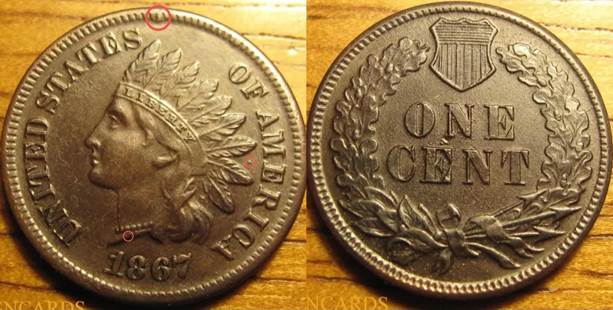
I discovered a rather large “Family” sharing a common obverse. A “Family” is code for counterfeits with common markers among various dates. Most notably, I viewed the deformed denticles at 12 o’clock on the obverse and a raised lump left of “M-E.” The 1867 pictured below is from that larger seller.


The above example also shared a depression in the neck. I recalled seeing this in an NGC article published about 2013 or thereabouts. That article didn’t include these “common marks” rather more of a description of the surfaces.


After browsing online for sometime it was clear this was a very large “Family” and not limited to a few dates. Most examples were either key or semi-key dates but it would be expected this could be seen on common date Indian Cents.

This listing includes the Key date 1877! Along with another 1908s and two semi-key dates including 1866 and 1870. All images highlight the lump on the field between the feathers as well as the deformed denticles.


Some pieces aren’t as deceptive as others but many of these were already in collections! Stay diligent when looking for new coins to add to your collection and research extensively.

If you like posts like this, you can read more articles on counterfeit coins by Jack D. Young, Jack Riley and Michael Bugeja at this URL. Also, please subscribe so you can be informed whenever there is a new article or column.

Proxiblog also has thousands of followers on Facebook Coin Groups, YouTube and social media. To get the latest discussion and commentaries, click here.

You can find more information about errors and varieties as well as buying and bidding on coins in Coin News Updated: The Essential Guide to Online Bidding. Please consider purchasing the work for yourself or a friend, as it underwrites this hobbyist website. Thank you.

Etsy’s Ripoff Replicas


Etsy, a major seller of coins, has house rules that prohibit fakes, and yet is one of the major distributors of counterfeits and replicas. That, in itself, is not the problem. Scam sellers on Facebook coin sites and online auctions purchase these replicas and then try to pass them off as authentic, hoping to bait new hobbyists who do not know any better.

Here’s an example:


Proxiblog catalogued keydate replicas and is sharing them here. Bookmark the URL and share this post whenever you see someone trying to pass off these items as genuine.


Proxiblog identifies these replicas every day across Facebook coin groups–to the extent that he regularly warns against sellers and scammers who claim these are genuine. Here’s a screenshot of a recent example:


If you like posts like this, you can read more articles on counterfeit coins by Jack Riley, Jack D. Young and Michael Bugeja at this URL. Also, please subscribe and be informed whenever there is a new article or column.

Proxiblog also has thousands of followers on Facebook Coin Groups, YouTube and social media. To get the latest discussion and commentary, be sure to friend us by clicking here.

You can find more information about errors and varieties as well as buying and bidding on coins in Coin News Updated: The Essential Guide to Online Bidding. Please consider purchasing the work for yourself or a friend, as it underwrites this hobbyist website. Thank you.

Several Suspicious 1804 “Large Cents”


By Jack D. Young

Before discussing those suspicious cents, a quick definition of an electrotype–a copy of a coin formed by depositing metal onto a mold using electricity. Electrotypes are not considered genuine coins, but rather reproductions. When offered in auctions, they are fake coins.

Here is an example as an acknowledged electrotype sold in a Goldberg 2006 auction:

Images courtesy Goldberg Auctioneers

In the time span from this auction until August 2017, there was another acknowledged example reportedly sold in two different eBay auctions in 2016:


On Aug 2, 2017 another example with many of the matching obverse marks sold on eBay as an electrotype:

eBay Aug 2, 2017 Listed Electrotype Example

During the same time frame as this listing another one was running with matching marks but listed as genuine:

eBay Aug 2017 Listed Genuine Example

 eBay Aug 2, 2017 Listed Electrotype Example      eBay Aug 2017 Listed Genuine Example

Comparison of the latest eBay example listed as genuine to the documented electrotype example from the Goldberg’s 2006 auction shows the same “circulation” marks:

    eBay Aug 2017 Listed Genuine Example             Goldberg 2006 Auction Example- Electrotype

Comparison of the reverse images between these two yields similar results:


Both examples show the same marks and what appear as casting “bubble”/ defects on the surface, “casting” serious doubt that listed example is a genuine 1804 large cent. I sent the seller a number of messages, but I was too late to have him stop the auction.

eBay messages with the author

At the same time another early copper collector (unidentified) was also asking questions:


The weight listed as “11.7 grams” is a red flag as the standard was 10.89! Electrotypes regularly weigh more than a genuine example as a result of the base metal used. So it sold:

Sold as genuine on eBay 2017

The main difference between this and the Goldberg example is this one sold for a whole lot more. And an edge view would have given it away; an in-hand inspection would have been interesting to see if it was oriented correctly to a genuine 1804 large cent.

A genuine example has the reverse rotated as noted in the lot description of the “finest known” example in a past Stack’s Bowers auction:

“This die state is traditionally known as ‘Sheldon-266c,’ with substantial cuds over RTY of LIBERTY and MERIC of AMERICA, the last of the three main die states. Clash marks are seen at Liberty’s profile and throat, as well as under her hair bow. Breen describes this state as his state IV. Genuine specimens show the distinctive die rotation typical of this variety, with the reverse aligned roughly 45 degrees counterclockwise of proper coin turn.”

The Stack’s example showing the rotation of all genuine examples (and the die breaks of the late state):

1804 S-266 Cent from the Pogue Collection. Image courtesy Stack’s Bowers.

So, now the twist! I had the opportunity to purchase an example at auction this month. That one showed a provenance back to 1987 with a couple of giants in early copper previously owning it.


Reviewing the images, I confirmed it matched the others with the many common “sister marks” and it became a “must have,” not just for my collection but for the research and history of this one.

So, I won the auction and having it in-hand allowed for more observations to document these!

Author’s example and some of the eye-catching common marks!

I had the opportunity to weigh my example; it weighed 12.10 grams versus the mint standard of 10.89 grams.

I also was able to take good images of the edge and evaluate the die rotation of this “copy” versus a genuine one as images earlier with the genuine example:

Proper Die Rotation for this electrotype

Electrotype Edge of this one

And the final “twist”–back to the example sold as genuine in 2017; I decided to ask the seller about it now. He apparently mistook me for the buyer and sent this response.

Well, maybe justice, as they say Karma is a “b**ch.”


If you like posts like this, please subscribe so you can be informed whenever there is a new article.

Proxiblog also has thousands of followers on Facebook Coin Groups, YouTube and social media. To get the latest discussion and commentaries, click here.

You can find more information about errors and varieties as well as buying and bidding on coins in Coin News Updated: The Essential Guide to Online Bidding. Please consider purchasing the work for yourself or a friend, as it underwrites this hobbyist website. Thank you.

Fake Family of Type A Reverse Peace Dollars


By Jack Riley

Today we discuss an extensive family of Type A fake reverse Peace Dollars, otherwise known as the 1921 High Relief reverse. We will investigate minor differences in the Type A and B (“Low Relief”) reverses whose diagnostics are key in identifying counterfeits.

First, some background: About 35,401 business strike High Relief 1922 Peace dollars were produced. All but one were melted. Also, 10-20 High Relief proof 1922 coins were made. These are not included in our discussion. Type B reverses appear on Peace dollars dated 1922-28 and 1934-35.

On the 1921 Type A reverse there are 4 rays below “ONE” and on the Type B reverse there are three. Secondly the shape of the leaf cluster is dramatically different. There are other subtle changes but we will use these two as the quick identifiers.


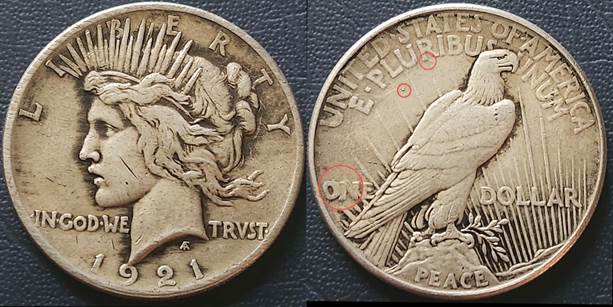
Now onto the “Fake Family”! This is an extensive group of counterfeits spanning various dates with improbable die pairings. The first image is the author’s example with highlighted markers in red. View the strong spread of one, small circular and raised lump between the rays below “L,” and a raised flaw below R. There are additional small depressions in many letters but minute.


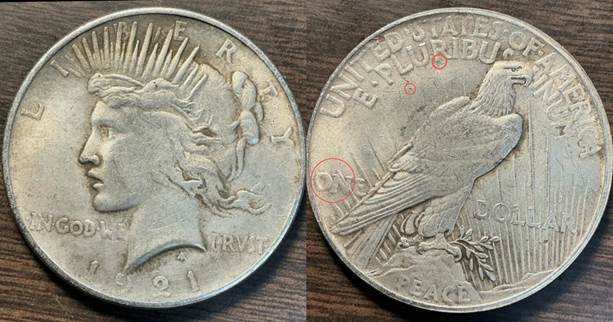
The next set of images are dated “1921” and from various online sources.


The next image was offered on Ebay by a seller who genuinely wasn’t aware the coin was counterfeit. The listing received a number of bids! I messaged the seller and had a brief discussion and they removed it. Owner stated it had been in the family’s collection since the late 1990’s.


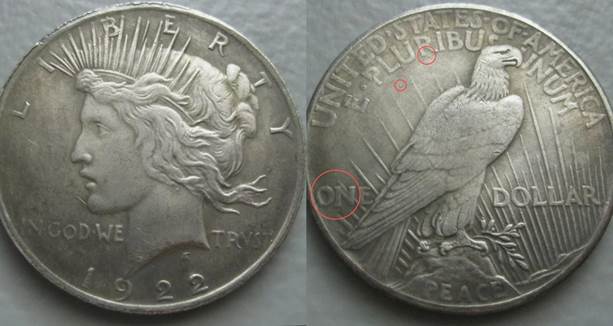
On to our “1921” dated pieces. This is an image from fellow counterfeit researcher Jack Young.


Various dates have been seen mismatched with this common reverse.


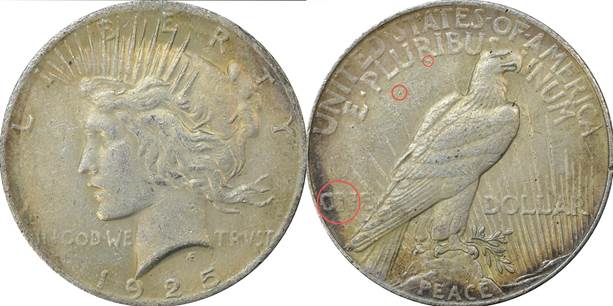
Behold one of the more fascinating pieces below. A fellow collector friend Winston Zack shared his 1925 showcasing the common counterfeit reverse and the catch? This piece scanned as 63.5% copper, 28.3% zinc, 7% nickel, 1.2% silver, and traces of iron!


Finally to round out this article, we present two matching counterfeit 1921 Peace Dollar in fake PCGS holders! One which was offered for sale through a Facebook group.


So once again a few of these bypassed numerous collectors who already purchased them or were in the process of doing that. Proxiblog hopes this information gets disseminated so no one purchases any of these counterfeit Peace Dollars!

If you like posts like this, you can read more articles on counterfeit coins by Jack Riley, Jack D. Young and Michael Bugeja at this URL. Also, please subscribe so you can be informed whenever there is a new article or column.

Proxiblog also has thousands of followers on Facebook Coin Groups, YouTube and social media. To get the latest discussion and commentary, be sure to friend us by clicking here.

You can find more information about errors and varieties as well as buying and bidding on coins in Coin News Updated: The Essential Guide to Online Bidding. Please consider purchasing the work for yourself or a friend, as it underwrites this hobbyist website. Thank you.

1806 Counterfeits, the Gift that Keeps Giving!


By Jack D. Young

My friend and half cent guru Ed Fuhrman alerted me to this one on eBay. His PM stated “I think someone just posted one of the super fake 1806 C-1 half cents on eBay. Take a look.”

I did and they did.

I have actually written two articles about these fakes for these EAC’s Penny-Wise as well as a couple for Coin Week and now this one for Proxiblog.

The subject coin is interesting as one of the very deceptive group of counterfeits I have been chasing down the rabbit hole since late 2015. This was one we saw in the 1st group of certified genuine fakes from a known CN connected buyer and group of sellers operating out of College Station Texas; I have discussed this group in many previous articles…

The listing of the subject:

eBay listing- counterfeit 1806 C-1 half cent

Yep, I made an offer knowing what this is; I chose not to discuss it upfront with the seller as I didn’t want to influence him while considering my lower offer.

I quickly marked up the posted image of the reverse with four known counterfeit tells, or attribution points for these. Done from memory, this one is burned into my mind as I owned five examples at the time with four being in TPG holders as genuine. And 14 total examples documented to date.

Subject reverse marked with 4 major attribution points of the counterfeits

So, no doubt what this one is, it is the 1st I had seen in the wild in a couple of years! I anxiously waited to see how the seller would respond to my offer.


Not for the listed price, but a fair price for what it is! And then waited to actually have it in-hand so that I could message the seller and start a conversation:

Messages through eBay with the seller after the sale

Interesting he stated this example “is from a Boston area old, abandoned coin shop”; he later stated he purchased it from the cleaning lady who cleaned the basement and painted for the owners two or three years ago.

And a nice image of this one including the edge:

Combination image of this featured example

And in-hand the main reverse attribution points for these from my microscope:


So, a good time to add some details on these from one of my previous articles:


Interestingly, there are 2 “varieties of this reverse”; apparently the counterfeiters tried a repair!

And an image of the 1st die state of the common reverse:

Reverse image from my article draft

And what about the obverse?

Obverse image from my article draft

Just an amazing number of common marks including a couple of light scratches noted! These are seen across both reverse die states.

So this example became the 6th one in my mini-hoard- talk about deep into the rabbit hole! And just a side note, I had several examples sent out for XRF testing of the metal and found them to have high levels of zinc in them, the only ones to test with that result against all of the other early copper coins we tested. Maybe the counterfeiters melted some later date Lincolns in their mix for planchets?

I did leave positive feedback for the seller but did note the coin is counterfeit.


So, I thought this the end of the story, but NO, as my articles often take a twist at the end!

And again, it was Ed who sent me a late Friday night link and said I really would like this one:

eBay listing over the weekend

I pulled up the listing and was literally shocked at the posted images!

And the special NGC label; apparently “traderbea” is a premier shop on whatnot.

eBay listing images

Look familiar?


Great images posted show all the “details”! No question what this one is and it is certified genuine by the TPG.


A quick note to my contact at the TPG resulted in an amended on-line cert:


Certainly makes it harder to sell if anyone considering a purchase takes the time to look…

Contacting the seller and discussing the issues lead to an agreement on a purchase; he had a buy-back guaranty through the whatnot dealer and of course the TPG has an authenticity guaranty as well so it is on its way to join the “Dark Side Collection.” Digging deeper into the abyss, two in a week 😎!

And this one is recent and slipped past both an established coin dealer and a top tier TPG, and that just goes to show how deceptive they are. So maybe my 5th published article will help. …

Ended eBay listing


And I will have to update my image of the TPG certified examples in the collection!

Author’s image of 4 certified examples

If you like posts like this, you can read more articles on counterfeit coins by Jack Riley, Jack D. Young and Michael Bugeja at this URL. Also, please subscribe so you can be informed whenever there is a new article or column.

Proxiblog also has hundreds of followers on Facebook Coin Groups. To get the latest discussion and commentary, be sure to friend us by clicking here.

You can find more information about errors and varieties as well as buying and bidding on coins in Coin News Updated: The Essential Guide to Online Bidding. Please consider purchasing the work for yourself or a friend, as it underwrites this hobbyist website. Thank you.

Fake Family, Type 2, Standing Liberty Quarters


By Jack Riley

With an ever growing amount of counterfeit coins being produced it can be a challenge to keep up with them. Tens of thousands of fake coins, replicas and copies flood the hobby market each month.

Numismatic News and other sources have reported these sobering results:

  • One factory along in China produces over 100,000 forged coins per month.
  • Annual figures of fakes range in the billions with entire cities or districts in China manufacturing them.
  • Flooding of fakes on eBay remains one of the biggest concerns.

The frenetic manufacturing rate now includes common 90% silver coinage to be counterfeit. Nothing is safe!

After a previous article of what one could call the “Spiked wing” counterfeit Standing Liberty quarters, a second family arose on different online venues.

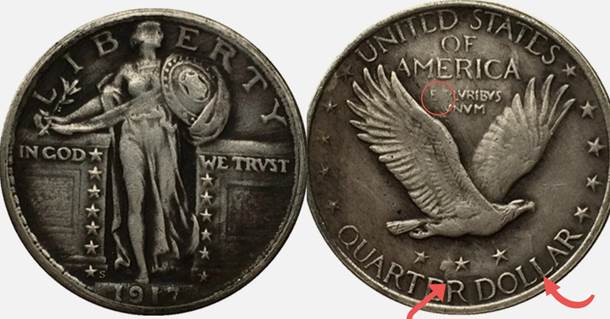
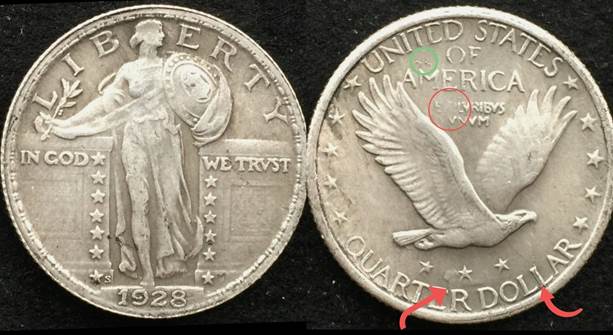
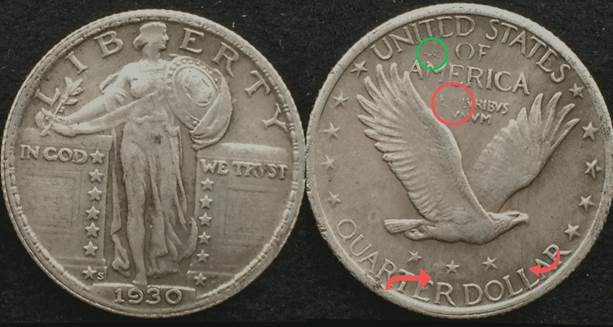
I have three images comparing this new “Family.” Two of which have a major casting flaws above “America” and will be highlighted in green since it isn’t seen on all examples. All markers highlighted in red have been on all examples seen as of the time of this article.

So to the Family! Three coins dated 1917, 1928, and 1930 showed up all sporting a San Francisco mintmark. Though this likely could be seen on any date/mintmark combination since the counterfeiters pay no mind to design changes or the series itself. First up is this 1917s Type 2 SLQ that shows a weak E-P highlighted in red as well as two cracks through “Quarter Dollar”.


Another seller offered two coins (1928s and 1930s) which share the same reverse but a different obverse as the 1917s. Additionally the raised lumps from a poor cast show on both of these examples.


It would seem a new “Family” surfaces regularly! Making it ever more important to be diligent in vetting who/where you purchase coins from and how you make that purchase, especial ly if buying on eBay, as counterfeit expert Jack D. Young has reported for Proxiblog.

Granted, even experienced hobbyists are scammed by purchasing counterfeits. As such, newer collectors should follow these general guidelines:

  1. If you are ready to bid hundreds of dollars on a coin, resist buying a raw one and shop for one holdered by PCGS, NGC, ANACS and CAC.
  2. Be especially careful when purchasing raw coins from eBay and other online venues. TAI bots cannot detect counterfeits, so you are on your own.
  3. Make sure the seller takes returns and has good reviews. Also, the number of positive reviews is a good indicator. If someone has 0 sales or even fewer than 100, do not take a chance.
  4. Weigh the coin and go to PCGS CoinFacts for the date and mintmark, checking your coin against weights and dimensions.
  5. Read this article about detecting counterfeits.

If you like posts like this, you can read more articles on counterfeit coins by Jack Riley, Jack D. Young and Michael Bugeja at this URL. Also, please subscribe so you can get our weekly newsletter and be informed whenever there is a new article or column.

Proxiblog also has thousands of followers on Facebook Coin Groups, YouTube and social media. To get the latest discussion and commentary, be sure to friend us by clicking here.

You can find more information about errors and varieties as well as buying and bidding on coins in Coin News Updated: The Essential Guide to Online Bidding. Please consider purchasing the work for yourself or a friend, as it underwrites this hobbyist website. Thank you.
“NGC certified” Large Cents–NOT!


By Jack D. Young

I have written a number of articles on fake Morgan Dollars in fake PCGS holders but now the latest from China (CN) are counterfeit large cents in fake NGC holders!

I was alerted to three bad listings in a coin forum I frequent, with one already showing sold. All listed on the Bay, all had the standard eBay answer they were A-OK, but they are not OK.

In all listings the seller cut-off the cert number on the label of the fakes, but the genius 😎 left enough of the barcode to scan. And unlike the PCGS Morgan fake slabs, the barcodes do scan properly!

So, starting with the “1840,” I show the Bay listing, the cert for the genuine one, and a comparison of the CN counterfeit to the genuine example.

One note I would like to make, when NGC receives information that a cert of theirs has been compromised with a counterfeit, they “nuke” the cert with a note “possible counterfeit holder” which can help someone considering a purchase if they just take the time to look it up. The certs for these three have all been reported and nuked and these are the images I will use in this discussion.

Recent eBay listing of a counterfeit 1840 large cent

The following shows the updated NGC cert and the comparison of the slabbed image of the listed counterfeit and the genuine example.


Next, the “1844”; same seller shipping from China:

Recent eBay listing of a counterfeit 1844 large cent

1844 comparison image of counterfeit, left; genuine example, right

And “last,” the “1846.” This is the initial example shown sold from the coin forum discussion.

Recent eBay listing of a counterfeit 1846 large cent

And the updated cert and comparison to the genuine example; WOW, MS61???


All three showed sold, and all appear to have been removed from the Bay after the fact. The 1840 actually showed as:


Kudos to NGC for so quickly addressing the issue! As far as the coins themselves, the1844 and 1846 are from the “smashed dentils” obverse family, the 1840 “crescent chip obverse” family from my previous Coin Week article, “It’s a Jungle out There! Later Date Large Cent Counterfeits.”

But as usual for these articles there is a twist! Reviewing the seller for any new items revealed another one, this a bad 1855 in bad NGC slab…

Counterfeit ”1855” on the left, genuine example on the right

And another comparison shows these are not even close!


And one common good “tell” for these holders is the size of the prongs!

Going back to check on the seller resulted in this, “No longer registered user”:


“NRU’ed”, I went back to the sold items and although you can see them, they have ALL been removed when you actually click on the links. eBay apparently put the hurt on this seller after the fact. This “1857” would have been interesting to see as it stated PCGS!

Apparent sold and removed later large cent counterfeit from the same seller

What another strange “twist”! I have been a very loud critic of eBay over the last several months about their apparent lack of caring about the number of counterfeits currently allowed for sale there. AND the inability of having obvious bad counterfeits removed through their “new and improved” reporting process. This lead to my latest Live Coin Q&A podcast premiered May 27 at https://www.youtube.com/watch?v=57HwefhVn_k

It seems rather ironic after previously receiving responses like the following one on these fakes that the day after the podcast all of these including the active listings and the seller were removed!

eBay response to my report of the bad 1844 not NGC large cent

So ends another episode of my Facebook group, Fun with Fakes (FwF’s) and Proxiblog; it continues to be really hard to keep up with all the ways the counterfeiters are challenging the Hobby but we will continue to release content like this in an effort to help!

Counterfeit 1872-S Seated Dollar


By Jack Riley

The ever growing saga of new counterfeits continues. This 1872 S Seated Dollar below was recently brought to our attention in a Facebook group.

That’s an example of how counterfeit investigations begin.


A quick glance tells the story.

The 1872-S was only produced with one die marriage and that is referred to as an OC-1. Below is an image of the mintmark location of a genuine coin.


The coin clearly isn’t attributable to a genuine variety. The next step to me is looking for anything that may standout as a notable marker to find additional “bad” coins. Another example offered by Aliexpress shows us just where this came from.

Both coins show both a common obverse and reverse. Highlighted markers in red include a raised lump on the center of the obverse, misplaced mintmark, gouge in the shield, small indent on the R as well as an overall weakness of the U.


To be sure, a poorly executed cast; but as always there is a potential to see this on numerous dates.

Join the Fight

As we become experienced numismatists, we have an obligation to expose fakes and to share the methods to identify them.

As in the case of the counterfeit Seated Dollar, numismatists study die markers for one common sense reason. If counterfeiters are going to invest time, effort and funds to manufacture fake coins, they are going to use the same die for multiple mintages. That’s when inconsistences occur, ranging from suspicious mintmarks to unique features that deviate from authentic examples.

For instance, there can be deviations in lettering and design, weight and size, metal composition and edge details. I analyze all of these and more.

I will continue to share these details in my articles for Proxiblog and other publications as well as Facebook’s “Fun with Fakes” (FwF).

By understanding how die markers are used and by carefully examining coins for inconsistencies, coin collectors can increase their ability to identify counterfeit coins. 

If you like posts like this, please go to our counterfeit archive with reports from Jack Riley, Jack D. Young and Michael Bugeja. Also, please subscribe so you can be informed whenever there is a new article or column.

Proxiblog also has hundreds of followers on Facebook Coin Groups. To get the latest discussion and commentary, be sure to friend us by clicking here.

You can find more information about errors and varieties as well as buying and bidding on coins in Coin News Updated: The Essential Guide to Online Bidding. Please consider purchasing the work for yourself or a friend, as it underwrites this hobbyist website. Thank you.