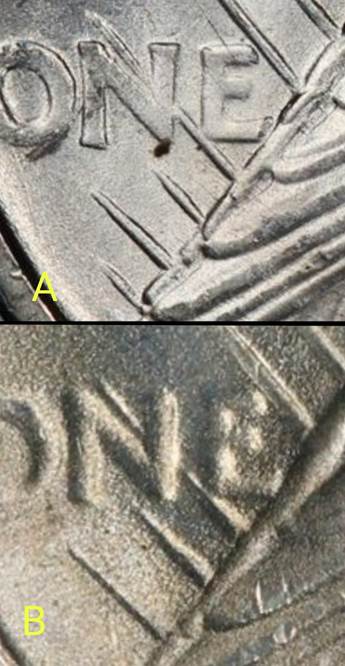
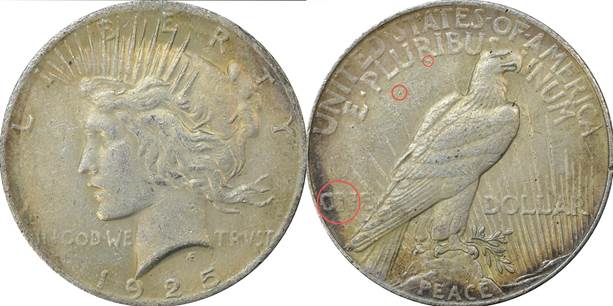
Today we discuss an extensive family of Type A fake reverse Peace Dollars, otherwise known as the 1921 High Relief reverse. We will investigate minor differences in the Type A and B (“Low Relief”) reverses whose diagnostics are key in identifying counterfeits.
First, some background: About 35,401 business strike High Relief 1922 Peace dollars were produced. All but one were melted. Also, 10-20 High Relief proof 1922 coins were made. These are not included in our discussion. Type B reverses appear on Peace dollars dated 1922-28 and 1934-35.
On the 1921 Type A reverse there are 4 rays below “ONE” and on the Type B reverse there are three. Secondly the shape of the leaf cluster is dramatically different. There are other subtle changes but we will use these two as the quick identifiers.
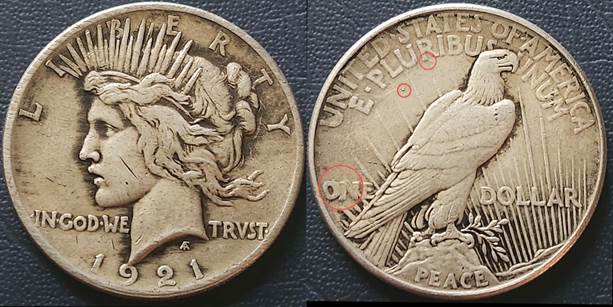
Now onto the “Fake Family”! This is an extensive group of counterfeits spanning various dates with improbable die pairings. The first image is the author’s example with highlighted markers in red. View the strong spread of one, small circular and raised lump between the rays below “L,” and a raised flaw below R. There are additional small depressions in many letters but minute.
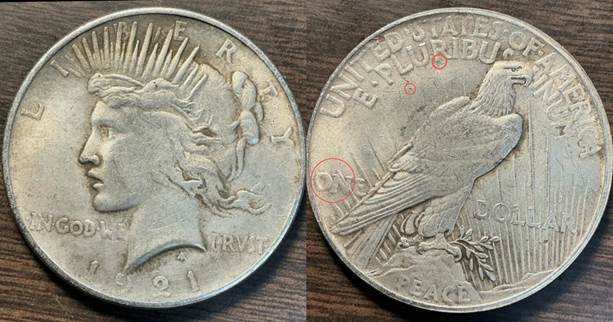
The next set of images are dated “1921” and from various online sources.
The next image was offered on Ebay by a seller who genuinely wasn’t aware the coin was counterfeit. The listing received a number of bids! I messaged the seller and had a brief discussion and they removed it. Owner stated it had been in the family’s collection since the late 1990’s.
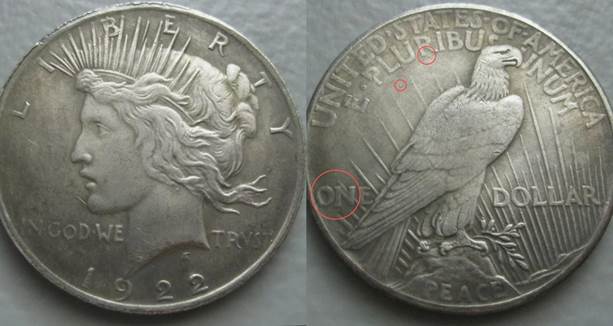
On to our “1921” dated pieces. This is an image from fellow counterfeit researcher Jack Young.
Various dates have been seen mismatched with this common reverse.
Behold one of the more fascinating pieces below. A fellow collector friend Winston Zack shared his 1925 showcasing the common counterfeit reverse and the catch? This piece scanned as 63.5% copper, 28.3% zinc, 7% nickel, 1.2% silver, and traces of iron!
Finally to round out this article, we present two matching counterfeit 1921 Peace Dollar in fake PCGS holders! One which was offered for sale through a Facebook group.
So once again a few of these bypassed numerous collectors who already purchased them or were in the process of doing that. Proxiblog hopes this information gets disseminated so no one purchases any of these counterfeit Peace Dollars!
If you like posts like this, you can read more articles on counterfeit coins by Jack Riley, Jack D. Young and Michael Bugeja at this URL. Also, please subscribe so you can be informed whenever there is a new article or column.
Proxiblog also has thousands of followers on Facebook Coin Groups, YouTube and social media. To get the latest discussion and commentary, be sure to friend us by clicking here.
You can find more information about errors and varieties as well as buying and bidding on coins in Coin News Updated: The Essential Guide to Online Bidding. Please consider purchasing the work for yourself or a friend, as it underwrites this hobbyist website. Thank you.
Scammers have counterfeited coins since ancient times using base metals, diluting precious metal content, reducing weight and diameter, altering dates, adding or deleting mintmarks and making cast copies of struck coins.
This article documents factors that continue to undermine numismatics, discussing top counterfeit coins and how to detect them.
Why is this so important? China exports 100,000 counterfeit coins per month with the capacity now of producing millions more per year, typically sold via Temu and Etsy whose buyers then try to sell them on social media or online auctions.
Before we share details on detecting counterfeits, here’s a history lesson so that you know the current state of the compromised market.
Gold to Goldfish
Before internet, distributing counterfeits took time and effort with many showing up in pawn shops, flea markets, garage sales and estate auctions. Some scammers tried without much luck to sell to coin shops. On occasion, they partnered with unscrupulous coin companies to distribute their fake products.
But there were problems.
In the 1980s and 90s, tens of thousands of hobbyists often read numismatic books and magazines, belonged to coin clubs and attended seminars at coin shows. They were informed. Internet was supposed to educate hobbyists worldwide. Instead, it undercut and then put out of business hundreds of brick-and-mortar shops, eliminating local experts.
As experienced numismatists know, the key to coin collecting is the ability focus to examine condition, flaws and errors. Many lack those skills now.
In the 1970s, attention spans averaged 30 seconds. It the 1990s, it dropped to 15 seconds, falling again in 2000 to 12 seconds. By 2015, it dropped to 8 seconds, below that of your average gold fish, according to Time magazine.
Counterfeiters took advantage of plummeting literacy rates and attention spans. They could easily scam new collectors who lacked numismatic knowledge and just wanted to score an expensive coin at bargain prices. That’s the ruse of internet.
Counterfeiters are improving their craft now with die struck fakes that have authentic die markers. Even experienced hobbyists are scammed by purchasing them. As such, newer collectors should follow these general guidelines:
If you are ready to bid hundreds of dollars on a coin, resist buying a raw one and shop for one holdered by PCGS, NGC, ANACS and CAC.
Be especially careful when purchasing raw coins from eBay and other online venues. TAI bots cannot detect counterfeits, so you are on your own.
Make sure the seller takes returns and has good reviews. Also, the number of positive reviews is a good indicator. If someone has 0 sales or even fewer than 100, do not take a chance.
Weigh the coin and go to PCGS CoinFacts for the date and mintmark, checking your coin against weights and dimensions.
Read this article about detecting counterfeits.
Difficult Counterfeit Detection
China has become so skilled at counterfeits that they have inserted fakes into their own PCGS holders. Here’s a recent one detected by counterfeit expert Jack D. Young:
The trained eye knows these are not the same coin. So it isn’t safe anymore to buy coins because they are in PCGS holders when Chinese PCGS holders look authentic (except for the fonts; and that’s an entirely different topic; see below).
Jack tried unsuccessfully to get eBay to take down the coin; but it sold:
The buyer thought he was getting a steal as the retail price for this coin is $6250–a profit of $2250. Coin collecting is a hazardous business if you do not know how to grade. But in this case, the key is this seller only had one sale, after which he opens another eBay account and does the same thing to another unschooled buyer.
Again, only buy from sellers who have good reviews and accept returns.
Easy Counterfeit Detection
One of the telltale signs of a Chinese fake is their difficulty in using the correct font when placing their counterfeits in PCGS or NGC holders. They also name the series. The only time grading companies do that is when two coins from different series were minted in the same year, as the 1921 Morgan and 1921 Peace dollar.
Here is an example:
Here is another roadmap to Chinese counterfeits without even examining the coin.
Another issue with Chinese fakes concerns whether they use the correct reverse. For instance, this coin purports to be an 1878-CC Morgan, a valuable coin. But it should have a rounded breast on the eagle and slanted top feather.
Popular Counterfeits
The most difficult fakes to detect are struck coins, using faux dies and alloyed or base metal planchets. The striking mimics the process used by the U.S. Mint, usually resulting in smooth or blurred devices because their machinery is inferior. Edges are particularly difficult to mimic, especially if they are reeded.
Here is an example of a base metal Morgan dollar that weighs 23.3 grams rather than 26.73 grams, according to its owner.
It’s easier to make cast copies, pouring molten metal into a mold made from a real coin. Again, details and devices are imprecise and blurry, often with casting bubbles and uneven thickness.
Coins most apt to be bogus are key dates that spike in value and are relatively easy to fake, adding or deleting a mintmark or designer initials, or altering a date.
Authentic ones from PCGS are displayed below.
The 1909-S VDB Lincoln cent is among the most frequently faked coins. You can take an inexpensive 1909 cent and add an “S” and “V.D.B” initials.
The 1916-D Mercury is an ultra-rarity with only 264,000 minted. All the counterfeiter had to do is acquire an inexpensive 1916 dime and add a mintmark.
The 1914-D cent is simple to fake by adding a mintmark to the 1914 cent or altering the first 4 of a 1944-D cent.
Then there is the key date 1922 no mint mark cent. These were actually struck in Denver. A Mint employee there over polished the dies, resulting in a weak “D” and then missing the “D.” All you need do is smooth by various means a better struck 1922-D, removing the mintmark.
The 1909-S Indian head cent is one of only two Indian cents with mintmarks, the other being the 1908-S. Counterfeiters simply add an “S” to an inexpensive 1909-P.
The same process of adding mintmarks is used for two of the most popular Morgan dollars, the 1889-CC (350,000 minted) and the 1893-S (100,000 minted).
Detecting Fakes
If you suspect your coin is not genuine, it does help to consult an expert. There are many in Facebook coin groups, with my favorite being Jack Young’s “Fun with Fakes.”
First, a little about Young, an engineer and counterfeit expert. He has worked as a consultant to the Secret Service and U.S. Senate Finance Committee and is a well-known numismatic and award-winning author.
If you doubted the introduction of this article about the unsuspecting newbie, join his group and see all the eBay fakes that people buy now directly from China.
Here’s one:
To identify counterfeits, you need to read, just as Young and others have done to enhance their numismatic education. Many recommend the Red Book, or A Guide Book of United States Coins. You can also subscribe to educational numismatic sites such as Proxiblog.org.
Once you have learned from books, groups and websites, you need to master these detecting skills:
Visual inspection
Compare your coin to one graded by a top company, such as PCGS or NGC. I recommend PCGS Gold Shield coins with excellent TrueView photos that you can blow up and study. You can use a coin microscope to view the edges, dates and devices for strike evidence, looking for those casting bubbles or blurry details.
Here’s what I did to show the difference between a fake and real 1893-S Morgan dollar.
Check Metal and Patina
Experienced hobbyists have looked at so many authentic coins that they easily identify base metal ones by the toning of the fields. They know the ping of silver by sound alone. They do not need a magnet to detect base metals, but beginners might purchase one. If it sticks, you’re stuck with a counterfeit.
What to Do if Scammed
If you have purchased a fake coin, contact the seller and return it. Even though eBay has attracted counterfeiters, you might be protected if returns are accepted or if you make a complaint to the company (frequently unsuccessful).
If you used PayPal, you could open a case there.
If you bought the coin from an online auction company, such as found on HiBid.com or LiveAuctioneers, you may not be able to return the coin because auctioneers will insist that all sales are final. Technically, selling a fake is illegal. But good luck threatening and then suing an auctioneer if you have agreed to their service terms. The best you might do is share the Hobby Protection Act, which states:
“The manufacture in the United States, or the importation into the United States, for introduction into or distribution in commerce, or the sale in commerce of any imitation numismatic item which is not plainly and permanently marked ‘copy,’ is unlawful and is an unfair or deceptive act or practice in commerce under the Federal Trade Commission Act.”
In any case, do not try to sell the coin. Take the coin out of hobby circulation and use it as an educational showpiece to enlighten others. You can also report your case to the U.S. Secret Service field office. Finally, join “Fun with Fakes” on Facebook and share your story so that others know the pitfalls of counterfeit coins.
If you like posts like this, you can read more articles on counterfeit coins by Jack Riley, Jack D. Young and Michael Bugeja at this URL. Also, please subscribe so you can get our weekly newsletter and be informed whenever there is a new article or column.
If you like posts like this, subscribe so you can be informed whenever there is a new article or column.
Proxiblog also has thousands of followers on Facebook Coin Groups, YouTube and other social media. To get the latest discussion and commentary, be sure to friend us by clicking here.
You can find more information about types, varieties, errors, grading, bidding and buying in Coin News Updated: The Essential Guide to Online Bidding. Please consider buying or gifting the work for a friend, as it underwrites this hobbyist blog. Thank you.