Numismatic posts about grading, identifying, buying, selling and bidding on coins
Category Archives: Counterfeit
These posts provide methods to detect Chinese and other fake coins and holders, bringing awareness to the thousands of counterfeit coins being sold on eBay and other platforms.
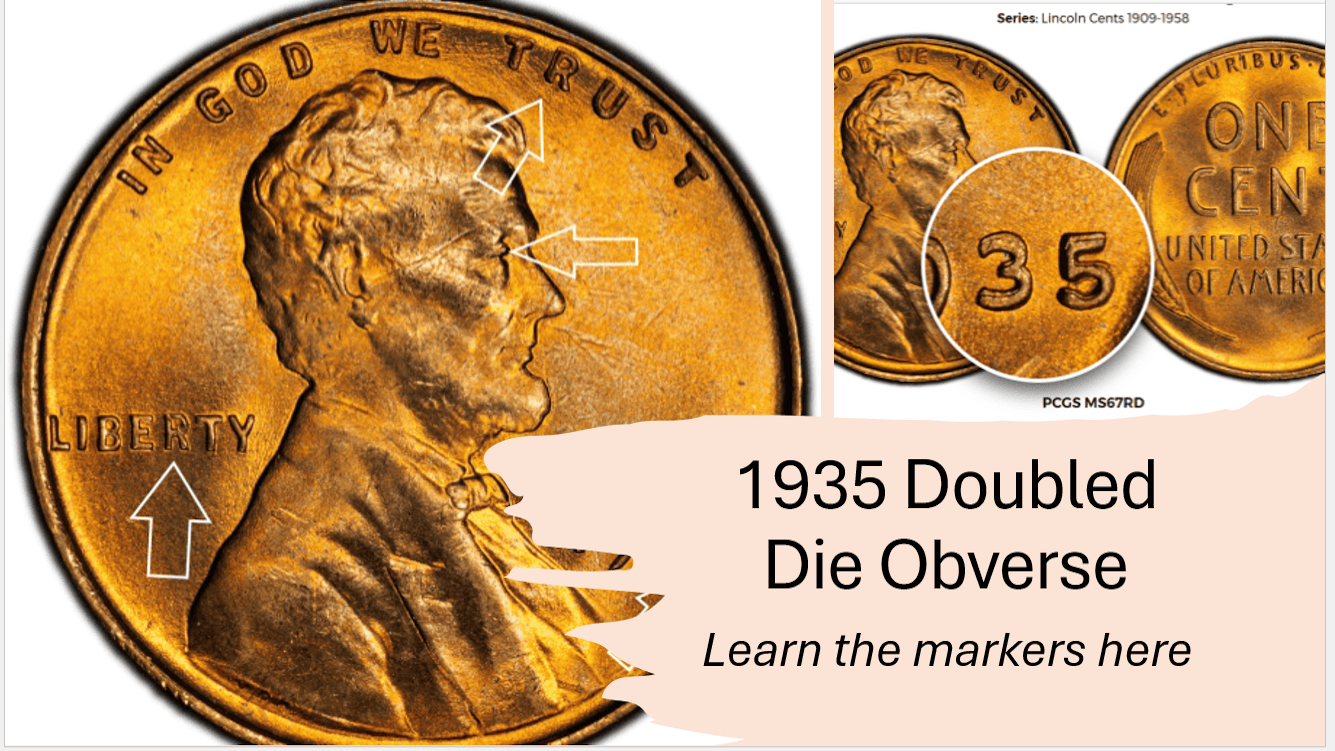
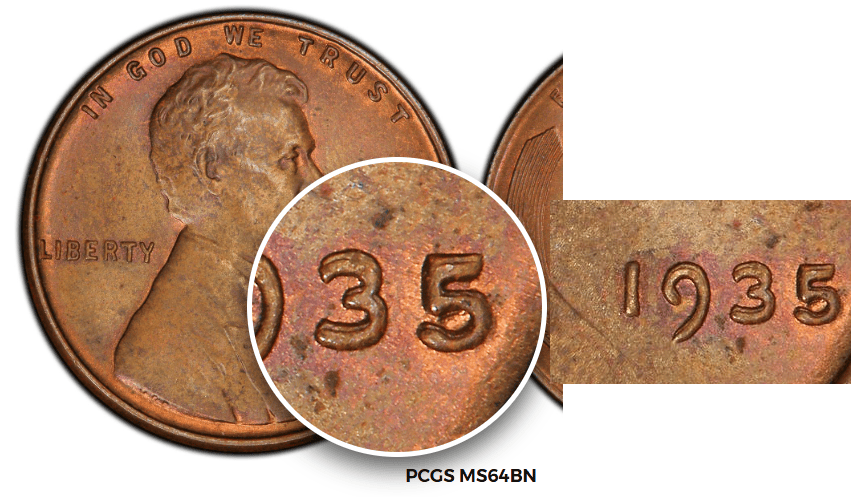
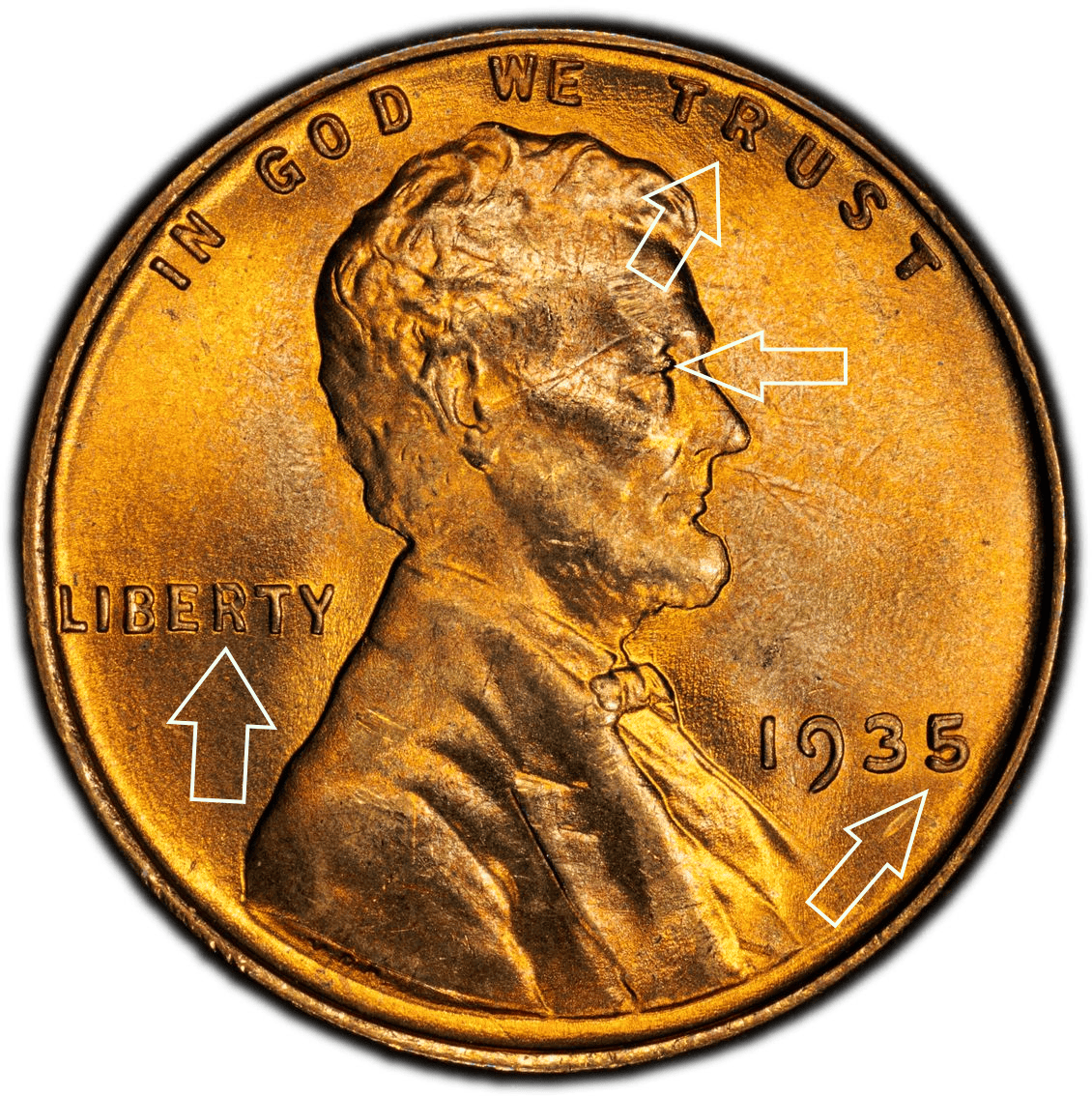
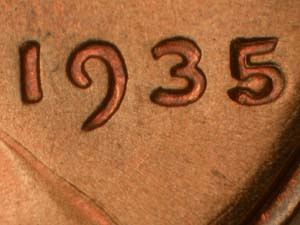
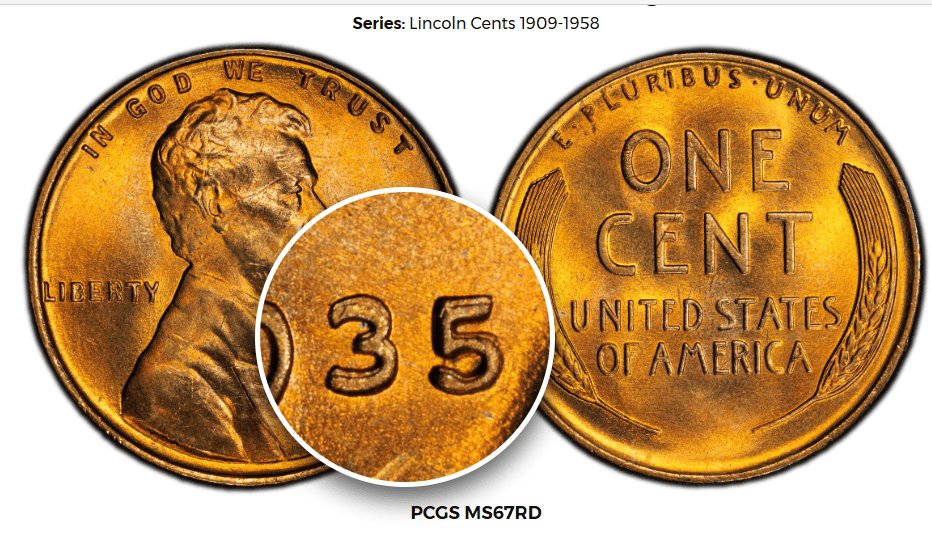
Officially known as 1935 Doubled Die Obverse (DDO) FS-101 variety, this coin has significant doubling, especially on the date, and is sought after by collectors.
You also can see doubling on the letters of “IN GOD WE TRUST” as well as the left portion of the motto LIBERTY.
If you look closely, you can see a doubled eyelid on the portrait.
This is the type of doubling that can be strong, if early in the manufacturing process, or weaker as the working die deteriorates.
Also, in those late-stage examples, the doubling can look flat. So many people attribute those to machine doubling. Example:
As for value, PCGS CoinFacts factors the color of the coin (Brown, Red-Brown, or Red) and its grade.
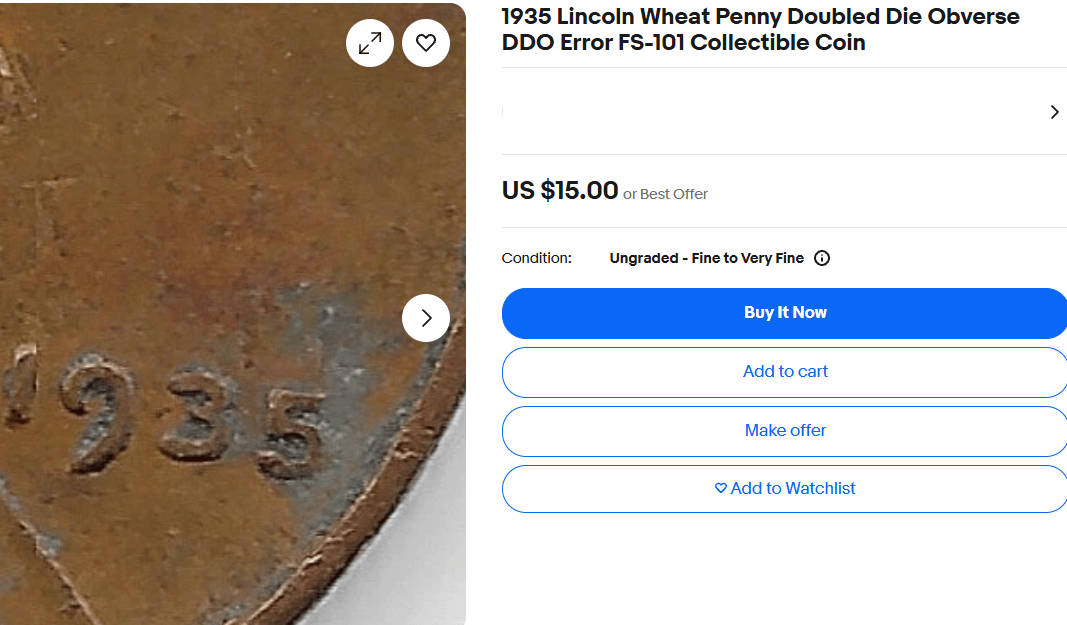
Well-circulated examples can be found on eBay for under $50. High grade red examples authenticated by PCGS sell for hundreds and even thousands.
This coin sold at auction for $3055.
If buying a raw example from eBay or online auctions, be sure to distinguish doubled die from die deterioration, as in this case:
If you like articles like these, please friend us on Facebook and subscribe to Proxiblog.
Proxiblog also has thousands of followers on Facebook Coin Groups, YouTube and social media. To get the latest discussion and commentaries, click here.
You can find more information about errors and varieties as well as buying and bidding on coins in Coin News Updated: The Essential Guide to Online Bidding. Please consider purchasing the work for yourself or a friend, as it underwrites this hobbyist website. Thank you.
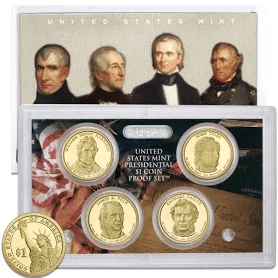
With the 2026 Semiquincentennial President Donald J. Trump $1 Coin, people are having a renewed interest in presidential dollars. Trump was not part of the series. Launched in 2007, the series requires a president to have been deceased for at least two years to appear on a coin. Trump got around this requirement as his is a commemorative coin.
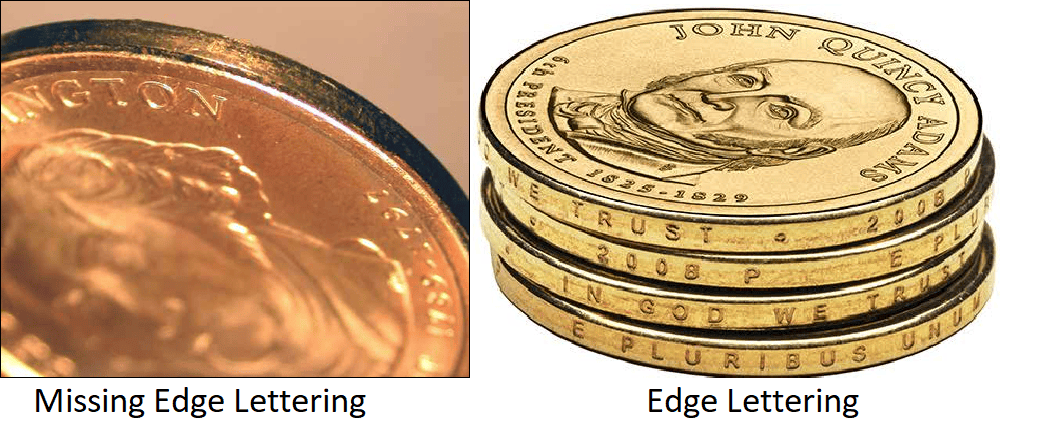
A hallmark of the presidential series is edge lettering.
Depending on the year the coin was minted, these elements appear on the edge: year of minting, mintmark and “E Pluribus Unum.”
In 2007 and 2008, presidential dollars also included “In God We Trust.”
That brings us to one of the major varieties.
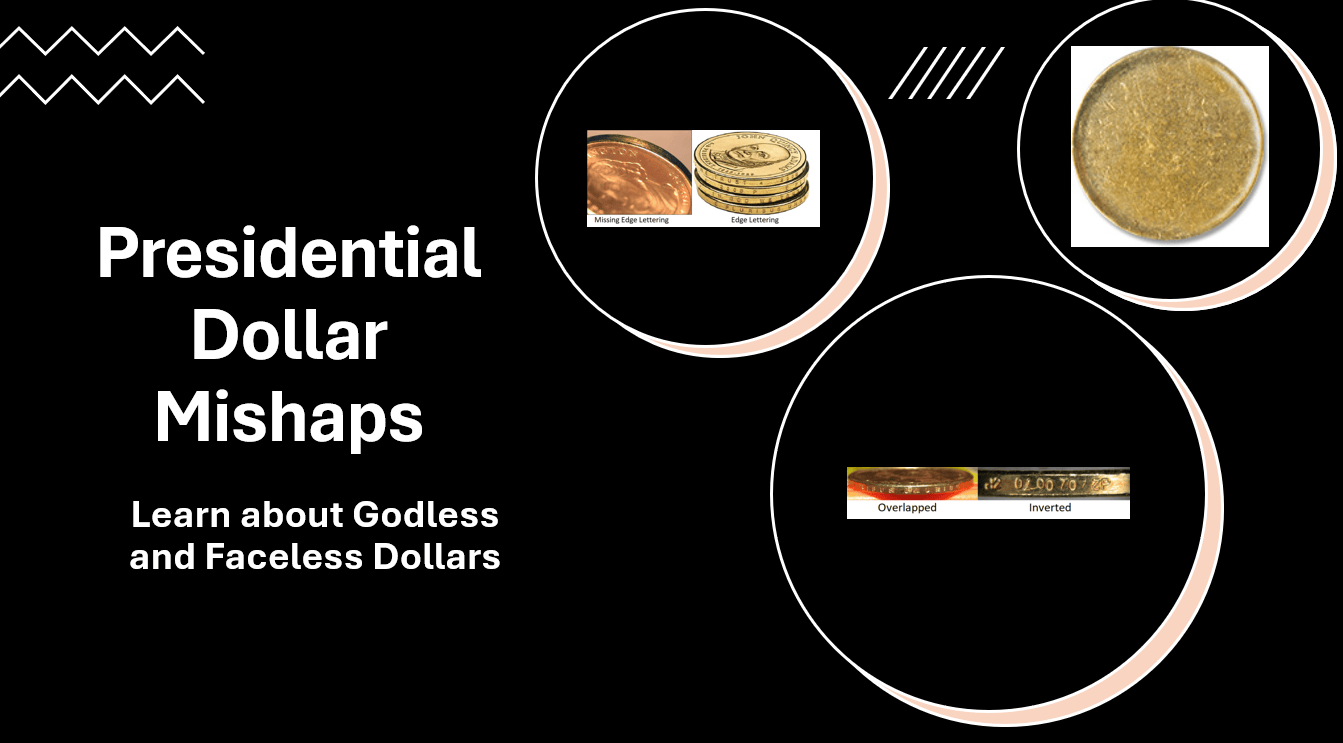
Godless Dollar
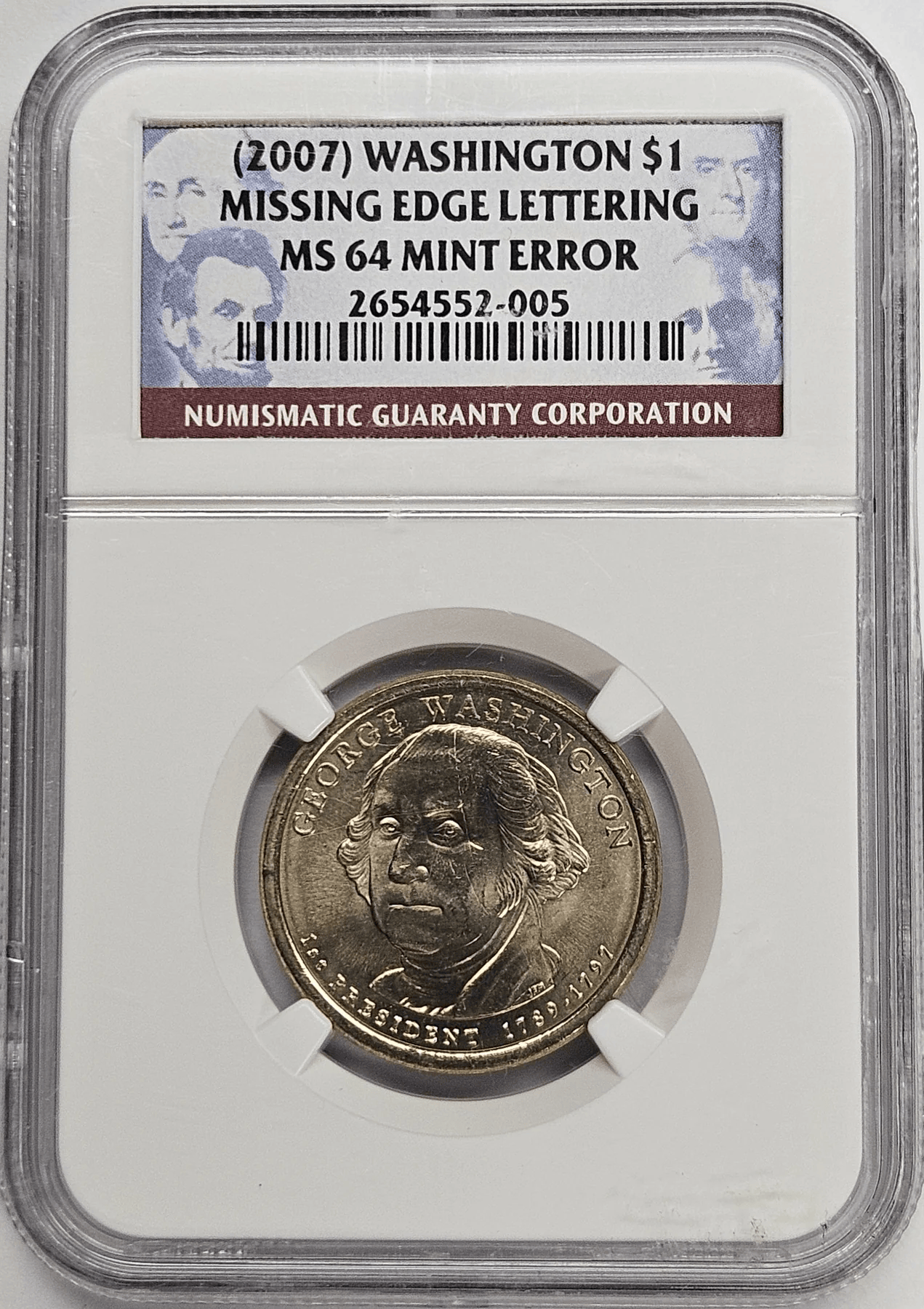
“In God We Trust” was moved to the obverse of these dollars in 2009 after a backlash occurred when edge letting was missing on the 2007 George Washington dollar. People started calling this variety “Godless dollars.”
The error happened when the machine that strikes the edge lettering somehow malfunctioned, leaving the edge blank. That started the furor over US coins lacking any mention of a supreme being.
Senator Sam Brownback (R-Kan.)responded to the backlash by introducing an amendment to a federal appropriations bill. The amendment was part of the Consolidated Appropriations Act of 2008, ordering the U.S. Mint to move “In God We Trust” to either the obverse or reverse of all future Presidential dollars. The law took effect in 2009.
An average uncirculated 2007–2008 Godless Dollar is typically worth $40 to $100, while heavily circulated examples sell for around $15 to $30.
Faceless Dollar
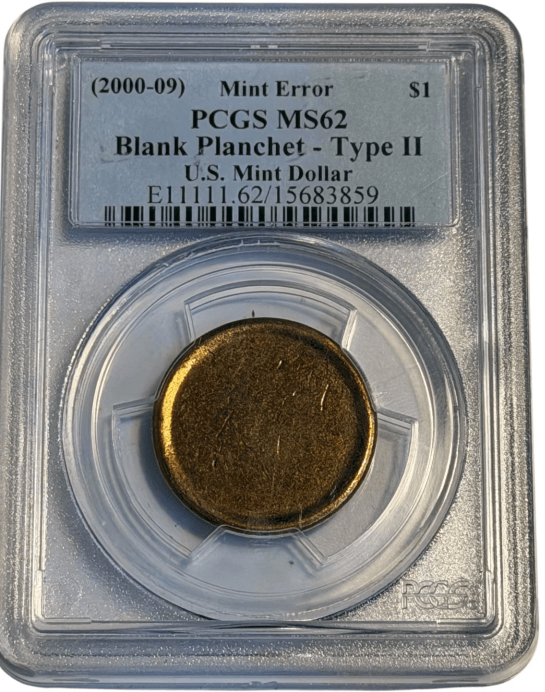
Also in 2007-2008 some coins on blank planchets escaped the Mint. These had edge lettering but no obverse of reverse designs.
This occurred because these dollars had a two-step minting process. Blanks were fed into the coining press to stamp the obverse and reverse designs. The second step involved edge lettering.
The “lettered blank” error, popularly known as the “Faceless Dollar,” happened when blank planchets accidentally bypassed the main coining press, going directly to the edge machine.
The value of Faceless dollars typically ranges between $40 and $500, depending on authentication and condition.
Overlapped/Inverted Dollars
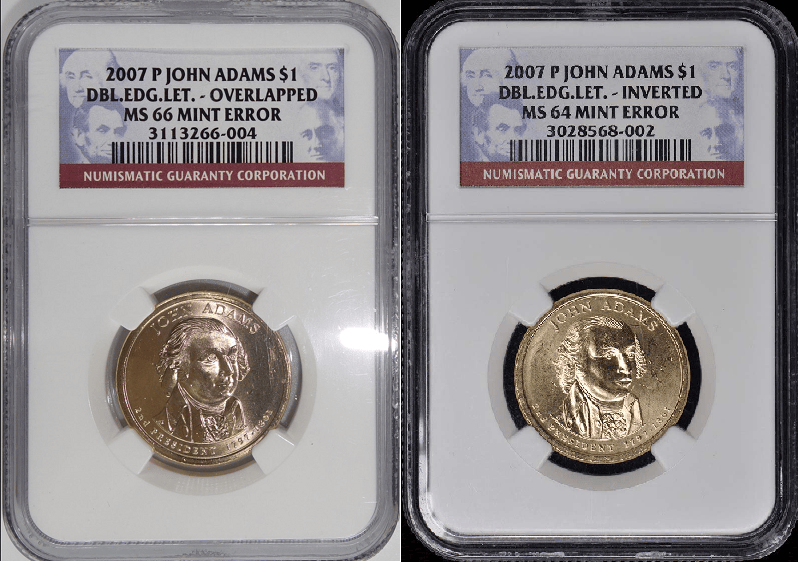
One final variety happened in 2007 involving the John Adams dollar. These coins were fed into the edge coining machine twice. This resulted in two varieties. Overlapped errors feature doubled edge lettering running in the same direction and inverted errors running in opposite directions and upside down.
These varieties typically retail between $50 to $300, depending on condition.
If you like posts like this, please subscribe so you can be informed whenever there is a new article or column.
Proxiblog also has thousands of followers on Facebook Coin Groups, YouTube and social media. To get the latest discussion and commentary, be sure to friend us by clicking here.
You can find more information about errors and varieties as well as buying and bidding on coins in Coin News Updated: The Essential Guide to Online Bidding. Please consider purchasing the work for yourself or a friend, as it underwrites this hobbyist website. Thank you.
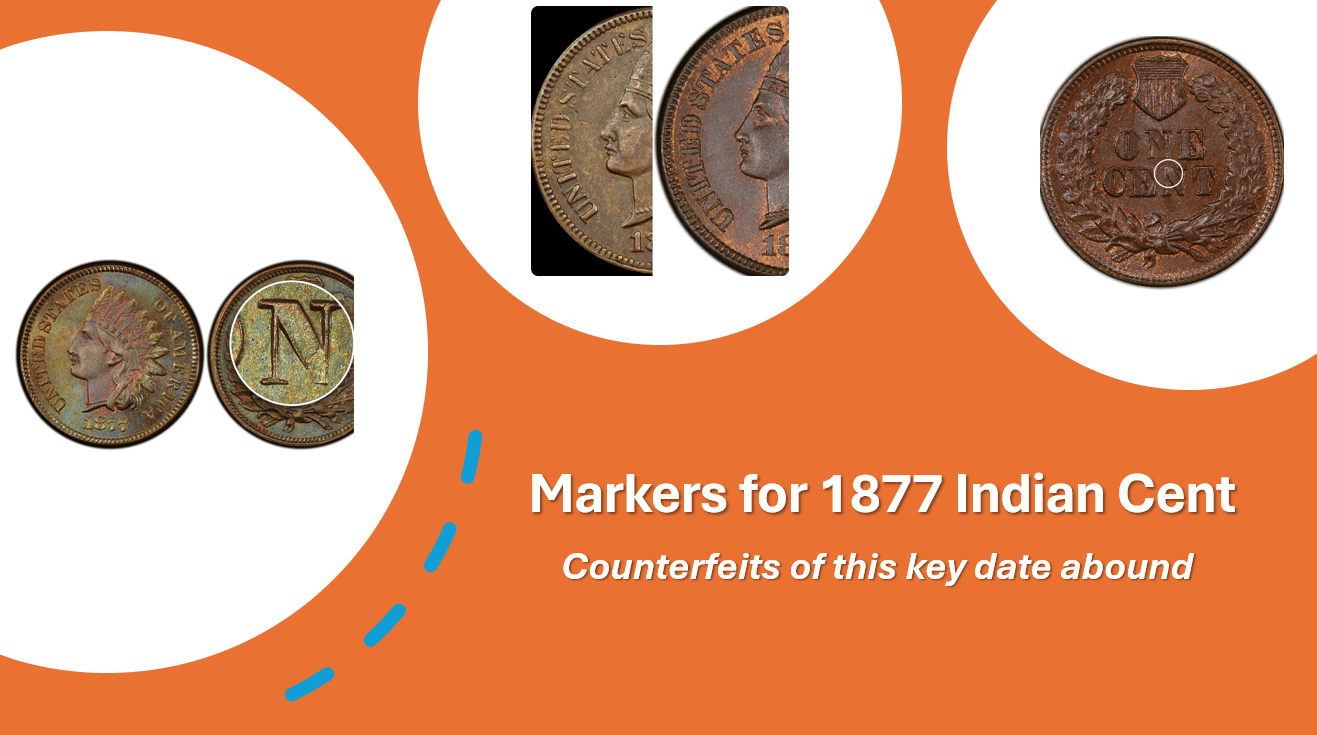
One of the most counterfeited coins is the key date 1877 Indian Cent. It has a low mintage of 852,500. Genuine examples cost hundreds and thousands of dollars. A Good-4 example retails for $650. Extra fine ones go for $3,000 and MS63 Brown, $7,000.
Those values alone make it necessary to know markers so you do not end up with a fake, altered or replica coin.
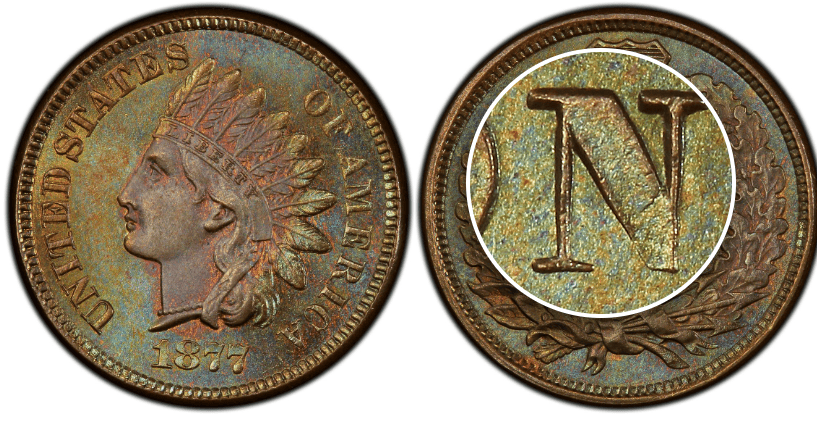
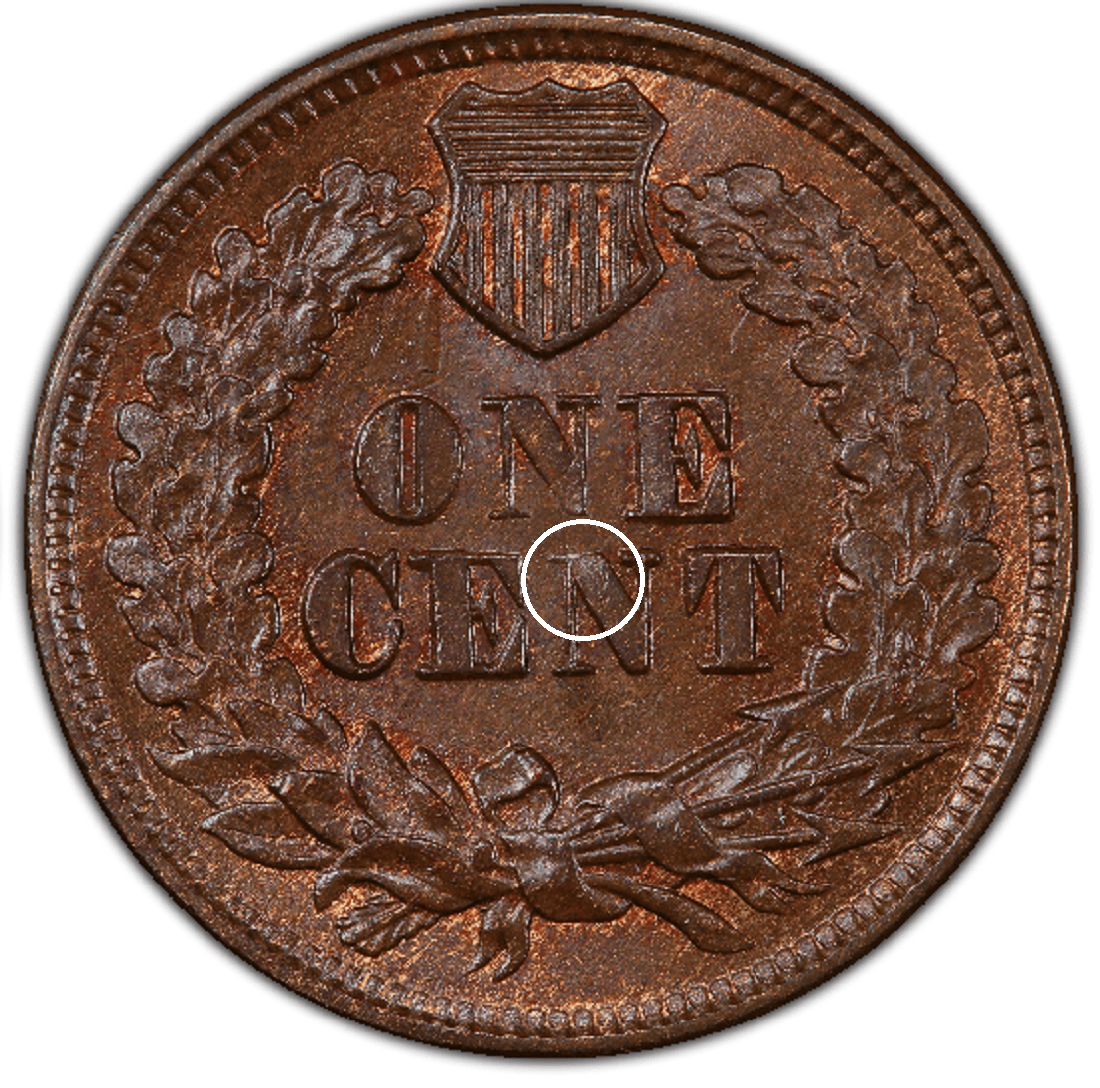
On all genuine circulation strikes, a single reverse working die was used. So these markers are vital and uniform.
The “N” in ONE slowly grows weaker and shallow as it proceeds to the bottom right corner.
The top left corner of the “N” in CENT also is weakly struck and shallow when you compare it to other letters.
If these “N”s are sharply struck on the reverse, you’re looking at a counterfeit coin.
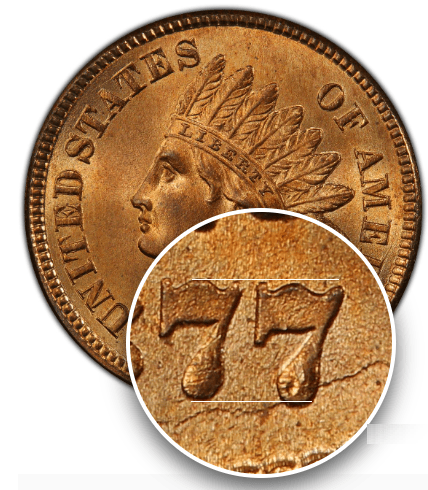
There are also obverse markers, beginning with the so-called “Slanted 77” in the date. Draw an imaginary horizontal line across the date, and the second “7” should be slightly lower than the first.
If the “7”s are parallel and equal in orientation, you have a fake coin.
You also should check the second “7” for evidence of tooling, changing the last digit of the less valuable 1871, 1874 or 1879 so it appears like a “7.”
You can also do the balance test to see if your coin is a counterfeit. Genuine Indian Head cents have beleved edges and as such cannot stand balanced on its edge. Chinese fakes have flat squared edges. You can balance these.
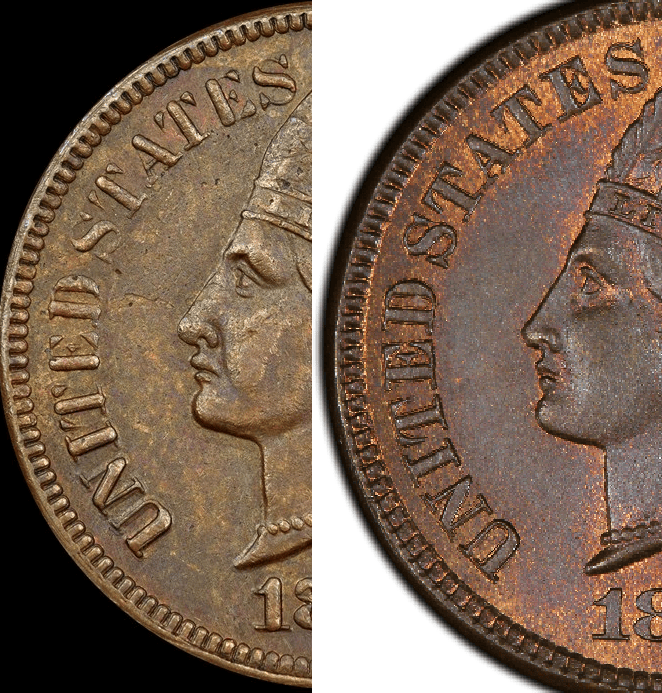
Also many examples of contemporary counterfeits have a mushy or weakly struck “United States of America.” On genuine coins, this should be legible and crisp. In the image below, the left example is the counterfeit.
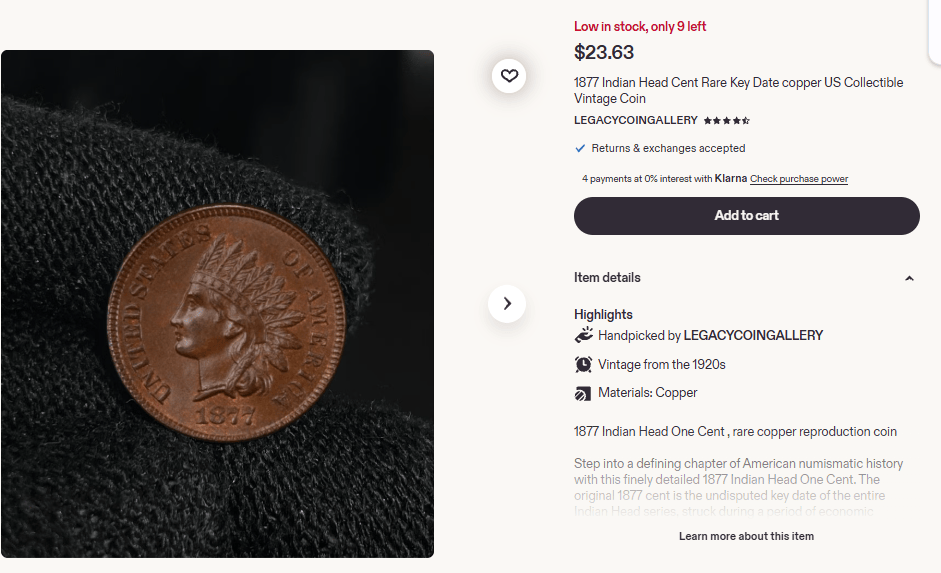
Keep in mind that Etsy and Temu sell replicas. Example:
These replicas have many of the same markers as authentic coins and often appear on eBay as authentic.
As a rule, be especially wary of spending hundreds or thousands of dollars on raw 1877 cents if you do not know the markers or have doubts about them. Best to wait for your treasured key date graded by a top holdering company and sold on a legitimate site or shop.
If you like posts like this, subscribe so you can be informed whenever there is a new article or column.
Proxiblog also has thousands of followers on Facebook Coin Groups, YouTube and social media. To get the latest discussion and commentary, be sure to friend us by clicking here.
You can find more information about types, varieties, errors, grading, bidding and buying in Coin News Updated: The Essential Guide to Online Bidding. Please consider buying or gifting the work for a friend, as it underwrites this hobbyist blog. Thank you.
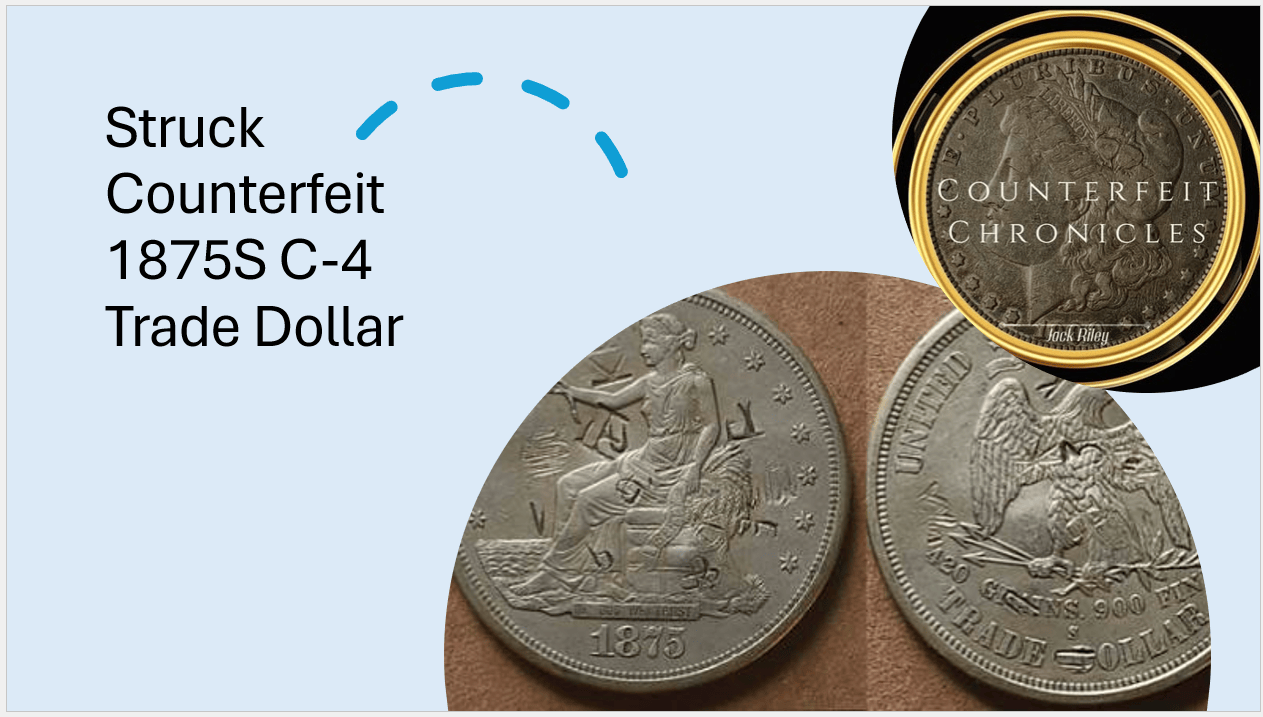
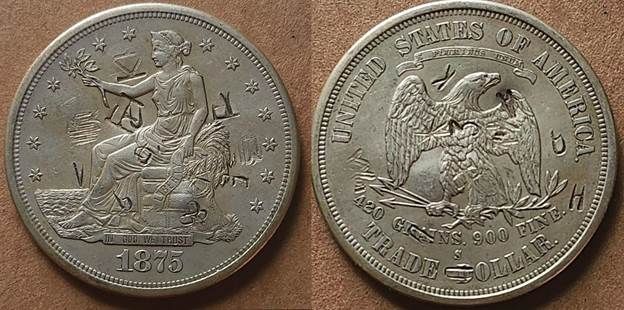
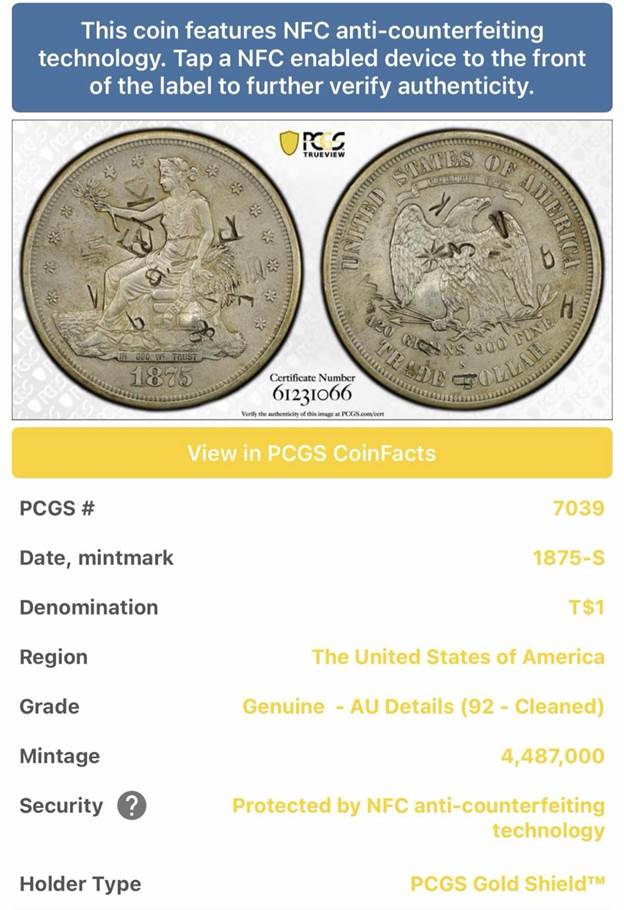
A recent 1875S Trade Dollar was shared by fellow collector Mike Printy, prompting a discussion about whether the coin was genuine or counterfeit. The coin (below) does attribute as a C-4 die marriage. Many well versed collectors note the chopmarks do not appear genuine and we’re likely done with a modern punch.
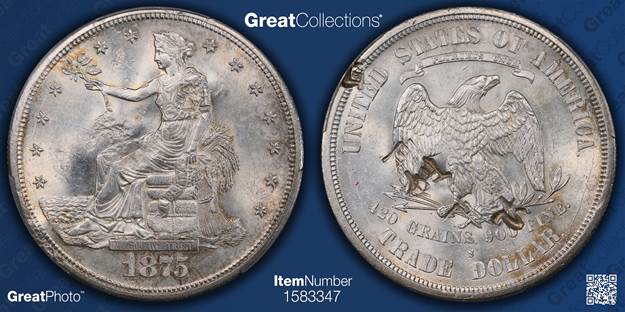
The photo courtesy of GreatCollections below shows a genuine 1875S C-4 counterstamped Trade Dollar.
Worth mentioning is that the coin in question was housed in a PCGS AU details holder but was cracked out by a previous owner.
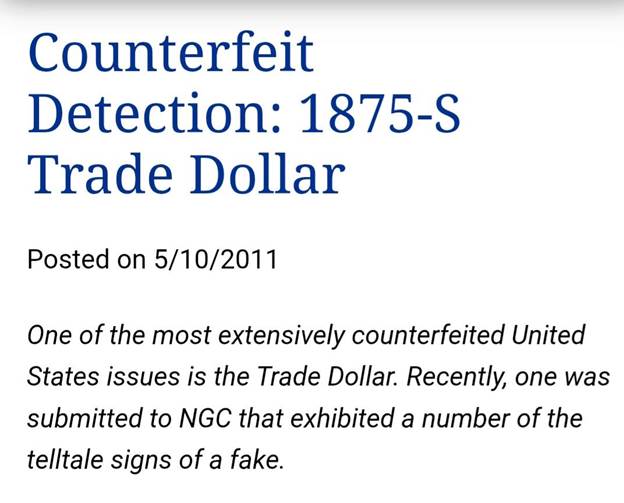
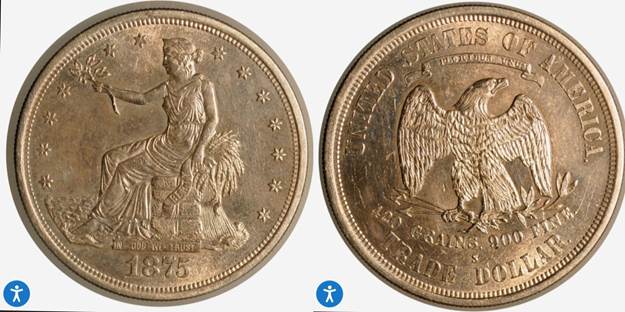
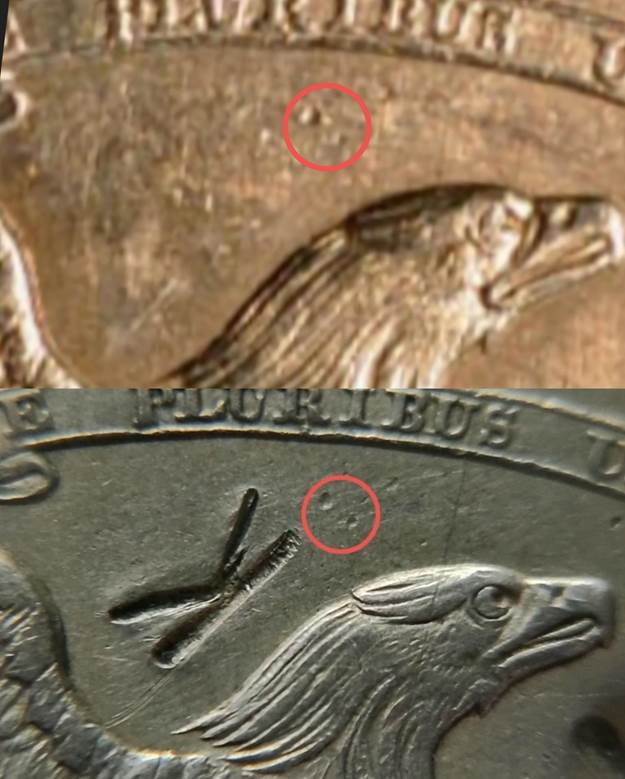
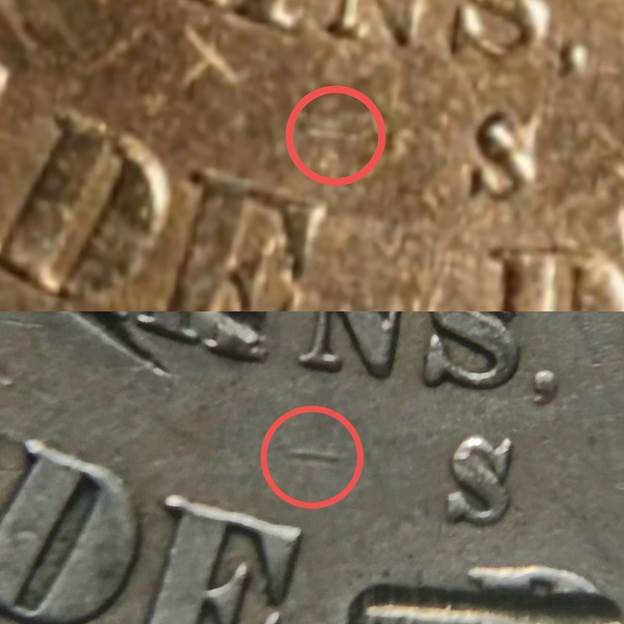
NGC has done tremendous work on sharing information on newly discovered counterfeits. This article cited below was written in 2011, about the time the coin in question surfaced. Photos below Courtesy of NGC.
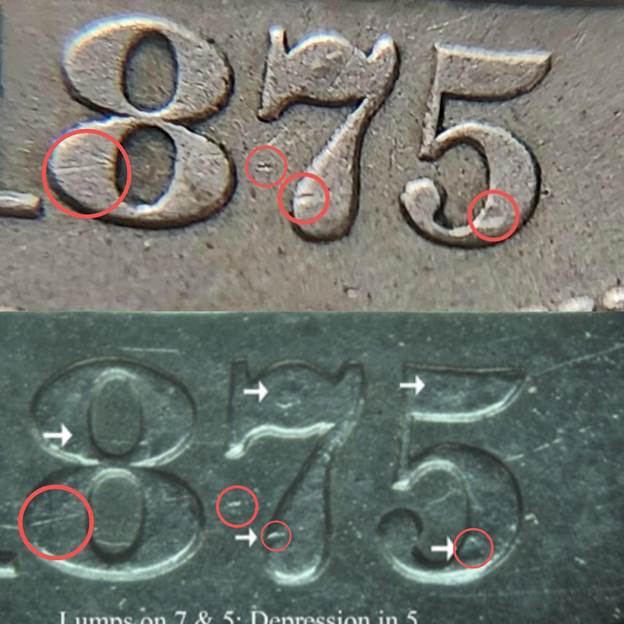
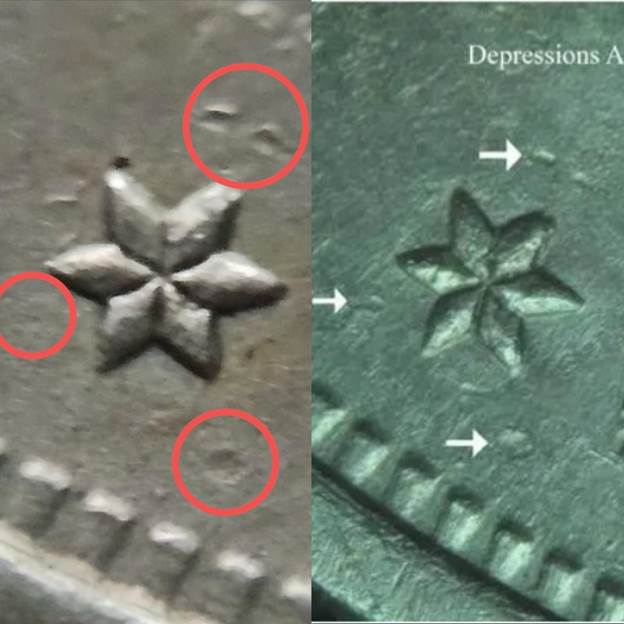
Diving into this article and coin tells the tale. Numerous repeating circulation marks are shared between the two coins. The obverse notes two minor depressions in the date along with four depression marks in the field around the first left star (highlighted in red). What isn’t mentioned in the NGC article is the horizontal scratch through the 8 and indent in the field between the 7 and 8.
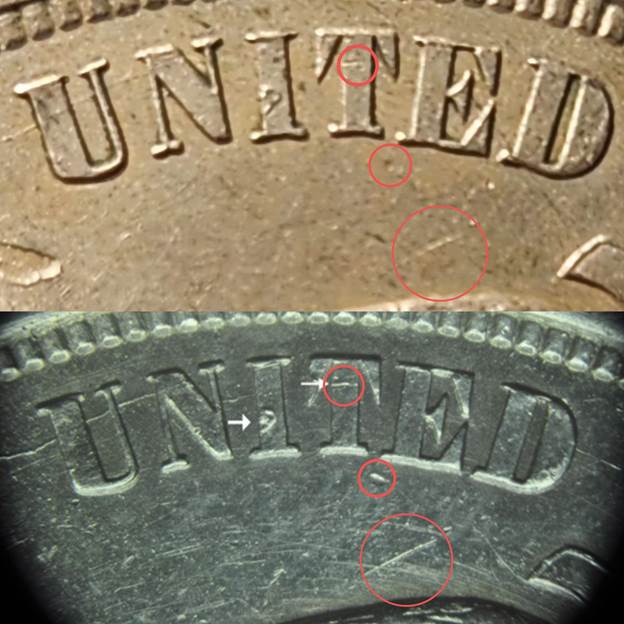
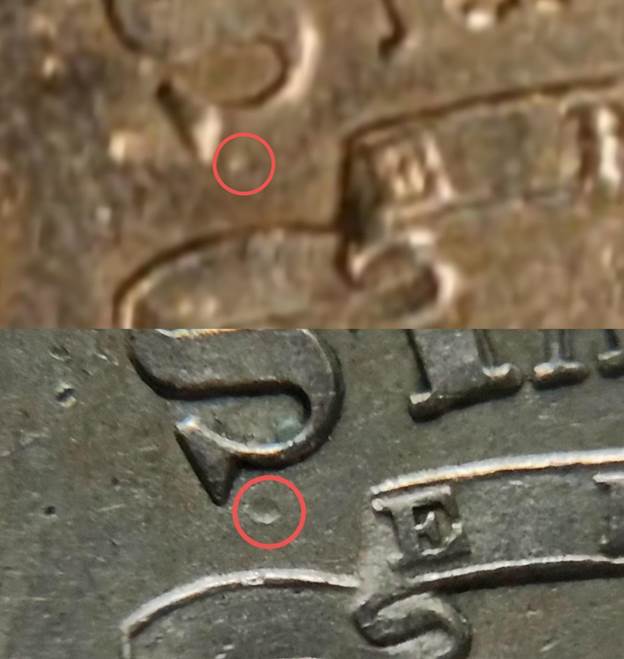
The reverse of this coin may be more telling than the obverse! A scratch through “T” in “UNITED”, depression below “E” and a scratch in the field are very clear. One minor depression mark below S1, a couple below the motto, and a long horizontal scratch left of the mintmark.
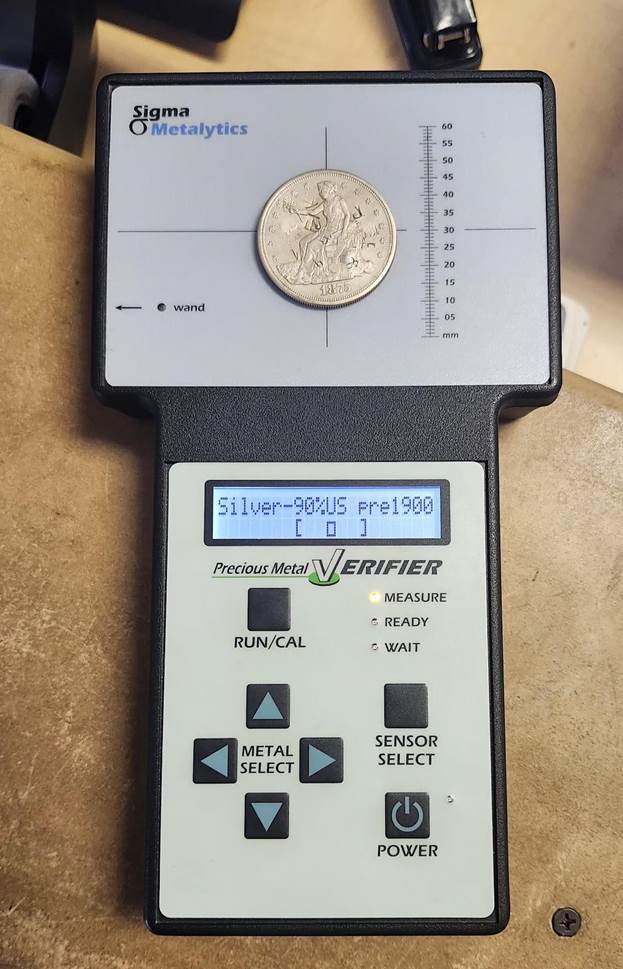
I did take this to a local area facility to have it sigma tested, and it passes for 90% silver. What isn’t captured well in photos is this coin lacks luster and has an overall dull appearance across the entire surface.
In conclusion, this coin is a highly deceptive counterfeit that mimics a genuine die pairing. This likely stems from the same counterfeiters as the 1875CC C-17 counterfeits that I have previously talked about. One could assume if this had not been chopmarked in the manor that it was that it may have prolonged its time as a “genuine coin.”
If you are interested in learning about counterfeit coins, go to this tab on Proxiblog. Collectively, Jack Riley, Jack D. Young and Michael Bugeja have published some 21 articles about counterfeits.
If you like posts like this, please subscribe so you can be informed whenever there is a new article or column.
Proxiblog also has thousands of followers on Facebook Coin Groups, YouTube and social media. To get the latest discussion and commentary, be sure to friend us by clicking here.
You can find more information about errors and varieties as well as buying and bidding on coins in Coin News Updated: The Essential Guide to Online Bidding. Please consider purchasing the work for yourself or a friend, as it underwrites this hobbyist website. Thank you.
This is an updated version for Proxiblog; the initial version was discussed during a “Live Coin Q&A’s podcast” and can be found at the YouTube video below. You can view that or continue reading about an 1891-CC Morgan “from the land of the Bay” … with a new twist.
Here is the listing in question:
Current eBay listed counterfeit 1891-CC not-PCGS Morgan Dollar
This coin includes “Slash, the eagle”–a common reverse we have seen on multiple counterfeit China Morgan Dollars of various dates and a mislocated “not-PCGS” label! But here the label location was new!
Large image of the reverse- not only does it sport the “slash” but the wrong mintmark position for a genuine 1891-CC:
So I thought I would start a conversation with the seller. Seller says, “It’s my grandfathers!” I respond, “Did he visit China recently?” Seller deadpans: “He’s dead.”
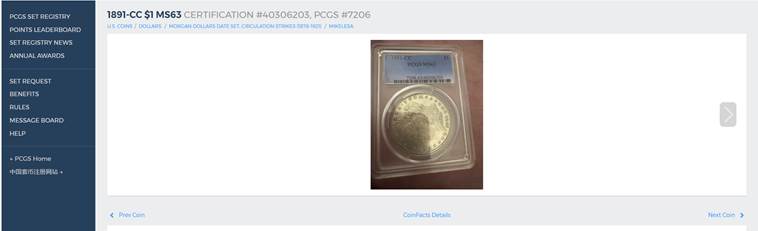
Didn’t see that coming. But looking up the on-line cert yielded this:
No image. I thought looking up the cited registry example would show an image of the genuine coin, but nooooo!
And the Chinese characters under “PCGS Home” seemed appropriate for this example!
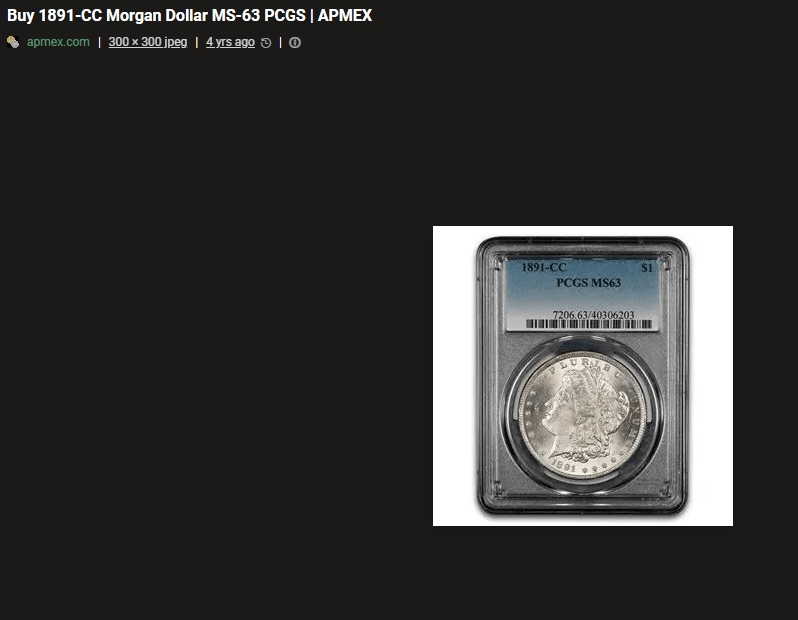
More digging finally yielded a low-resolution image of the genuine example listed some time ago by APMEX.
I created this combination image of all three for reference:
What about Grandpa’s coin? It stayed up with active bidding. I posted it on my Facebook page as well as reported it to eBay through their (useless) reporting process.
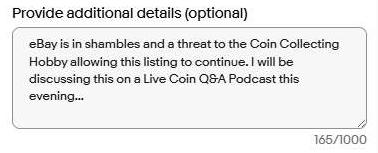
I actually reported it twice, with the same results both times. Screen shot of my 2nd attempt:
Both times the Baybots said it is AOK:
So I suppose Grandpa would be proud as this finally sold for $332.00:
One has to wonder if the buyer will ever figure it out?
But once again, as Michael Bugeja, Jack Riley and I have done multiple times, reporting counterfeits to eBay, only to see the fake coins sell (as this one did), we have to wonder how can we counter this alarming trend of counterfeits being sold despite multiple reports, alerts and messages.
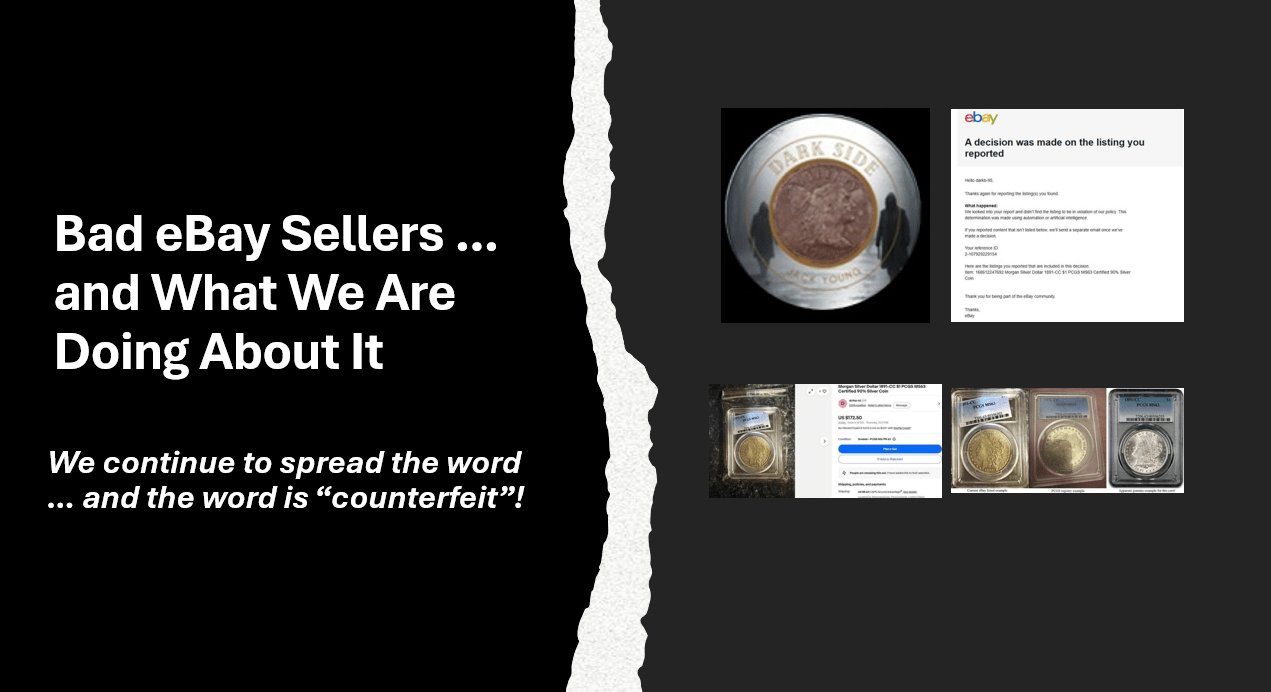
It seems the only recourse is to get out the word, as I did with the “Live Coin Q&A’s podcast” and as we do regularly here.
If you are interested in all of our reports, go to this tab on Proxiblog. Collectively, we have published some 21 articles about counterfeits with eBay figuring prominently in them.
If you like posts like this, please subscribe so you can be informed whenever there is a new article or column.
Proxiblog also has thousands of followers on Facebook Coin Groups, YouTube and social media. To get the latest discussion and commentary, be sure to friend us by clicking here.
You can find more information about errors and varieties as well as buying and bidding on coins in Coin News Updated: The Essential Guide to Online Bidding. Please consider purchasing the work for yourself or a friend, as it underwrites this hobbyist website. Thank you.
In 2017, I won in an online auction a roll of Morgan dollars supposedly from a Carson City, Nev., bank. The date 1879 was on one end of the roll and the CC Mint mark of the Carson City Mint on the reverse. I paid $2,400 for the roll and reported the results for Coin World.
If the roll was actually from Carson City, with 1879-CCs therein, it would have been a magnificent score, worth tens of thousands. I knew that would not be the case. This was research for an article. As it turned out, there was one 1883-CC low mint state (the coin whose reverse showed on one end of the roll). The rest were sliders with a few uncirculated common date Morgans. A few, though, were toned, so I did recoup some of the investment. In the end, I lost more than $1,300.
That was a baited roll. In other words, someone had access to a Carson City bank paper roll and filled it so that one end had a CC, fooling optimists (fools) that other coins therein had the same rare mintmark.
This article cautions against buying these rolls on eBay, HiBid or other auction venues. Not only because almost all of these have searched already; but because the specter of counterfeits in those rolls is increasing
For instance, Jack D. Young wrote an article titled “Bad Coin Rolls,” about a seller offering two mixed rolls of small cents with an apparent 1857 Flying Eagle counterfeit cent.
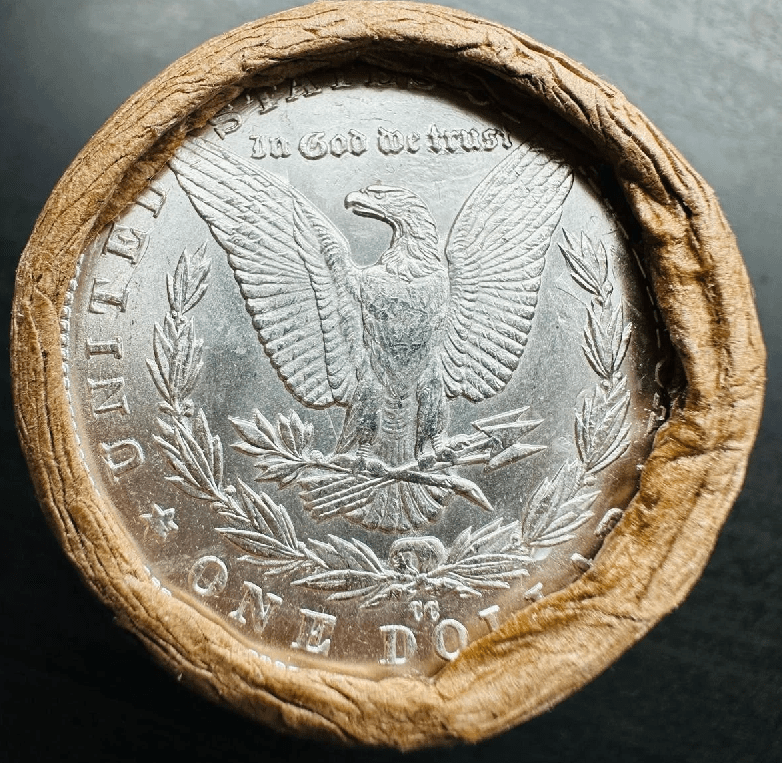
Here’s a clearly opened roll from HiBid. Note how loose the ends of the roll are, even though the seller states “SEALED. (For newbies, “sealed” does NOT mean “unopened.”)
Learn what an opened roll looks like, with loose ends that the owner could not get back into original form. Example:
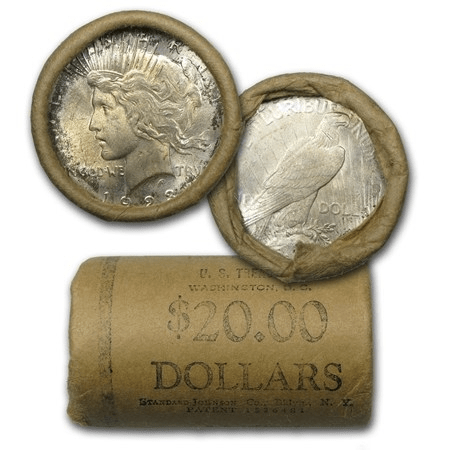
Proxiblog has written about photos of rolls, important before you bid or buy. You should see both ends in any offering to identify if they show evidence of being opened. Here’s a legitimate offering of Peace Dollars with one side (left) tight and original and the other (reverse side, right), opened.
Veteran hobbyists know that you should never bid on these rolls, even if both sides look tight and unopened. A good scammer can use an Exacto knife to open and reseal a roll so that it looks original. (I won’t share how to do that; I learned from my local coin dealer, decades ago, who showed me all the scammer tricks, pre Internet.)
But now, with the onslaught of Chinese fake Morgan dollars, the risk has increased. Many hobbyists cannot identify counterfeit coins. Consider this Etsy copy (right) if inserted into a Morgan roll. Would you be able to tell the difference?
In the past, scammers had to shell out for at least one uncirculated Carson City 1882-1884 Morgan dollars. Now, counterfeits are in play. This, in itself, is a good reason NOT to purchase these rolls.
Recommendations:
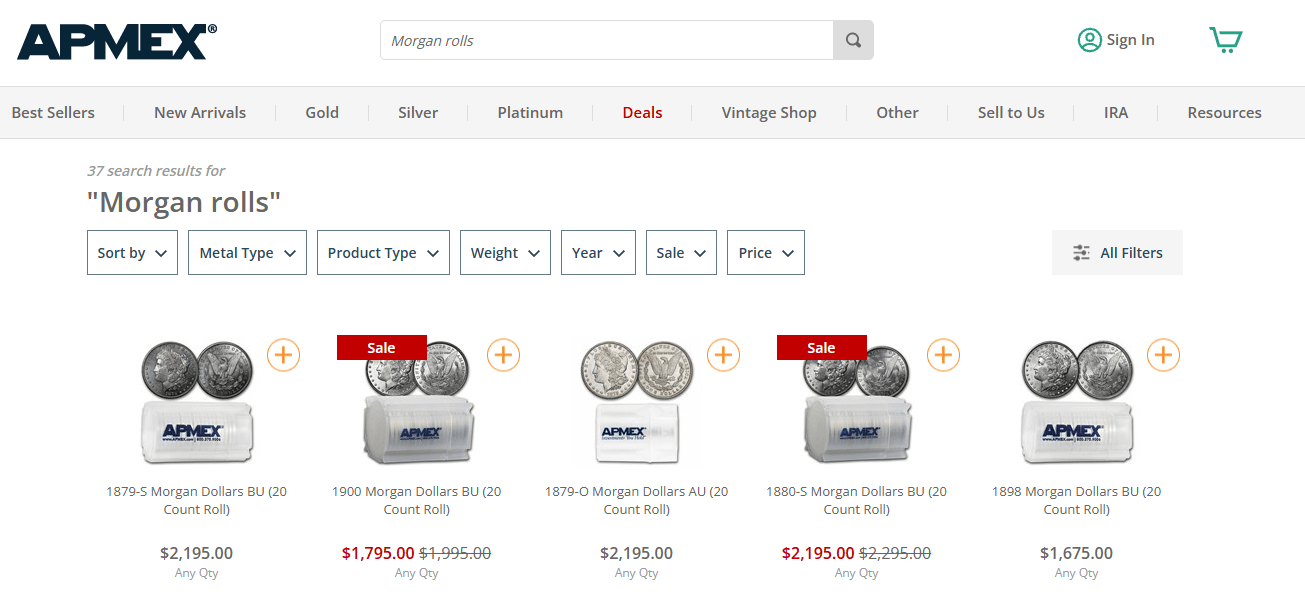
If you want to stack silver or buy Morgan and Peace rolls, purchase from reputable online sellers using their own plastic rolls, like APMEX:
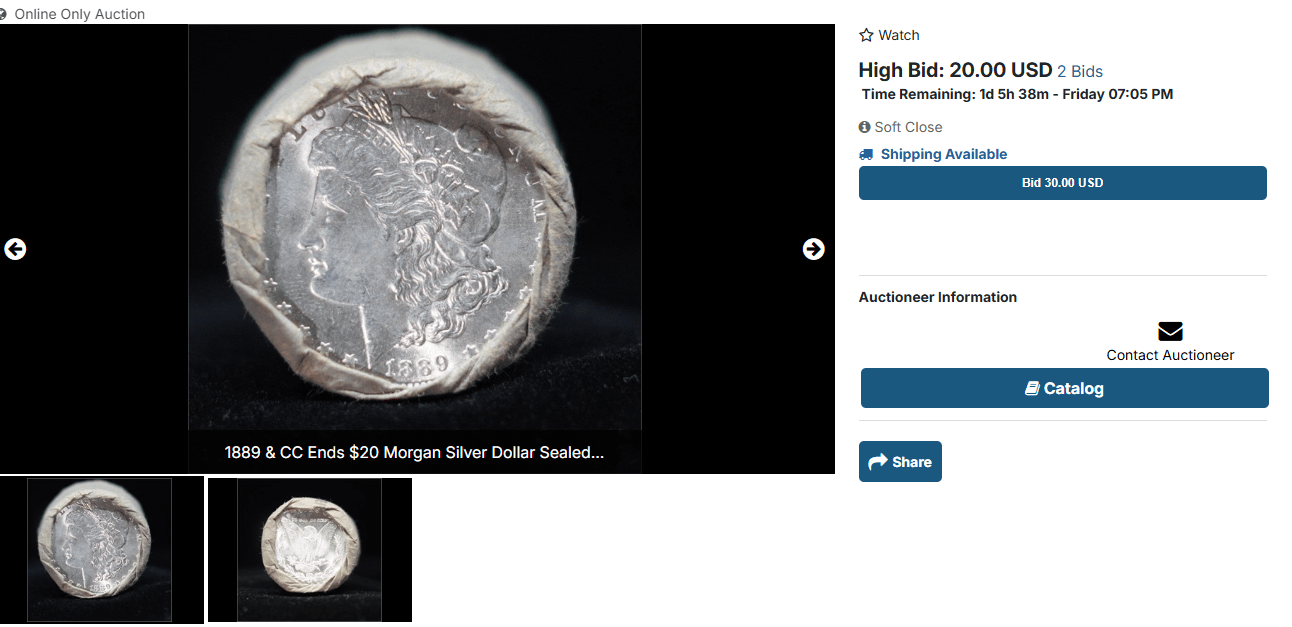
2. Do not bid or buy any roll on eBay or other online venues if one end of the roll looks opened or if the seller doesn’t show both ends of that roll. Classic bad example with no ends of roll depicted:
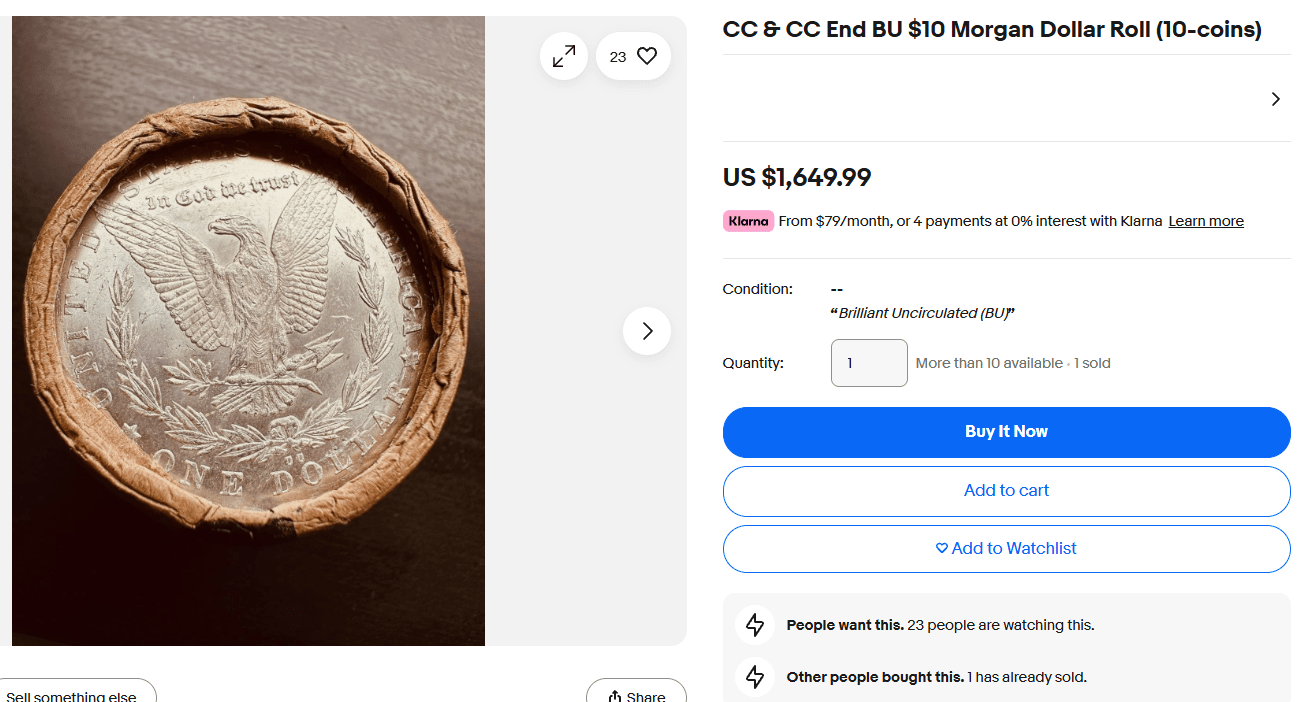
3. Do not fall for baited Carson City bank rolls. Those are almost always opened. Below is a 10-coin roll from eBay. (Note for newbies: Morgan and Peace dollars are routinely offered in 10-coin and 20-coin rolls. Do not assume all rolls have 20 coins.)
Finally, learn about Etsy replicas. Proxiblog has documented these in several articles. CLICK HERE FOR EXAMPLES.
The more you learn about coins, the less chance of your being snookered.
If you like posts like this, subscribe so you can be informed whenever there is a new article or column.
Proxiblog also has thousands of followers on Facebook Coin Groups, YouTube and social media. To get the latest discussion and commentary, be sure to friend us by clicking here.
You can find more information about types, varieties, errors, grading, bidding and buying in Coin News Updated: The Essential Guide to Online Bidding. Please consider buying or gifting the work for a friend, as it underwrites this hobbyist blog. Thank you.
I have known Ian Russell for a quarter century when he worked for Teletrade, an early pioneer in the certified coin market. He served as president of Teletrade from 2005-2010. He then founded GreatCollections Coin Auctions, which I whole-heartedly recommend. Good buyer and seller rates. I have used the site for years.
If you don’t known Russell, you can read his biography by clicking here.
Russell is treasurer of the Anti-Counterfeiting Educational Foundation, which raises awareness about counterfeit coins and bullion and works with authorities to track down sources of fake lots and sales.
I asked Russell to comment on what Jack D. Young, Jack Riley and I have been documenting on eBay and other online venues, i.e., counterfeit coins in fake PCGS holders whose certification numbers open to a Chinese site.
The Elements: The scam consists of three parts: a cheap base-metal counterfeit coin, a slab designed to mimic an authentic PCGS holder, and a fake URL/QR code.
The Fake Website: Scanning the QR code on the slab directs victims to a mirror website that falsely “verifies” the fake certification number as legitimate.
Prevalence: Investigated by numismatists on Proxiblog Coin News and Views, these scams heavily flood online marketplaces like eBay.
Proxiblog recommended these actions if encountering the sale of fake coins:
Verify Directly: Never use the QR code or URL printed on a suspicious slab’s label. Manually search the certification number on the Official PCGS Verification Portal.
Compare Markers: Scrutinize the coin’s die markers and weight, as counterfeiters often use stolen images of genuine coins for their listings.
Report Fakes: You can read investigative articles by numismatists at the Proxiblog Counterfeit Archive to stay up-to-date on current fakes.
The sheer number of “Not PCGS” counterfeits has reached epidemic proportions. See this video for examples:
Proxiblog recently contacted PCGS President Stephanie Sabin, who provided this statement:
“Since founding PCGS in 1986, our mission has been to protect collectors through leading authentication, grading, and the most secure holders in the industry. However, a powerful brand inevitably attracts counterfeiters, and we treat combating these fraudulent holders as an aggressive, ongoing priority. True security requires staying multiple steps ahead, which is why we continually invest in advanced overt and covert security features across all our product lines. We applaud the dedicated individuals and organizations within our community who work tirelessly to educate collectors on the dangers of counterfeit holders; their vigilance to eliminate altered and fraudulent collectibles is essential to protecting consumers and preserving the integrity of the numismatic marketplace.”
After that article ran, Proxiblog began getting emails and messages about whether their actual PCGS-holdered coins were legitimate. That shows the damage being done to the main reason that holdering companies exist: authentication. Proxiblog viewers also wanted to know what the big auction houses are doing to ensure that coins holdered by PCGS, NGC and other companies contain genuine coins.
So we contacted Russell to find out.
“The rise in counterfeit coins housed in fake PCGS holders has become one of the most serious threats facing the numismatic marketplace today,” Russell says. “At GreatCollections, every coin is carefully reviewed before it is offered for sale, and our team is highly experienced at identifying counterfeit holders, altered labels, and fraudulent verification schemes. Protecting bidders and maintaining confidence in third-party grading are top priorities.”
When questionable material is identified, GreatCollections removes it from consideration regardless of its source. While most consignors are acting in good faith and are often unaware they possess a counterfeit item, Russell says, “we will not offer any coin whose authenticity cannot be fully verified. The integrity of the marketplace depends on strict authentication standards and consistent enforcement.”
Russell is concerned about the growing sophistication of counterfeit holders. This has understandably caused some collectors to question genuine certified coins. “That is why auction houses, grading services, dealers and collectors must remain vigilant and work together to identify and remove counterfeit material whenever it appears. Confidence in certified coins is built on trust, and that trust must be protected.”
Jack D. Young also was among the first to report counterfeit coins in fake PCGS holders with GreatCollection labels. The label on the left side below is fake. Compare it to the real label, right.
Russell says, “We’ve also encountered counterfeit PCGS holders that use fake GreatCollections labels. Ironically, the counterfeiters often print a GreatCollections inventory label inside the sealed PCGS holder, as though it were inserted during the grading process. It’s almost comical, but it also illustrates how far these operations are willing to go to create a false sense of authenticity.”
As counterfeiters continue to refine their methods, Russell recommends reading Proxiblog and other numismatic publications, paying attention to careful examination and buying from reputable sources.
For an inventory of Proxiblog counterfeit articles, click here.
If you like posts like this, subscribe so you can be informed whenever there is a new article or column.
Proxiblog also has thousands of followers on Facebook Coin Groups, YouTube and social media. To get the latest discussion and commentary, be sure to friend us by clicking here.
You can find more information about types, varieties, errors, grading, bidding and buying in Coin News Updated: The Essential Guide to Online Bidding. Please consider buying or gifting the work for a friend, as it underwrites this hobbyist blog. Thank you.
Prompting this article is a counterfeit 1878-CC that was previously listed to eBay and quickly removed. All 1878cc have B reverses, otherwise known as the “2nd reverse” with parallel arrow feathers (rather than slanted).
As a refresher, here are both kinds.
In addition, the 1878-CC has a different type of mintmark from other CC years, excluding some 1880cc varieties.
Compare mintmarks with the 1879-CC Morgan, which has slanted tail feathers.
Now inspect the 1878-CC coin below.
Looking through my log of documented counterfeit reverses for Morgan Dollars I realize I’ve seen this one a few times. The “Doubled wreath reverse.” If any of these were genuine they would be some of more dramatic doubled dies of the series, which evident by this 1878cc that isn’t the case.
Now to the real meat and potatoes of this article! An 1881-CC that was posted to a Facebook coin group for determination of value and authenticity. Being that 1881-CC has a low mintage of a mere 296,000 coins, there are very few die marriages. Only VAM-2 and VAM-6 has a CC tilted left, clearly this coin doesn’t attribute to either die marriage. (To learn about VAMs, click here.)
It does match the reverse of the previous 1878cc!
Below see a comparison image of both the 1878 and 1881-CC reverses. The “doubled wreath” stands out clearly. Along with a few repeating circulation marks, one being a minor indent on the wreath and another in the field below the right star.
After a lengthy conversation with the individual who owns the coin, they couldn’t come to terms that it was a very modern counterfeit. I’m sure our readers will see this coin is clearly unattributable to a genuine die marriage and matches a known counterfeit.
The best way to guard against buying a counterfeit coin is to purchase an authentic one from a reputable dealer. Barring that, view Jack Young’s Jack Riley’s and my articles on counterfeit coins published by Proxiblog.
If you like posts like this, please subscribe so you can be informed whenever there is a new article or column.
Proxiblog also has more than a thousand friends and followers on Facebook Coin Groups and thousands more across YouTube and social media. To get the latest discussion and commentary, be sure to friend us by clicking here.
You can find more information about errors and varieties as well as buying and bidding on coins in Coin News Updated: The Essential Guide to Online Bidding. Please consider purchasing the work for yourself or a friend, as it underwrites this hobbyist website. Thank you.
Today’s feature subject- the Trifecta all over again; counterfeit 1882-CC Morgan $, counterfeit PCGS slab, and counterfeit PCGS CN “authentication” website.
This article documents what is happening to our hobby. It is important for every collector to know what is happening on eBay and other venues with counterfeit coins, slabs and websites.
So, let’s start with the current one. I notified PCGS about this 1882-CC Morgan. As I have noted previously I use eBay for new material to write counterfeit articles on, and eBay apparently remembers me and my dumpster dive searches! The following is one page of a series of “inspiring” Bay offerings that came up the other day:
So the 1882-CC looked different and I thought worth taking a deeper dive on (notice the similar looking 1880-CC to the right as well). The original listing:
I have seen many odd listings on the Bay, but this one is notable. Starting with not-PCGS label the nomenclature seems bizarre; I have never seen a genuine one with the word “America” on it, making me think of others with “Morgan” on the label! And I had no clue what the “LM” and “Y” designations stands for; turns out they are attributions for Chinese coins!
The barcode doesn’t scan, the cert number doesn’t exist in the true PCGS database, and the gold shield looks like a child’s coloring book effort.
The seller shows front and back images and then a raw one on a scale while stating “With NFC C” for whatever that is supposed to mean.
And an old friend, “slash” the eagle! And where do you suppose the scale came from?
So bad cert #:
So, what about the reverse QR code? With that many “cn’s” in the address where do you suppose it will lead?
So a note for reference- the site we exposed at the beginning of the year was entirely different and was taken down quickly after notifying my contacts at PCGS and reporting on Proxiblog:
And the new site and images:
And like the previous site there is a “TrueView” type image to aid with authentication…
A little pricy to me at the time as I had 2 others going through the eBay refund/ return process then. Interestingly, both of them were reported through the Bay AI reporting process and came back AOK, but when I posted each on my Face Book sites and stated I bought one, they suddenly were removed along with the sellers…
So I reported this one and the bogus site to my contacts at PCGS and then posted on my personal FB page:
And poof, both the seller and listing were removed from the Bay…
From my post one can see there are Chinese coins included, as I went through the effort to find other ‘coins” on the site. Many CC Morgans and even more CN coins including this example:
Notice the cert #, 66259150 and the subject example, 66259979- each cert # in-between these shows another counterfeit. It goes on and on…
And an image of the ones I screen printed:
Saved images from the bad website
A true nightmare IMHO.
And the story continues, as after the subject listing and seller “disappeared”, more showed up to the party.
2 new sellers with the same appearing stuff, they now state “with grading box”.
I looked at the 1880-CC, and it matched the website examples but decided to purchase the 1882-CC.
And what about seller feedback? WOW, I didn’t know there was even such a thing as counterfeit perfume!
Yep, I took the chance of submitting feedback before receiving the item, so we will see how that worked for me.
And I did also report the 1880-CC, but both of these and the website are still up.
And eBay’s responses to both reports:
eBay’s report response states made by a “customer service agent” in both cases!
And the 1882-CC seller’s response to my feedback? Well, like another seller he cancelled my order stating I requested the cancellation.
And he added to the negative feedback chain and asked I contact them “directly to discuss”:
And an interesting anecdote, Paula Bluhm found a Chinese coin with the variety nomenclature used on this “Morgan” counterfeit! (Maybe a viewer can help with the Y and LM designations.)
I actually tried to purchase another one from the same seller, but he cancelled it after I paid for it; I was refunded by eBay.
And a 6-18 update- more sellers of these counterfeits hit the Bay, and they must have read my negative feedback and now obstruct the reverse QR code!
I purchased an 1880-CC, so we will see what I receive.
If you like posts like this, you can read more articles on counterfeit coins by Jack D. Young, Jack Riley and Michael Bugeja at this URL. Also, please subscribe so you can be informed whenever there is a new article or column.
Proxiblog also has thousands of followers on Facebook Coin Groups and across social media. To get the latest discussion and commentary, be sure to friend us by clicking here.
You can find more information about errors and varieties as well as buying and bidding on coins in Coin News Updated: The Essential Guide to Online Bidding. Please consider purchasing the work for yourself or a friend, as it underwrites this hobbyist website. Thank you.
Everyone knows that Chinese counterfeits have flooded the coin market with some production estimates exporting between 100,000 to 500,000 counterfeit coins per month. The majority of these are offered as raw coins on eBay, Etsy and Temu, among others. But now a new threat has emerged: sellers offering counterfeits in fake PCGS holders with phony “Not PCGS” certification sites.
This is a much-overlooked consequence because it attacks the fundamental priority of top holdering companies: authentication.
These fakes pop up when you try to access PCGS. To show how frequent, I now will access the site and report the results in 10 minutes of searching.
These are from different sellers. I could have published a dozen or more.
When viewing counterfeit “Not PCGS” coins on eBay, you’ll see that sellers have few sales. Never bid or buy from such sellers. Nevertheless, that is not the lesson here. It is the erosion of the reputation of the top holdering companies in the hobby.
While we cannot do anything about Chinese fakes, we can ask eBay to listen more closely to our messages and reports about counterfeits and perhaps fix their algorithm and provide more education for their customer service employees.
To be fair, eBay has honored many of our complaints about counterfeit coins. It has forced sellers to reimburse buyers of counterfeit coins. We know that.
But the issue now is the proliferation of counterfeits in fake PCGS holders. An algorithm or customer service employee may see that famous logo and–ironically!–believe the listing is authentic because … wait for it … it trusts PCGS’s reputation.
That is why counterfeiters are using fake PCGS holders, playing off of PCGS’s good name. They also play off the good name of top auction houses like GreatCollections with fake stickers.
Every hobbyist needs to know counterfeit detection. Click here for that. Here is a visual primer on how you, too, can identify counterfeit coins in fake PCGS holders:
Our concern here focuses on the hobby and the ramifications of using fake PCGS holders to fool hobbyists into thinking they have a genuine coin.
While many hobbyists have complained about counterfeits, the conventional wisdom is disappointing: nothing can be done because the Chinese government allows this as part of its economy.
That thinking results in defeatism. If nothing can be done, then the hobby is at risk. But that risk is becoming greater each day. If eBay in particular does little when informed about counterfeits, because (a) its algorithm cannot detect a fake based on die markers and (b) its customer service may not be schooled enough to know those markers, seeing only a slabbed PCGS coin; then (c) the corporate reputation of PCGS is at issue.
This is an article about that premise. eBay can argue that it has invested $X amount of dollars in counterfeit detection and even has customer service employees check listings when multiple complaints have been lodged; but if both are proving at many occasions ineffective, that is not a strong defense when it comes to PCGS. It only means that eBay’s methods need enhancement.
These are matters beyond the scope of this article.
Stephanie Sabin, president of PCGS, is aware of the ongoing issue.
She provided Proxiblog with this statement:
“Since founding PCGS in 1986, our mission has been to protect collectors through leading authentication, grading, and the most secure holders in the industry. However, a powerful brand inevitably attracts counterfeiters, and we treat combating these fraudulent holders as an aggressive, ongoing priority. True security requires staying multiple steps ahead, which is why we continually invest in advanced overt and covert security features across all our product lines. We applaud the dedicated individuals and organizations within our community who work tirelessly to educate collectors on the dangers of counterfeit holders; their vigilance to eliminate altered and fraudulent collectibles is essential to protecting consumers and preserving the integrity of the numismatic marketplace. By combining their grassroots educational initiatives with our ongoing technical innovations and strengthened marketplace partnerships, we will continue to build a safer, more secure hobby for all.”
In recent years, Chinese counterfeiters have upped the ante, targeting PCGS, often cited as the most reliable and top holdering company. Not only are the coins fake; the holders are too. And the certs open to a fake PCGS authentication site.
Proxiblog’s Jack Young, Jack Riley and Michael Bugeja have been monitoring the proliferation of “Not PCGS” counterfeit coins.
In January, Jack Young wrote, “As if the Chinese counterfeit coins in fake PCGS slabs isn’t bad enough, now there appears to be a fake Chinese PCGS website to verify them.”
Young identified this counterfeit:
Of course he checked the cert and found no similar or other coin. His next step was to try to read the reverse label QR code. He got this:
A fake coin. A fake holder. A fake site. (If you are interested in the complete article about this fake coin and site, click here.) Jack Young has found that this trifecta is happening again.
He has found two more sellers that offer fake coins in fake PCGS holders with certs going to a fake PCGS site.
Jack Young says “Michael and I have been discussing what I have termed the ‘proliferation’ of counterfeit coins using stolen PCGS Intellectual Property, fake ‘PCGS’ holders on eBay. I see all of the listings ‘allowed’ there as a huge failing of eBay. And their AI reporting process is also an apparent failure to many collectors and hobbyists as well.
“So, going forward I use eBay for new material to write counterfeit articles on, and today’s usual browse of ‘US Coins’ on the Bay resulted in 44 counterfeit coins in fake PCGS slabs listed on just the 1st page. I screen-printed a number but quite frankly got tired of the effort after documenting these below.”
Snippet of the 44 listings available on 1-page of eBay US Coin listings 6-11-26
The frustration with eBay stems from counterfeit experts using the eBay reporting system only to be told that the fraudulent listing is fine and nothing will be done. Example:
But it gets worse. Jack Young has been warned about reporting counterfeit coins on eBay, further damaging its supposed defense that it vets all reports of fake offerings on the platform. Example:
Because of the proliferation of “Not PCGS” counterfeits, Jack Young and Proxiblog have received or seen requests on Facebook coin groups to check if an actual authentic PCGS coin is, well, authentic!
In sum, scam sellers acting in effect as agents of Chinese counterfeiters are eroding the very heart of what top holdering companies do: authenticate.
The question now, of course, is what can be done collectively.
Jack Young and I have contacts at PCGS, which has encouraged us to report fake offerings and to do one more thing: inform the company if eBay refuses to take action. But that will hardly fix the problem. The issue at hand is what can be done when popular platforms like eBay get it wrong at the expense of its bidders and holdering companies.
That will have to be decided by others.
Proxiblog can help by continuing to grow our subscriber base and influence on Facebook. Jack Young and Jack Riley also have large spheres of influence. But we need the American Numismatic Association, the U.S. Mint and the National Coin and Bullion Association to understand this new threat of corporate reputation and to break the defeatism that nothing can be done.
Let’s review legalities:
Counterfeiting or knowingly passing fake coins is a federal crime punishable by up to 15 years in prison and severe fines. The U.S. Secret Service investigates all suspected counterfeit coins.
The creation, sale and distribution (pertinent here) of fake coins can be prosecuted under United States Codes:
Manufacturing and Forging (18 U.S. Code § 485): Falsely making, forging, or counterfeiting any coin (valued higher than 5 cents) or any gold or silver bar is punishable by up to 15 years in prison and substantial fines.
Passing or Possessing (18 U.S. Code § 485): Passing, selling or bringing counterfeit coins into the United States with the intent to defraud carries a penalty of up to5 years in prison.
There is also the Hobby Protection Act, which states, it is illegal to buy, sell or possess counterfeit coins. Moreover, all replica, copy or imitation numismatic items must be plainly and permanently marked with the word “COPY”.
Jack Young, Michael Bugeja and Proxiblog subscribers have encountered sellers who bought a counterfeit coin, are reselling it as genuine and refuse to take it down.
We present one example here, but we encounter this regularly.
Here are exchanges by Bugeja and subscriber Tim Scott, trying fruitlessly with eBay to take down this obvious fake. Our complaints were ignored by eBay.
Despite our concerns, shared across Facebook coin groups, the fake coin in a fake PCGS holder sold for $607.33. You can see it had 24 bids.
We thank Stephanie Sabin and PCGS for helping us safeguard their reputation and our hobby.
If you like posts like this, please go to our counterfeit archive with reports from Jack Riley, Jack D. Young, John Lorenzo and Michael Bugeja. Also, please subscribe so you be informed whenever there is a new article or column.
Proxiblog also has thousands of followers on Facebook Coin Groups, YouTube and social media. To get the latest discussion and commentary, be sure to friend us by clicking here.
You can find more information about errors and varieties as well as buying and bidding on coins in Coin News Updated: The Essential Guide to Online Bidding. Please consider purchasing the work for yourself or a friend, as it underwrites this hobbyist website. Thank you.