How do repunched mintmarks happen? Mint employees used to hand punch mintmarks until that practice was phased out between 1985 and 1991, ending over-mintmarks (OMM) along with repunched ones (RPMs) from modern coinage.
But there is keen interest in identifying these errors especially in Wheat Cents because there aren’t many.
In this article we feature two prominent RPMs you can find in pocket change and rolls–the 1943-D/D Repunched Mintmark (RPM FS-501) and 1956-D/D Repunched Mintmark. We also will give markers for one Wheat Cent OMM and a lesser RPM at the end of the article.
The 1943-D/D has a clear doubled mintmark. A second “D” is visible tilted next to the main strike, as below.
The value of this coin depends on its condition, ranging from $25 for a worn example and thousands for uncirculated ones.
1956-D/D overstrike also is clear, especially on uncirculated coins as below. This is highly coveted.
Once again, values depend on condition. Worn examples are anywhere from $15-25. Uncirculated ones can range in the hundreds if red and high mint state.
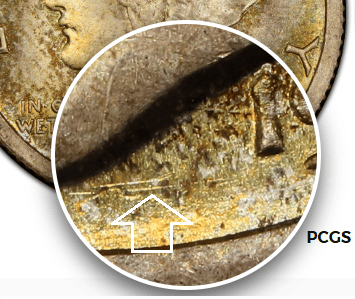
There is one lesser error: 1911-D/D Repunched Mintmark (RPM FS-501): A faint RPM featuring a serif of second “D” stamped northwest of the primary mintmark. You’ll need a loupe or microscope to see it.
These are worth anywhere from $25 to $150+ depending on how clear the remaining detail and mintmark are. Pristine examples can go in the hundreds and even thousands of dollars, but these are true rarities.
Then there is the 1951-D/S Over Mintmark (OMM FS-511): This error features a slight doubled mintmark as shown below by the main Denver “D.” You can see remnants of the “S” with a loupe or coin microscope.
The value of a 1951-D/S OMM ranges from $20 to $35 for lower-grade or raw uncirculated examples, while certified high-grade specimens can fetch anywhere from $200 to over $500.
If you are interested in Wheat Cent errors and varieties, check out Proxiblog’s directory:
If you like articles like these, please friend us on Facebook and subscribe to Proxiblog.
Proxiblog also has thousands of followers on Facebook Coin Groups, YouTube and social media. To get the latest discussion and commentaries, click here.
You can find more information about errors and varieties as well as buying and bidding on coins in Coin News Updated: The Essential Guide to Online Bidding. Please consider purchasing the work for yourself or a friend, as it underwrites this hobbyist website. Thank you.
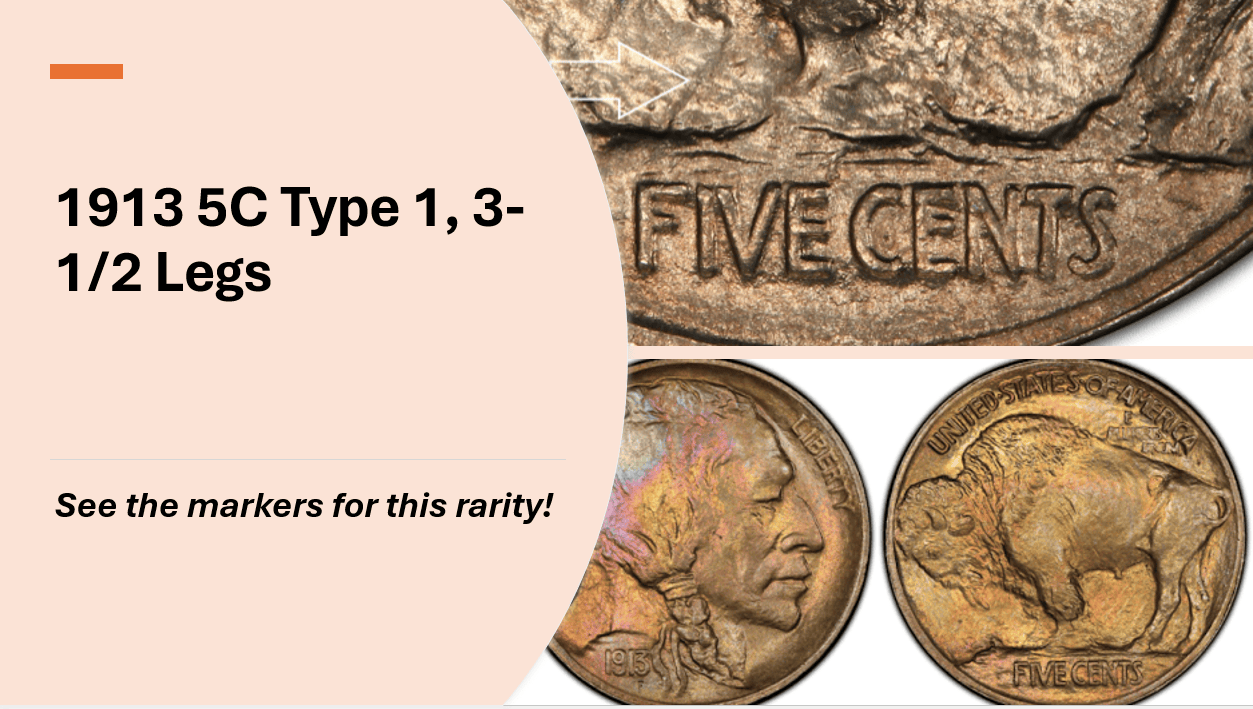
You probably know about the famous 1937-D Three-Legged Nickel and maybe even the 1936-D 3 1/2-Legged Nickel. (If not, you can learn about them here.) But did you know about the rarity 1913 3-1/2 Legged Buffalo Nickel (Type 1)?
All three of these desired varieties happened because of polishing of the dies in an attempt to lengthen the life of the working die. As a result, parts of the buffalo’s legs have been removed.
The 1913 3-1/2 Nickel is missing much of the front leg. It is not nearly as obvious as the 1937-D Three-Legged coin.
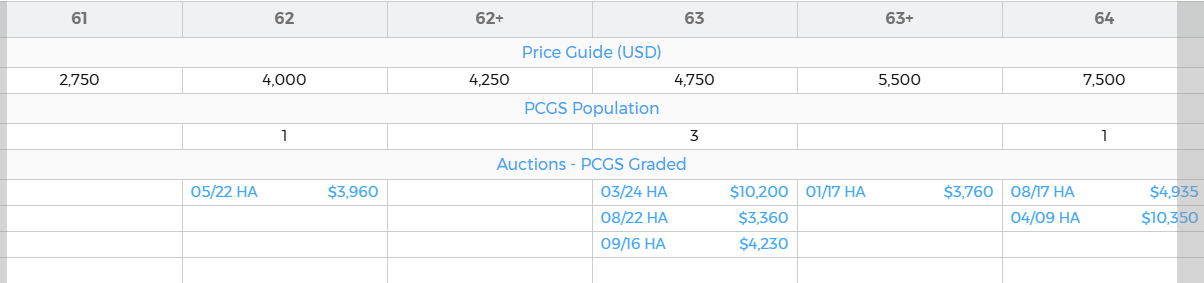
Ron Guth, a long-time PCGS chronicler, writes, “This is a rare variety that has proven to be difficult to find in most grades.” He notes that a PCGS MS64 “splashed onto the market in 2003 and sold for $19,550 at auction. A year later, an NGC MS65 sold at auction for $47,437.50. In early 2017, PCGS certified an MS66 example which has yet to come to market (as of 2/2017).”
Those values are less today as more have been found. But they are still pricey!
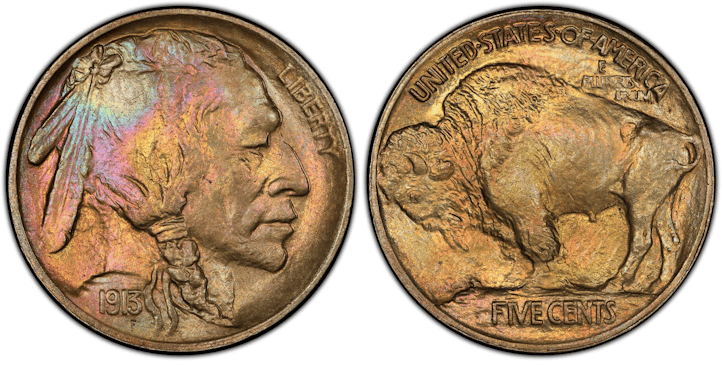
Now that we know about its history, let’s take a look at the markers. Below is a beautiful MS64 example.
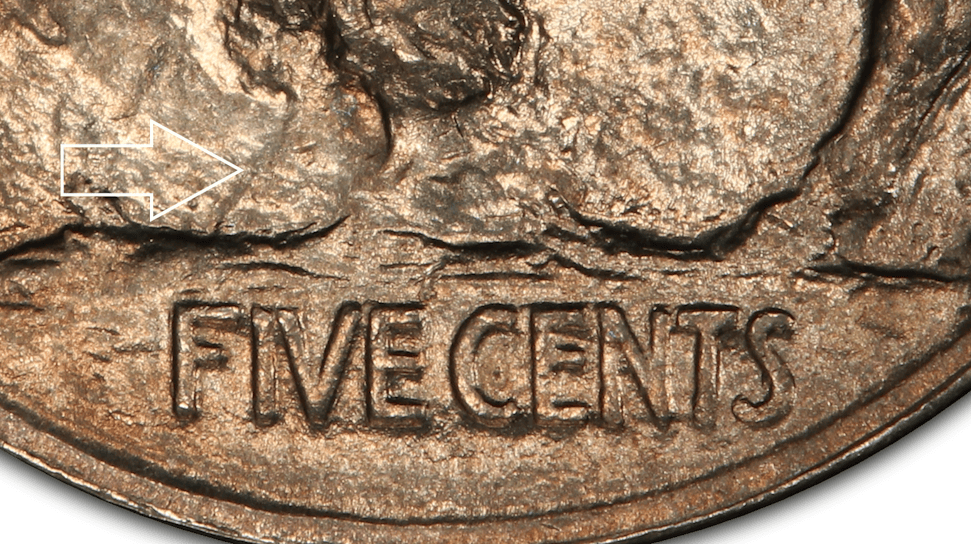
You want to look above the “I” in “FIVE.”
Here’s an expanded example:
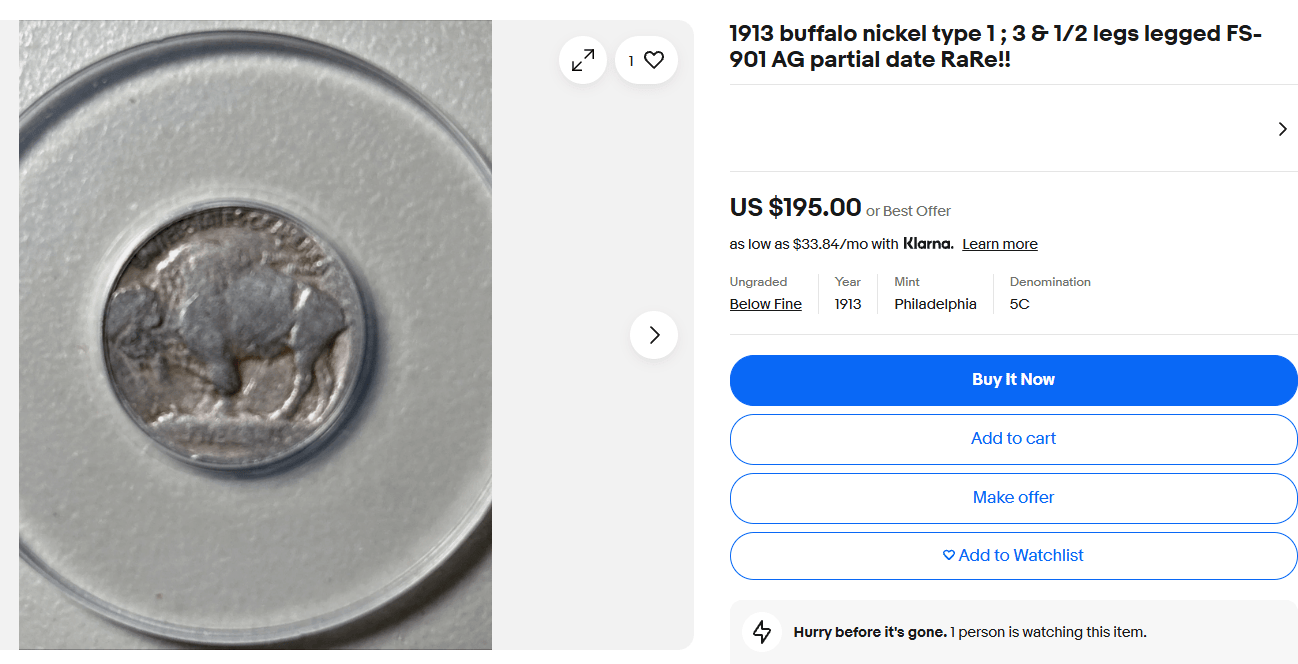
As always, be wary of others selling worn examples of a regular 1913 Type I Nickel and calling it 3 1/2 legs, as below:
If you like posts like this, subscribe so you can be informed whenever there is a new article or column.
Proxiblog also has thousands of followers on Facebook Coin Groups and across social media. To get the latest discussion and commentary, be sure to friend us by clicking here.
You can find more information about types, varieties, errors, grading, bidding and buying in Coin News Updated: The Essential Guide to Online Bidding. Please consider buying or gifting the work for a friend, as it underwrites this hobbyist blog. Thank you.
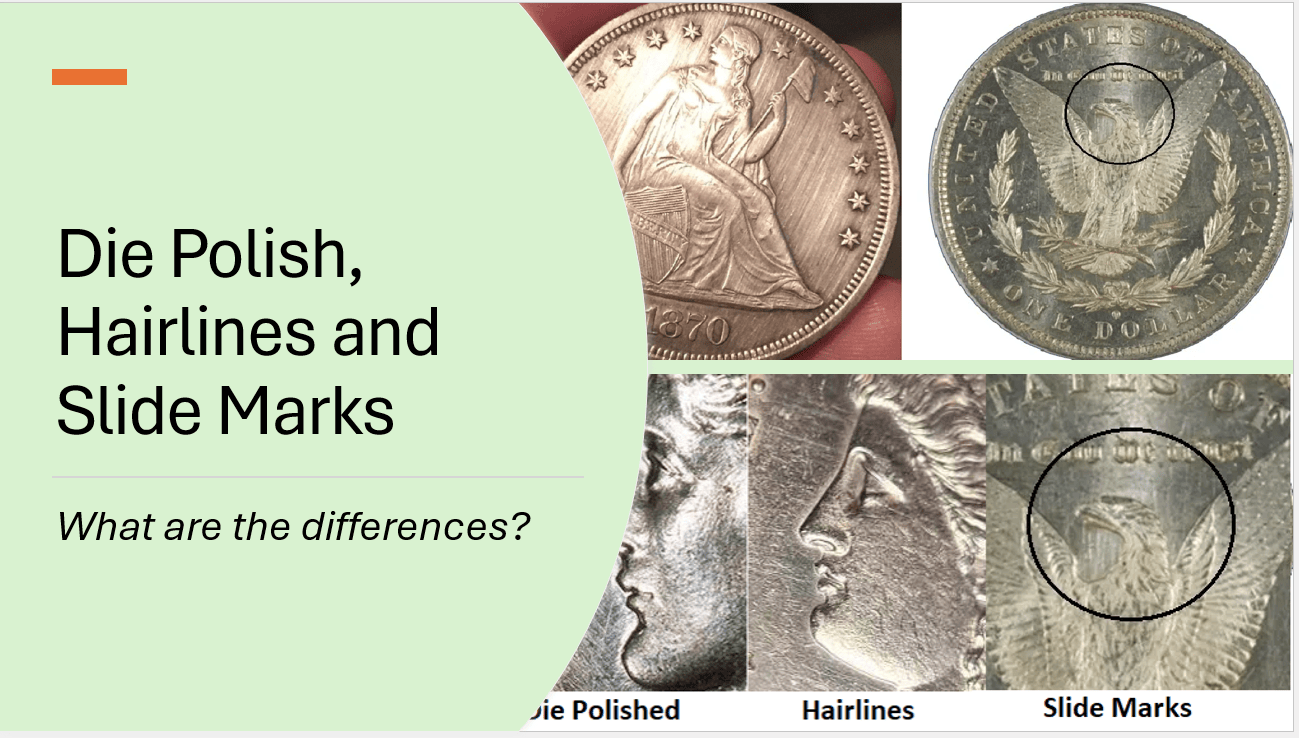
Die polish lines look like cleaning hairlines and album slide marks, but there are distinct differences, discussed here. Die polish lines meant to extend the life of a working die have no effect on straight grading. Album slide marks, if light, may lower a straight grade because of eye appeal or may disqualify it if significant. Hairlines earn a Details grade from major holdering companies.
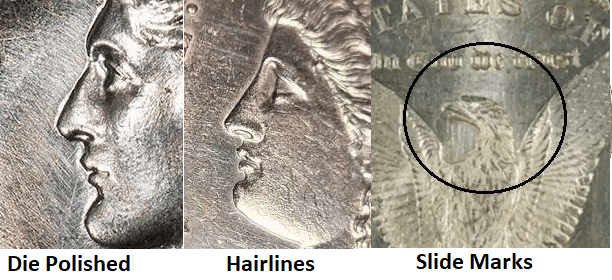
Let’s look at the difference and similarity here:
To understand the difference, you need to know how coins are made. Lines from die polish, done to preserve the life of the working die, are raised. In other words, the metal from the striking process fills in the lines and raises them. Lines from cleaning and album slide marks are not raised and dig into the metal surface.
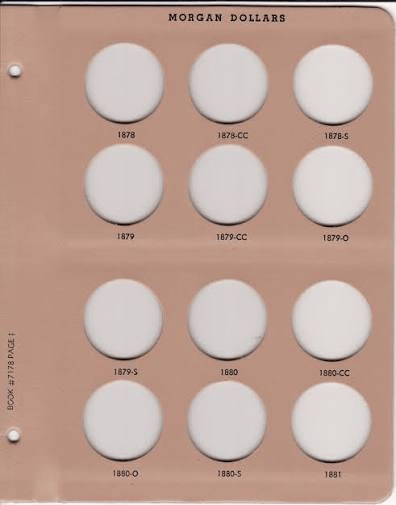
You should never clean a coin with any kind of abrasive. When you do, you get hairlines. Slide marks occur when plastic covers are inserted and removed from Dansco and similar albums:
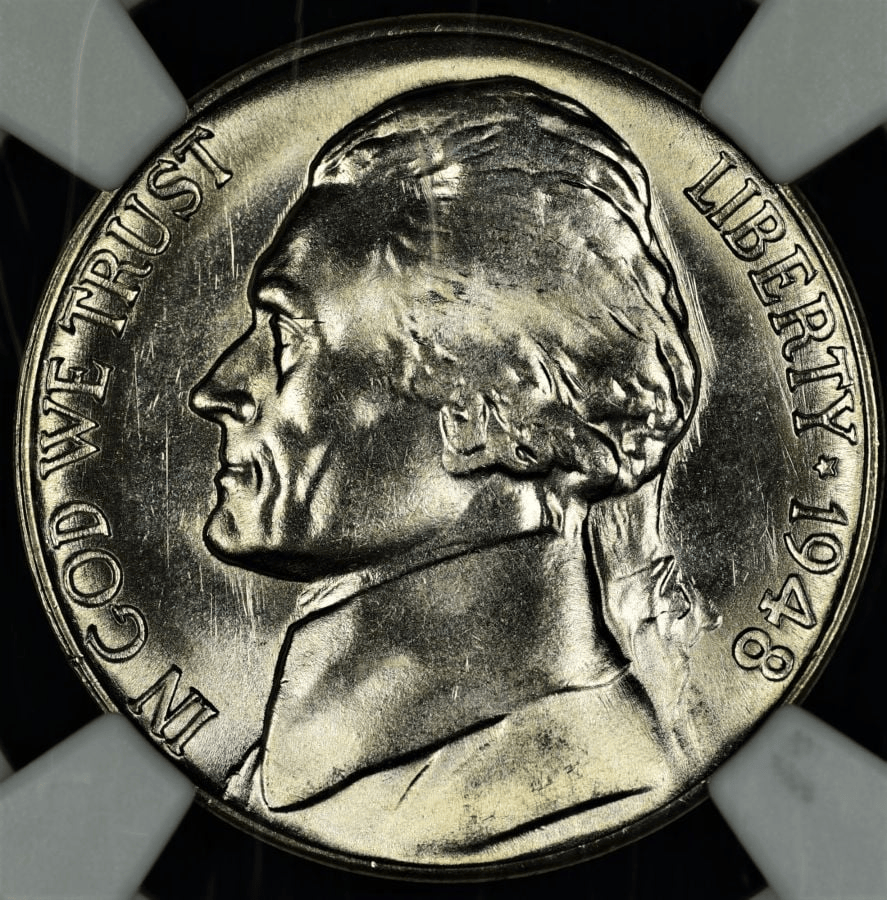
Another difference: Die polish lines do not go over nearby devices. See how the lines do not run into Jefferson’s profile on this nickel:
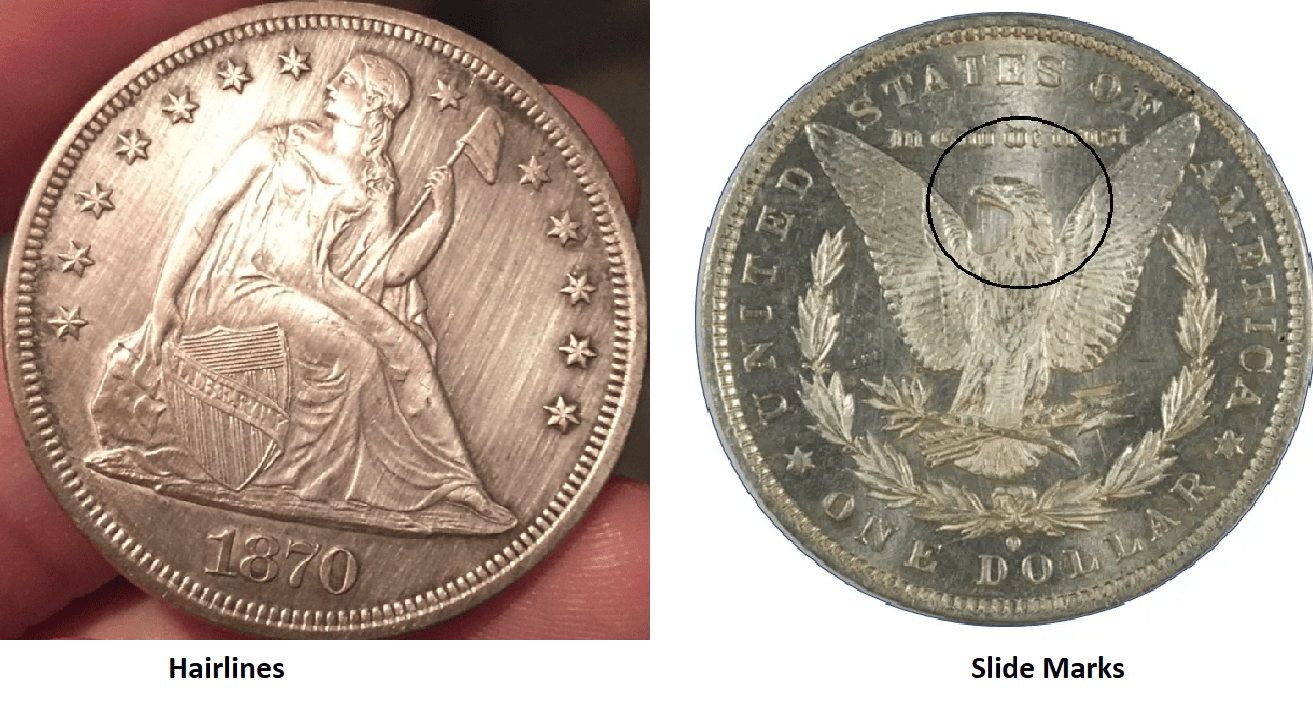
This 1870 dollar has been harshly cleaned, with hairlines going over devices. The same effect occurs with slide marks; however, the lines typically are straight rather than irregular. See the difference:
As you can see, hairlines not only go over devices but are curved and irregular. Slide marks go over devices but are usually more uniform as the plastic cover slides out in a uniform manner.
PCGS considers slide marks a common form of unintentional, secondary handling rather than deliberate alteration or harsh cleaning; as such, they do not trigger an automatic “Details” grade. If the lines are shallow, faint and not in key areas, the coin will straight grade with a lower numerical grade. However, if the plastic panels dragged debris across the coin, you probably will get a scratch/Details grade.
If you like posts like this, subscribe so you can be informed whenever there is a new article or column.
Proxiblog also has thousands of followers on Facebook Coin Groups and across social media. To get the latest discussion and commentary, be sure to friend us by clicking here.
You can find more information about types, varieties, errors, grading, bidding and buying in Coin News Updated: The Essential Guide to Online Bidding. Please consider buying or gifting the work for a friend, as it underwrites this hobbyist blog. Thank you.
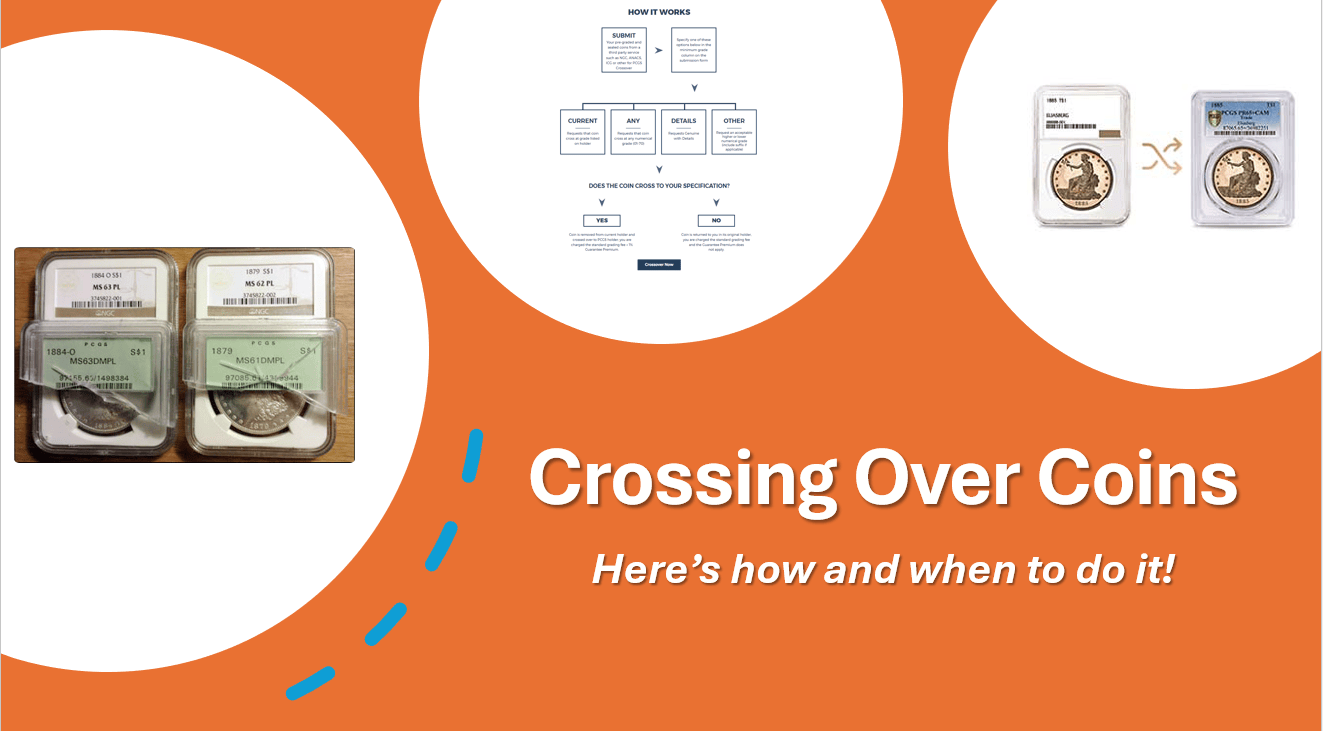
There are many reasons to submit coins for crossover service: You might have coins in lesser-tier holders. You might want to change companies for set registries. Or perhaps your holdered coin is damaged or cracked, giving you a reason to try another company. Maybe you have a coveted green PCGS first generation holder and now want to try for a higher grade at NGC.
We will be addressing those questions and discussing here the two major holdering companies, PCGS and NGC. If you are interested in ANACS crossover service, click here for more information. CAC? Click here.
Crossovers require that you have a coin in a holder with some sort of certification and grade. Before giving the details for PCGS/NGC services, refresh yourself with lower-tier companies. This article describes second, third and bottom-tier slabbing companies.
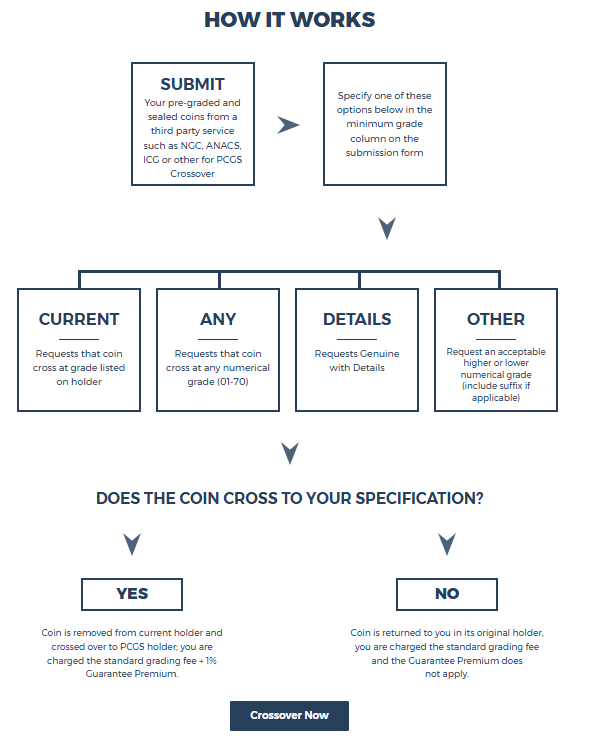
PCGS has a nifty visual explaining how to cross over any coin in a certified holder.
Coins must be pre-graded by that other company, completely sealed. The form to fill out your crossover is on the dark blue “Crossover Now” tab. But before you submit, know what you will need to do.
These are you options:
You can request that your coin be the same grade as on the label.
Or you can request any numerical grade on the Sheldon 1-70 scale.
If your coin has a flaw, such as cleaning, you must decide whether you want a PCGS Details label spelling out the problem.
Finally, you can request a specific grade higher or lower than what is on the label.
If PCGS holders your coin, it will crack it out of your slab. If it doesn’t meet the company’s standards, you will get it back with your original holder.
NGC only considers coins graded by PCGS for its crossover service. You will be asked to state your minimum grade. If NGC agrees, it will automatically remove the coin from the PCGS holder. If the coin fails to meet NGC standards, it will be returned to the submitter in its original PCGS holder. The full NGC grading fee will apply.
What if you have coin from another service and still want to cross over to NGC? Your coin is not eligible for crossover. However, NGC states that it can remove coins from these holders when submissions are accompanied by a coin removal consent form, which must accompany the submission form.
Of course, you do not have to submit your holdered coins for crossover service. You can crack them out of the old holder and just submit your coins as raw. Experienced hobbyists know how to crack open a holder. Proxiblog will not explain how because injuries are possible from the shards of plastic. Some can literally burst and injure your eyes.
If you don’t know how to do, please do not try.
Finally, a word about old green PCGS holders, which you can submit to NGC for a new grade and label. The myth about those green holders is that they were undergraded in the late 1980s. Many were, and these were long since crossed over or submitted for a regrade.
The green holder grades are inconsistent. Some were undergraded. Some were overgraded. And some had flaws that current graders would catch.
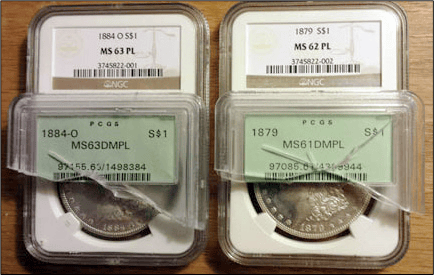
Here are two green-holdered PCGS coins that were sent to NGC.
As you can see, the DMPL designation was lost on both in the transfer. One point higher for the 1879. I lost hundreds of dollars.
If you like posts like this, subscribe so you can be informed whenever there is a new article or column.
Proxiblog also has thousands of followers on Facebook Coin Groups, YouTube and social media. To get the latest discussion and commentary, be sure to friend us by clicking here.
You can find more information about types, varieties, errors, grading, bidding and buying in Coin News Updated: The Essential Guide to Online Bidding. Please consider buying or gifting the work for a friend, as it underwrites this hobbyist blog. Thank you.
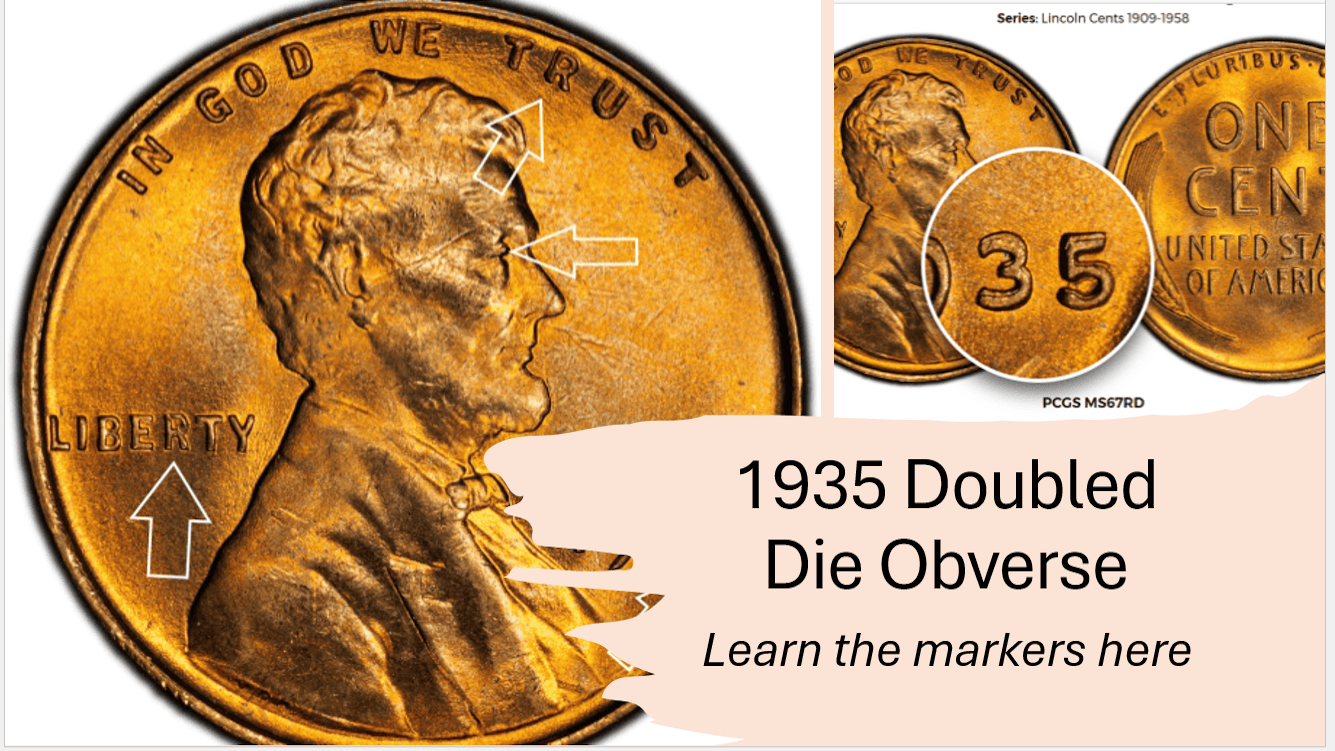
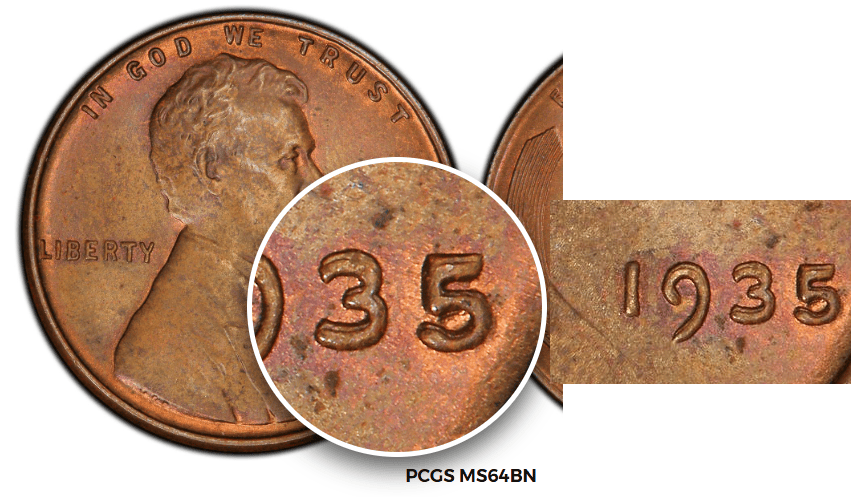
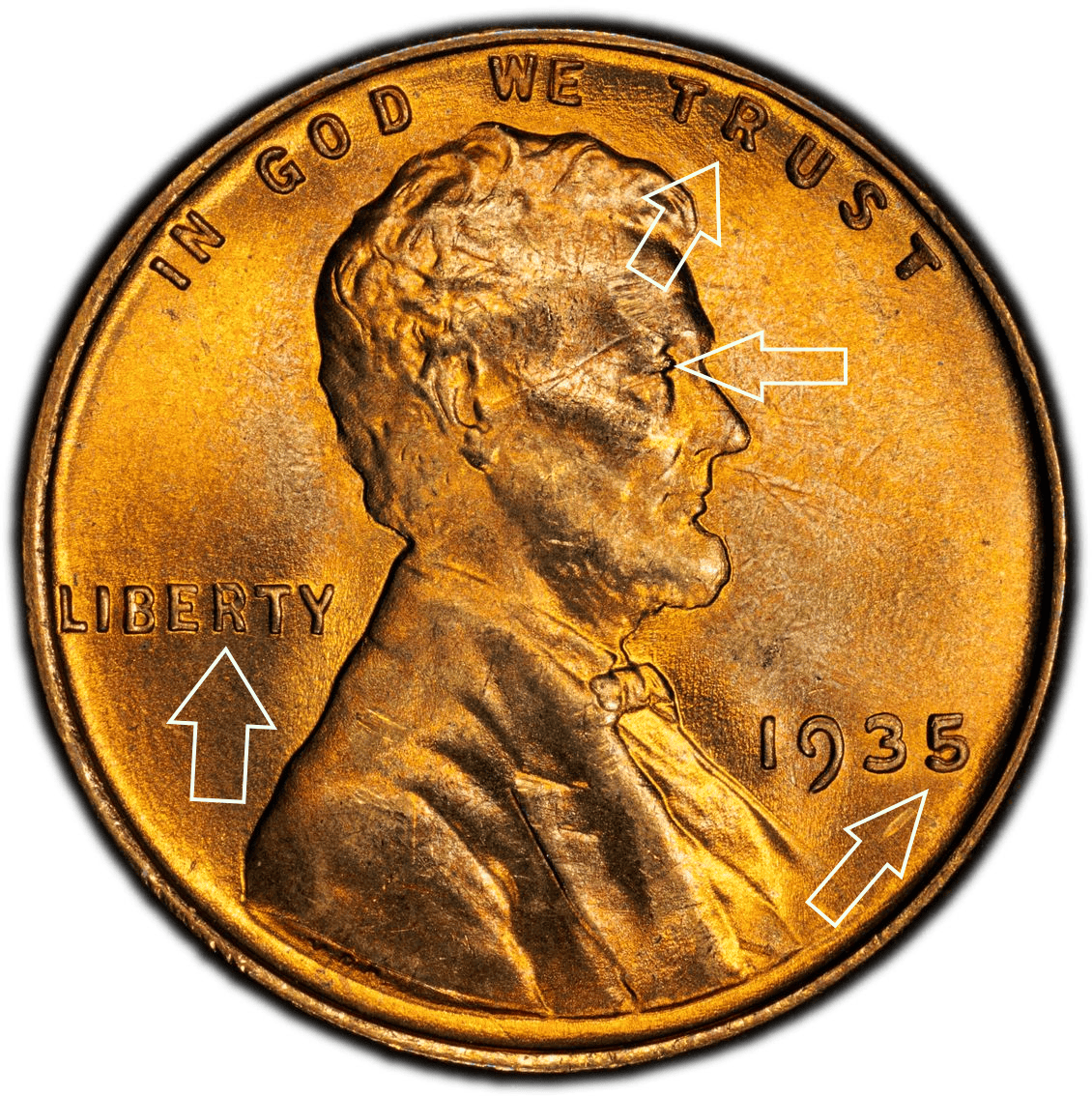
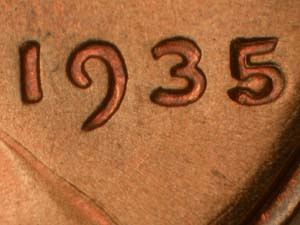
Officially known as 1935 Doubled Die Obverse (DDO) FS-101 variety, this coin has significant doubling, especially on the date, and is sought after by collectors.
You also can see doubling on the letters of “IN GOD WE TRUST” as well as the left portion of the motto LIBERTY.
If you look closely, you can see a doubled eyelid on the portrait.
This is the type of doubling that can be strong, if early in the manufacturing process, or weaker as the working die deteriorates.
Also, in those late-stage examples, the doubling can look flat. So many people attribute those to machine doubling. Example:
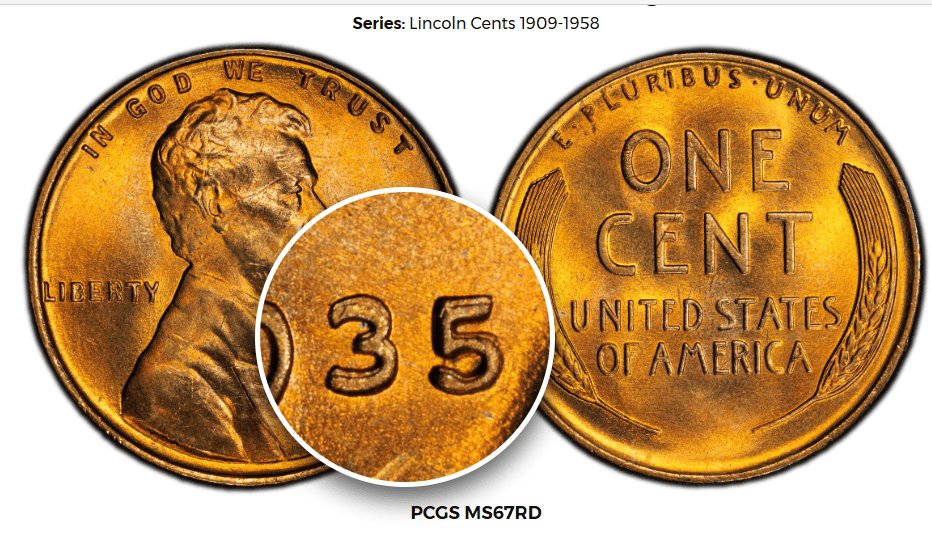
As for value, PCGS CoinFacts factors the color of the coin (Brown, Red-Brown, or Red) and its grade.
Well-circulated examples can be found on eBay for under $50. High grade red examples authenticated by PCGS sell for hundreds and even thousands.
This coin sold at auction for $3055.
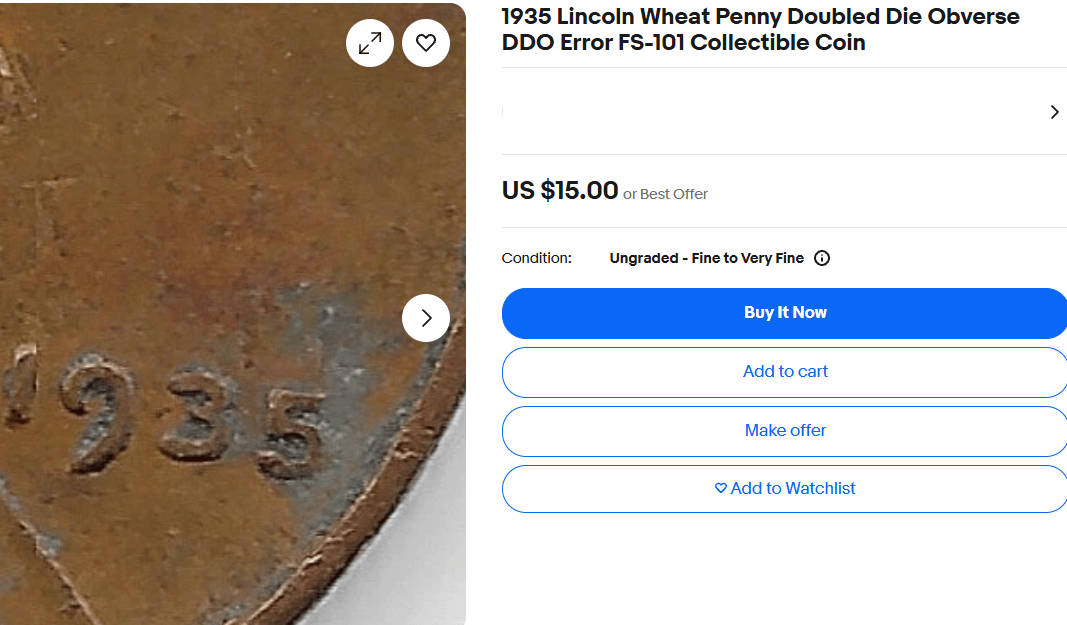
If buying a raw example from eBay or online auctions, be sure to distinguish doubled die from die deterioration, as in this case:
If you like articles like these, please friend us on Facebook and subscribe to Proxiblog.
Proxiblog also has thousands of followers on Facebook Coin Groups, YouTube and social media. To get the latest discussion and commentaries, click here.
You can find more information about errors and varieties as well as buying and bidding on coins in Coin News Updated: The Essential Guide to Online Bidding. Please consider purchasing the work for yourself or a friend, as it underwrites this hobbyist website. Thank you.
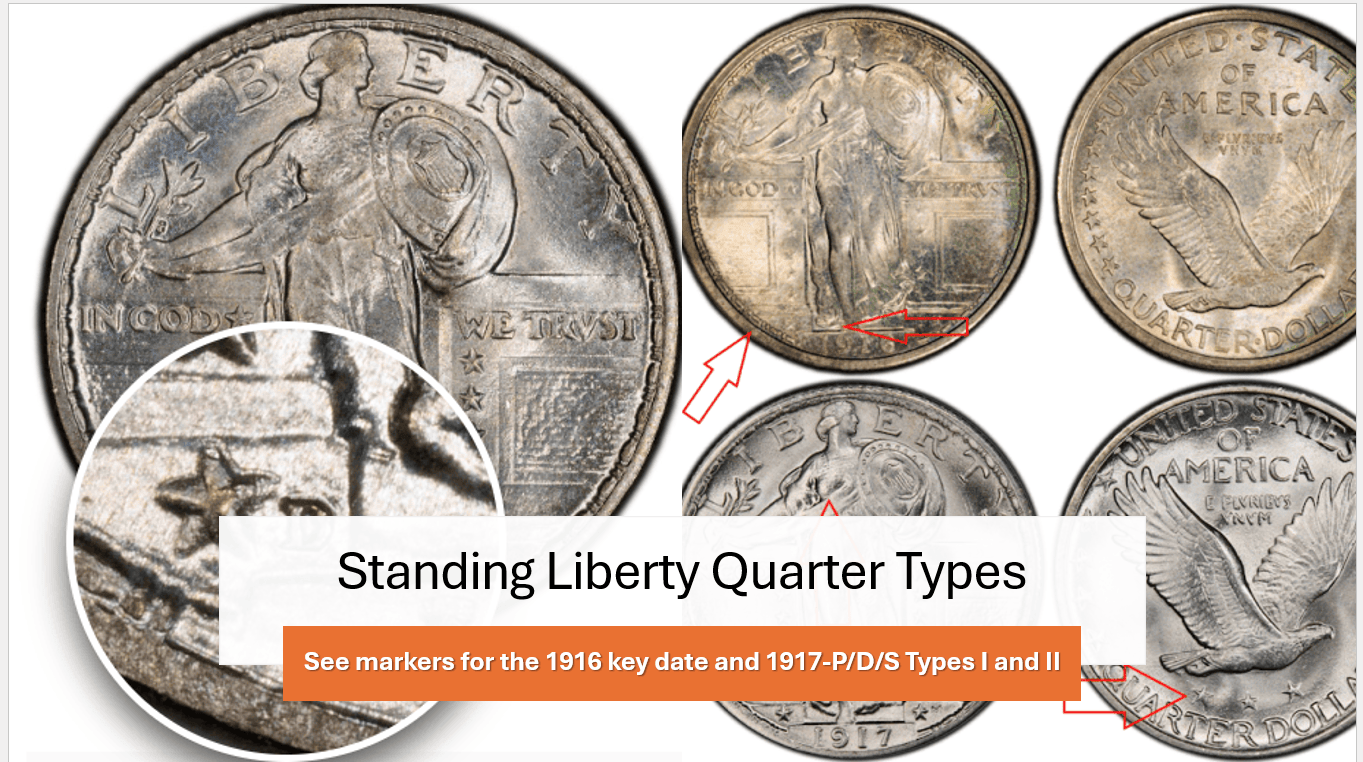
The first two years of the Standing Liberty Quarter resulted in seven varieties: 1916 key date and 1917-P/D/S Types I and II. This article defines markers and designs so you can distinguish differences among these coins.
The 1916 Quarter with a mintage of a mere 52,000 only used one obverse and one reverse die. So these are easy to distinguish from the many replicas and counterfeits out there.
Every coin should have the same placement and design of its devices.
Soon after minting this beautiful quarter, the US Mint realized that the date was positioned on a raised pedestal. That meant it could wear away completely with years in circulation.
You can identify the key date by these major markers:
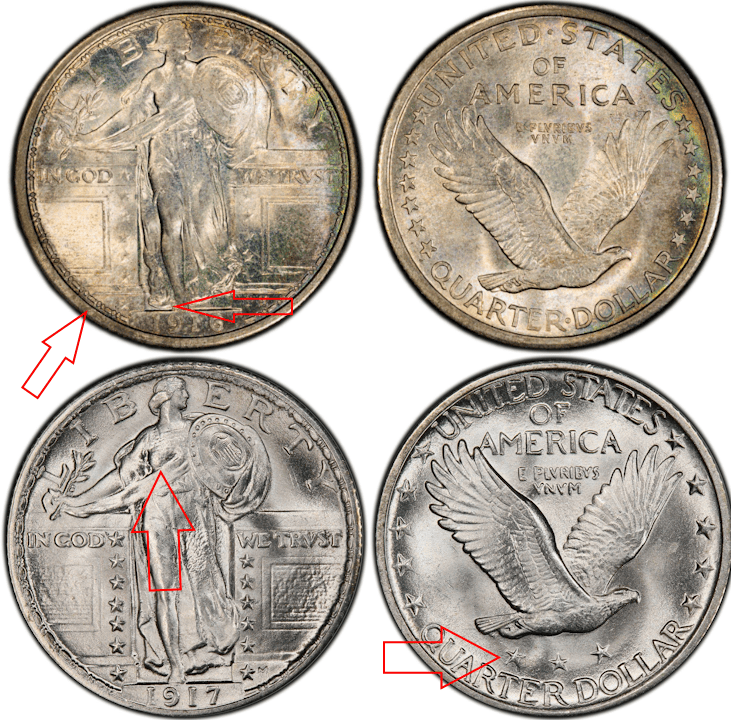
The Gown: Drapery of the dress clings to Lady Liberty’s right foot down to the pedestal. On a 1917 quarter, the gown drapery is away from the foot and curled.
The Shield and Border: The dots framing the coin’s outer rim resemble diamonds on the 1916, rather than the dashes on the 1917.
No Mint Mark: The entire mintage of the 1916 was struck at the Philly mint.
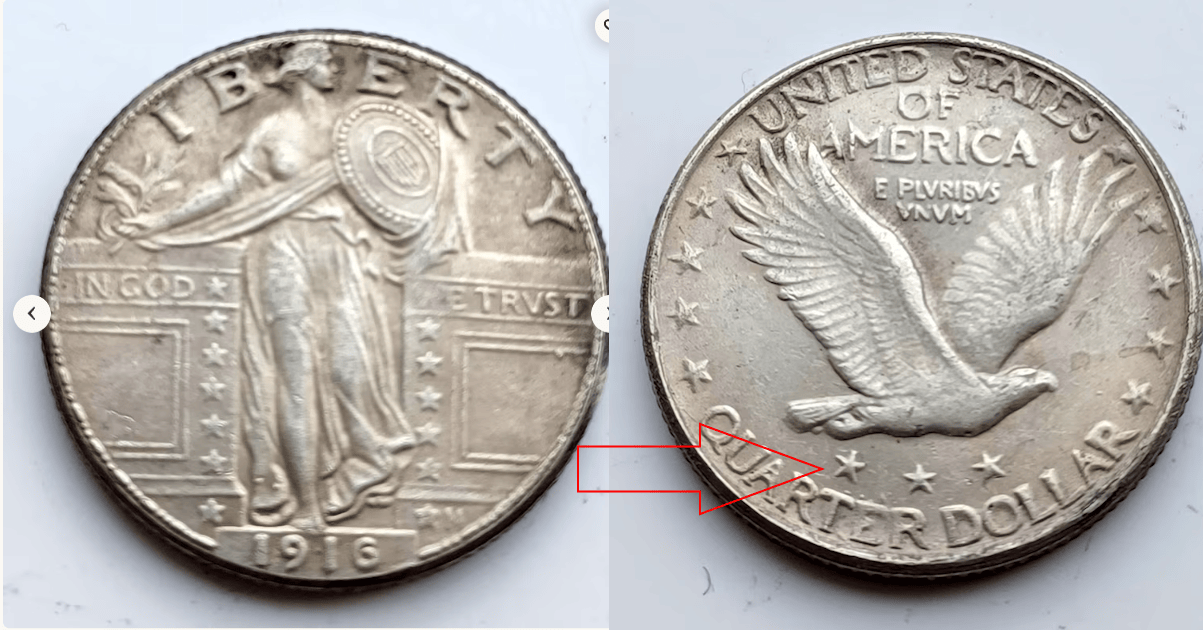
Type I Reverse: The 1916 quarter uses the Type 1 Reverse. There are no stars underneath the eagle. There are 7 stars on the left and 6 on the right. Type II has three stars under the eagle.
Right Breast Exposed: This differs from other reverses with Lady Liberty in chainmail.
Let’s illustrate that with a 1917 Type II design.
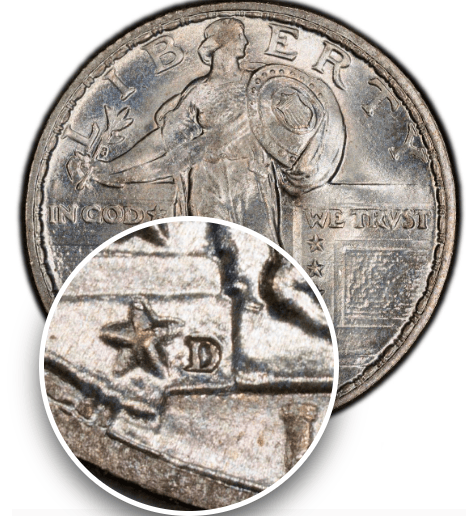
One other marker is important in Type II designs, and that is placement of the mintmark. Here is a 1917-D as example:
This brings us to why Type II was designed. Numismatists debate why Lady Liberty’s exposed breast was covered with chainmail armor in Type II designs. Some thought the exposed breast was lewd. The coin was designed by Hermon Atkins MacNeil. It drew some criticism in the media. But also World War I also might have inspired the armor. What happens, though, is that you can tell the difference.
This brings us to Type I and II of 1917 P/D/S/ designs.
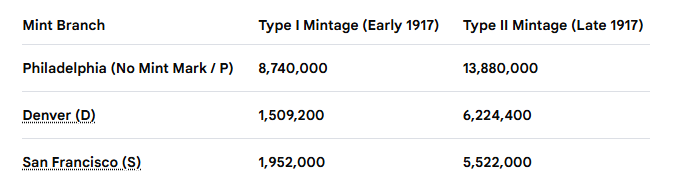
Mintages were roughly equal with Type I and II P/D/S quarters. Type II mintages were greater than Type I in 1917:
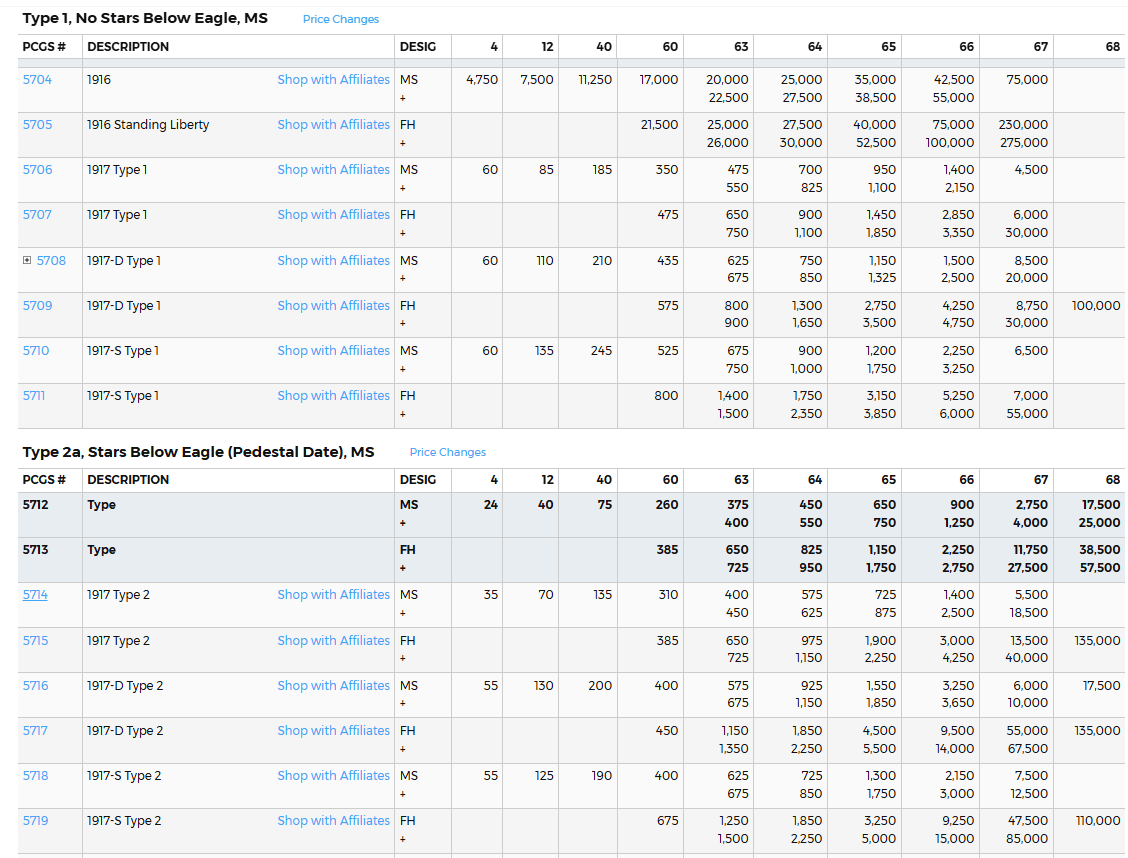
As such, values are marginally higher in Type I examples, especially since these are coveted because of the Type I design. Here are complete values compliments PCGS CoinFacts.
It is especially important to note the design differences because Chinese has flooded the market with fakes. Here’s an example, a purported 1916 with a Type II reverse:
If you like articles like these, please friend us on Facebook and subscribe to Proxiblog.
Proxiblog also has thousands of followers on Facebook Coin Groups, YouTube and social media. To get the latest discussion and commentaries, click here.
You can find more information about errors and varieties as well as buying and bidding on coins in Coin News Updated: The Essential Guide to Online Bidding. Please consider purchasing the work for yourself or a friend, as it underwrites this hobbyist website. Thank you.
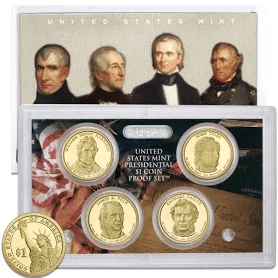
With the 2026 Semiquincentennial President Donald J. Trump $1 Coin, people are having a renewed interest in presidential dollars. Trump was not part of the series. Launched in 2007, the series requires a president to have been deceased for at least two years to appear on a coin. Trump got around this requirement as his is a commemorative coin.
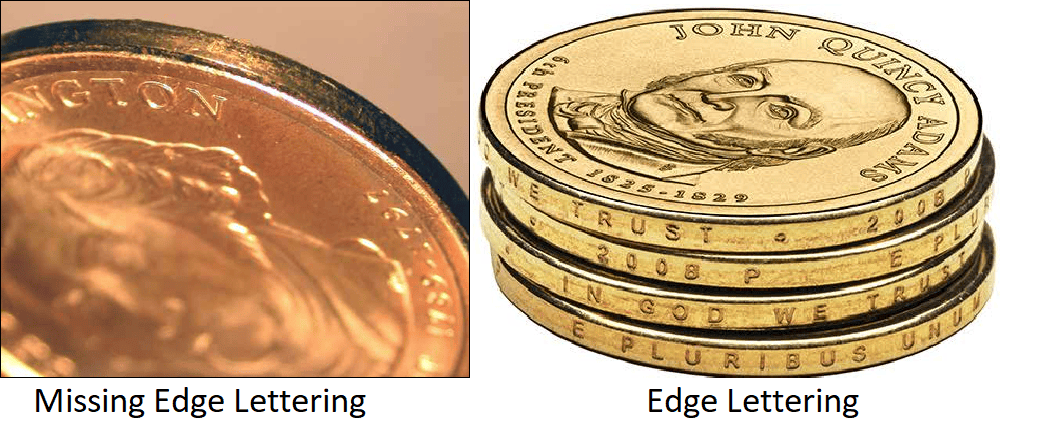
A hallmark of the presidential series is edge lettering.
Depending on the year the coin was minted, these elements appear on the edge: year of minting, mintmark and “E Pluribus Unum.”
In 2007 and 2008, presidential dollars also included “In God We Trust.”
That brings us to one of the major varieties.
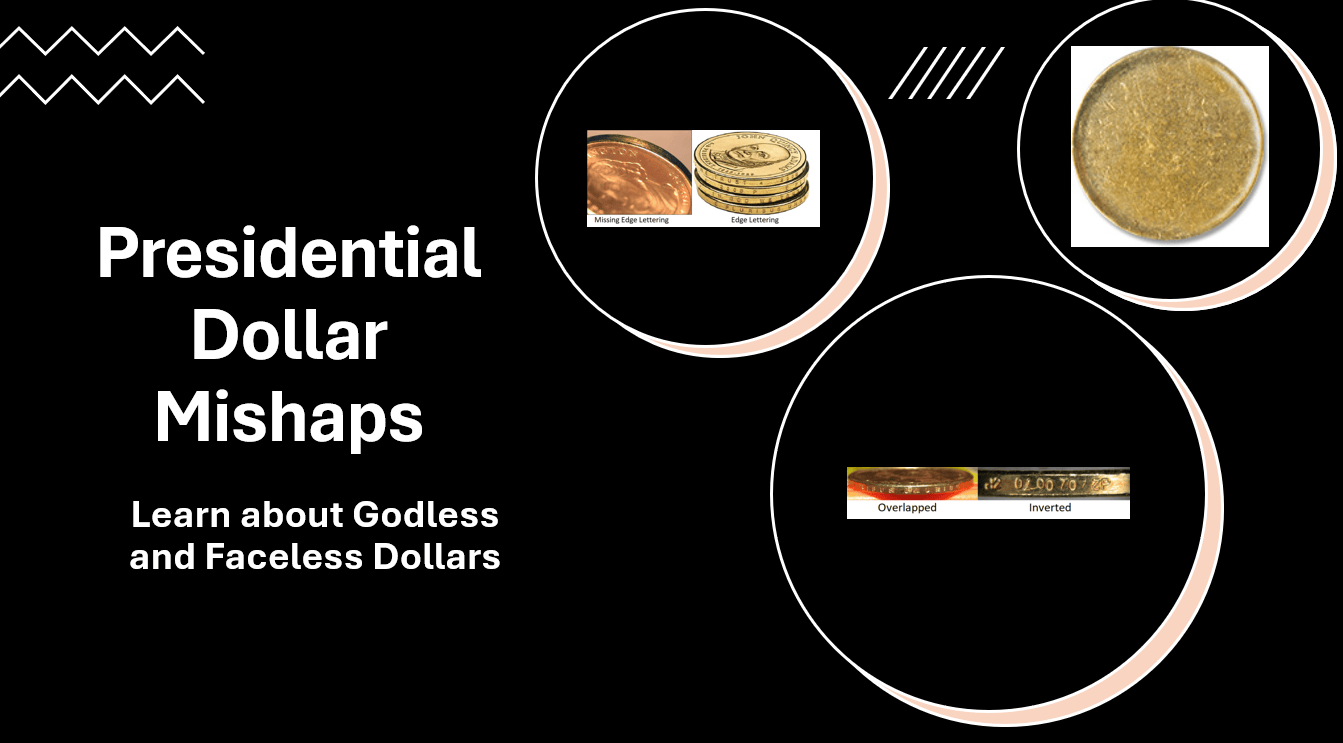
Godless Dollar
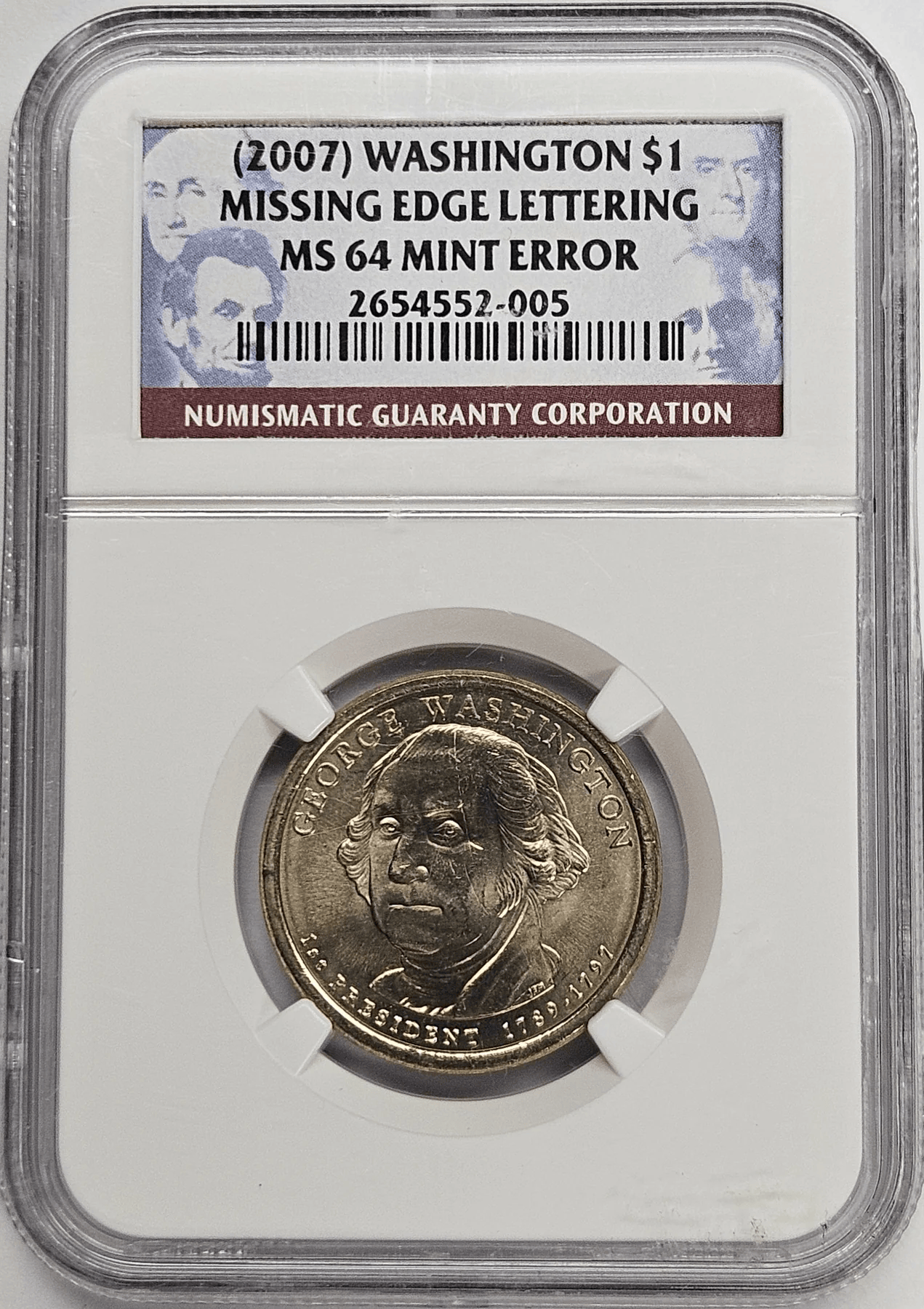
“In God We Trust” was moved to the obverse of these dollars in 2009 after a backlash occurred when edge letting was missing on the 2007 George Washington dollar. People started calling this variety “Godless dollars.”
The error happened when the machine that strikes the edge lettering somehow malfunctioned, leaving the edge blank. That started the furor over US coins lacking any mention of a supreme being.
Senator Sam Brownback (R-Kan.)responded to the backlash by introducing an amendment to a federal appropriations bill. The amendment was part of the Consolidated Appropriations Act of 2008, ordering the U.S. Mint to move “In God We Trust” to either the obverse or reverse of all future Presidential dollars. The law took effect in 2009.
An average uncirculated 2007–2008 Godless Dollar is typically worth $40 to $100, while heavily circulated examples sell for around $15 to $30.
Faceless Dollar
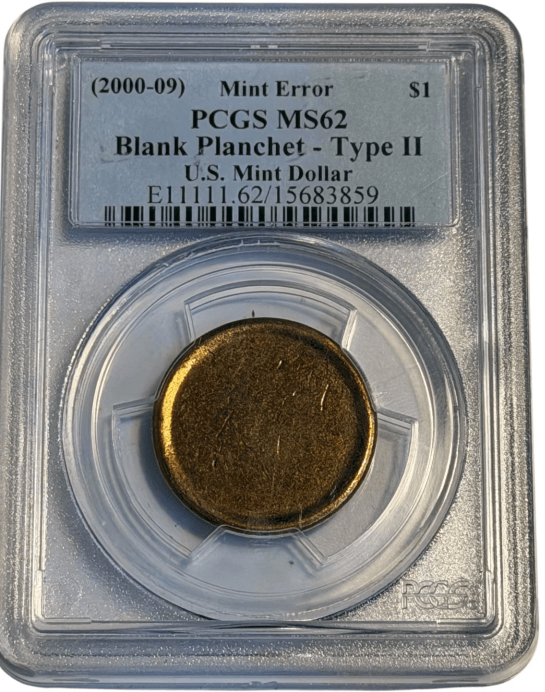
Also in 2007-2008 some coins on blank planchets escaped the Mint. These had edge lettering but no obverse of reverse designs.
This occurred because these dollars had a two-step minting process. Blanks were fed into the coining press to stamp the obverse and reverse designs. The second step involved edge lettering.
The “lettered blank” error, popularly known as the “Faceless Dollar,” happened when blank planchets accidentally bypassed the main coining press, going directly to the edge machine.
The value of Faceless dollars typically ranges between $40 and $500, depending on authentication and condition.
Overlapped/Inverted Dollars
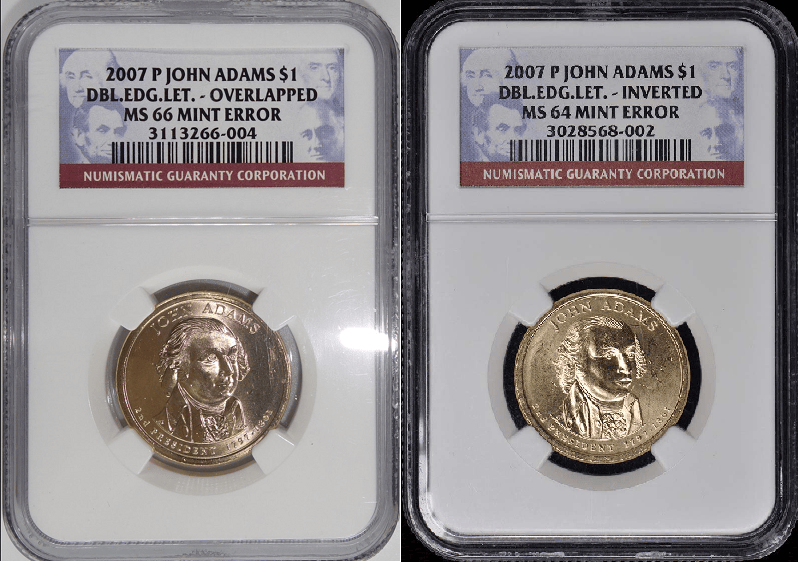
One final variety happened in 2007 involving the John Adams dollar. These coins were fed into the edge coining machine twice. This resulted in two varieties. Overlapped errors feature doubled edge lettering running in the same direction and inverted errors running in opposite directions and upside down.
These varieties typically retail between $50 to $300, depending on condition.
If you like posts like this, please subscribe so you can be informed whenever there is a new article or column.
Proxiblog also has thousands of followers on Facebook Coin Groups, YouTube and social media. To get the latest discussion and commentary, be sure to friend us by clicking here.
You can find more information about errors and varieties as well as buying and bidding on coins in Coin News Updated: The Essential Guide to Online Bidding. Please consider purchasing the work for yourself or a friend, as it underwrites this hobbyist website. Thank you.
According to AI, there is good and bad news about finding the third 1982-D Small Date bronze cent–perhaps the most sought after coin due to social media hype about its lottery-prize-like value.
As you read this, remember that AI is not an expert numismatist. Maybe those folks would have used different metrics. But I am an AI authority as one of the top technology professors with 48 years at top research institutions. So I expect those fellow hobbyists will be commenting and demurring and otherwise questioning these results.
Let’s have some fun.
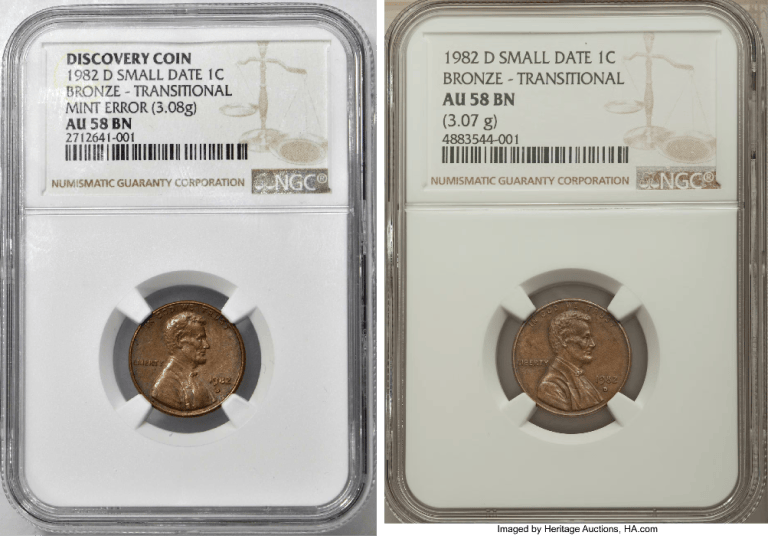
Only two of these transitional varieties have been found since it was theorized that a copper planchet with a small date might have left the Denver Mint. Here they are, authenticated.
Some more facts: There are seven common varieties of 1982 cents: The copper ones should weigh 3.1 grams; the zinc ones, 2.5 grams. The copper ones are Large Date, Philadelphia; Small Date, Philadelphia; and Large Date, Denver. The zinc ones are Philadelphia, Large Date; Philadelphia, Small Date; Denver, Large Date; and Denver, Small Date.
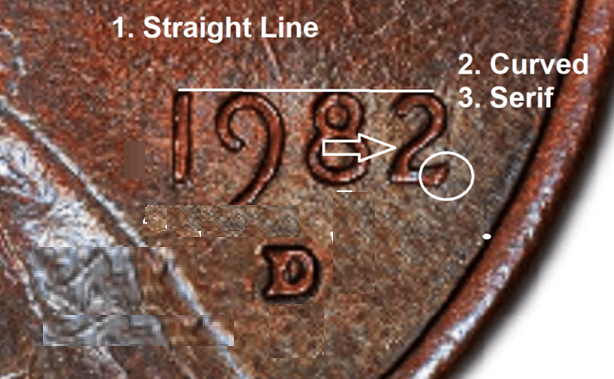
The coveted transitional variety weighing 3.1 grams has these markers:
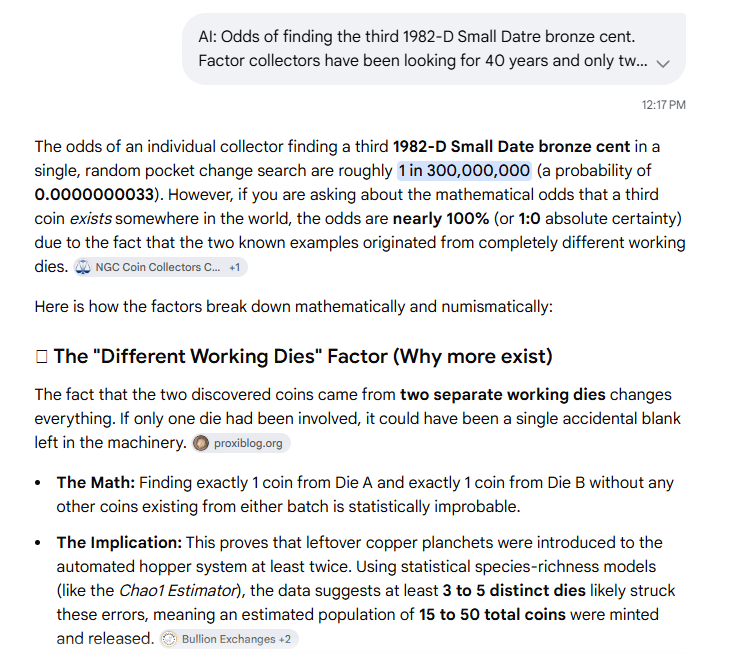
AI factored these odds: a hobbyist looking for the third example every day in a dollar’s worth of Lincoln cent pocket change over 40 years as roughly 1 in 300,000,000, or a probability of 0.0000000033.
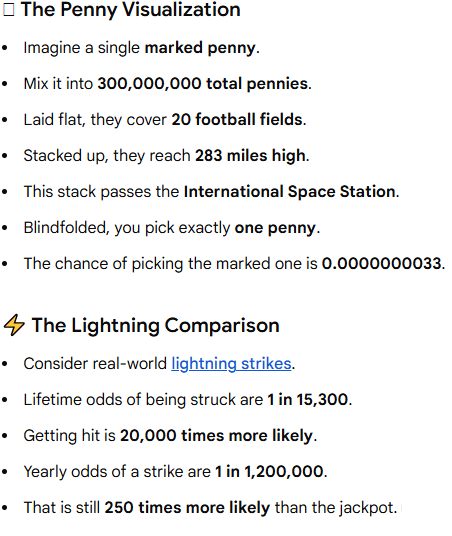
Let’s illustrate those odds. Imagine one 1982-D Small Date 3.1 grams is mixed into 300,000,000 total cents. Let’s stack those coins one atop the other. They would reach 283 miles high, surpassing the International Space Station. Blindfolded, you pick exactly one coin from that stack anywhere up the cosmic ladder.
What? You don’t like that analogy?
How about this: You are 20,000 times more likely to be hit by lighting than finding the third example.
Here’s the AI screenshot:
But there is good news, too. AI factors that odds of another example (as many as 15-50 might exist!) being circulated in pocket change are nearly 100% probability!
Here’s the screenshot:
It was gratifying to know that AI cited Proxiblog about coins coming from two working dies. You can read that article by clicking here.
AI also included these factors:
The discovery coin was found in 2016.
The second was found in 2019.
This yields an empirical discovery rate of roughly 0.05 coins per year since the hunt began. This low yield confirms that while more coins exist, the vast majority of the 6.01 billion Denver cents have either been melted down, lost in landfills, or remain sitting unexamined in hoarders’ casual coin jars.
Summary of Your Search Odds
Metric
Statistical Value
Odds a 3rd coin exists
~100% (Virtually guaranteed)
Estimated total supply remaining
15 to 50 coins
Odds per individual unsearched 1982-D cent
1 in 300,000,000
Before you start celebrating and searching your grandparents’ coin jars, don’t count on winning the numismatic lottery. You would have better odds winning the Powerball jackpot (again hypothetically) if you bought a ticket every day for 40 years,
AI puts those odds as 1 in 20,000.
Remember the odds of the third 1982-D Small Date bronze coin? That’s 1 in 300,000,000!
Here is its breakdown of the math:
Single Ticket Odds: The odds of winning the Powerball jackpot with a single $2 ticket are 1 in 292,201,338.
Total Tickets Bought: Buying one ticket every day for 40 years (including leap years) equals 14,610 tickets.
Cumulative Probability: Each ticket is an independent event. Your cumulative chance of hitting the jackpot at least once over those 14,610 tries is roughly \(0.005\%\) (or about 1 in 20,000).
Have you made the correlation yet?
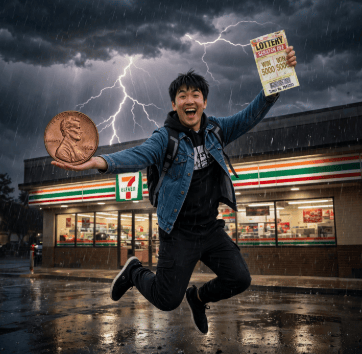
Go to the corner gas station. Buy a Powerball ticket. Your odds of winning the lottery jackpot with that single ticket is roughly the same as finding the third 1982-D Small Date bronze cent after 40 years of searching for the unicorn!
If you are intent on searching for those theorized 15-50 examples of the 1982-D Small Date bronze cent, keep doing it. Miracles happen.
Your own existence is 1 in 300,000,000!
AI states: “Yes, events with odds of 1 in 300,000,000 happen around us all the time. When dealing with massive populations or billions of trials, things that are nearly impossible for an individual become statistical guarantees on a larger scale.”
Let’s start with your own existence.
AI states, “Every person alive is the result of a 1-in-300-million event. During human conception, a typical fertile ejaculation releases between 100 million and 300 million sperm cells. The fact that one highly specific sperm successfully fertilized a specific egg to create your exact DNA blueprint means that your existence is equal to finding the third 1982-D Small Date bronze cent!”
If you like posts like this, subscribe so you can be informed whenever there is a new article or column.
Proxiblog also has thousands of followers on Facebook Coin Groups, YouTube and other social media. To get the latest discussion and commentary, be sure to friend us by clicking here.
You can find more information about types, varieties, errors, grading, bidding and buying in Coin News Updated: The Essential Guide to Online Bidding. Please consider buying or gifting the work for a friend, as it underwrites this hobbyist blog. Thank you.
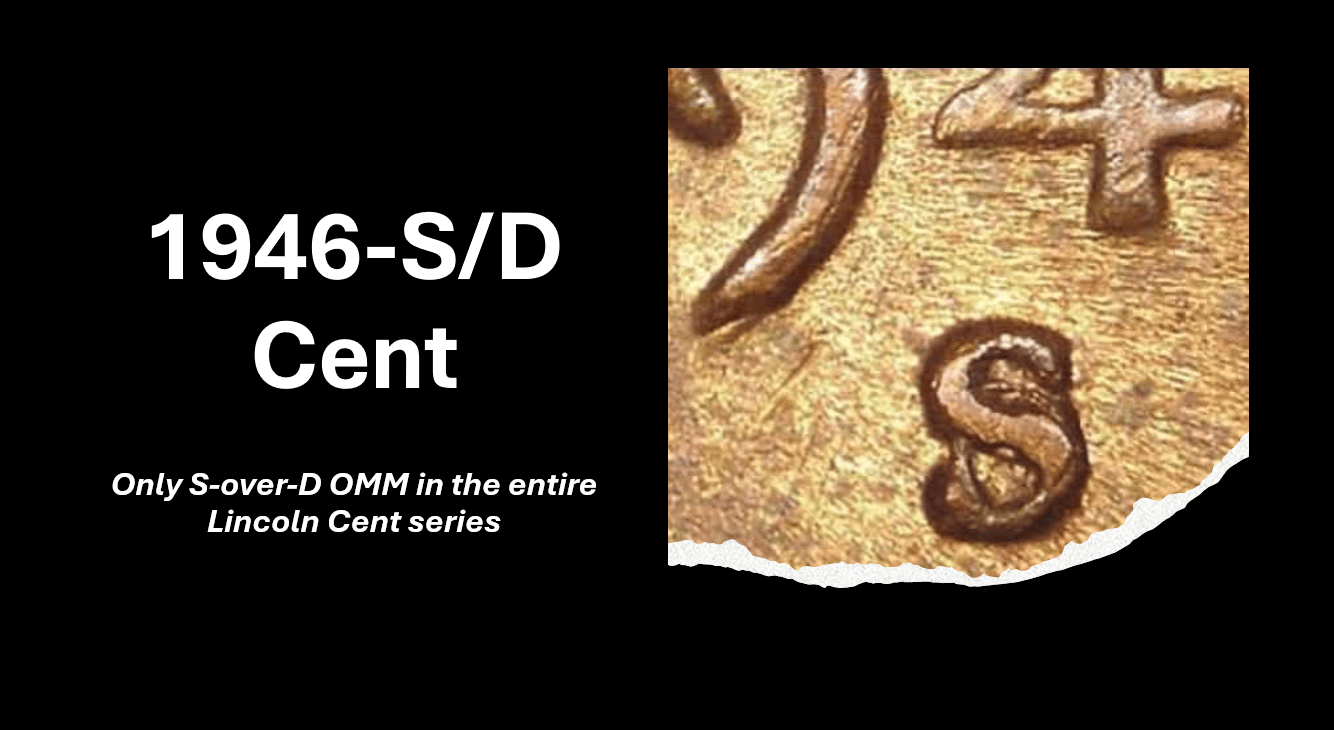
The 1946-S/D variety is highly collectible because it is the only S-over-D overmintmark in the entire Lincoln Cent series.
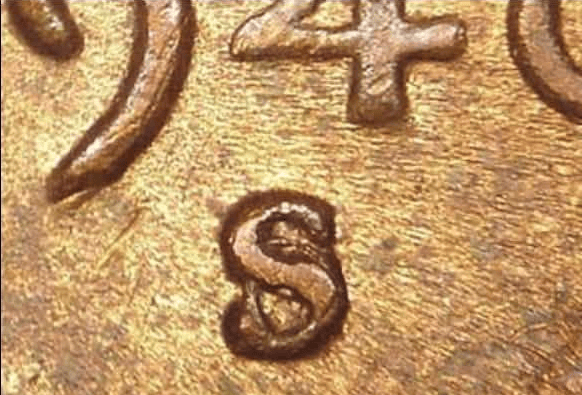
You will need magnification to see this variety. A loupe should do it, but you can also use a coin microscope. Here’s how it looks without magnification:
In 1946, mintmarks were hand-punched into coin dies. A mint employee punched a “D” into a working die and then realized that it should have been an “S”–a perfect example of how these errors happen. He did his best to correct human error.
To identify the 1946-S/D variety, use that magnification. Look for the curve of the “S” underneath the “D” in the upper inside loop of the “S.”
Study the crossbar of the “D” appearing through the center cavity of the “S.”
The value of a 1946-S/D cent depends on condition, eye appeal and appearance. There are three designations for cents: Brown, Red-Brown, or Red.
Color Designation
Percentage of Original Mint-Red Color
Description
Red (RD)
95% or more
Retains almost all of its original brilliant mint bloom, allowing for only very slight mellowing.
Red-Brown (RB)
Between 5% and 95%
A mix of original red luster and brown toning from air exposure.
Brown (BN)
Less than 5%
The original red color has completely or nearly completely turned into a brown patina.
As for value, from Fine to Very Fine, you are looking at a retail value of $20 to $25. In mint state red, the coin will sell for hundreds if holdered by PCGS or NGC. There have been examples in s MS66 Red for thousands of dollars.
If you are interested in varieties, be sure to check out Proxiblog’s directory, which includes articles, illustrations and markers for popular coins.
If you like posts like this, please subscribe so you can be informed whenever there is a new article or column.
Proxiblog also has thousands of followers on Facebook Coin Groups, YouTube and social media. To get the latest discussion and commentary, be sure to friend us by clicking here.
You can find more information about errors and varieties as well as buying and bidding on coins in Coin News Updated: The Essential Guide to Online Bidding. Please consider purchasing the work for yourself or a friend, as it underwrites this hobbyist website. Thank you.
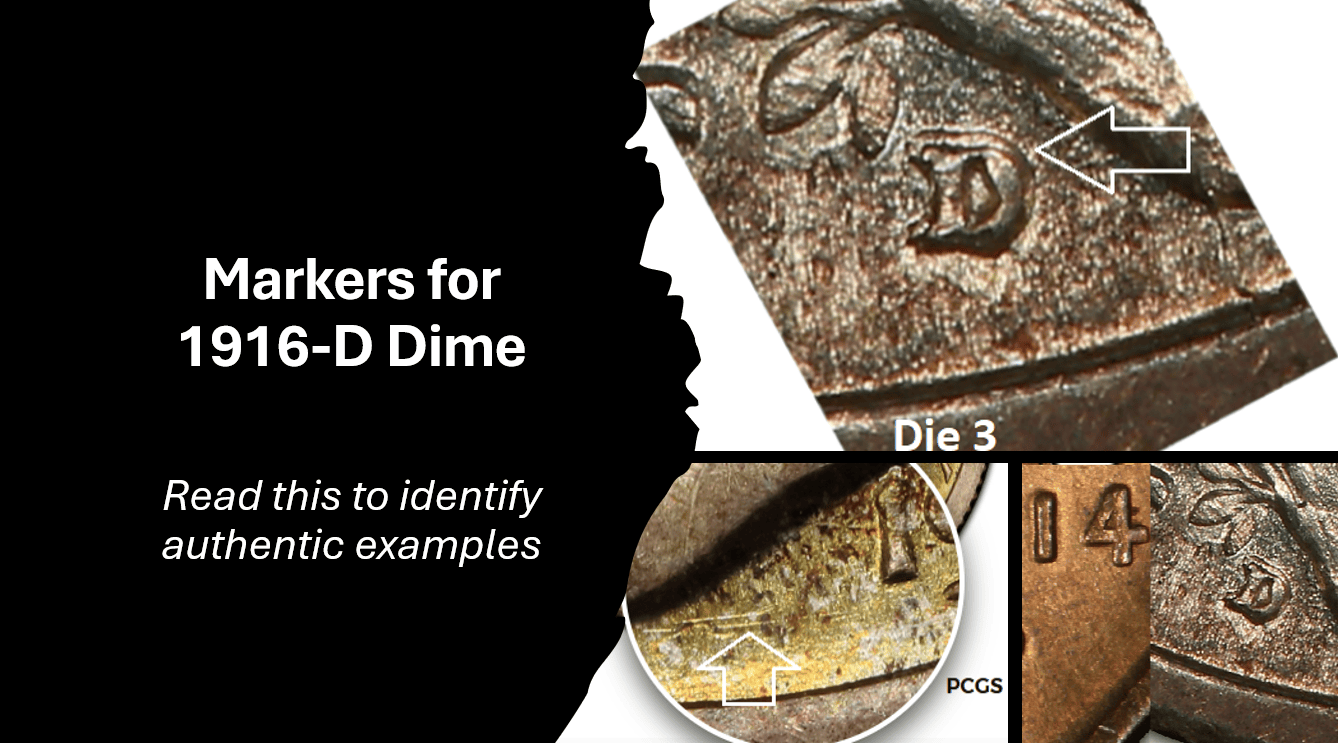
The 1916-D Mercury Dime is the key date of the Mercury series with a mintage of 264,000 coins. In 1916, the Philadelphia Mint made 22,180,080 coins and the San Francisco Mint, 10,450,000. Those two other mintages are important because scammers began added a mintmark to Philadelphia coins that year. Many also altered 1916-S dimes to make that mintmark look like a D.
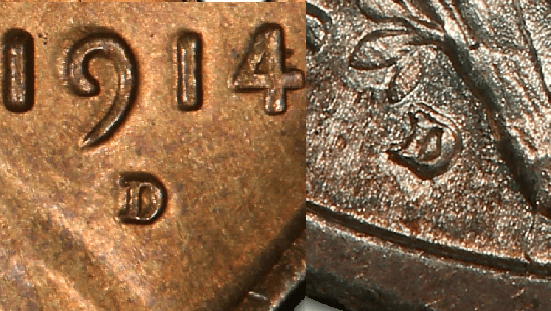
Fortunately, we know much about the Denver mintmark. For starters, the Mint used the same punch tool for the 1916-D as it did for the coveted 1914-D Cent.
Look closely: The outer shape of the D is squared off rather than rounded. And the cavity inside the D has a vague triangular shape rather than oval.
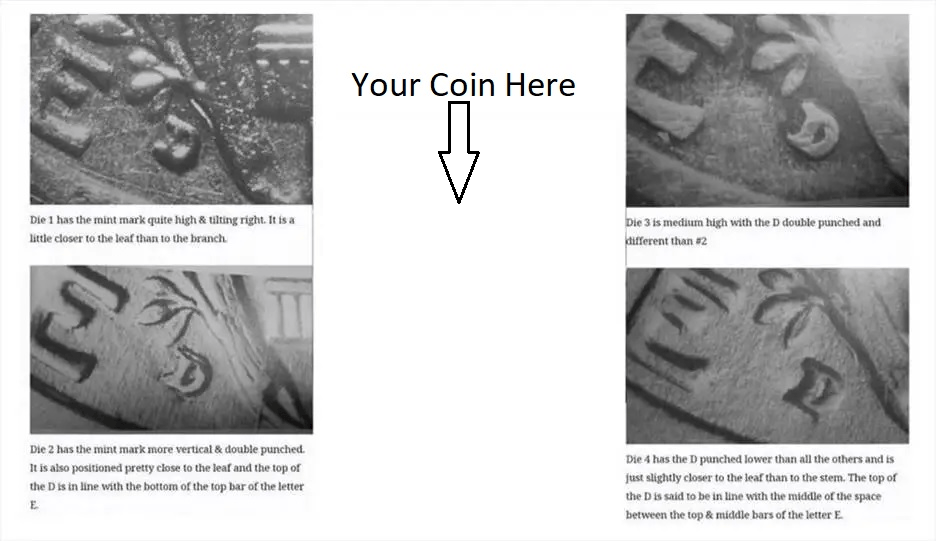
Four reverse dies were used on the 1916-D Dime. If your coin deviates from these positions, it is fake.
Jack D. Young has a great Proxiblog article on fake 1916-Ds offered on eBay. He made this graphic below, which we use here. Take a photo of your 1916-D coin or a screenshot if you are considering purchasing one and then compare.
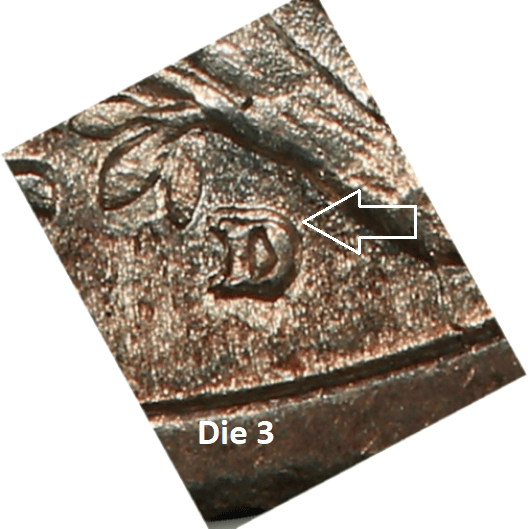
Two of the four genuine reverse dies feature a repunched mint mark (Dies 2 and 3 above).
Here is the example used earlier but now identified.
Genuine 1916-D Dimes often have tiny die scratches or die cracks near the date on the obverse.
It is important to know markers of rarities in coin collecting. Otherwise you may end up with a counterfeit or replica if not holdered by a major company like PCGS or NGC. Be sure to check out our rarity tab for markers of our most desirable coins.
If you like posts like this, subscribe so you can be informed whenever there is a new article or column.
Proxiblog also has thousands of followers on Facebook Coin Groups, YouTube and social media. To get the latest discussion and commentary, be sure to friend us by clicking here.
You can find more information about types, varieties, errors, grading, bidding and buying in Coin News Updated: The Essential Guide to Online Bidding. Please consider buying or gifting the work for a friend, as it underwrites this hobbyist blog. Thank you.