1944 steel cents from all three US Mints are extremely rare transitional errors occurring when leftover 1943 zinc-coated steel planchets became stuck in annealing furnaces, tote bins or coining presses. Because of their rarity, however–a few dozen have been actually found and authenticated–there are thousands of counterfeits, altered dates and copies flooding online coin venues.
The most common of these ultra rarities came from the Philadelphia Mint, which was using steel planchets to produce foreign coins. Some of those planchets got into the Lincoln cent bin. Fewer than 10 1944-D steel cents have been authenticated. These steel planchets were left over when the Mint started making copper cents that year. Steel planchets were mixed in totes mistakenly and were struck as 1944-S cents.
Step-by-Step Method
To test if you have one of these ultra rarities, use a magnet. If it sticks, you can continue to check if real.
Weigh the coin. If it weighs more than 2.7 grams, typically 3.1 grams, you have a fake.
If not, look at the second “4” in the date. If you spot anything suspicious, such as a scratch or tool mark–or weird spacing between numbers–you have an altered date.
Look for plating bubbles–tiny bumps–in the fields especially. You also might find pitting in these.
Check for strike. Zinc-plated counterfeits have mushy devices and dates. Authentic ones have sharper devices.
A key diagnostic is the word “Liberty.” Again, if mushy, you probably have a fake. In authentic examples, the word not only is sharp but also close to the edge. Striking copper differs from striking steel. The later has more hardness, pushing the “L” close to the rim.
Comparison of “Liberty”
Examples of Fakes
Online sellers on Temu and Etsy have flooded the market with all manner of fakes and replicas.
REPLICAS
CASTING BUBBLES
ZINC PLATED
It goes without saying that you should never bid on or buy a raw 1944 P/D/S steel cent that isn’t certified by a major holding company such as PCGS, NGC, ANACS and CAC. Even then, look up the certification number and check to make sure you are looking at the same coin because China also packages fake coins in fake holders. The best way is to wait for one of these rarities featured on a major auction house such as GreatCollections, Heritage or Stacks Bowers.
f you like posts like this, please go to our counterfeit archive with reports from Jack Riley, Jack D. Young, John Lorenzo and Michael Bugeja. Also, please subscribe so you can be informed whenever there is a new article or column.
Proxiblog also has thousands of followers on Facebook Coin Groups, YouTube and social media. To get the latest discussion and commentary, be sure to friend us by clicking here.
You can find more information about errors and varieties as well as buying and bidding on coins in Coin News Updated: The Essential Guide to Online Bidding. Please consider purchasing the work for yourself or a friend, as it underwrites this hobbyist website. Thank you.
There are all manner of scams by people looking to cash in on collectors who do not know markers for ultra rarities. And when it comes to the 1982-D Small Date Bronze transitional error, there is a desperation by newbies educated by clickbait social media that the third example is out there in pocket change.
Sellers take advantage of such ignorance.
If you are interested in an article about the various types of 1982 cents, including all markers for the transitional error, click here.
But let’s cut to the chase with basic knowledge.
Only two 1982-D Small Date 3.1 grams have been found.
Here’s how they look close up.
Here are markers for the small date.
DO NOT bid or buy any coin that is placed on a scale reading 3.1. You’ll be buying a zinc small date, of little or no value. Or a coin on tinkered scale.
You will see several examples on eBay of sellers showing a regular 1982-D large date bronze cent in a PCGS holder. Sellers think if they claim a regular strike is the small date, you’ll believe it, only because it is holdered by PCGS and you don’t know the markers.
Here’s an example:
Here’s how to decipher.
There are two numbers below the condition. In this case below, 146021.58, means two things: 146021 goes to the CoinFacts designation and the 58, the condition, AU58. In the image below, you can see that the 146021 goes to the regular large date strike.
Here’s another example with the seller claiming this large date is a small date. Again, the 146021 gives it away.
The seller of the above coin did not take kindly to my message that this is a scam.
He doesn’t like his time being wasted. He just wants to waste your money.
Ultra rarities are not found in pocket change; when one is, that becomes a national news story. If you think you found one, do not post it on social media and claim authenticity. If you are so sure, send it to PCGS, NGC, ANACS or CAC. And if you want to buy an ultra rarity, make sure you know how to read the holder company label.
If you like posts like this, subscribe so you can be informed whenever there is a new article or column.
Proxiblog also has thousands of followers on Facebook Coin Groups, YouTube and other social media. To get the latest discussion and commentary, be sure to friend us by clicking here.
You can find more information about types, varieties, errors, grading, bidding and buying in Coin News Updated: The Essential Guide to Online Bidding. Please consider buying or gifting the work for a friend, as it underwrites this hobbyist blog. Thank you.
No one is exactly sure how this variety happened, but the US Mint–under pressure then to produce billions of coins–mistakenly used the reverse of a 1968-S Proof Dime for the reverse of 1969-P, 1970-P and 1970-D Roosevelt business strikes. The official variety is known as 1969 rev. of 1968, 1970 rev. of 1968 and 1970-D rev. of 1968 (FS-901).
The FS-901 refers to a catalog number identified by Bill Fivaz and J.T. Stanton, co-authors of the Cherrypickers’ Guide to Rare Die Varieties of United States Coins.
“Reverse of 1968” on these three dimes is a numismatic variety recognized by all major holdering companies. The 1968 reverse shows two distinct, well-defined, and sharp valleys in the torch flame, whereas the business strike reverse has a less defined, blurry flame.
The 1969-P FS-901 is generally considered the rarest of the three with about 15 holdered by PCGS. 1970-D FS-901 is the most common with about 30 holdered by PCGS. About 20 for the 1970 rev. of 68.
All of these varieties can be found in rolls, although they are very scarce.
While this is a rare variety by population data, PCGS values remain low, ranging from $50-100.
You can find the variety on eBay selling about the same or higher, although the coins are unholdered, as in these examples:
If you are a dime roll hunter, keep your eyes peeled for other Roosevelt dime varieties:
As you can see, there are not many varieties for Roosevelt dimes, but click the links above and go to Proxiblog for articles explaining die markers.
If you like posts like this, subscribe so you can be informed whenever there is a new article or column.
Proxiblog also has thousands of followers on Facebook Coin Groups, YouTube and other social media. To get the latest discussion and commentary, be sure to friend us by clicking here.
You can find more information about types, varieties, errors, grading, bidding and buying in Coin News Updated: The Essential Guide to Online Bidding. Please consider buying or gifting the work for a friend, as it underwrites this hobbyist blog. Thank you.
Many hobbyists recommend holdering coins only if they are valuable enough without considering other reasons listed here.
True, the cost to grade can be prohibitive for some collectors. Top companies charge anywhere from $25-38 per coin in addition to fees for membership, handling and mailing, with additional fees for error coins, varieties, special labels or quicker turnaround times.
If cost is not a factor, you might consider holdering a coin for reasons other than inherent value.
Authenticity
A slab provides assurance that a coin is genuine, reducing the risk of purchasing a counterfeit. China exports hundreds of thousand fake coins each year to the United States, especially ones with a Carson City mintmark. If you holder the coin with PCGS, NGC, ANACS, CAC or ICG, you will have a unique barcode or serial number, allowing collectors to verify the coin’s details. Additionally, PCGS and other companies embed security chips to guard against counterfeiting.
Storage
Slabs are sonically sealed in hard plastic, protecting coins from physical damage, such as scratches and drops, as well as environmental damage. Companies also sell containers for compact storage. What’s more, you can share your love of the hobby with family and friends, letting them hold the slabs without your worrying about the coins being improperly handled.
NGC offers some of the most advanced coin holders in a range of sizes to fit virtually every coin ever struck. The company writes, “Designed for long-term preservation and protection, the NGC holders are comprised of high-quality inert materials” with security features. “Collectors, dealers and even the Smithsonian Institution trust NGC holders to protect their most treasured rarities.”
Photography
Top holdering companies also provide photos of coins, sometimes for an additional fee. This is especially important for toned coins. For example, PCGS does a fine job enhancing the rainbow of colors that grace the patina. Photos are important if you keep your collection in a bank box or live somewhere else (i.e. a college student away from home) allowing you to see your coins when and where ever you wish.
PCGS TrueView images are perfect for toned coins like this:
Family
A “family” of coins share common design elements, denominations, mintmarks or thematic characteristics within a series. For instance, you may want to collect all five 1878 Morgan dollars or W-mintmark Quarters or perhaps an example of various errors or varieties, as in the seven 1982 cents or 1942-45 silver war nickels. In these cases, a slab’s labeling is important as you assemble the family of your choice.
Set Assemblies and Registries
A complete date and mint mark set of Morgan Silver Dollars (1878–1921) usually contains close to 100 coins. Because there are so many, some hobbyists prefer year sets. Other assemble sets of a specific mintmark, such as all the coins minted in San Francisco or Carson City. A date and mintmark set of Peace Silver Dollars (1921–1935) consists of 24 coins. Regardless of the set in question, collectors may include a lesser value coin in a holder merely to complete the set in question.
Veteran hobbyists also may participate in set registry competitions, again requiring every coin or variety in the series. One of the most popular PCGS set registries are “low-ball” ones featuring the most worn coins.
Selling
It is often easier to sell, trade, or auction a coin that is already certified, particularly online or to collectors who cannot inspect it in person. Some large auction companies such as GreatCollections or Heritage may require you to holder your coins before they will list them in their catalogs. If you holder with PCGS, NGC or CAC, your coins can be sold sight unseen because of the consistency and quality of the grading.
GreatCollections even notes certification in his banner: “Certified Coin and Paper Money Auctions.”\
Provenance
Serious hobbyists often are concerned about provenance of specific rarities. But even damaged or heavily worn coins may be family heirlooms, such as a grandfather’s “pocket piece.” A coin with deep personal history can be preserved in a “perfect” state by slabbing it, even if it is not especially valuable.
In the past, family members might have passed down coins that they wore as jewelry. This was especially popular in the 19th Century. Here’s a perfect candidate for a slabbed personal heirloom, an 1885 20th Anniversary medal commemorating Abraham Lincoln’s death.
Many collectors prefer raw coins to slabbed ones because they want to hold history. There certainly is a place for that. Just keep some of the low-ball Morgan dollars, for instance, so friends and children can feel the heft of the silver.
If you like posts like this, subscribe so you can be informed whenever there is a new article or column.
Proxiblog also has thousands of followers on Facebook Coin Groups, YouTube and other social media. To get the latest discussion and commentary, be sure to friend us by clicking here.
You can find more information about types, varieties, errors, grading, bidding and buying in Coin News Updated: The Essential Guide to Online Bidding. Please consider buying or gifting the work for a friend, as it underwrites this hobbyist blog. Thank you.
There are many ways to figure the worth of a coin. Follow this step-by-step method, answering these questions along the way:
Is it certified?
Do you know denomination, series, strike?
Do you know the mintmark?
Do you know the Sheldon Scale?
Can you identify your coin on the Sheldon Scale?
Can you spot flaws affecting value?
Are you ready to estimate value now?
Do you know how to establish silver melt?
Is it certified?
If you have a coin certified by PCGS, NGC, ANACS, CAC and ICG, simply go to their verification sites and input the certification number on the label. Here are links:
Even though these holdering companies all have certification websites that show the exact coin, grades for each are not equal. For instance, compare an 1883 MS66PL Morgan in an ICG slab with the same grade and condition for a PCGS Morgan. The ICG coin has disqualifying marks that may be a scratch and rim ding. I also do not think the ICG coin is prooflike. It may just have a good caftwheel.
In general, PCGS, NGC and CAC are top tier. ANACS a close second. ICG considerably less.
If you have a coin holdered by another company, consider the coin inside “raw” or unholdered.
Do you know denomination, series, strike?
You need to identify these features, which every coin has:
Denomination Definition: The face value of a coin, or the specific amount of money it is meant to represent. Example: Common U.S. circulating denominations include 5 cents (nickel), 10 cents (dime), and 25 cents (quarter).
Series Definition: A series is the complete set of a specific coin design, minted over a period of years, usually including all dates and mint marks. Example: Lincoln Cent Series (1909–Present): Includes every date/mint combination of the Lincoln penny.
Strike Definition: Refers to the method of manufacturing used to create the coin. Types of Strike:
Circulation Strike (Business Strike): Coins made for everyday commerce, usually produced quickly in high volumes.
Proof Strike: Coins made for collectors, typically with higher pressure, multiple hits, and polished dies to create a mirror-like field and frosted design.
Special Mint Strike (SMS) / Burnished: Specific, high-quality finishes used for special sets.
Do you know the mintmark?
These are mintmarks for US coins identifying the facility of manufacture:
P – Philadelphia, Pennsylvania: The primary U.S. Mint. Most coins from Philadelphia historically had no mint mark, but the “P” now appears on most denominations except the penny. D – Denver, Colorado: Operating since 1906, this mark is found on most modern circulating coins. S – San Francisco, California: Since 1975, primarily produces high-quality “proof” sets for collectors. W – West Point, New York: Established as a mint in 1988, it mostly produces bullion and special collector coins.
Historic U.S. Mint Marks: These letters appear on older coins from facilities that are no longer in operation. C – Charlotte, North Carolina: Produced gold coins only from 1838 to 1861. D – Dahlonega, Georgia: Also produced gold coins only from 1838 to 1861 (not to be confused with the modern Denver “D”). O – New Orleans, Louisiana: Struck gold and silver coins intermittently from 1838 to 1909. CC – Carson City, Nevada: Famous for silver dollars, operating from 1870 to 1893.
Once you know the denomination, series and strike, you can go to PCGS CoinFacts to find the location of the mintmark.
Do you know the Sheldon Scale?
The Sheldon Scale is a 70-point numerical system to determine a coin’s condition and market value, ranging from 1 (Poor) to 70 (Perfect Mint State).
There are two main types of condition: circulated and uncirculated. Numbers 1–59 (Circulated), from poor to almost uncirculated.
Intermediate grades are Poor, About Good, Good, Very Good, Fine, Very Fine, Extra Fine, About or Almost Uncirculated, Uncirculated.
Here is a nifty chart for numbers and condition.
Can you identify your coin on the Sheldon Scale?
Identifying the condition is subjective, even for veterans; but you can come close if you compare your coin to the denomination, series and strike on PCGS Photograde, which provides photographs that you can use for comparison.
Example:
You have to compare obverse and reverse, but for purposes here, we’ll just do obverse.
Underestimate when you compare your coin to one on Photograde, adjusting for personal bias. In this case, you may be tempted to think your coin is almost uncirculated. But a strict comparison puts it in the Extra Fine category, somewhere between Very Fine 35 and XF45. Let’s go with XF45
Can you identify flaws affecting value?
There are dozens of possible flaws on a coin that lower value or prevent it from being “straight graded” (a numerical score). Here are major ones:
Cleaning: Harsh abrasive cleaning or polishing that damages the surface.
Environmental Damage: Corrosion, excessive toning, or verdigris.
Physical Damage: Major scratches, rim dents, or metal movement.
Altered Surfaces: Applying substances like wax, putty, or lacquer to hide flaws.
Questionable Color: Artificial re-toning, often used to make a coin look more attractive.
Filed Rims: Rims that have been filed to smooth out dents or damage.
Any one of the above flaws will reduce the value of your coin, depending on severity. In many cases, that is 25-50% of estimated worth.
Are you ready to estimate value now?
You know the denomination, series, strike and mintmark. You know the Sheldon Scale and have estimated the grade using PCGS Photograde. You eliminated possible flaws and think your coin can be straight graded.
Let’s continue with the 1900 Morgan Dollar at XF40:
Go to PCGS CoinFacts for retail and auction values for such a coin.
The retail value here is $85 (due at the time in part to the high price of silver). But only 20 have been slabbed at that grade, meaning it probably wasn’t worth the cost of grading. That is confirmed because there are no recent auction sales listed at that low grade.
Your coin is silver melt.
Do you know how to establish silver melt?
Here is the formula:
Multiply the item’s total weight (in troy ounces) by its purity percentage, then multiply that result by the current spot price of silver.
Again, let’s use that 1900 Morgan Dollar.
Morgan dollars (1878–1904, 1921) contain 90% silver and 10% copper, with a total weight of 26.73 grams, resulting in 0.77344 troy ounces of pure silver per coin.
The current market value for one troy ounce of silver, which changes frequently, happens to be $109 (during a spike in that precious metal). Thus, the silver melt value of your Morgan is 0.77344 times $109 = $84.30.
Keep in mind that coin dealers usually only buy 10-15% under silver melt. So you’re looking at about $71, depending on your buyer.
If you like posts like this, subscribe so you can be informed whenever there is a new article or column.
Proxiblog also has thousands of followers on Facebook Coin Groups, YouTube and other social media. To get the latest discussion and commentary, be sure to friend us by clicking here.
You can find more information about types, varieties, errors, grading, bidding and buying in Coin News Updated: The Essential Guide to Online Bidding. Please consider buying or gifting the work for a friend, as it underwrites this hobbyist blog. Thank you.
I enjoy browsing through various Facebook coin groups and seeing what collectors have acquired and enjoy. While scrolling through a rather large group I came across a post where a fellow collector had completed his Lincoln Wheat Cent collection. A major milestone for any collector! In the mix was a 1909s Cent, about which I commented, and later had a private message conversation explaining that this was a counterfeit and showed proof.
He stated it was bought on eBay from a non-reputable seller in a “shotgun roll.” These are rolls of wheat cents hand assembled with generally a nicer condition coin or key date on the ends. This fell within the 30-day return policy so the collector should get his money back after returning the coins to the seller.
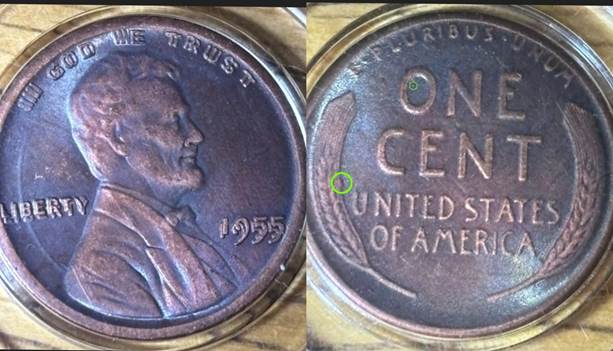
Another online venue offered this counterfeit 1909s. Both coins share a common reverse that has been known for awhile.
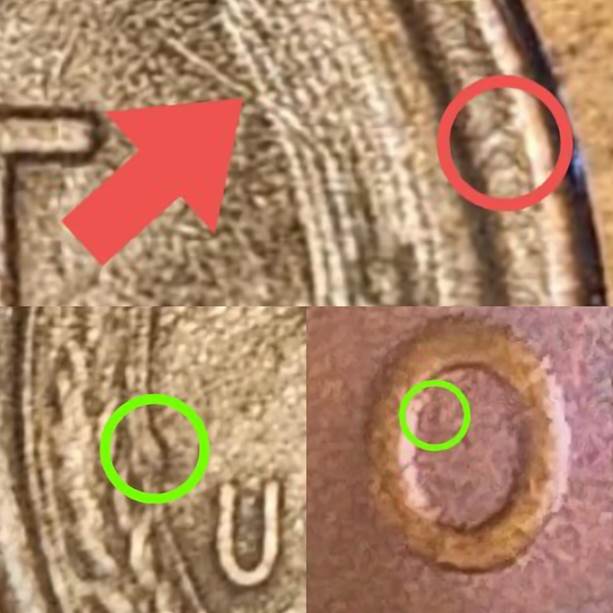
Image comparison of both coins show many repeating marks. Highlighted in green are common to all coins with this reverse and include:
Lump at the edge of wheat stalk
Small lump inside of ONE
Highlighted in red are common but not seen on all examples.
Crack from the rim to Wheat stalk
Extending Crack through the stalk to the field
Being the Lincoln Cent series is one of the most popular to collectors and many key/semi key dates are needed to complete the set, it is of no surprise this counterfeit family is extensive. Other dates that have been seen from this family include the 1931s, 1955 “DDO”, and 1924D cents imaged below.
A close-up collage of identifying marks.
If anyone thought it was just key/semi key dates that are counterfeited, you would be wrong. Here is a common date 1958 exhibiting the “Lumped reverse.”
For more information, including die markers, see Michael Bugeja’s post, titled, “Identifying Fake 1909-S VDB Cents.” Now collectors have two comprehensive articles about this key date. Proxiblog strongly encourages any Lincoln cent collector to read and refer to these two articles before bidding on any raw 1909-S VDB. Also, make sure to check the certification to ensure that the holder also is not counterfeit.
Proxiblog advises newer collectors to follow these general guidelines:
If you are ready to bid hundreds of dollars on a coin, resist buying a raw one and shop for one holdered by PCGS, NGC, ANACS and CAC.
Be especially careful when purchasing raw coins from eBay and other online venues. AI bots cannot detect counterfeits, so you are on your own.
Make sure the seller takes returns and has good reviews. Also, the number of positive reviews is a good indicator. If someone has 0 sales or even fewer than 100, do not take a chance.
If you already bought the coin, weigh it and go to PCGS CoinFacts for the date and mintmark, checking your coin against weights and dimensions.
If you like posts like this, you can read more articles on counterfeit coins by Jack Riley, Jack D. Young and Michael Bugeja at this URL. Also, please subscribe so you can get our weekly newsletter and be informed whenever there is a new article or column.
Proxiblog also has more than a thousand friends and followers on Facebook Coin Groups and thousands more across YouTube and social media. To get the latest discussion and commentary, be sure to friend us by clicking here.
You can find more information about errors and varieties as well as buying and bidding on coins in Coin News Updated: The Essential Guide to Online Bidding. Please consider purchasing the work for yourself or a friend, as it underwrites this hobbyist website. Thank you.
PCGS, NGC, ANACS, CAC, ICGS have certification web sites. You’ll gain knowledge about everything from counterfeit detection to retail, wholesale and auction values.
New collectors and others who have inherited coins typically ask Facebook coin group members what their holdered coins are worth. There is no need to do this. In fact, the question alone indicates that you do not know what you have, opening you up to low-ball offers and scam buyers.
This Facebook member posts photos of PCGS-graded coins and wonders what they are worth.
All he had to do was go to the PCGS certification site for the information. Just input the numbers and you get all the facts.
Did you catch what happened here? If so, you are beginning to understand why checking certs of ANY slabbed coin is worthwhile.
His coin is counterfeit. The label is the giveaway: “Morgan.” The Chinese forgot that the only time PCGS states the dollar is a Morgan is on labels for 1921 coins because the Peace Dollar was introduced in that year!
The person’s coins are counterfeit.
Here is another person asking about worth for this NGC coin:
NGC is not nearly as reliable with updating current value as PCGS. Note that this cert states “Price Guide Not Available.” NGC has been negligent with this for years, one of the reasons I prefer PCGS and CoinFacts. But you can still check the retail price by hitting the “Research this coin” tab.
Here are lookup sites for ANACS, CAC and ICG. Follow the same procedure.
If you want an estimate about what a coin dealer might pay you, you can access that information on the Greysheet wholesale website, requiring a subscription.
A better option to ascertain what a dealer might pay you, once again, is PCGS CoinFacts, an indispensable directory.
Let’s look up the retail and latest auction values (better than wholesale values because these states what people will pay) for that 1880-S MS64 Morgan mentioned earlier.
You get all the data for this coin, including mintages, which also play a role in value. But lower on the page you get population date and more specific details.
Better still, you can click the link for each auction. The first link, most recent sale 08/25, states someone paid a retail price in a Stacks Bowers auction. Why? Hit the link, and you get this superb coin, again with tons of data.
The ability to know retail and wholesale/auction values is a mandatory skill if you collect coins. Many just opt to go to a coin dealer who probably will use Greysheet wholesale and then deduct even more, especially if he owns a brick-and-mortar shop (he has to pay expenses, don’t you know).
Here is a typical advertisement promising to appraise coins and showing ones whose values are readily available online.
Wouldn’t it make sense, if this were your collection, to know what the retail and wholesale/auction values are before allowing someone else to tell you?
As you can see, checking certs guards against fakes and informs you in detail about your coin. Over time, you will learn not only the values but also all those data, helping you become the numismatist you were meant to be!
If you like posts like this, subscribe so you can be informed whenever there is a new article or column.
Proxiblog also has thousands of followers on Facebook Coin Groups, YouTube and social media. For the latest discussion and commentary, be sure to friend us by clicking here.
You can find more information about types, varieties, errors, grading, bidding and buying in Coin News Updated: The Essential Guide to Online Bidding. Please consider buying or gifting the work for a friend, as it underwrites this hobbyist blog. Thank you.
No matter how you look at it, selling coins evokes feelings. Perhaps you are ending your interest in the hobby and will have to find other ways to spend your free time. Perhaps you inherited a collection and now must dispose of it for heirs. Or maybe because you just need the money.
Experienced hobbyists know the basics of how to sell coins. But newer or “never” hobbyists may have a difficult time because the process requires a modicum of numismatic knowledge, which this article provides. And, of course, money is at stake in the form of precious metals and intrinsic values.
Here are seven steps that I have used in selling my coins. They worked for me. You may experience different results.
Step 1: Read the Red Book and consult the Blue Book
The Red Book, otherwise known asA Guide Book of United States Coins, is required reading. You have to know what you actually have. Google, eBay, Etsy, YouTube and other online listings are unreliable and often erroneous.
The Red Book shares retail values and the Blue Book, wholesale, or what a coin dealer is apt to pay you–important later.
The Red Book has updated pricing and auction data with detailed expert commentary and photos–more than 2000 images, 7,600 listings and 32,500 coin values. You’ll learn about each denomination, type, mint error and varieties as well as read articles about investing, grading and holdering coins, and detecting counterfeits.
Click here or the photo below and scroll down to “HOW TO USE THE RED BOOK” to view a Proxiblog video on the book’s utility.
Step 2: Separate coins according to denomination
To view the various denominations, again consult your Red Book or PCGS CoinFacts, a free encyclopedia of U.S. Coins.
You will find at PCGS CoinFacts detailed photos and retail/auction values of coins from half cents to gold issues as well as commemorative coins, bullion, territorial issues and patterns.
But the utility now is using the Red Book or CoinFacts to separate your coins into categories.
Step 3: Divide collection again by precious metals
These will mostly be silver and gold coins but also platinum, palladium and rhodium.
Familiarize yourself with spot price values. A fine resource is provided by the coin company APMEX, which gives updated values of all precious metals. Click the photos belowfor gold and silver values to view what your coins are worth apart from collector premium.
Step 4: Create an inventory of your collection
Create your inventory by denomination. You can do this manually via pencil and paper but eventually you want to have this in digital format. You can use Word for this. It’s a hassle, but you also should photograph obverse and reverse of each coin and include that in your inventory. You can do this with any mobile phone with a decent camera. Photos also will help your appraiser later in the process.
You also have to remember what you paid for your coins. Note that in your inventory, along with the date of sale, if you can remember it. Bookkeeping is important, as you will learn in Step 7.
Once you have a draft of what you own, consider downloading an application for a formal inventory of your coins.
There are many low-cost and free coin collection applications. Coin Week has recommended the low-cost Coin Book Pro.
You will immediately have a sense of relief once you have completed your inventory. That sense comes from due diligence.
Step 5: Learn grading basics
Start with the Sheldon scale
The Sheldon Grading Scale describes the condition of a coin without damage or other flaws, earning a number between 1 (lowest) and 70 (highest). The scale is used by PCGS, NGC, ANACS and other grading companies. The grade is an indication of value.
Know key dates of the series
Here is a nifty chart that many coin shops use on their sites. It’s not comprehensive and doesn’t include what we call “condition rarities,” or coins that are common in lower grades on the Sheldon scale but rare in about uncirculated or uncirculated condition. But it will give you an idea about dates and rarities.
Do not use digital applications to identify your coin and grade it. Programs like CoinSnap powered by AI are notoriously inaccurate. Instead, train your eye by comparing your coin to the denomination and condition as found on PhotoGrade. You may have a tendency to overgrade and overlook flaws. That’s okay. You’re not expected to be an expert grader. But a little knowledge goes a long way.
You can find a list of numismatic terms on the Proxiblog site. Click here.
Step 6: Get an appraisal
Before you sell your coins, you need to have an expert give you a fair evaluation of their worth. The best way is to contact a friend, colleague or acquaintance who knows coins. There is trust there. Keep in mind it is not enough merely to send to your appraiser the denomination, date and mint mark of your coins. Condition is everything. If your hobbyist friend lives out of town and cannot eyeball your collection, you will have to send photos of obverse and reverse of each coin or set.
You can also go to a nearby coin shop. Make sure the owner is a PNG member as they are committed to honesty and professionalism. You can find a directory here.
There also are online appraisal sites. One of the most popular is Coinappraiser.com. Visit the site. It also has useful articles about selling, auctioning and grading coins.
Step 6: Sell or consign
The coin buying world is full of scammers. DO NOT sell on social media like Facebook, Etsy or YouTube or accept payment via Venmo or other non-traceable monetary venues. You will want payment by money order, bank wire or cash (if local).
If you have valuable coins, the best place to sell them is at Heritage and GreatCollections. The problem here is that major auction houses only accept coins holdered by PCGS, NGC, ANACS, ICG and CAC. It is beyond this article to explain the cost and procedures of getting coin graded. GreatCollections has a form to submit raw coins for you at discount prices. In other words, you won’t have to pay extra for grading and also can avoid membership, handling and postal fees.
You can consign your raw and holdered coins to an online auctioneer. This requires you to (a) contact the auction house, (b) ask if they will consign your coins and (c) request a contract and terms of service (usually a 10-20% selling fee).
You can find menu tabs of online sellers at Proxiblog’s home page. We are not endorsing these auctions as places to sell coins. Suffice to say that we have either bought or consigned coins to a few of these and find them reputable. Your experience may differ.
Step 7: Accept Reality
Unless you are a skilled hobbyist, chances are you bought or purchased coins with flaws or have dozens or even hundreds of raw coins that have little value, despite what the Blue and Red books state. Sellers have to earn a profit, too, and may not want to photograph, list and pay fees for your coins on their sites unless they are fairly confident that they will sell.
Even coin shops, loaded with junk coins and low value mint sets, typically will only be looking at the precious metal or rarity of your coins. You can sell part of your collection or hold out for a price for everything, even coins of little value or ones holdered by bottom-tier companies that exaggerate condition.
In other words, anticipate low-ball offers and seller’s remorse.
Sometimes it is worth taking a loss and focusing on what you can get for inexpensive coins or sets, just to dispense with them. A typical coin dealer will usually pay about 70-75% of current market value.
Now for the ultimate reality check: taxes. Refer back to your inventory. You will need to know what you paid and what you received for your coins. You should have these data in your inventory.
The Internal Revenue Service classifies gold and silver as collectibles. Capital gains are taxed at a maximum rate of 28% of any profit. Go to this IRS site for more information.
If you like posts like this, subscribe so you can be informed whenever there is a new article or column.
Proxiblog also has thousands of followers on Facebook Coin Group, YouTube and social media. To get the latest discussion and commentary, be sure to friend us by clicking here.
You can find more information about types, varieties, errors, grading, bidding and buying in Coin News Updated: The Essential Guide to Online Bidding. Please consider buying or gifting the work for a friend, as it underwrites this hobbyist blog. Thank you.
Grading is expensive. If you don’t know how to grade coins, buying ones from top-tier companies mentioned here will be your best bet. If you want to send you coins to a company, though, you had better know the various companies and which ones to avoid.
Also, some general price an submission rules. Go to the site of the top companies here and read their price and submission guidelines:
If you decide on a company, be sure to note whether it has membership fees. You’ll also have to pay grading, handling and mailing fees. If you want photos of your coin, you’ll pay more. If you are submitting error coins, you’ll pay again. As such, you don’t want to join a company and send in one coin. Figure at least five.
And you will have to fill out forms and use the correct flips for submissions.
Each holdering company has its own rules, but two stand out with their grades so consistent that they were considered sight-unseen buys in the pre-internet era. Those are PCGS and NGC.
TOP TIER
My favorite for U.S. coins is PCGS because of its spectacular TrueView photos and set registries. Here’s one from a coin that I sold recently at GreatCollections, an MS68 1990 American Silver Eagle that looks like a flag, primarily because it was stored in corrugated cardboard.
NGC grades as consistently as PCGS. I recommend it for ancients.
Both PCGS and NGC have shortcomings. For instance, they are inconsistent with toned coins, often calling them artificial. But I always recommend the two if you are considering grading.
CAC (see photo below) is as consistent or even more so than NGC and PCGS. But it’s relatively new to the grading game as it initially was founded as a fourth-party grading company, in essence, affirming (or not) grades of PCGS and NGC. One drawback concerns those assembling a set of PCGS or NGC to compete in registry sets. CAC is not there yet but will be in time.
SECOND TIER
Second-tier reliable grading companies include ANACS and ICG. ANACS coins in my view are close to PCGS/NGC in grading. ICG, less reliable.
Older ANACS holders sometimes are rigorously graded, as in this one:
Here is an 1878-S MS64 by ICG (I say MS63 at PCGS):
THIRD TIER
A few other holdering companies are hit-and-miss with a tendency to overstate grades and to overlook flaws. Nevertheless, they are somewhat reliable. I place them in a third tier. I would not submit to these. But I do at times see coins accurately graded. Some, like PCI, were taken over by unreliable companies. Look for old green and yellow PCI holders and SEGS and Numistrust holders. See below. I always look at these coins at auction and rely on my grading ability to affirm their grades. Personally, I like SEGS the best but have spotted common flaws on some of its coins, including pin scratches. So again I inspect rigorously.
BOTTOM TIER
These are some holdering companies I skip right over, not wasting time, because the grades are usually inflated and flaws, overlooked: SCG, National Numismatic Certification, newer PCI, PGA.
Here are examples:
JUST MY OPINION
Keep in mind that this post is based on my opinion and experience. You may think differently, experience different results, and even prefer lower tiers to PCGS and NGC.
But here is a warning if you are buying coins housed in these lower holders: Do not look up the year/date/mint mark on the PCGS or NGC values sites. All grading companies use the Sheldon 70 scale, but different grading standards mean different values. Read this post about that.
If you like posts like this, subscribe so you can be informed whenever there is a new article or column.
Proxiblog also has thousands of followers on Facebook Coin Groups, YouTube and other social media. To get the latest discussion and commentary, be sure to friend us by clicking here.
You can find more information about types, varieties, errors, grading, bidding and buying in Coin News Updated: The Essential Guide to Online Bidding. Please consider buying or gifting the work for a friend, as it underwrites this hobbyist blog. Thank you.