Counterfeit “Lumped Wheat” Stalk Reverse


By Jack Riley

I enjoy browsing through various Facebook coin groups and seeing what collectors have acquired and enjoy. While scrolling through a rather large group I came across a post where a fellow collector had completed his Lincoln Wheat Cent collection. A major milestone for any collector! In the mix was a 1909s Cent, about which I commented, and later had a private message conversation explaining that this was a counterfeit and showed proof.

He stated it was bought on eBay from a non-reputable seller in a “shotgun roll.” These are rolls of wheat cents hand assembled with generally a nicer condition coin or key date on the ends. This fell within the 30-day return policy so the collector should get his money back after returning the coins to the seller.


Another online venue offered this counterfeit 1909s. Both coins share a common reverse that has been known for awhile.


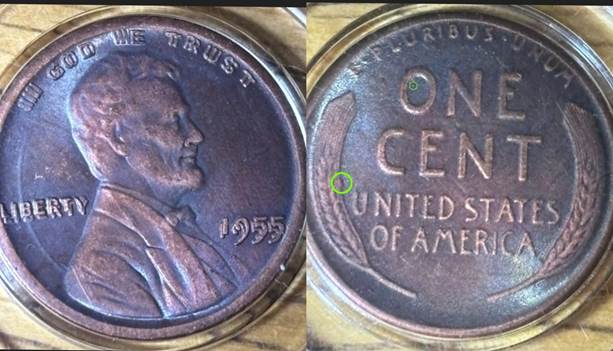
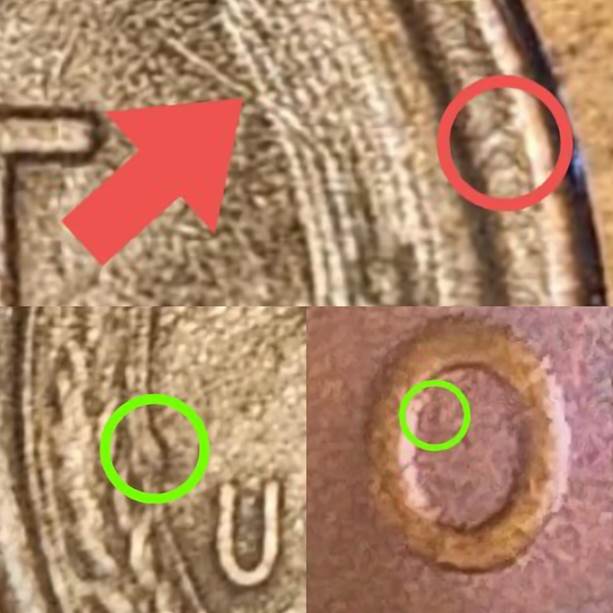
Image comparison of both coins show many repeating marks. Highlighted in green are common to all coins with this reverse and include:

  • Lump at the edge of wheat stalk
  • Small lump inside of ONE

Highlighted in red are common but not seen on all examples.

  • Crack from the rim to Wheat stalk
  • Extending Crack through the stalk to the field

Being the Lincoln Cent series is one of the most popular to collectors and many key/semi key dates are needed to complete the set, it is of no surprise this counterfeit family is extensive. Other dates that have been seen from this family include the 1931s, 1955 “DDO”, and 1924D cents imaged below.


A close-up collage of identifying marks.

If anyone thought it was just key/semi key dates that are counterfeited, you would be wrong. Here is a common date 1958 exhibiting the “Lumped reverse.”


For more information, including die markers, see Michael Bugeja’s post, titled, “Identifying Fake 1909-S VDB Cents.” Now collectors have two comprehensive articles about this key date. Proxiblog strongly encourages any Lincoln cent collector to read and refer to these two articles before bidding on any raw 1909-S VDB. Also, make sure to check the certification to ensure that the holder also is not counterfeit.

Proxiblog advises newer collectors to follow these general guidelines:

  1. If you are ready to bid hundreds of dollars on a coin, resist buying a raw one and shop for one holdered by PCGS, NGC, ANACS and CAC.
  2. Be especially careful when purchasing raw coins from eBay and other online venues. AI bots cannot detect counterfeits, so you are on your own.
  3. Make sure the seller takes returns and has good reviews. Also, the number of positive reviews is a good indicator. If someone has 0 sales or even fewer than 100, do not take a chance.
  4. If you already bought the coin, weigh it and go to PCGS CoinFacts for the date and mintmark, checking your coin against weights and dimensions.
  5. Read this article about detecting counterfeits.

If you like posts like this, you can read more articles on counterfeit coins by Jack Riley, Jack D. Young and Michael Bugeja at this URL. Also, please subscribe so you can get our weekly newsletter and be informed whenever there is a new article or column.

Proxiblog also has more than a thousand friends and followers on Facebook Coin Groups and thousands more across YouTube and social media. To get the latest discussion and commentary, be sure to friend us by clicking here.

You can find more information about errors and varieties as well as buying and bidding on coins in Coin News Updated: The Essential Guide to Online Bidding. Please consider purchasing the work for yourself or a friend, as it underwrites this hobbyist website. Thank you.

Identifying Fake 1909-S VDB Cents


The key date of the Wheat Cent series is not only among the most popular of U.S. coins but also one of the most counterfeited ones, too, due to its value, rarity and ease of alteration. This is why Proxiblog recommends that collectors authenticate their raw coins with a top third-party grader. There are just too many fake coins out there.

But how to tell?

This article provides several die markers so that you can verify whether a coin is real before you purchase it. But before introducing them, we need to revisit coin history.

Controversial Initials

Fake 1909-S VDB cents have sullied the hobby ever since the U.S. Mint called attention to it by repositioning the designer’s initials from the reverse to the obverse in a much less conspicuous place.

Secretary of the Treasury Franklin MacVeagh disliked the prominence of Victor David Brenner’s initials and stopped production in August of that year, removing initials entirely on the remaining 1909 and 1909-S cents. That is why you only find the initials on some 1909 and 1909-S examples. In fact, those initials did not appear again until 1918 when the VDB appears below Lincoln’s shoulders. That’s how angry MacVeagh was. But he wasn’t thinking about counterfeits at the time even though his actions inadvertently made altered dates easy.

Scammers realized they stood to make big profits merely by adding:

  • An “S” to a 1909 VDB cent.
  • VDB to a 1909-S cent.
  • An “S” and “V.D.B” to a 1909 cent.

Rationale to do this concerned the scant 484,000 mintage of the key date 1909-S VDB and the high mintage of the Philadelphia coins (72,702,618 regular 1909 cents and 27,995,000 1909 VDB cents). The 1909-S NO VDB has a small mintage of 1,825,000 and is considered a semi-key date. But even these have been used in altered coins.

Values are synced with mintages. An EF45 1909 regular retails for about $7; 1909 VDB, $20; 1909-S, $200; and 1909-S VDB, $1,450.

In addition to the tens of thousands of altered dates over the years, current hobbyists have to contend with Chinese counterfeits and replicas sold as authentic on eBay and other venues.

This is why it is essential to know attributes of the dies that struck the rarity.

1909-S VDB Markers

As NGC reported in 2016 that just one “S” mintmark punch was used on all San Francisco Lincoln cent issues from 1909 to 1916. This is the first step in identifying a fake.

Real “S” mintmarks have a nodule here:


Now compare mintmarks with a genuine, added mintmark and cast replica mintmark:


As you can see, the real mintmark has a Roman font with serif. The added mintmark doesn’t. The replica has a serif but no nodule.

There are also four mintmark positions with respect to the date, with each edging a tad lower from the first 9 and 0 of 1909.

  • Mintmark 1 has the highest “S” with the top close to the first 9 of the date.
  • Mintmark 2 has the top of the “S” equal distance between the first 9 and 0 of the date.
  • Mintmark 3 also has the top of the “S” closer to the 0 of the date than the first 9.
  • Mintmark 4 has the lowest position with top of the “S” nearly flush under the 0 of the date.

Another die marker concerns the initials themselves. The “B” in VDB has a slanted crossbar; fakes usually forget this.


The last die marker concerns the extra thick stem of the letter “N” in “United.” A fake coin often forgets this minor detail.


If you like posts like this, you can read more articles on buying, selling and collecting at Proxiblog.org. Also, please subscribe to be informed whenever there is a new article or column.

Proxiblog also has hundreds of followers on Facebook Coin Groups. To get the latest discussion and commentary, be sure to friend us by clicking here.

You can find more information about errors and varieties as well as buying and bidding on coins in Coin News Updated: The Essential Guide to Online Bidding. Please consider purchasing the work for yourself or a friend, as it underwrites this hobbyist website. Thank you.