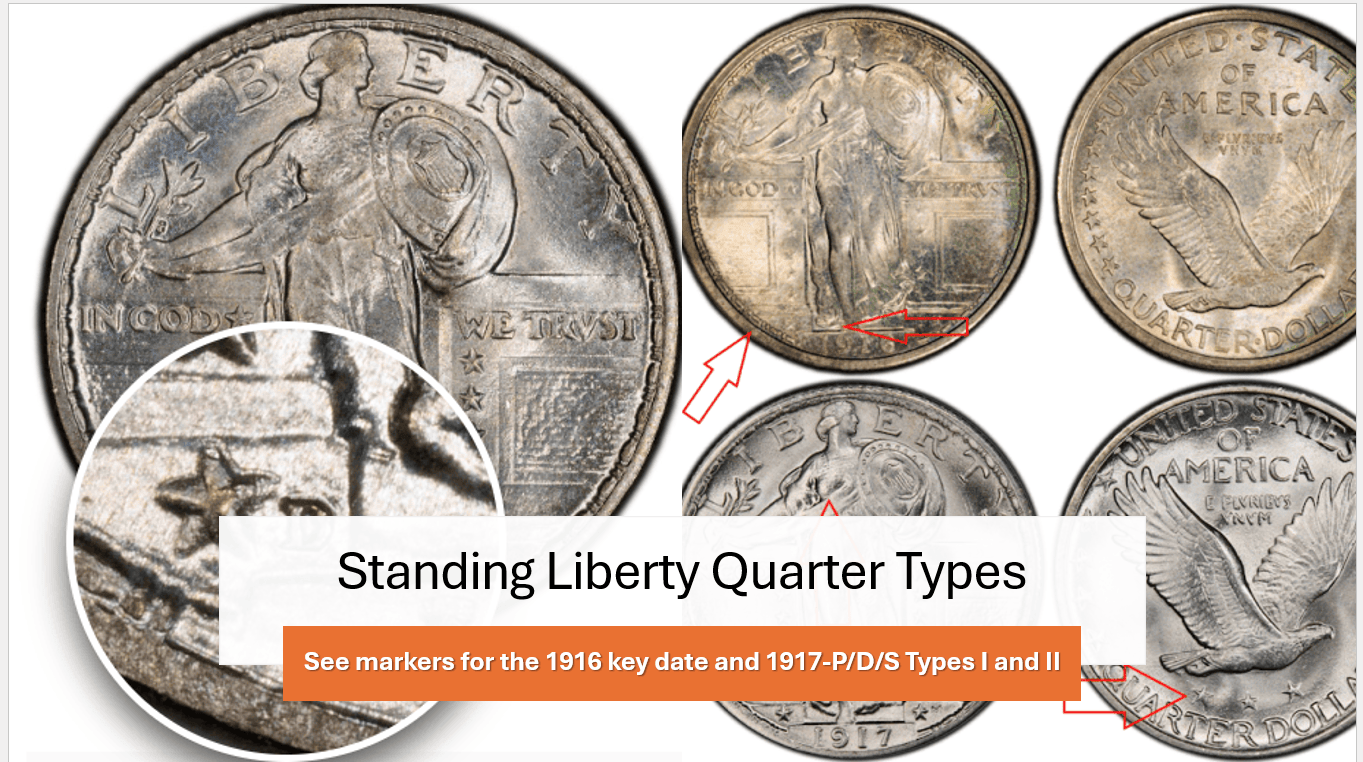
The first two years of the Standing Liberty Quarter resulted in seven varieties: 1916 key date and 1917-P/D/S Types I and II. This article defines markers and designs so you can distinguish differences among these coins.
The 1916 Quarter with a mintage of a mere 52,000 only used one obverse and one reverse die. So these are easy to distinguish from the many replicas and counterfeits out there.
Every coin should have the same placement and design of its devices.
Soon after minting this beautiful quarter, the US Mint realized that the date was positioned on a raised pedestal. That meant it could wear away completely with years in circulation.
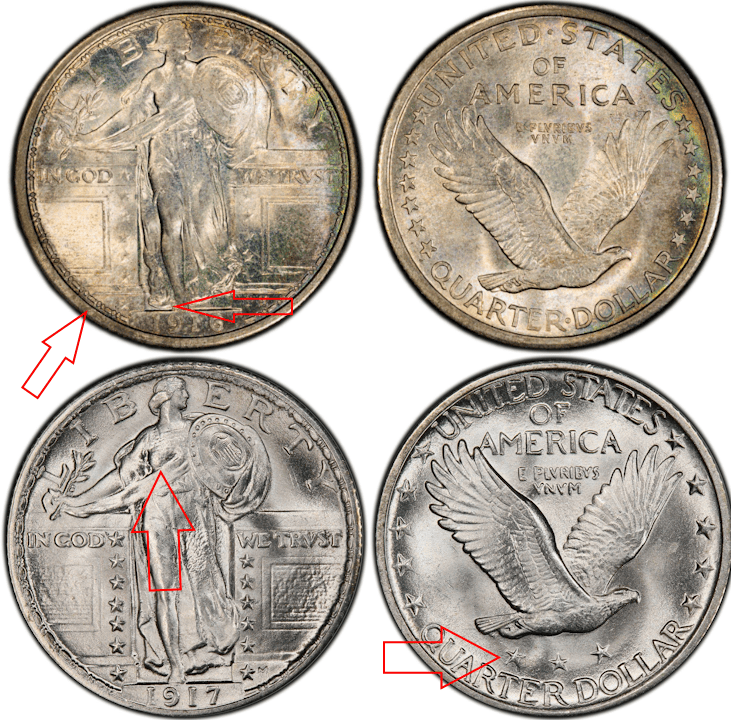
You can identify the key date by these major markers:
The Gown: Drapery of the dress clings to Lady Liberty’s right foot down to the pedestal. On a 1917 quarter, the gown drapery is away from the foot and curled.
The Shield and Border: The dots framing the coin’s outer rim resemble diamonds on the 1916, rather than the dashes on the 1917.
No Mint Mark: The entire mintage of the 1916 was struck at the Philly mint.
Type I Reverse: The 1916 quarter uses the Type 1 Reverse. There are no stars underneath the eagle. There are 7 stars on the left and 6 on the right. Type II has three stars under the eagle.
Right Breast Exposed: This differs from other reverses with Lady Liberty in chainmail.
Let’s illustrate that with a 1917 Type II design.
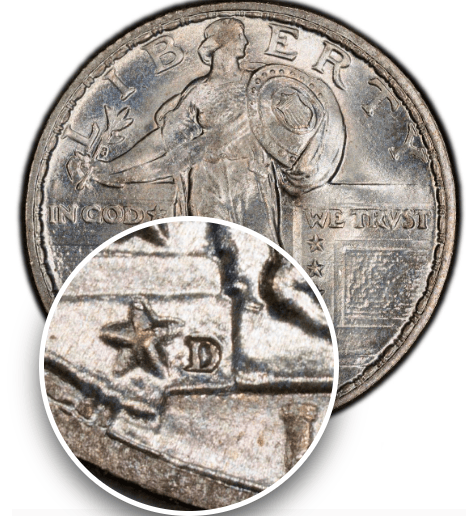
One other marker is important in Type II designs, and that is placement of the mintmark. Here is a 1917-D as example:
This brings us to why Type II was designed. Numismatists debate why Lady Liberty’s exposed breast was covered with chainmail armor in Type II designs. Some thought the exposed breast was lewd. The coin was designed by Hermon Atkins MacNeil. It drew some criticism in the media. But also World War I also might have inspired the armor. What happens, though, is that you can tell the difference.
This brings us to Type I and II of 1917 P/D/S/ designs.
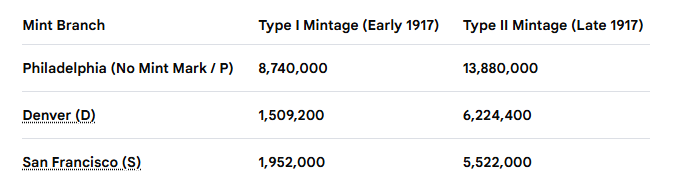
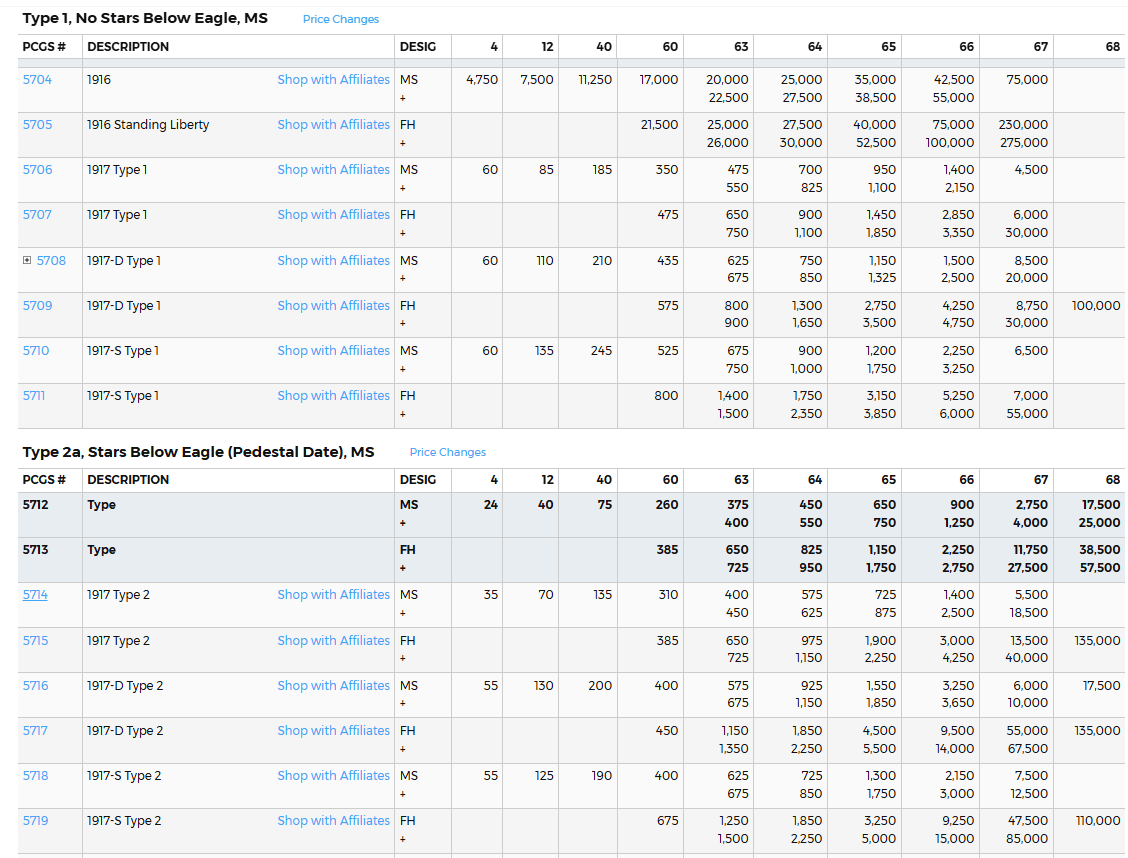
Mintages were roughly equal with Type I and II P/D/S quarters. Type II mintages were greater than Type I in 1917:
As such, values are marginally higher in Type I examples, especially since these are coveted because of the Type I design. Here are complete values compliments PCGS CoinFacts.
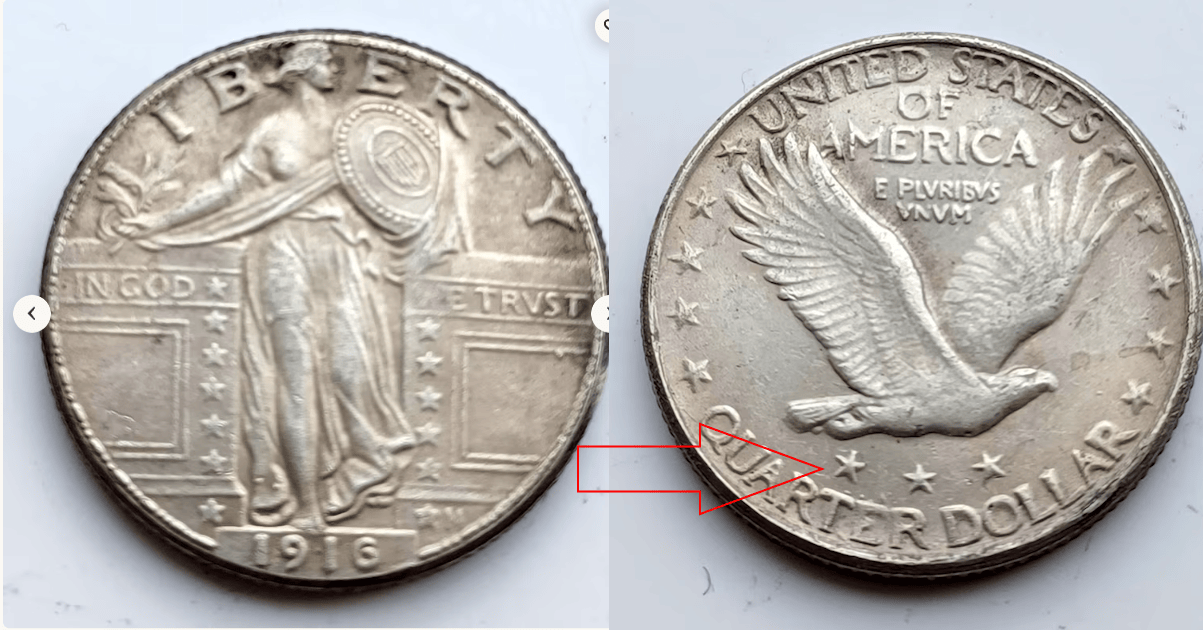
It is especially important to note the design differences because Chinese has flooded the market with fakes. Here’s an example, a purported 1916 with a Type II reverse:
If you like articles like these, please friend us on Facebook and subscribe to Proxiblog.
Proxiblog also has thousands of followers on Facebook Coin Groups, YouTube and social media. To get the latest discussion and commentaries, click here.
You can find more information about errors and varieties as well as buying and bidding on coins in Coin News Updated: The Essential Guide to Online Bidding. Please consider purchasing the work for yourself or a friend, as it underwrites this hobbyist website. Thank you.
The 1916-D Mercury Dime is the key date of the Mercury series with a mintage of 264,000 coins. In 1916, the Philadelphia Mint made 22,180,080 coins and the San Francisco Mint, 10,450,000. Those two other mintages are important because scammers began added a mintmark to Philadelphia coins that year. Many also altered 1916-S dimes to make that mintmark look like a D.
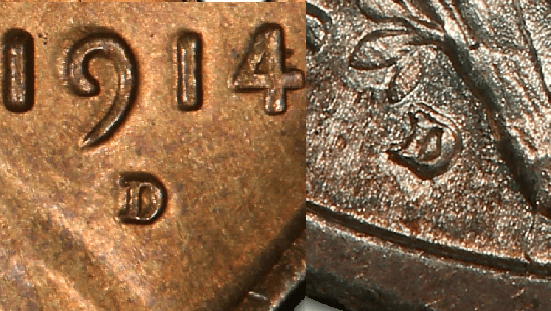
Fortunately, we know much about the Denver mintmark. For starters, the Mint used the same punch tool for the 1916-D as it did for the coveted 1914-D Cent.
Look closely: The outer shape of the D is squared off rather than rounded. And the cavity inside the D has a vague triangular shape rather than oval.
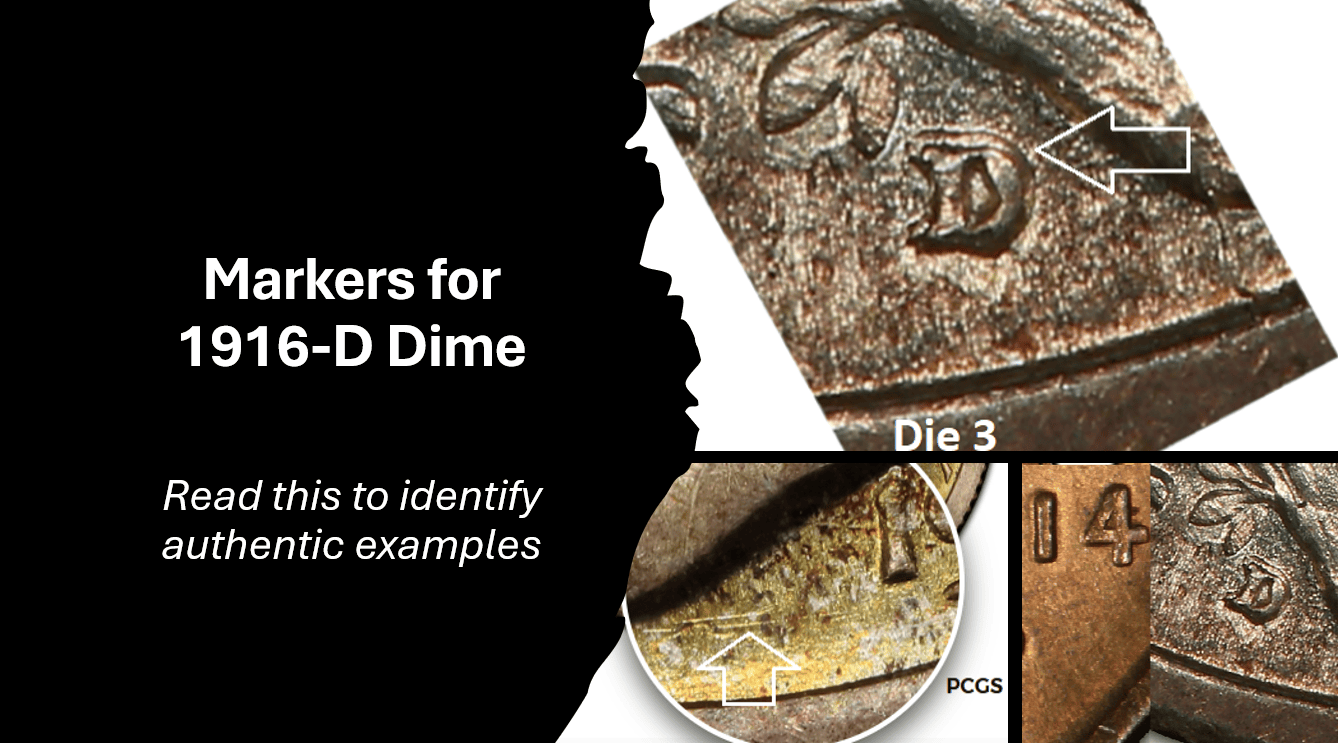
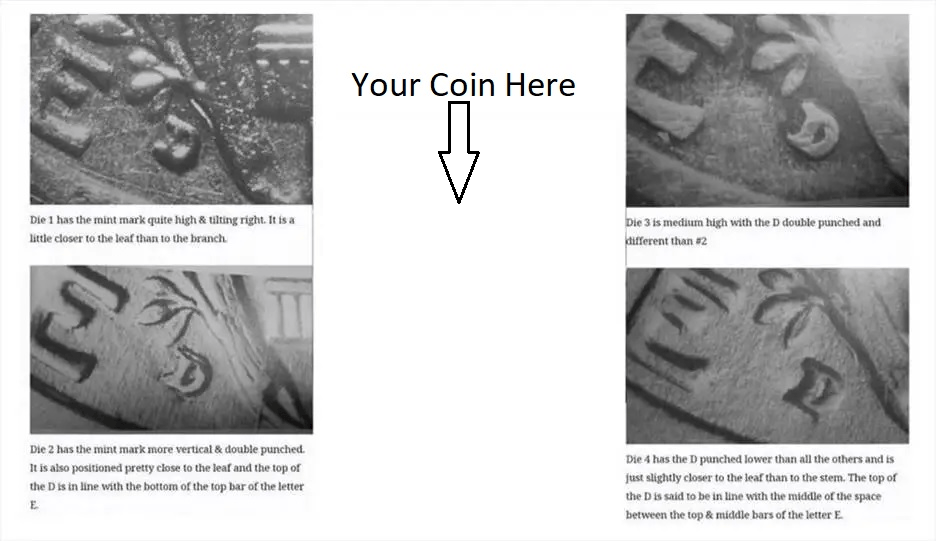
Four reverse dies were used on the 1916-D Dime. If your coin deviates from these positions, it is fake.
Jack D. Young has a great Proxiblog article on fake 1916-Ds offered on eBay. He made this graphic below, which we use here. Take a photo of your 1916-D coin or a screenshot if you are considering purchasing one and then compare.
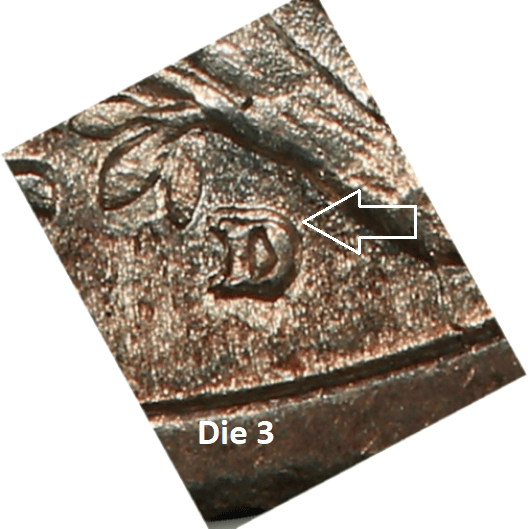
Two of the four genuine reverse dies feature a repunched mint mark (Dies 2 and 3 above).
Here is the example used earlier but now identified.
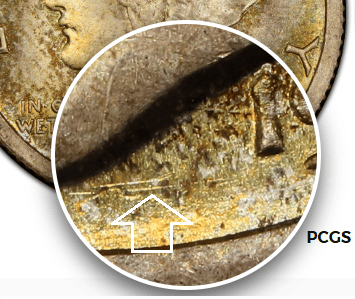
Genuine 1916-D Dimes often have tiny die scratches or die cracks near the date on the obverse.
It is important to know markers of rarities in coin collecting. Otherwise you may end up with a counterfeit or replica if not holdered by a major company like PCGS or NGC. Be sure to check out our rarity tab for markers of our most desirable coins.
If you like posts like this, subscribe so you can be informed whenever there is a new article or column.
Proxiblog also has thousands of followers on Facebook Coin Groups, YouTube and social media. To get the latest discussion and commentary, be sure to friend us by clicking here.
You can find more information about types, varieties, errors, grading, bidding and buying in Coin News Updated: The Essential Guide to Online Bidding. Please consider buying or gifting the work for a friend, as it underwrites this hobbyist blog. Thank you.
Fake and replica 1893-S Morgan dollars abound as only 100,000 were minted with current values in multiples of thousands of dollars. This is a summary of markers so that you can identify this coveted key date.
The basic test of any Morgan dollar is its weight: 26.73 grams and diameter of 38.1 millimeters. Any deviation is a fake.
The 1893-S was produced using a single obverse die and two reverse dies. In other words, any deviation of markers also signifies a counterfeit.
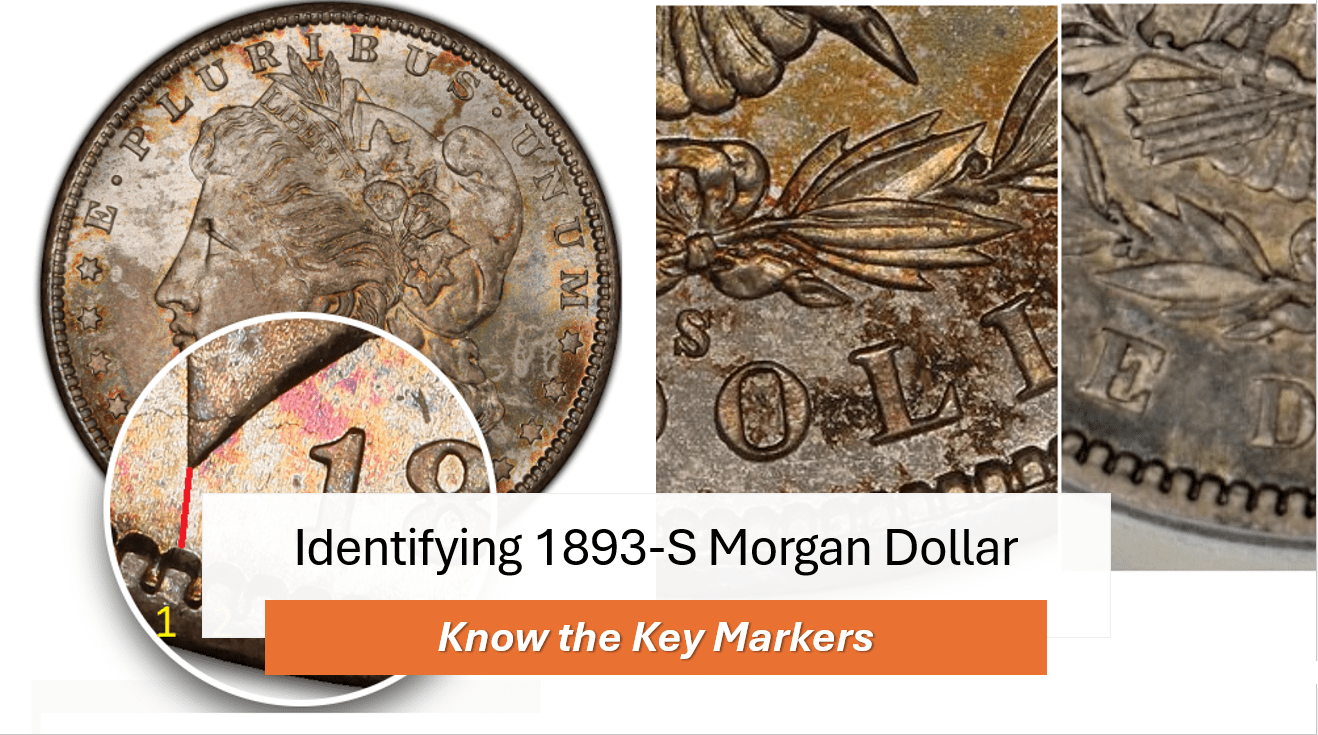
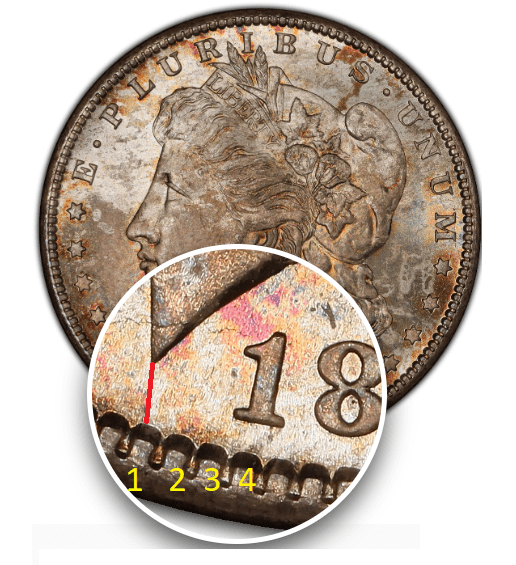
View the date. The “1” is squarely atop the fourth denticle (my illustration).
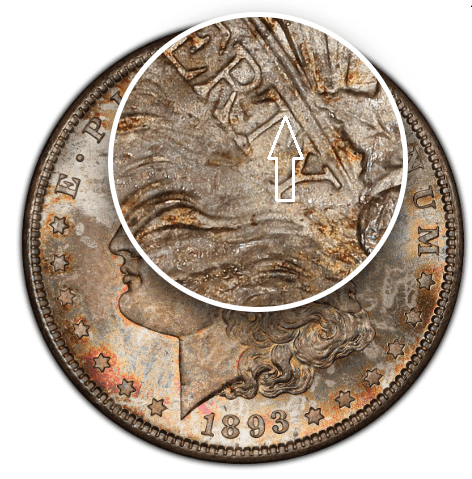
Another marker, difficult to see on worn dollars, is a faint line through the “T” in “Liberty.”
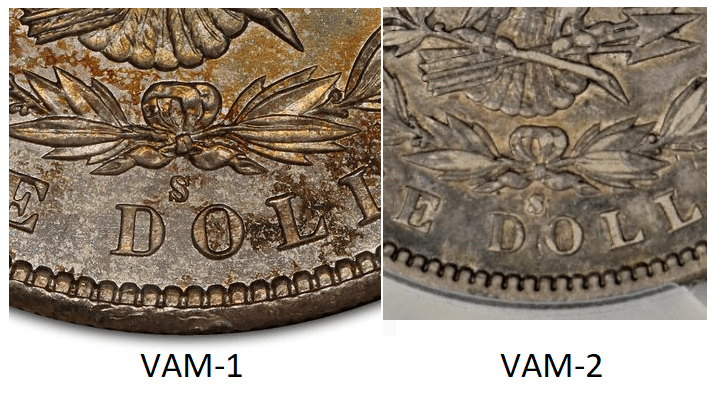
Because the reverse had two dies, they are numbered VAM-1 and VAM-2 according to the directory by Leroy Van Allen and A. George Mallis (hence, VAM after their names). The key marker is the mintmark. VAM-1 has a centered “S” and VAM-2 an “S” tilted slightly to the right.
Be careful if purchasing a 1893-S Morgan dollar. Run the above tests. Again, any deviation from the markers is a red flag for a counterfeit. China also exports counterfeits in fake PCGS holders. To learn more about that, see Jack D. Young’s “Counterfeit PCGS Morgan.”
If you like posts like this, subscribe so you can be informed whenever there is a new article or column.
Proxiblog also has thousands of followers on Facebook Coin Groups, YouTube and social media. To get the latest discussion and commentary, be sure to friend us by clicking here.
You can find more information about types, varieties, errors, grading, bidding and buying in Coin News Updated: The Essential Guide to Online Bidding. Please consider buying or gifting the work for a friend, as it underwrites this hobbyist blog. Thank you.
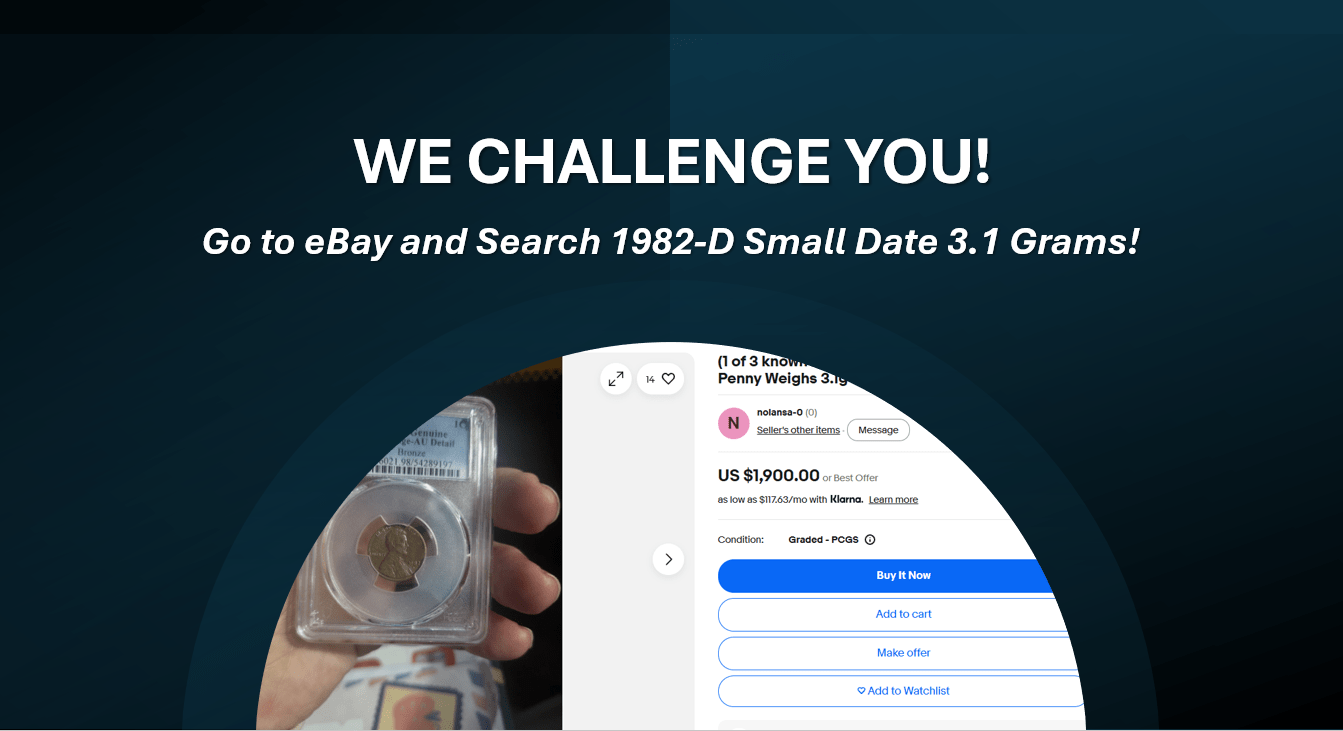
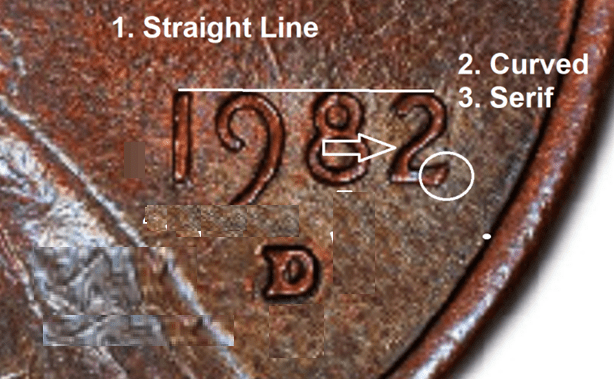
Here’s a challenge for all of you looking for the third example of the 1982-D Small Date 3.1 Gram Rarity. Go to eBay and search “1982-D Small Date 3.1 Grams.” Before you go, make sure you know the markers:
You also can refresh your memory by reading an entire article on those markers. Click here for that.
Also, here is background on mintages:
Variety Name
Composition
Weight
Date Hub
Estimated Mintage / Rarity
1982-D Large Date Copper
95% Copper / 5% Zinc
3.11 grams
Large Date
Common (Estimated in the hundreds of millions)
1982-D Large Date Zinc
Copper-plated Zinc Core
2.50 grams
Large Date
Common (Estimated in the billions)
1982-D Small Date Zinc
Copper-plated Zinc Core
2.50 grams
Small Date
Common (Estimated in the billions)
1982-D Small Date Copper(Transitional Error)
95% Copper / 5% Zinc
3.11 grams
Small Date
Extremely Rare (Only 2 known examples exist)
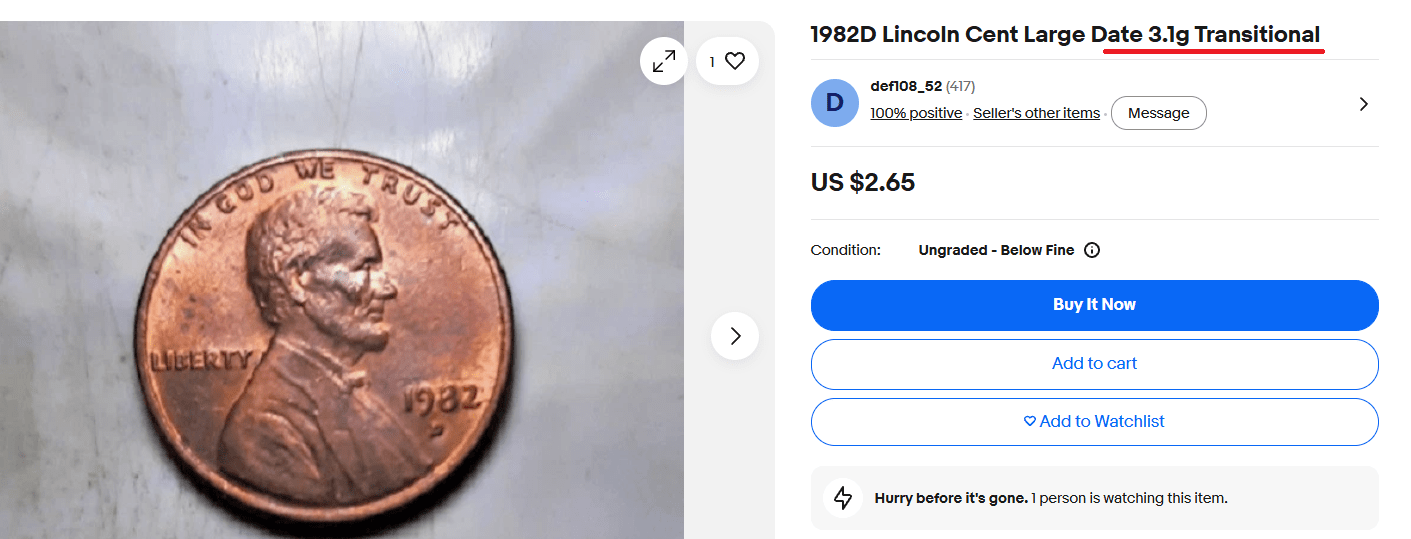
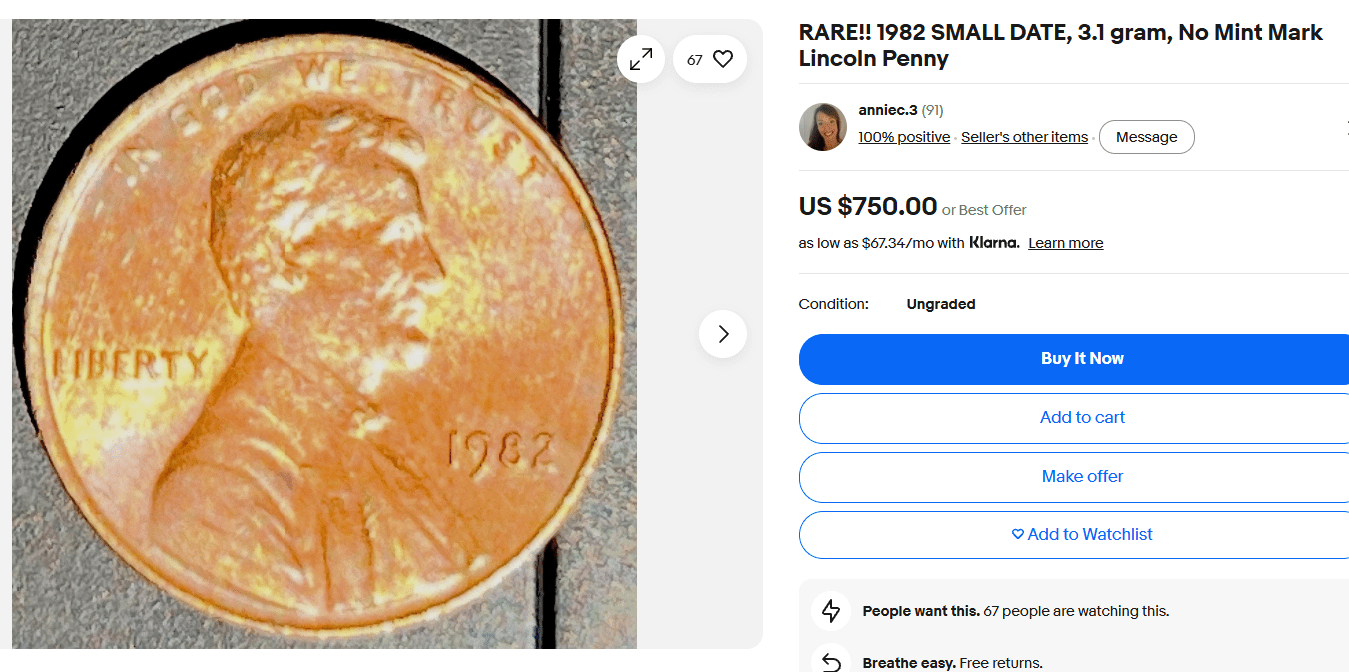
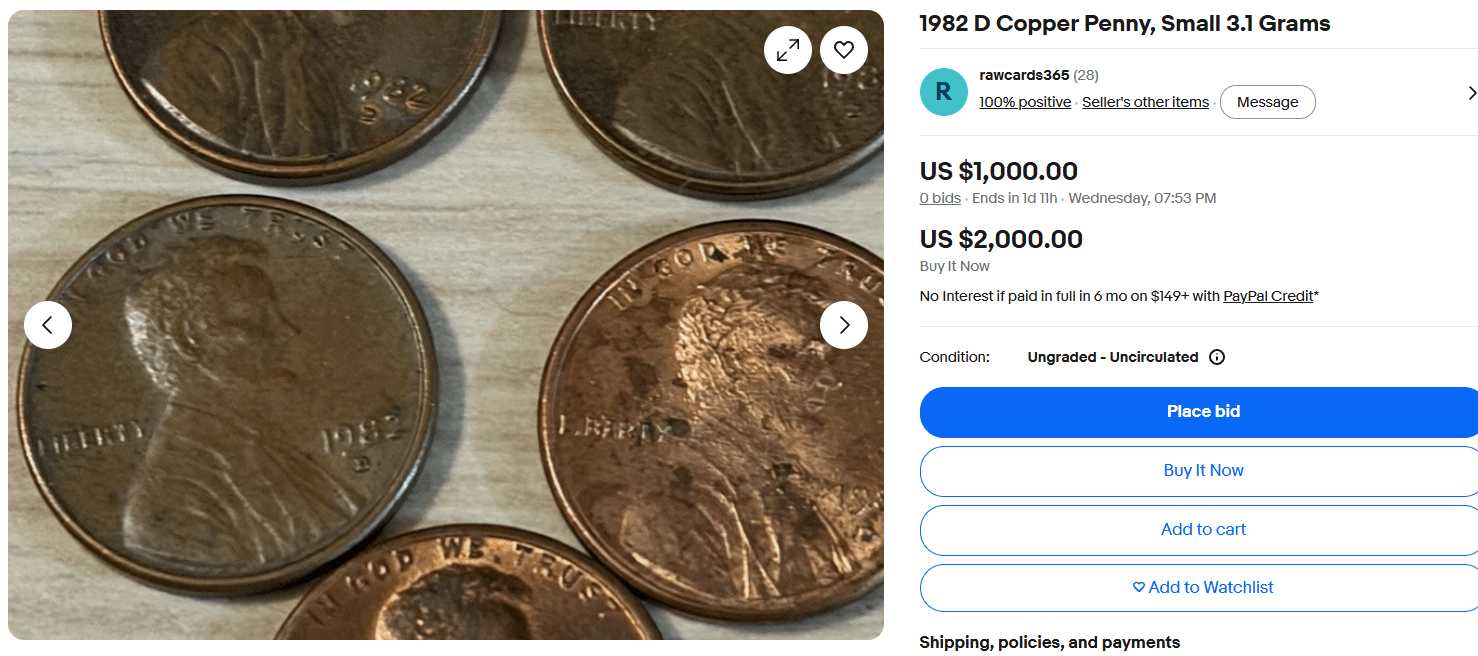
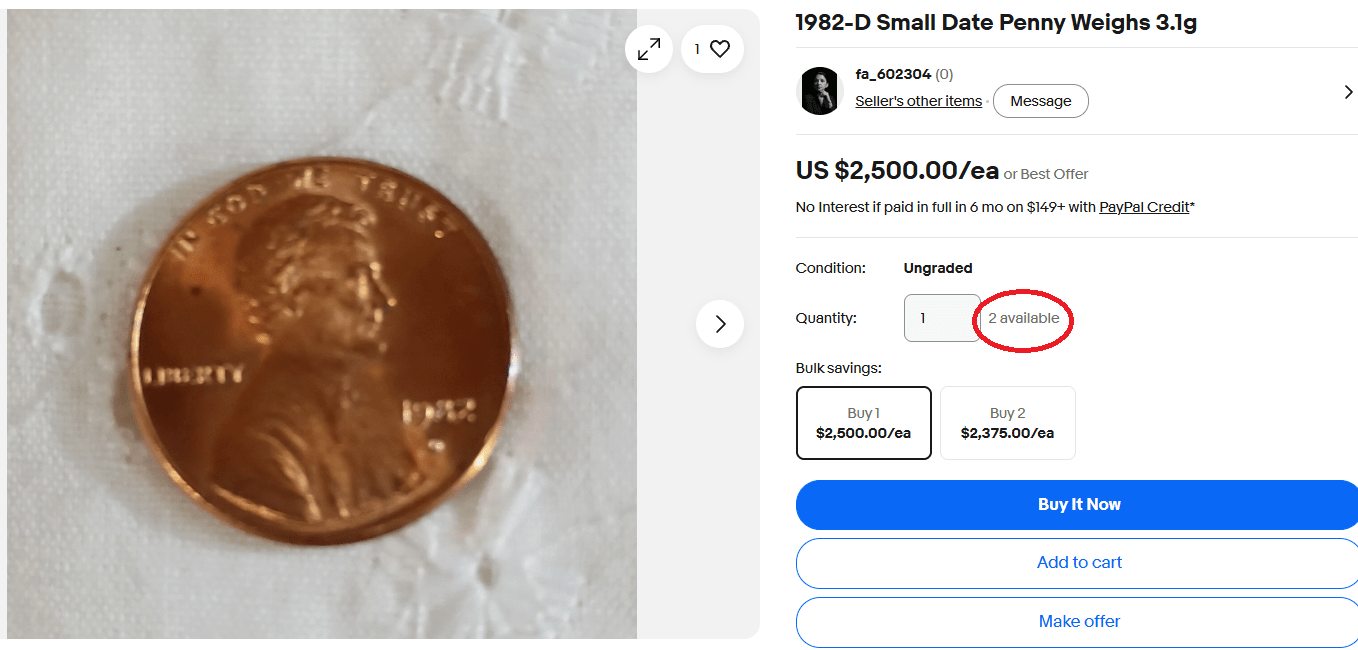
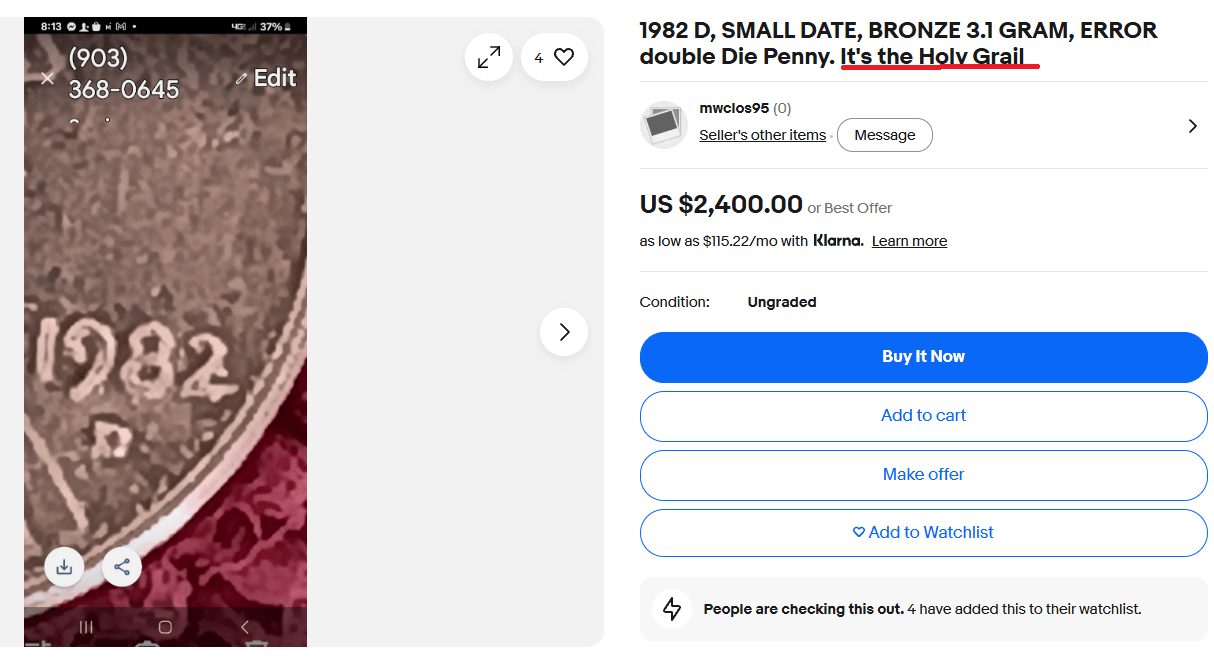
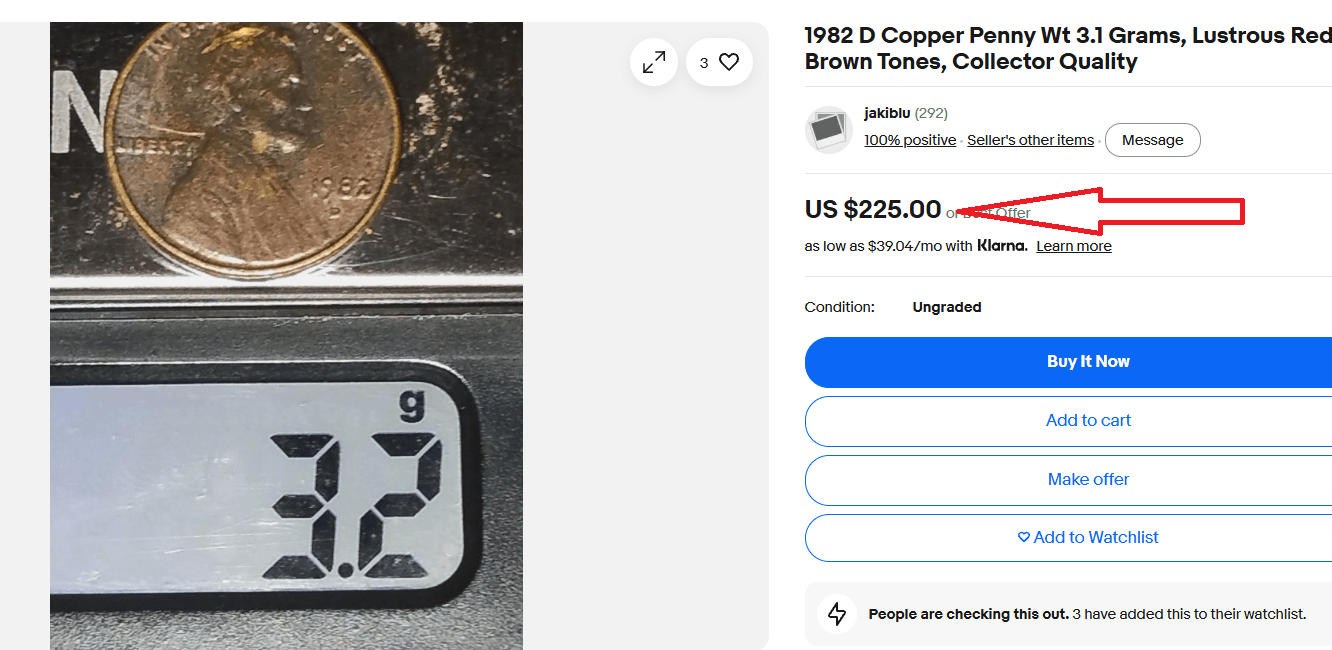
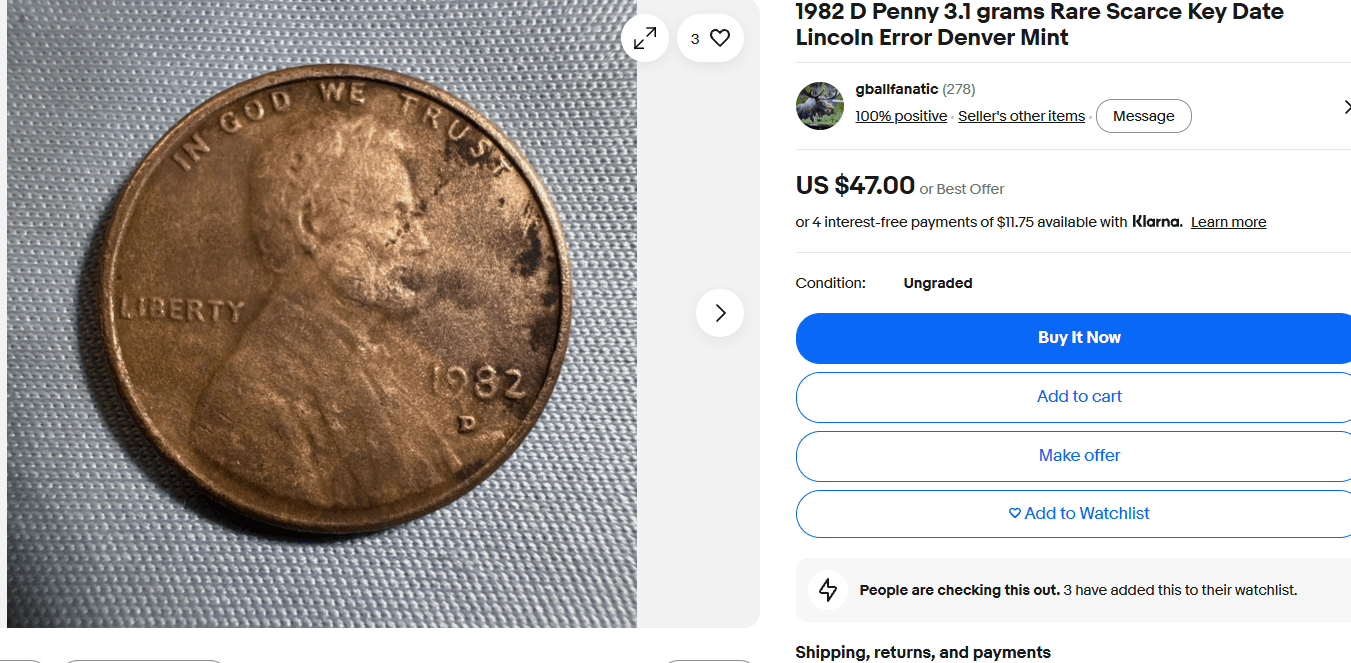
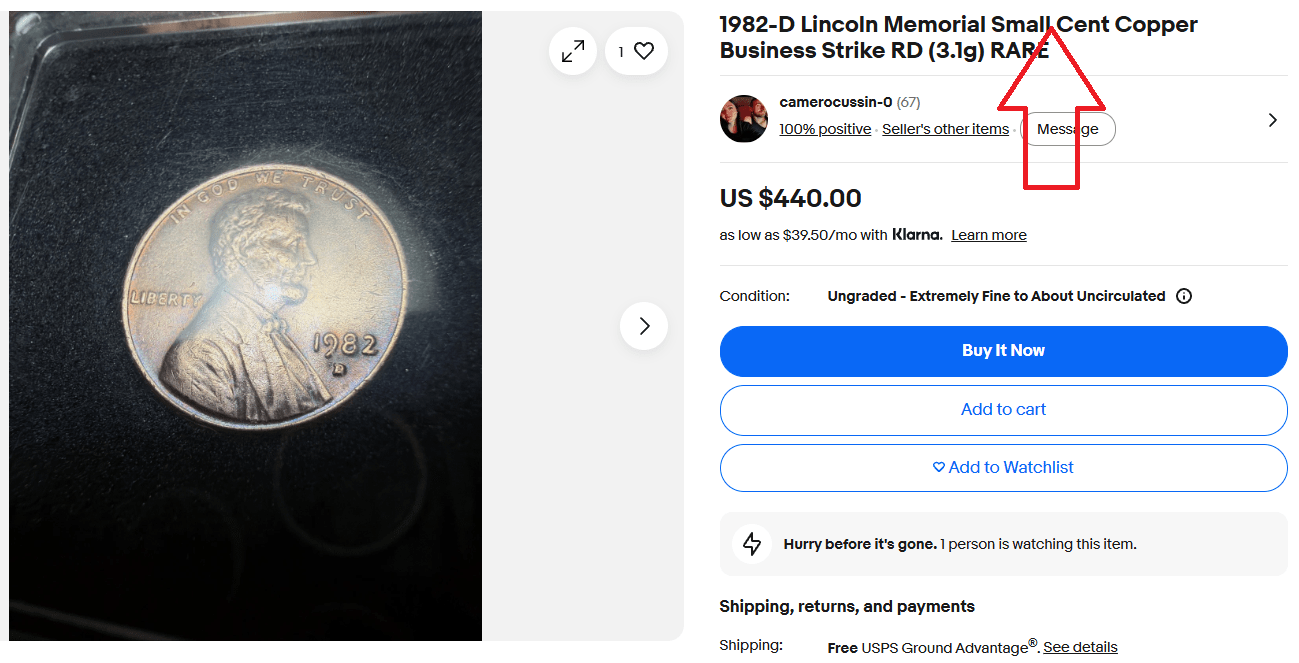
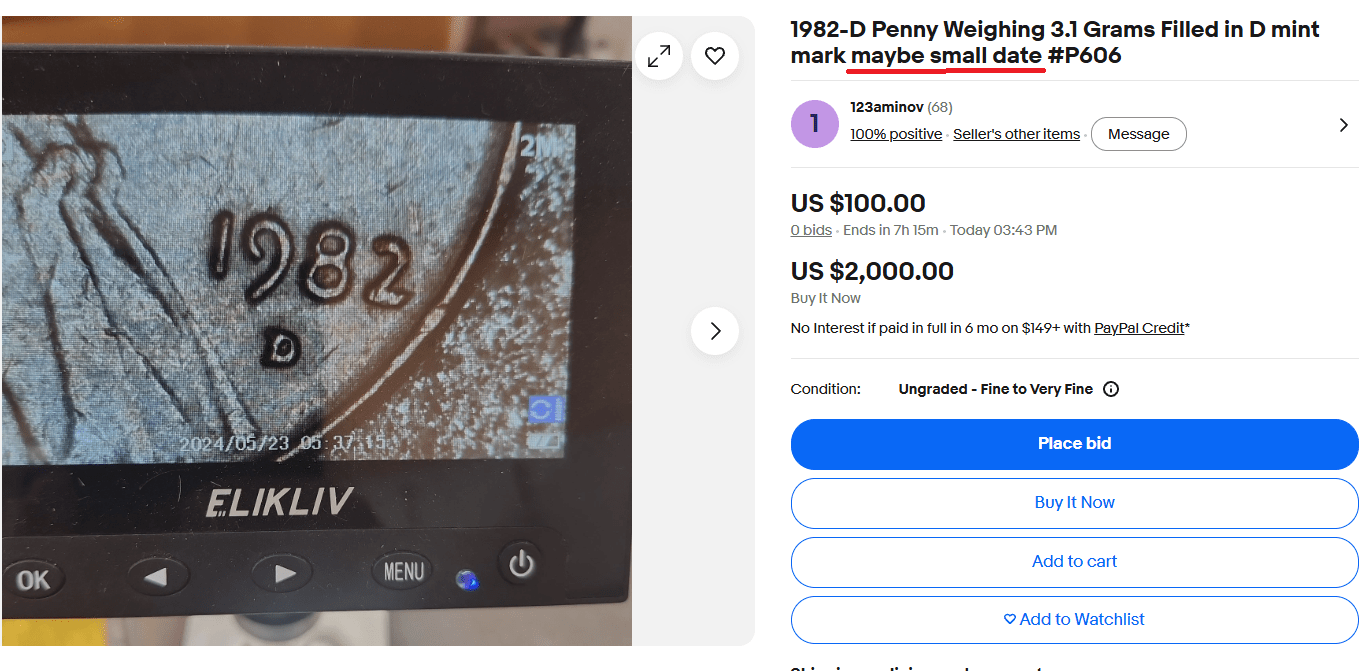
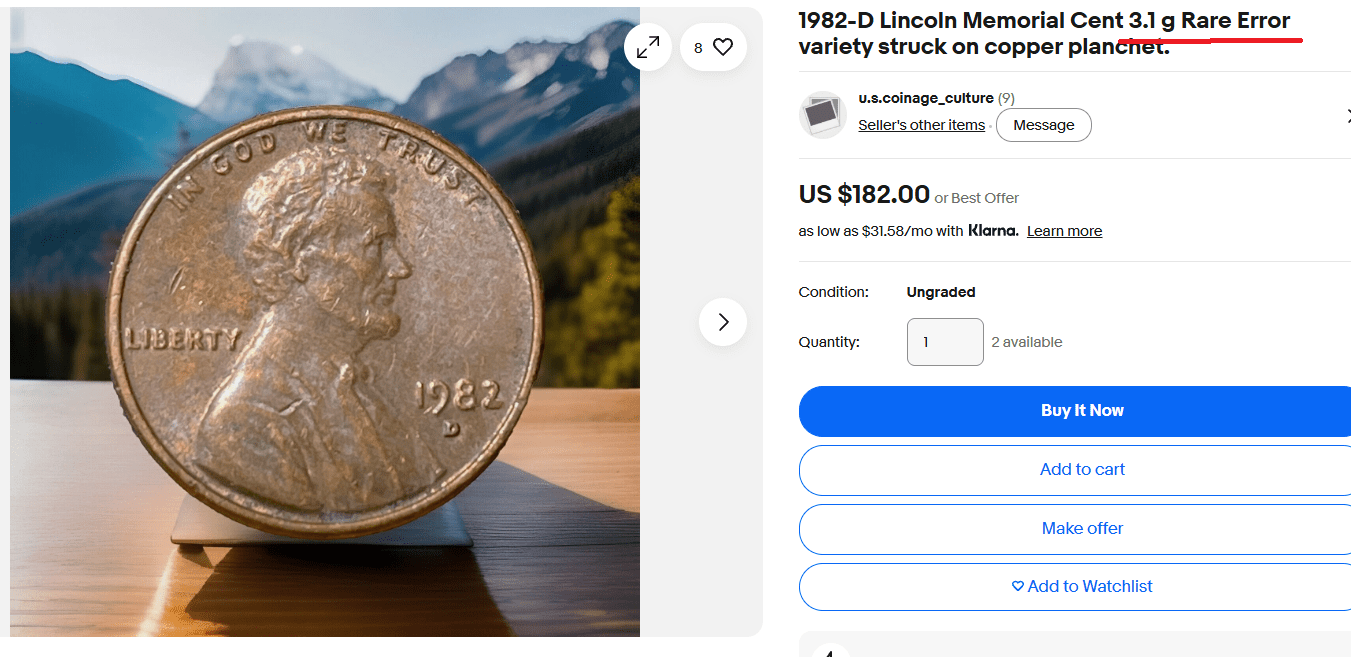
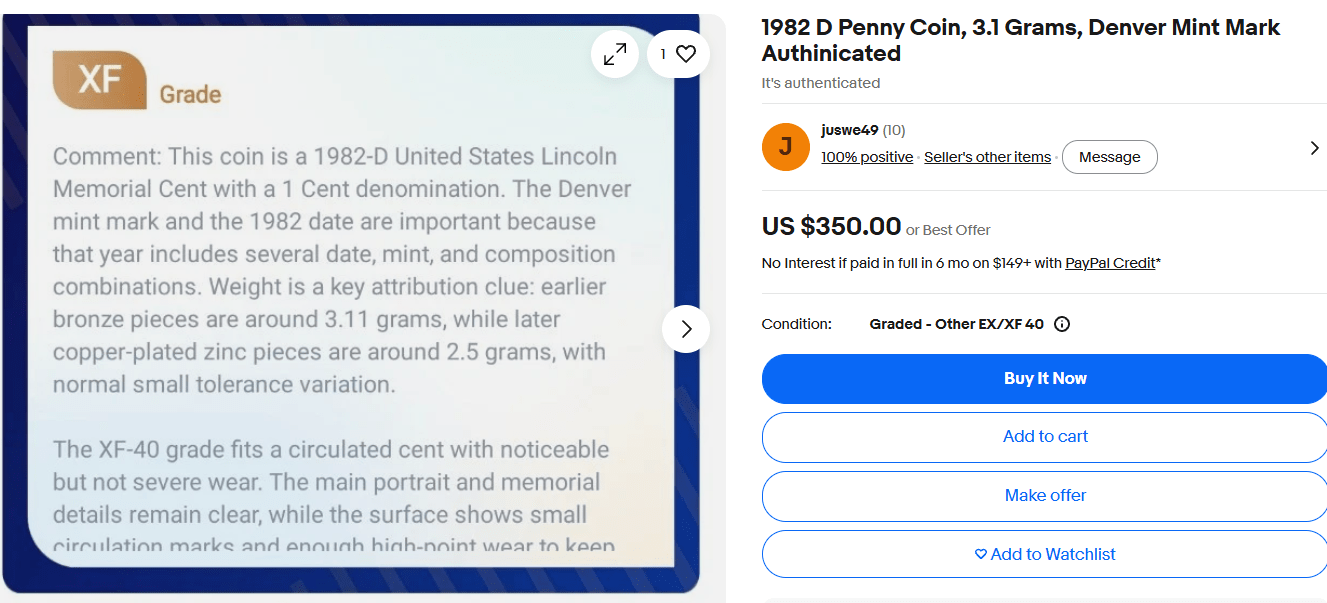
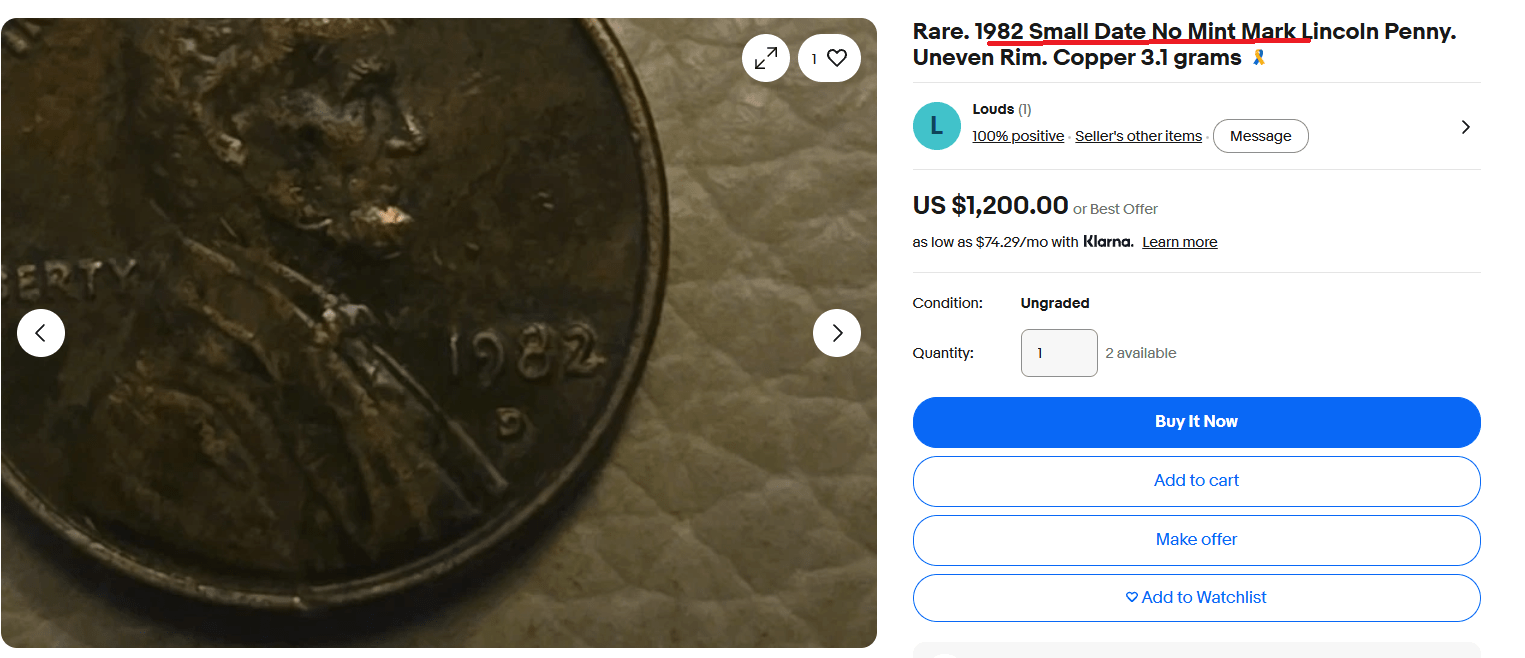
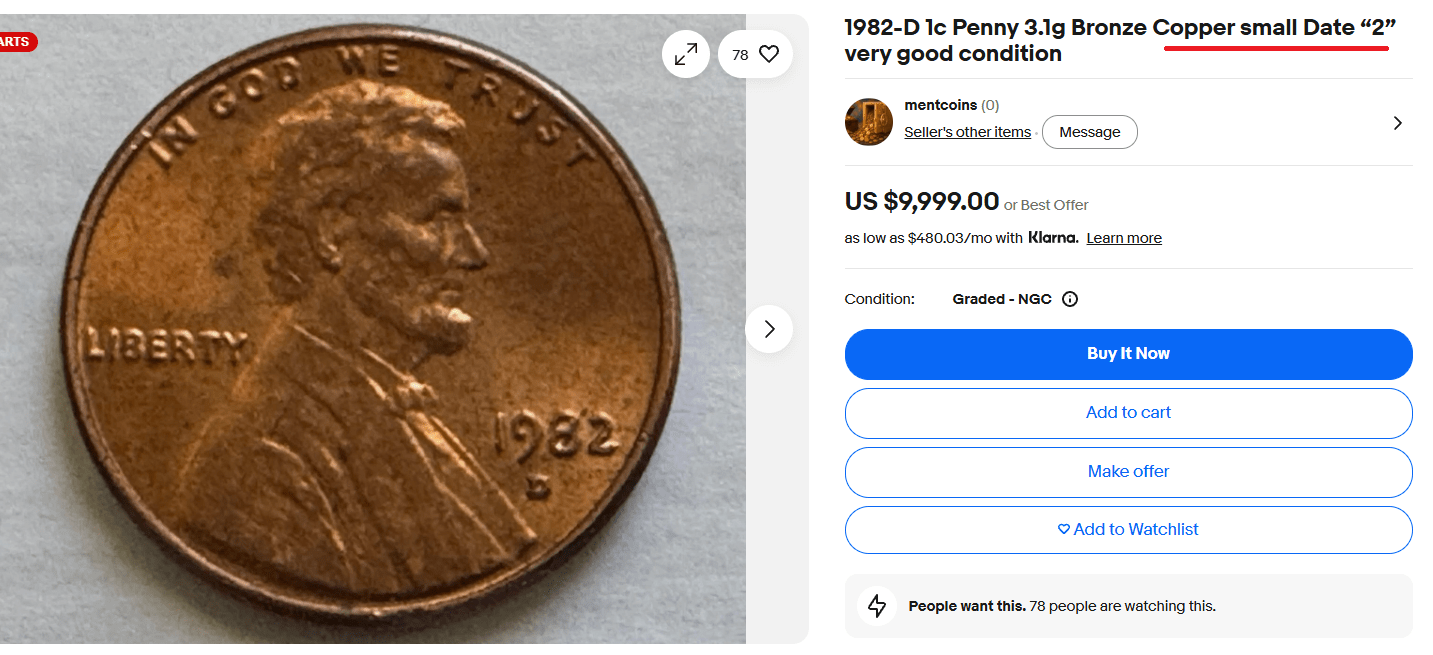
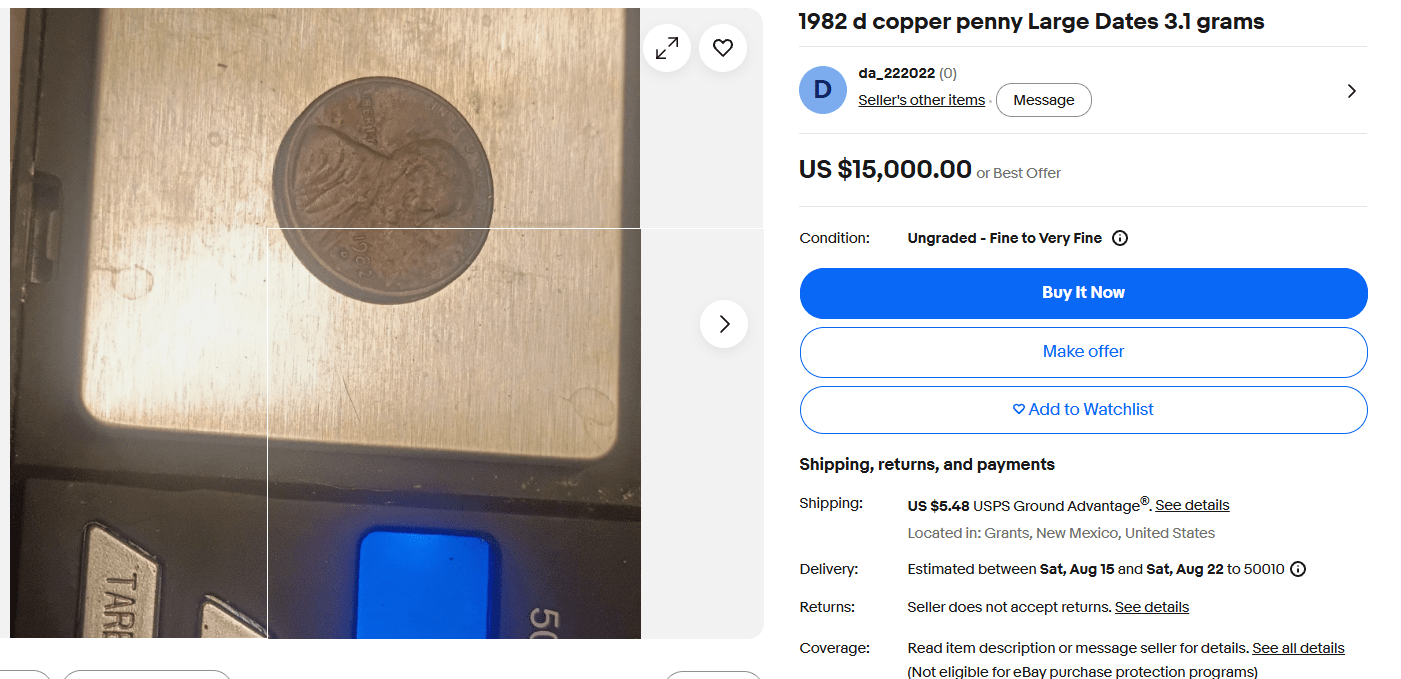
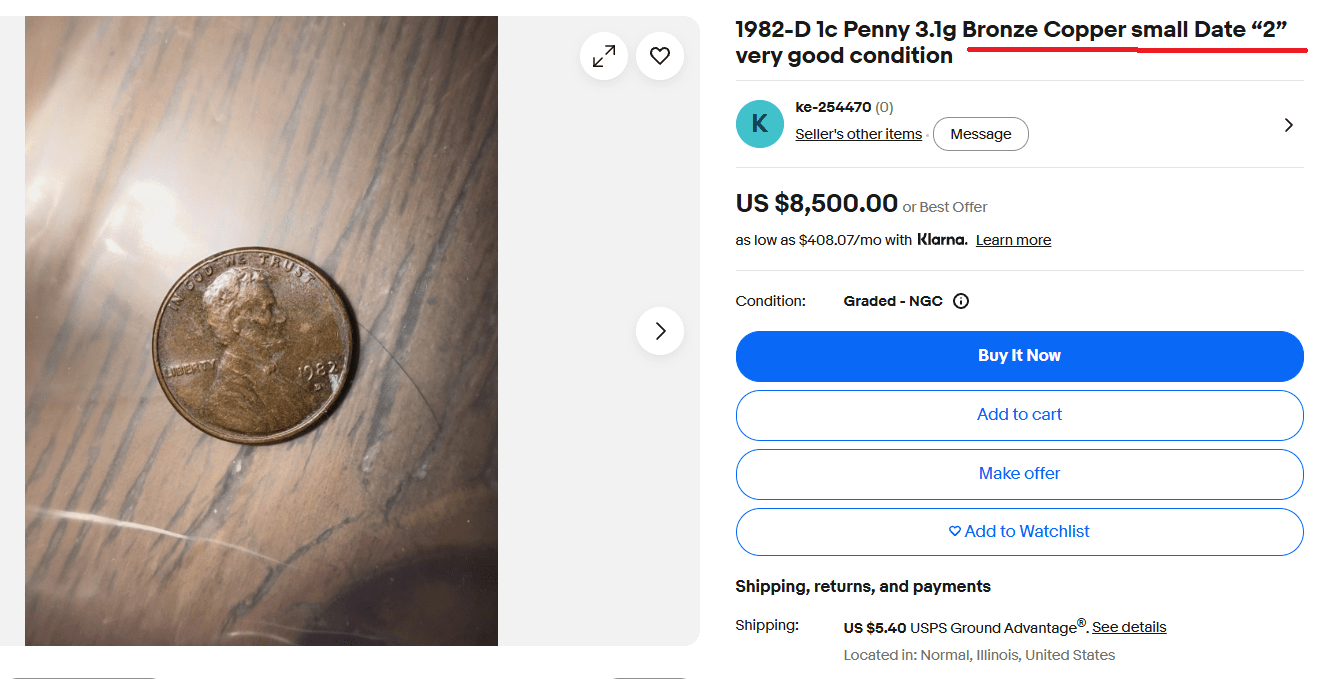
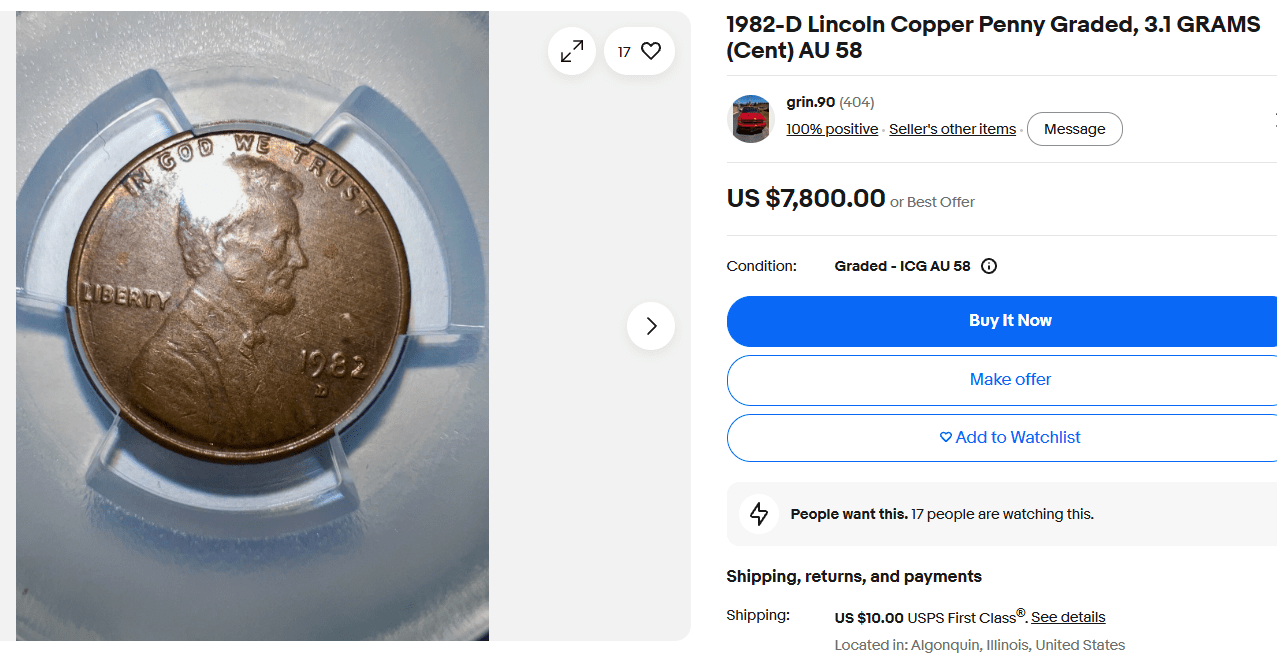
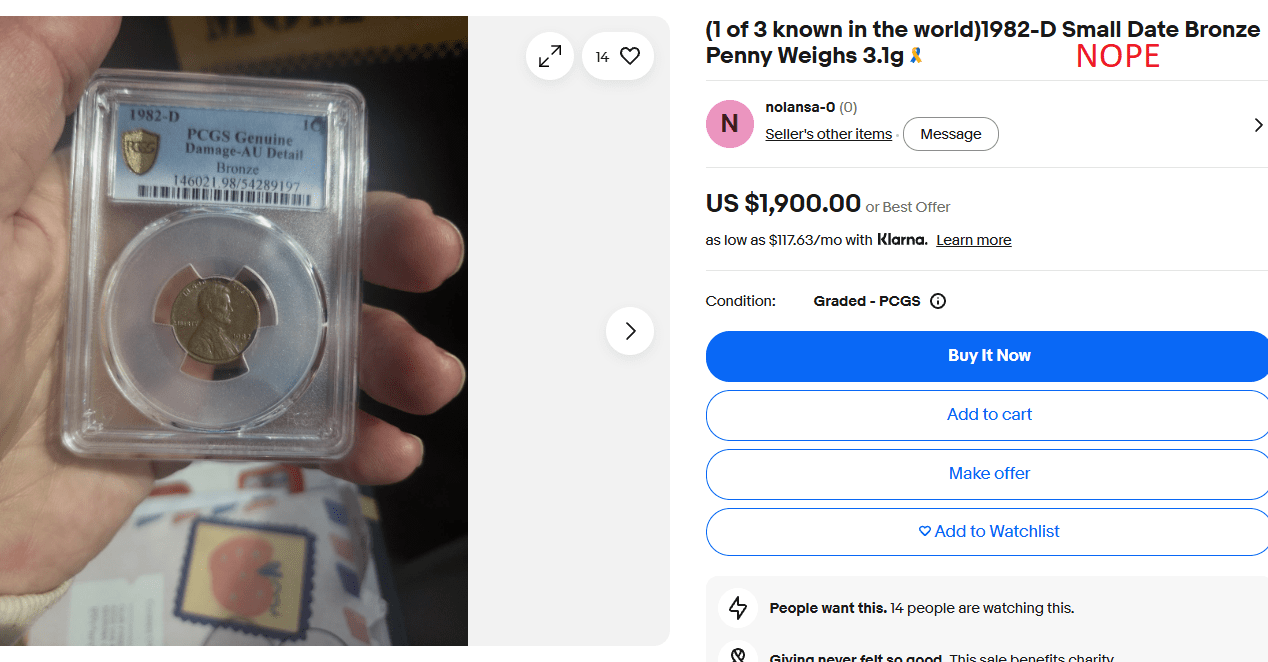
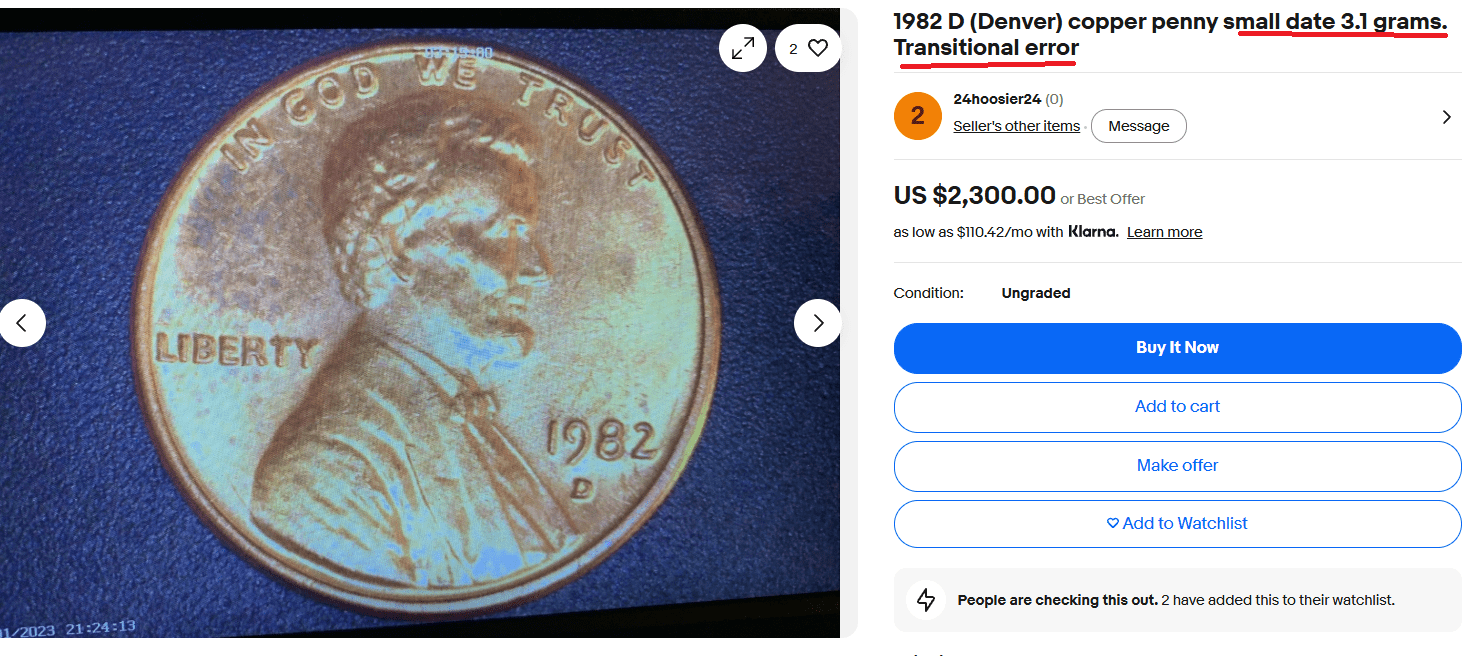
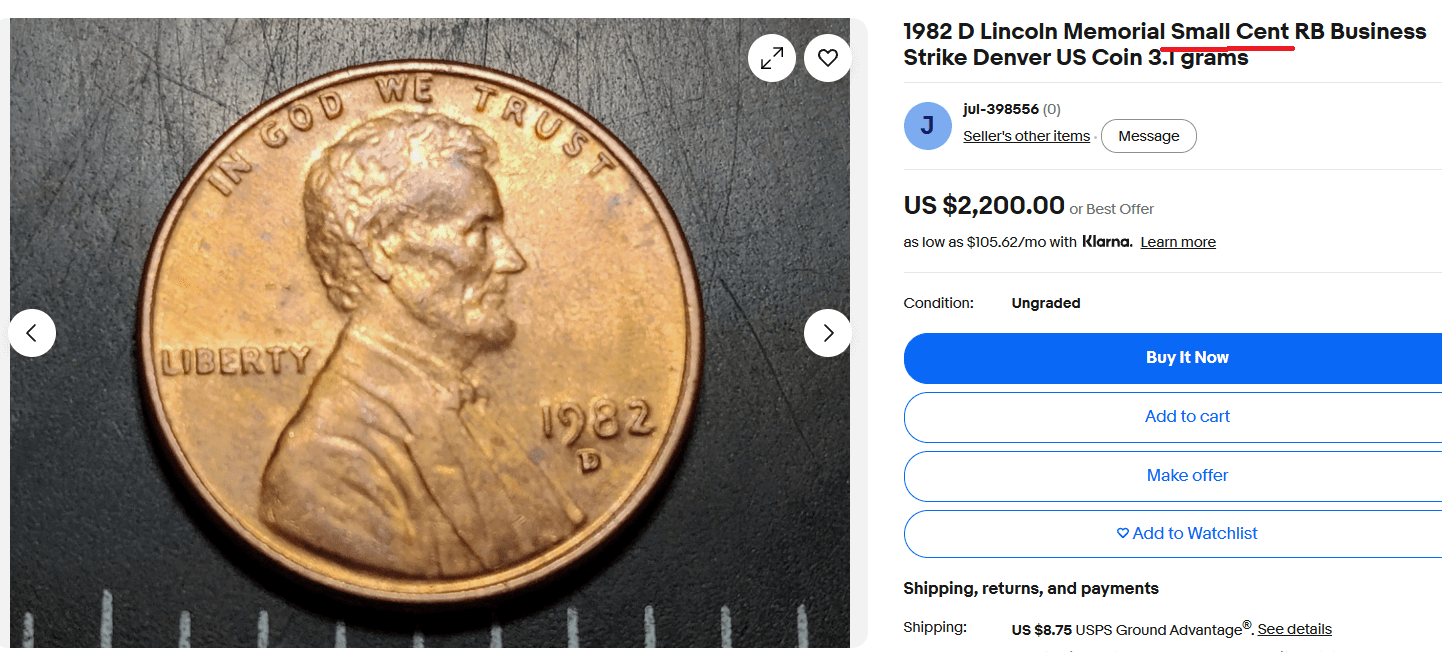
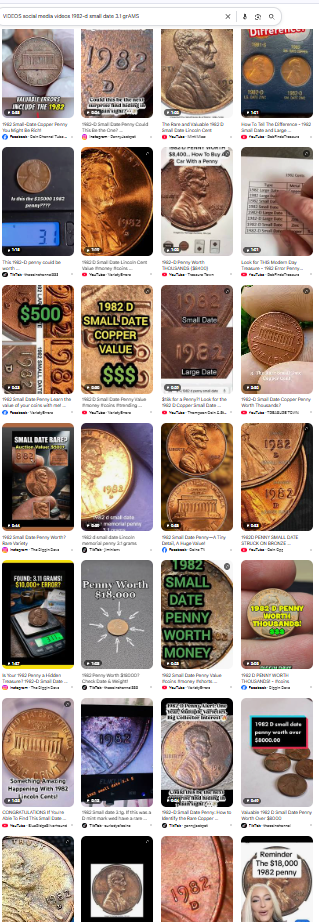
Here are the first 20 of my search. Got tired, but could have found dozens if not hundreds more if I had all day.
IT’S 3.1 GRAMS: Take my Word for It!
1982 SMALL DATE, NO D, One of Billions!
I’M SO LUCKY I FOUND FIVE!
IF I BLUR THE PHOTO, MAYBE THEY WON’T KNOW IT’S ZINC!
IT’S THE UNHOLY GRAIL LARGE DATE!
LARGE DATE: NOT RARE!
LARGE DATE, SCRATCHED: NO COLLECTOR VALUE!
LARGE DATE, ENVIRONMENTAL DAMAGE!
LARGE DATE, CLEANED!
LARGE DATE: I DON’T KNOW WHAT IT IS BUT MAY BE VALUABLE!
NO ERROR, NOT RARE!
LARGE DATE BUT COIN APP SAYS RARE!
LARGE DATE WITH A MINTMARK, DUMMY!
IF I SAY SMALL DATE, WHO WOULD KNOW?
LARGE DATE, COMMON, BUT I WANT THOUSANDS!
LARGE DATE, ENVIRONMENTAL DAMAGE!
LARGE DATE, GRADED SO I WANT MONEY!
ANOTHER LARGE DATE, GRADED, SO I ALSO WANT MONEY!
I’VE STRUCK IT RICH … SO I’LL SCAM YOU BECAUSE YOU CAN’T TELL LARGE DATE FROM SMALL!
IF I SAY SMALL DATE, IT’S SMALL DATE … SO PAY ME!
You can continue searching for the third example of the 1982-D Small Date 3.1 Grams. There is a desperation about it because collectors in the past decade theorized you can find this in pocket change. Then social media hyped the rarity!
If you think you have found the unicorn, and are sure that you know the markers, odds are you’re wrong. If you send it in for grading at PCGS or NGC, and you found the third example–one found in 2016 and another in 2019–be prepared for the national media to come knocking on your door.
If you like posts like this, subscribe so you can be informed whenever there is a new article or column.
Proxiblog also has thousands of followers on Facebook Coin Groups, YouTube and other social media. To get the latest discussion and commentary, be sure to friend us by clicking here.
You can find more information about types, varieties, errors, grading, bidding and buying in Coin News Updated: The Essential Guide to Online Bidding. Please consider buying or gifting the work for a friend, as it underwrites this hobbyist blog. Thank you.
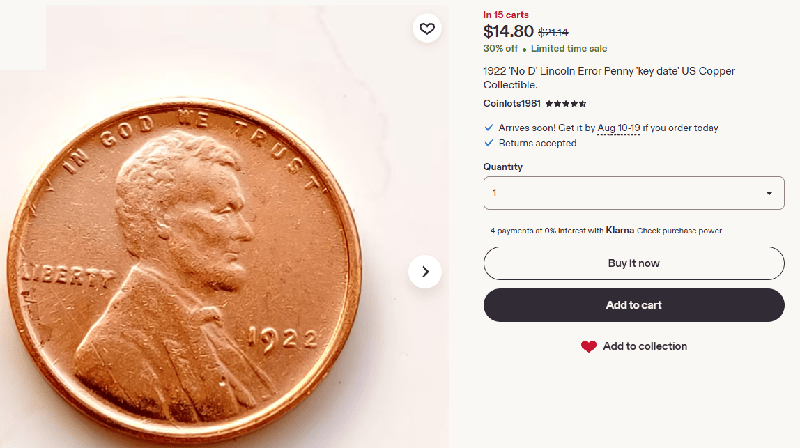
Every 1922 cent should carry the “D” mintmark from Denver, which was the only facility to produce cents in 1922. But accidents happen, and a mint employee over polished a working die, erasing the “D.”
The Denver Mint struck a total of 7,160,000 Lincoln cents that year. Due to a shortage of coin dies, Denver workers polished and reused damaged, clogged dies. That is how the mistake happened.
Coin collectors know that the Philadelphia Mint typically does not use a mintmark for coinage. So the missing mintmark has the appearance of being struck at Philly.
Only about 15,000 examples exist of the missing mintmark cent, a key date for collectors and a rarity, worth hundreds and even thousands of dollars, depending on the die pairs.
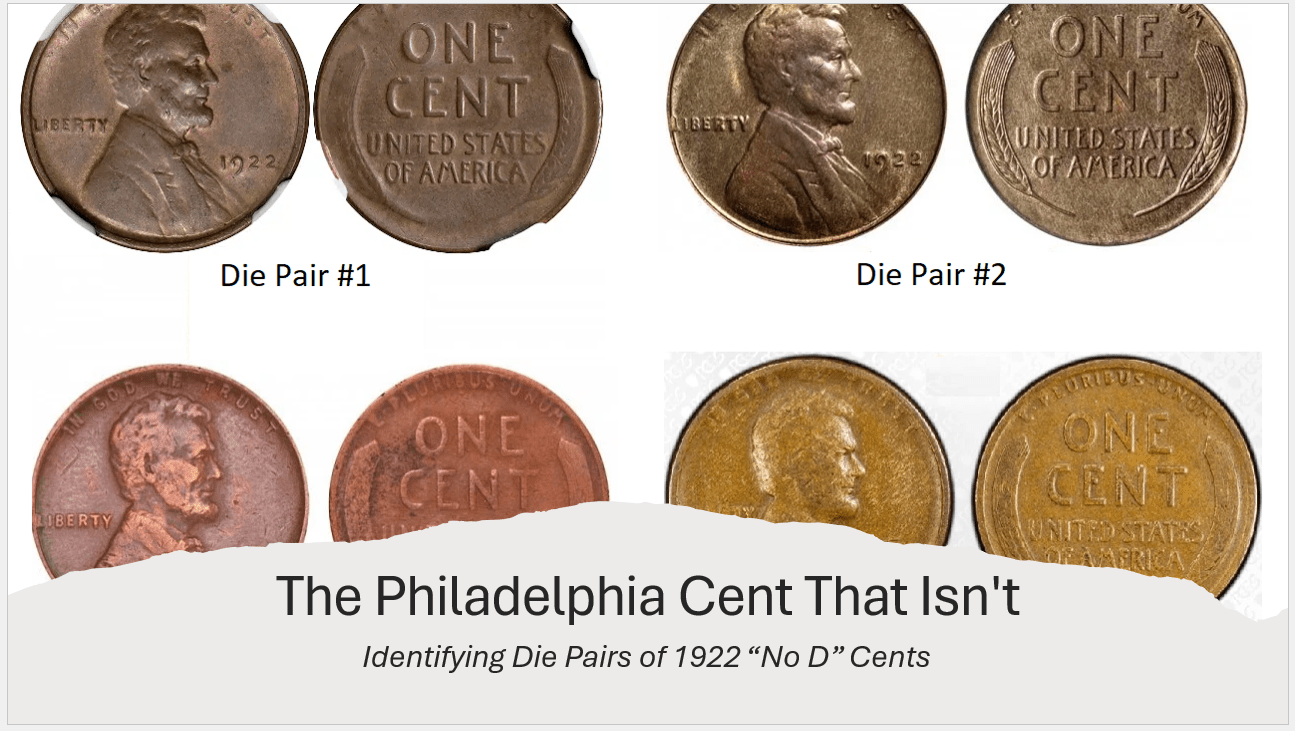
That’s why identifying the rarity is important. We’ll explore that here.
The 1922 Cent is categorized as follows:
Standard 1922-D (Normal mint mark)
1922 “Weak D” (Faint, blurry, or partially filled mint mark)
1922 “No D” / Plain (Mint mark completely missing)
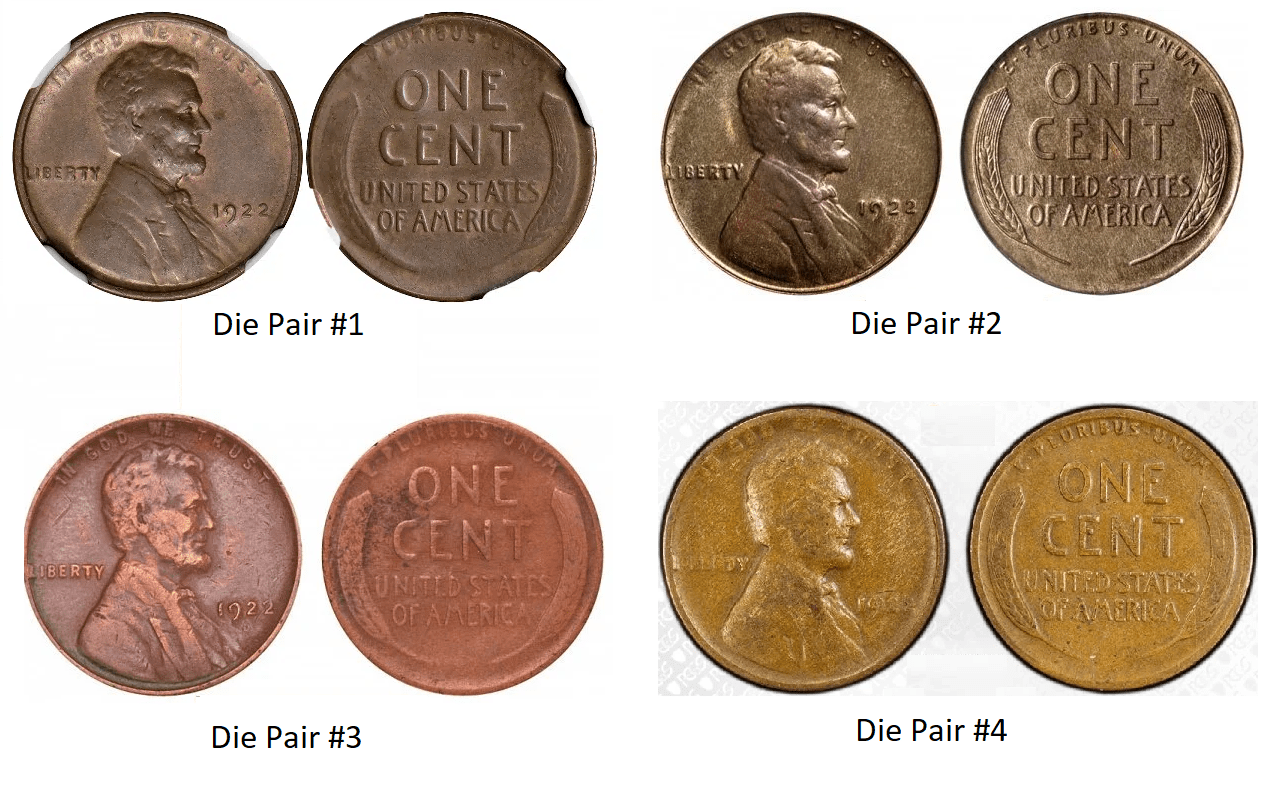
In addition, value is assessed by die pairs:
Die Pair #1 (Weak D / No D – Weak Reverse). Mushy or missing lines on wheat stalks. Die Pair #2 (“No D” Strong Reverse). Clear lines on wheat stalks. Die Pair #3 (Weak D / No D – Weak Reverse). The final “2” in the date is notably weaker than the first “2”. Die Pair #4 (Weak D / No D – Weak Reverse): Very similar to pair 3 but typically even mushier.
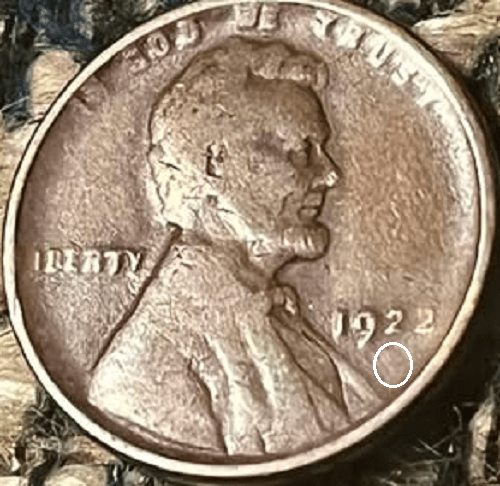
Scammers find it easy to erase the “D” on a well-defined 1922-D normal mintmark coin. They do so by tooling or filling the area where the mintmark should be. Here’s a suspicioius example:
This is one occasion to use a coin microscope. Any deviation on the surface is suspect.
Also keep in mind that China mass produces replicas that dishonest sellers offer as authentic. Example:
As always, if you cannot distinguish die pairs, or are unsure, do not bid on or buy any unholdered coin.
As you might anticipate, die pair #2 values are expensive.
If you like posts like this, subscribe so you can be informed whenever there is a new article or column.
Proxiblog also has thousands of followers on Facebook Coin Groups, YouTube and social media. To get the latest discussion and commentary, be sure to friend us by clicking here.
You can find more information about types, varieties, errors, grading, bidding and buying in Coin News Updated: The Essential Guide to Online Bidding. Please consider buying or gifting the work for a friend, as it underwrites this hobbyist blog. Thank you.
A condition rarity is not associated with mintage but with other factors. Sometimes people neglected to save uncirculated examples, as in the 1884-S Morgan Dollar. The 1927-D Saint-Gaudens Double Eagle had a good mintage of 180,000; but almost all were melted. The 1953-S Franklin half dollar had a mintage of 4,148,000 but suffers from poor strikes due to worn working dies. As such, it is extremely rare to find one with full bell lines. There just wasn’t enough pressure to create the unbroken lines on the liberty bell.
But can strive to find an example with at least some of the lines on the reverse.
Let’s define FBL. The designation requires fully separated, uninterrupted lines at the bottom of the Liberty Bell on the reverse. The lower sets of horizontal lines on the bell must be complete and distinct. To qualify, coins must grade MS-60 or higher, with no major disruptions to the lines, which also must be free from major cuts, heavy marks, or disturbances.
The horizontal lines must be clear and readable. Let’s take a close look this FBL example:
You can find many uncirculated Franklin halves with full bell lines. But the 1953-S is the key date. The dozens of 1953-S halves that earned FBL were struck early in the production run before the dies deteriorated.
While you may not find the ultra rare 1953-S FBL, you might have luck with other San Francisco business strike half dollars, as these also bring premiums.
The San Francisco Mint made half dollars in these years: 1949, 1951, 1952, 1953 and 1954. Each one apart from the rare 1953-S brings a nice premium with FBL.
YEAR
1949-S
1951-S
1952-S
1953-S
1954-S
MS65
$130
$70
$125
$125
$50
MS65FBL
$475
$375
$1,050
$32,500
$225
The San Francisco Mint stopped making half dollars in 1954 so that its machinery could be updated. But you can still assemble a set of 1949-54 halves for a reasonable price. The goal is to get the FBL on 1949-52 and 1954 and a 1953-S half with at least some of the full bell lines.
This PCGS slabbed MS65 1953-S Sold for $100 at Stack’s Bowers. I consider this a score because so many of the lines are evident, apart from the middle.
You can find some with some distinguishable lines on eBay, but they often are overpriced, as this example. I drew the red circle showing this is NOT Full Bell Lines.
You also want to watch what 1953-S half dollars sell for on major auction houses, including GreatCollections, which sold this gem in 2019.
Assembling a set of Franklin halves is easily doable. Try for as many full bell lines as your budget allows.
If you like posts like this, subscribe so you can be informed whenever there is a new article or column.
Proxiblog also has thousands of followers on Facebook Coin Groups, YouTube and social media. To get the latest discussion and commentary, be sure to friend us by clicking here.
You can find more information about types, varieties, errors, grading, bidding and buying in Coin News Updated: The Essential Guide to Online Bidding. Please consider buying or gifting the work for a friend, as it underwrites this hobbyist blog. Thank you.
Doubled dies are valuable because you can usually readily see the spread without a coin microscope. The naked eye or loupe is all you need.
You can easily go down the rabbit hole checking Wexler or Variety Vista, both of which are dedicated to die markers and varieties, along with hub doubling. There are just too many entries with obtuse markers for the beginning collector. Focus on these first so you can see what hub doubling actually looks like.
1972 Lincoln Cent (DDO-001):Another famous modern cent variety with a huge spread. NOTE: Go to the link to see other 1972 doubled dies. You might need a microscope to see them.
1995 Lincoln Cent (DDO-001): A popular modern find heavily distributed into regular circulation with easily seen doubling on “LIBERTY.”
1909 VDB Lincoln Cent (DDO-001): The first year of the Lincoln cent with doubling on the date and obverse text.
1917 Lincoln Cent (DDO-001): This cent features very strong, distinctive doubling on the date and the motto.
1936 Lincoln Cent (DDO-001): Philadelphia produced three separate DDOs this year, but Type 1 is famous for its wide, bold spread on the date and legends.
1970-S Lincoln Cent “Large Date” (DDO-001): A rare San Francisco variety with strong doubling on the mottoes and date.
1916 Buffalo Nickel (DDO-001): Heavily doubled and easy to see, one of the most coveted.
Veteran hobbyists forget that beginning collectors typically do not know VAMs for Morgan and Peace dollars and also for minor doubled dies–Wexler and Variety Vista is full of them.
Veteran hobbyists, especially on Facebook and social media, should remember that beginners do not know how to navigate those rabbit holds and think everything is a valuable doubled die. Few beginners and even long-time hobbyists may not know VAMs, obscure types of doubled dies (Classes I-IX), and common mint errors.
Keep it simple, as this article does.
If you are a collector of varieties and doubled dies, be sure to see our directory that features denominations that carry unique PCGS numbers. Articles there, too.
If you like posts like this, subscribe so you can be informed whenever there is a new article or column.
Proxiblog also has thousands of followers on Facebook Coin Groups, YouTube and other social media. To get the latest discussion and commentary, be sure to friend us by clicking here.
You can find more information about types, varieties, errors, grading, bidding and buying in Coin News Updated: The Essential Guide to Online Bidding. Please consider buying or gifting the work for a friend, as it underwrites this hobbyist blog. Thank you.
The 2017 Lincoln cent carried the “P” mint mark to celebrate the U.S. Mint’s 225th anniversary. The Mint released the coins into circulation in January 2017 without any announcement, gaining publicity as collectors began noticing the change.
While unique, these cents are common. More than 4 billion of them were struck. Examples grading MS67+ retail for $80 but typically sell for about $30 in PCGS slabs. At MS68, graded by top companies, the price skyrockets to $500; but these are ultra rarities in such a high grade. Nevertheless, it is still fun to find the 2017-P cent in pocket change.
The “P” mint mark has never been used on a cent before or after 2017.
Hobbyists know that the Philadelphia Mint used no mintmark on coins because initially there were no branch mints. However, when other mints opened in Denver and San Francisco, for instance, they started using the “D” and “S” mintmarks on coins.
Beware of scammers claiming some 2017 cents are missing the “P” mintmark. That can only happen on grease strikes. Why? Because the “P” mintmark was etched on the master die for 2017 cents. You have to know how coins are made to realize why there is no missing “P” errors on 2017 cents.
In 2018, the Philadelphia Mint returned to the convention of no mintmark.
Other denominations have used the P mintmark. The nickel used the mintmark from 1942 to 1945 on 35% Silver “War Nickels” and then was removed. The “P” returned to nickels in 1980. Also in that year, dimes, quarters, half dollars started using the P mintmark. In 1979 the P mintmark appeared on the Susan B. Anthony dollar and henceforth was used on all Philly dollar coins, including the Sacagawea, Presidential, and American Innovation dollars.
Social media has hyped “missing mintmarks” as ultra rarities. Here’s a chart of them with odds of finding any.
If you would like to know more about these missing mintmarks, click here.
If you like posts like this, please subscribe so you can be informed whenever there is a new article or column.
Proxiblog also has thousands of followers on Facebook Coin Groups, YouTube and social media. To get the latest discussion and commentaries, click here.
You can find more information about errors and varieties as well as buying and bidding on coins in Coin News Updated: The Essential Guide to Online Bidding. Please consider purchasing the work for yourself or a friend, as it underwrites this hobbyist website. Thank you.
Everyone knows that Chinese counterfeits have flooded the coin market with some production estimates exporting between 100,000 to 500,000 counterfeit coins per month. The majority of these are offered as raw coins on eBay, Etsy and Temu, among others. But now a new threat has emerged: sellers offering counterfeits in fake PCGS holders with phony “Not PCGS” certification sites.
This is a much-overlooked consequence because it attacks the fundamental priority of top holdering companies: authentication.
These fakes pop up when you try to access PCGS. To show how frequent, I now will access the site and report the results in 10 minutes of searching.
These are from different sellers. I could have published a dozen or more.
When viewing counterfeit “Not PCGS” coins on eBay, you’ll see that sellers have few sales. Never bid or buy from such sellers. Nevertheless, that is not the lesson here. It is the erosion of the reputation of the top holdering companies in the hobby.
While we cannot do anything about Chinese fakes, we can ask eBay to listen more closely to our messages and reports about counterfeits and perhaps fix their algorithm and provide more education for their customer service employees.
To be fair, eBay has honored many of our complaints about counterfeit coins. It has forced sellers to reimburse buyers of counterfeit coins. We know that.
But the issue now is the proliferation of counterfeits in fake PCGS holders. An algorithm or customer service employee may see that famous logo and–ironically!–believe the listing is authentic because … wait for it … it trusts PCGS’s reputation.
That is why counterfeiters are using fake PCGS holders, playing off of PCGS’s good name. They also play off the good name of top auction houses like GreatCollections with fake stickers.
Every hobbyist needs to know counterfeit detection. Click here for that. Here is a visual primer on how you, too, can identify counterfeit coins in fake PCGS holders:
Our concern here focuses on the hobby and the ramifications of using fake PCGS holders to fool hobbyists into thinking they have a genuine coin.
While many hobbyists have complained about counterfeits, the conventional wisdom is disappointing: nothing can be done because the Chinese government allows this as part of its economy.
That thinking results in defeatism. If nothing can be done, then the hobby is at risk. But that risk is becoming greater each day. If eBay in particular does little when informed about counterfeits, because (a) its algorithm cannot detect a fake based on die markers and (b) its customer service may not be schooled enough to know those markers, seeing only a slabbed PCGS coin; then (c) the corporate reputation of PCGS is at issue.
This is an article about that premise. eBay can argue that it has invested $X amount of dollars in counterfeit detection and even has customer service employees check listings when multiple complaints have been lodged; but if both are proving at many occasions ineffective, that is not a strong defense when it comes to PCGS. It only means that eBay’s methods need enhancement.
These are matters beyond the scope of this article.
Stephanie Sabin, president of PCGS, is aware of the ongoing issue.
She provided Proxiblog with this statement:
“Since founding PCGS in 1986, our mission has been to protect collectors through leading authentication, grading, and the most secure holders in the industry. However, a powerful brand inevitably attracts counterfeiters, and we treat combating these fraudulent holders as an aggressive, ongoing priority. True security requires staying multiple steps ahead, which is why we continually invest in advanced overt and covert security features across all our product lines. We applaud the dedicated individuals and organizations within our community who work tirelessly to educate collectors on the dangers of counterfeit holders; their vigilance to eliminate altered and fraudulent collectibles is essential to protecting consumers and preserving the integrity of the numismatic marketplace. By combining their grassroots educational initiatives with our ongoing technical innovations and strengthened marketplace partnerships, we will continue to build a safer, more secure hobby for all.”
In recent years, Chinese counterfeiters have upped the ante, targeting PCGS, often cited as the most reliable and top holdering company. Not only are the coins fake; the holders are too. And the certs open to a fake PCGS authentication site.
Proxiblog’s Jack Young, Jack Riley and Michael Bugeja have been monitoring the proliferation of “Not PCGS” counterfeit coins.
In January, Jack Young wrote, “As if the Chinese counterfeit coins in fake PCGS slabs isn’t bad enough, now there appears to be a fake Chinese PCGS website to verify them.”
Young identified this counterfeit:
Of course he checked the cert and found no similar or other coin. His next step was to try to read the reverse label QR code. He got this:
A fake coin. A fake holder. A fake site. (If you are interested in the complete article about this fake coin and site, click here.) Jack Young has found that this trifecta is happening again.
He has found two more sellers that offer fake coins in fake PCGS holders with certs going to a fake PCGS site.
Jack Young says “Michael and I have been discussing what I have termed the ‘proliferation’ of counterfeit coins using stolen PCGS Intellectual Property, fake ‘PCGS’ holders on eBay. I see all of the listings ‘allowed’ there as a huge failing of eBay. And their AI reporting process is also an apparent failure to many collectors and hobbyists as well.
“So, going forward I use eBay for new material to write counterfeit articles on, and today’s usual browse of ‘US Coins’ on the Bay resulted in 44 counterfeit coins in fake PCGS slabs listed on just the 1st page. I screen-printed a number but quite frankly got tired of the effort after documenting these below.”
Snippet of the 44 listings available on 1-page of eBay US Coin listings 6-11-26
The frustration with eBay stems from counterfeit experts using the eBay reporting system only to be told that the fraudulent listing is fine and nothing will be done. Example:
But it gets worse. Jack Young has been warned about reporting counterfeit coins on eBay, further damaging its supposed defense that it vets all reports of fake offerings on the platform. Example:
Because of the proliferation of “Not PCGS” counterfeits, Jack Young and Proxiblog have received or seen requests on Facebook coin groups to check if an actual authentic PCGS coin is, well, authentic!
In sum, scam sellers acting in effect as agents of Chinese counterfeiters are eroding the very heart of what top holdering companies do: authenticate.
The question now, of course, is what can be done collectively.
Jack Young and I have contacts at PCGS, which has encouraged us to report fake offerings and to do one more thing: inform the company if eBay refuses to take action. But that will hardly fix the problem. The issue at hand is what can be done when popular platforms like eBay get it wrong at the expense of its bidders and holdering companies.
That will have to be decided by others.
Proxiblog can help by continuing to grow our subscriber base and influence on Facebook. Jack Young and Jack Riley also have large spheres of influence. But we need the American Numismatic Association, the U.S. Mint and the National Coin and Bullion Association to understand this new threat of corporate reputation and to break the defeatism that nothing can be done.
Let’s review legalities:
Counterfeiting or knowingly passing fake coins is a federal crime punishable by up to 15 years in prison and severe fines. The U.S. Secret Service investigates all suspected counterfeit coins.
The creation, sale and distribution (pertinent here) of fake coins can be prosecuted under United States Codes:
Manufacturing and Forging (18 U.S. Code § 485): Falsely making, forging, or counterfeiting any coin (valued higher than 5 cents) or any gold or silver bar is punishable by up to 15 years in prison and substantial fines.
Passing or Possessing (18 U.S. Code § 485): Passing, selling or bringing counterfeit coins into the United States with the intent to defraud carries a penalty of up to5 years in prison.
There is also the Hobby Protection Act, which states, it is illegal to buy, sell or possess counterfeit coins. Moreover, all replica, copy or imitation numismatic items must be plainly and permanently marked with the word “COPY”.
Jack Young, Michael Bugeja and Proxiblog subscribers have encountered sellers who bought a counterfeit coin, are reselling it as genuine and refuse to take it down.
We present one example here, but we encounter this regularly.
Here are exchanges by Bugeja and subscriber Tim Scott, trying fruitlessly with eBay to take down this obvious fake. Our complaints were ignored by eBay.
Despite our concerns, shared across Facebook coin groups, the fake coin in a fake PCGS holder sold for $607.33. You can see it had 24 bids.
We thank Stephanie Sabin and PCGS for helping us safeguard their reputation and our hobby.
If you like posts like this, please go to our counterfeit archive with reports from Jack Riley, Jack D. Young, John Lorenzo and Michael Bugeja. Also, please subscribe so you be informed whenever there is a new article or column.
Proxiblog also has thousands of followers on Facebook Coin Groups, YouTube and social media. To get the latest discussion and commentary, be sure to friend us by clicking here.
You can find more information about errors and varieties as well as buying and bidding on coins in Coin News Updated: The Essential Guide to Online Bidding. Please consider purchasing the work for yourself or a friend, as it underwrites this hobbyist website. Thank you.
Grease or debris, coupled with die deterioration, causes a filled mintmark, evidenced on many coins, including Morgan dollars. But the “1921-S VAM 6B, Filled S” dollar is special because the mintmark has a flaw in the die as well as a gouge on the obverse.
Before we delve into this variety, we need to define some terms, beginning with VAMs, initials of numismatists Van Allen and Mallis who cataloged die varieties of U.S. Morgan and Peace silver dollars.
As noted earlier, the specific die marker for this coin is: VAM 6B.
In addition to the filled “S” mintmark, the 1921-S variety has a die gouge on the obverse, making it more valuable than a regular issue.
A die gouge can be mistaken at times for a die crack. So we have to define those, too.
Die gouges occur when a foreign object is dragged across the die face, allowing metal to fill the divot, resulting in a raised area. Sometimes the dragged object creates a line, as in the 1921-S VAM 6B dollar. It may appear like a die crack. The difference is a gouge is created by that foreign object whereas a die crack results from pressure during the striking process.
Here’s an example:
Now that we know those terms, we can discuss the die markers of the 1921-S VAM 6B.
Let’s look at the filled S mintmark first:
The filled mintmark of this Morgan variety differs from a grease strike because the “S” also exhibits a flaw in the die, distorting the S. Compare:
Now let’s look closely at the die gouge:
Not all die gouges are straight lines as here. In this case, the dragged object caused the line.
This particular variety carries a unique number in the PCGS catalogue (412698) from which these photos have been taken.
PCGS CoinFacts also lists values for this variety. Compare the prices with a regular 1921-S:
As you can see, the higher the grade on this variety, the more valuable.
While you may not be interested in this Morgan, going through the die markers here–or any VAM–will help you learn more about the minting process.
If you like posts like this, subscribe so you can be informed whenever there is a new article or column.
Proxiblog also has thousands of followers on Facebook Coin Groups, YouTube and social media. To get the latest discussion and commentary, be sure to friend us by clicking here.
You can find more information about types, varieties, errors, grading, bidding and buying in Coin News Updated: The Essential Guide to Online Bidding. Please consider buying or gifting the work for a friend, as it underwrites this hobbyist blog. Thank you.