Numismatic posts about grading, identifying, buying, selling and bidding on coins
Category Archives: Counterfeit
These posts provide methods to detect Chinese and other fake coins and holders, bringing awareness to the thousands of counterfeit coins being sold on eBay and other platforms.
Only a handful of 1992/92-D Close AM coins have been found in the past decades, making these high-value variations extremely desired and also relatively easy to dupe both the buyer and eBay (when sellers do not accept returns). In the video below, Proxiblog’s Michael Bugeja shows how a person can photograph the obverse of a typical 1992/92-D Wide AM and the reverse of a 1993-2000 Close AM and depict them side by side as if one coin.
Now comes the hard part for the unfortunate buyer. He receives a 1992/92-D Wide AM. He may not know the die markers (disclosed in the video) or he may, leaving him with the distressing chore of trying to explain die markers to eBay when the seller doesn’t accept returns. While arguing counterfeit with eBay sometimes works, good luck when it comes to die markers. This is why Proxiblog recommends never buying or bidding on unholdered rarities.
If you like posts like this, please subscribe so you can get our weekly newsletter and be informed whenever there is a new article or column.
Proxiblog also has thousands of followers on Facebook Coin Groups, YouTube and social media. To get the latest discussion and commentaries, click here.
You can find more information about errors and varieties as well as buying and bidding on coins in Coin News Updated: The Essential Guide to Online Bidding. Please consider purchasing the work for yourself or a friend, as it underwrites this hobbyist website. Thank you.
A few months after Julius Caesar was assassinated on the Ides of March 44 BC, a comet streaked through the skies, making him a god in his followers’ eyes.
Some historical background: On March 15, the great Roman statesman and reformer, Gaius Julius Caesar, was assassinated. The historical record notes his military brilliance as well as his less popular role in ending the Roman Republic.
The celestial object, now known as Caesar’s Comet (C/-43 K1), appeared in July of that year and was seen as a sign Caesar’s deification.
The brilliant comet was visible for seven days. Romans interpreted the cosmic event as a sign that Caesar’s soul was ascending into the heavens and that he had joined the gods and Venus mother–a reference by the Roman poet Ovid.
Ovid describes the deification in Book 15 of his epic poem, Metamorphoses. In the passage, Venus takes Caesar’s spirit from his murdered body and carries it to the heavens, where she transforms it into a star.
This provided a propaganda occasion for Caesar’s adopted son, Octavian (who later became Emperor Augustus). He claimed to be a son of the now god Caesar, legitimizing his own rise to power.
The recognition had been put in place by Caesar before his death.
By placing Venus’s image on coins during his lifetime, Caesar had already reinforced his divine right to rule. Here are representative coins featured in a Coin Week article.
By imitating Caesar’s use of Venus in his own coinage, Octavian symbolically inherited not just his father’s name and legacy, but also his divine mandate.
Collectors covet these coins because of the heavenly history. They are pricey, too, because of the demand. Here is a retail example:
As with all coins, the marketplace is full of counterfeits. This is especially prevalent with Caesar’s military coins. His “Elephant” silver Denarius, minted circa 49–48 BC, typically weighs between 3.5 and 4.0 grams (commonly cited around 3.78g to 3.98g) and has a diameter of roughly 18mm.
eBay is full of counterfeits, especially from China and Bulgaria. Etsy and Temu offer these as replicas and they have flooded the market as authentic with scammers counting on buyers not understanding how to detect fakes.
If you are unfamiliar with ancient coins, only purchase ones slabbed by NGC (the best for ancients):
If you do not know ancient coins and want to add a Caesar coin to your collection, bid on or buy an example holdered by NGC. Also note these attributes of fake ones:
Seams: A genuine ancient Roman coin was struck between two metal dies, not cast in a mold. Counterfeit coins that are cast often have a raised line or seam on the edge.
Soft details: Cast fakes tend to have a soft, “soapy,” or indistinct appearance, especially in the fine details of the portrait and lettering. Genuine struck coins show a much sharper impression, even if worn.
Uneven surface: Pores or small bumps on the coin’s surface can indicate that it was cast. These marks are caused by trapped air bubbles in the mold during the casting process.
Weight and size: Casting can cause metal to shrink. As a result, cast fakes are often slightly smaller and lighter than their genuine counterparts.
Artificial patina: Forgers often apply a chemical patina to make a coin look ancient.
Consider the difference between a genuine and fake Venus Caesar coin:
If you like posts like this, please subscribe so you can get our weekly newsletter and be informed whenever there is a new article or column.
Proxiblog also has thousands of followers on Facebook Coin Groups, YouTube and social media. To get the latest discussion and commentaries, click here.
You can find more information about errors and varieties as well as buying and bidding on coins in Coin News Updated: The Essential Guide to Online Bidding. Please consider purchasing the work for yourself or a friend, as it underwrites this hobbyist website. Thank you.
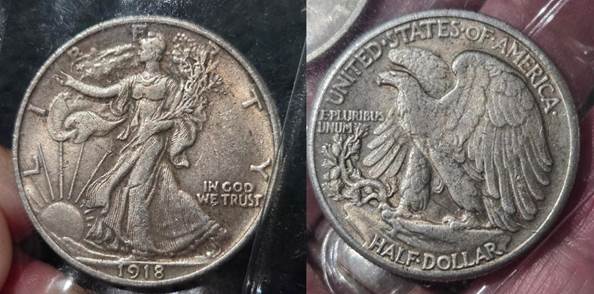
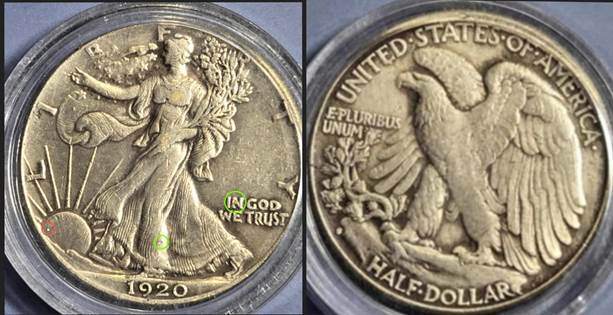
A counterfeit 1918 Half Dollar–part of what I refer to as the “Ruptured N Family”–has been documented for several years and recently surfaced on Facebook, prompting this article. As is common with many modern counterfeits, the piece displays grainy surfaces, raised lumps within the fields, and design elements that appear inconsistent with genuine examples and poorly executed.
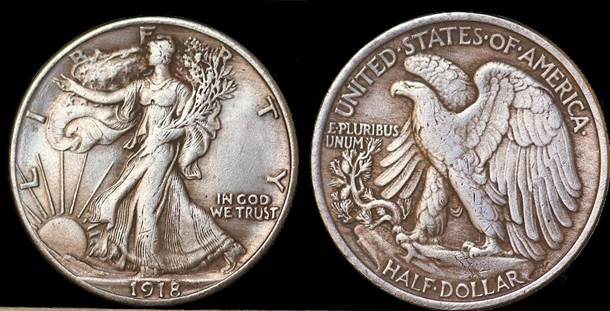
Another example offered online from a non-reputable source.
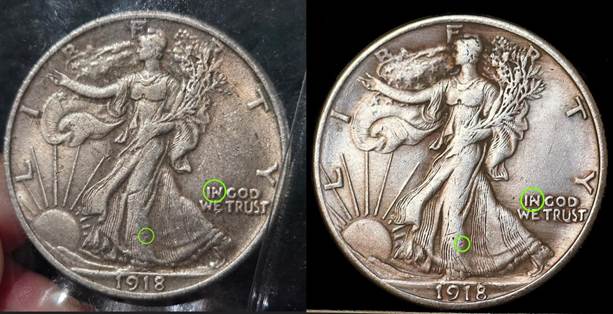
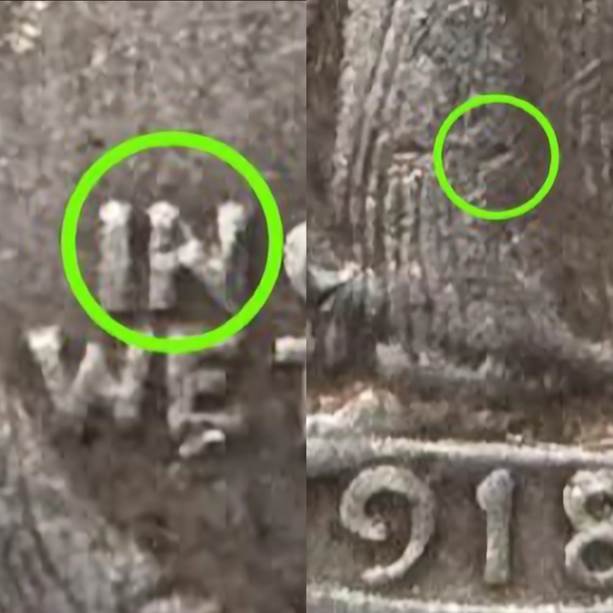
A comparison of the obverses show repeating marks with a prominent depression of the “N” and a noticeable dent in the lower gown.
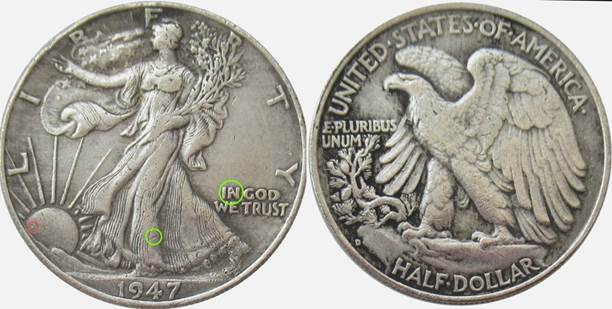
Of course, this would not be considered a “family” without additional dates. Evidence suggests a large-scale operation, with counterfeiters mixing and matching both obverse and reverse dies. Notably the 1920 and 1947 dated examples also display the distinctive large dot on the sun (highlighted in red).
Given the mix of various date and mintmark combinations, I did not provide an overview of the reverses, as they differ significantly. On the obverse, however, two consistent diagnostics are always present.
Once again, this counterfeit family reminds me to advise newer collectors to follow these general guidelines:
If you are ready to bid hundreds of dollars on a coin, resist buying a raw one and shop for one holdered by PCGS, NGC, ANACS and CAC.
Be especially careful when purchasing raw coins from eBay and other online venues. TAI bots cannot detect counterfeits, so you are on your own.
Make sure the seller takes returns and has good reviews. Also, the number of positive reviews is a good indicator. If someone has 0 sales or even fewer than 100, do not take a chance.
Weigh the coin and go to PCGS CoinFacts for the date and mintmark, checking your coin against weights and dimensions.
If you like posts like this, you can read more articles on counterfeit coins by Jack Riley, Jack D. Young and Michael Bugeja at this URL. Also, please subscribe so you can get our weekly newsletter and be informed whenever there is a new article or column.
Proxiblog also has thousands of followers on Facebook Coin Groups, YouTube and social media. To get the latest discussion and commentary, be sure to friend us by clicking here.
You can find more information about errors and varieties as well as buying and bidding on coins in Coin News Updated: The Essential Guide to Online Bidding. Please consider purchasing the work for yourself or a friend, as it underwrites this hobbyist website. Thank you.
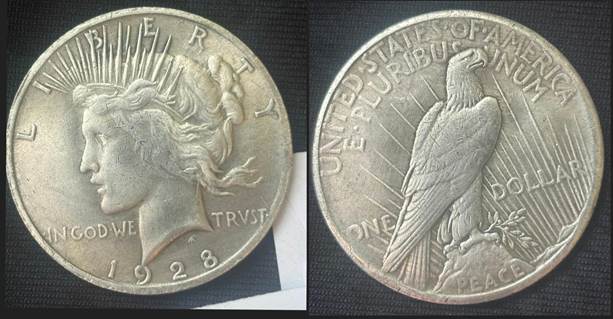
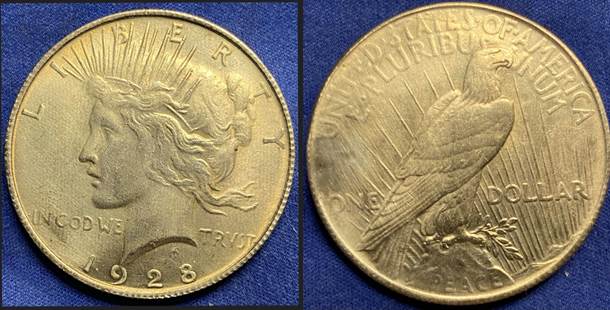
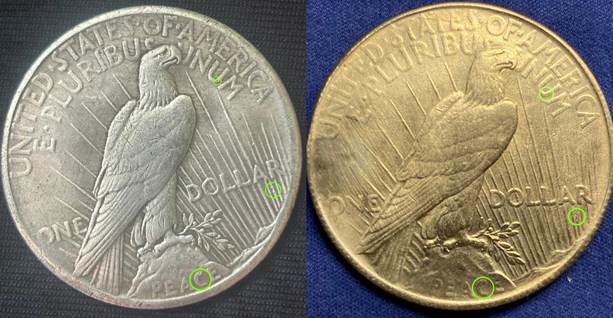
Another group of counterfeit Peace Dollars has surfaced. During my routine browsing of various Facebook groups and online marketplaces, I frequently encounter counterfeit examples of various series. In one of the larger groups, a 1928 Peace Dollar was shared with many commenters claiming this to be genuine and stating it “should be certified”. At first glance the overall appearance is that of many modern cast counterfeits. This prompted me to investigate further.
Several weeks ago, I was contacted by my colleague Dave Jordan, regarding a counterfeit 1928 Peace Dollar we had the opportunity to examine. At the time, I hadn’t documented this particular counterfeit. The recent example of another specimen, however, suggests that there are additional pieces in the market.
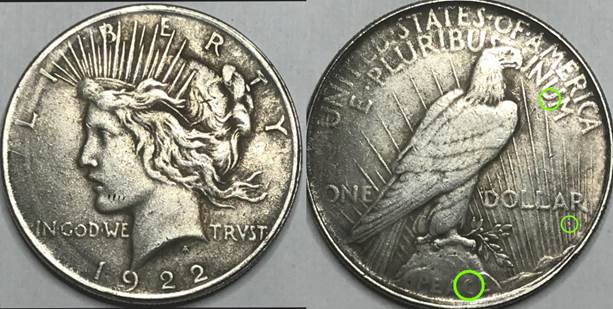
Upon comparison,it became evident that both examples originated from the same counterfeit family , which I refer to as the “Dotted Rays.” Several repeating marks are consistently present on the reverse, highlighted in green for reference :
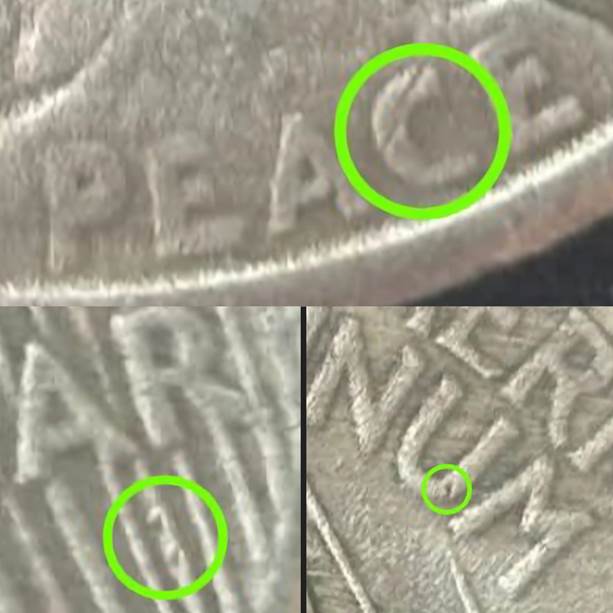
Two dent in the ray below A of Dollar
Diagonal slash through C of Peace
Depression in U of UNUM
This wouldn’t be a “family” with just one date. Following the search yielded at least 2 additional dates (1922 and 1927). Both of which share the “Dotted Rays reverse.”
I recognize that examining these markers in detail can be challenging. To assist readers, I have prepared a collage of close-up images highlighting the key diagnostics.
I share the news about these counterfeit dollars because you can lose many dollars bidding and buying them, only to find out later that you have been scammed.
In Proxiblog’s recent article about bidding online, titled “Bidding Basics,” we recommend working only with trusted sellers, especially on eBay, making sure you can return your purchases.
If you like posts like this, you can read more articles on counterfeit coins by Jack D. Young, Jack Riley and Michael Bugeja at this URL. Also, please subscribe so you can get our weekly newsletter and be informed whenever there is a new article or column.
Proxiblog also has thousands of followers on Facebook Coin Groups, YouTube and other venues. To get the latest discussion and commentary, be sure to friend us by clicking here.
You can find more information about errors and varieties as well as buying and bidding on coins in Coin News Updated: The Essential Guide to Online Bidding. Please consider purchasing the work for yourself or a friend, as it underwrites this hobbyist website. Thank you.
I have written a number of articles in several different venues about a scourge of counterfeit Morgan Dollars in fake “PCGS” holders including here on Proxiblog.
The subject of this short article features a newly discovered example and a known bad eBay seller and his other wares.
First, the bad seller. His 2 listings at this writing on the Bay are known bad ones including the stolen PCGS certification numbers:
Both were reported through their latest AI reporting process and removed.
His next one was previously sold last month and unfortunately, I missed it. The seller is now in a more prominent place on my bad seller list for periodic review.
And back a minute, the original source of these bad “coins” is actually in China (CN), and I continue to record new examples introduced to the marketplace in one of my Facebook Groups focused on counterfeits. And this one just hit my list this first week of September.
So, let’s review what makes this new one a counterfeit!
This one was sold as genuine, and someone got severely burned but apparently doesn’t know it:
Holy crap Batman, $786.01 for a counterfeit Morgan in a fake PCGS slab!
OK, we all say, “buy the coin, not the holder”; but I will start with the obvious, the holder. …
I know Proxiblog’s Michael Bugeja may have a comment, especially about fonts, as he is a journalist (wrong font again here for PCGS); but there also are a couple of “easy” observations without this one in hand.
There is no PCGS insignia in the lower right-hand corner, and the barcode is common gibberish for these: it will not read with my on-line scanner.
Similar ones I have in-hand have the “PCGS” label stuck to the outside of the slab and won’t scan. And the notion it has a scannable chip shown on the reverse is false as well.
And what about the “coin”?
One place I always start is looking for the TPG cert number on-line for any descriptions and images!
And this example uses a genuine PCGS cert # with on-line genuine images:
And comparing the genuine example to the counterfeit reverse shows some obvious differences.
Images of the genuine certed example on the left, subject counterfeit on the right
The “S” is an obvious issue with this one; many of the current CN counterfeits use a common reverse which is one of the reasons I often start with the reverse on this type of counterfeit.
At first blush I can say I have not seen this specific reverse previously, but that will be another research project going forward.
For completeness I have also included an obverse comparison image of the genuine certed one to this one. The date font and surface scratches show as major differences between the two.
Images of the genuine certed example are on the left, and the subject counterfeit on the right.
So, definitely not a match! And on to another reason I focus on the reverse. As I always state attribution is a major step in the review process and I regularly look up the known genuine reverses in VAMWorld.
For those not familiar with a “VAM,” I quote the following from my friends at APMEX:
A VAM Morgan dollar is a Morgan die variety. VAM Morgan dollars and VAM Peace dollars were first identified by numismatists Leroy Van Allen and A. George Mallis in The Comprehensive Catalog & Encyclopedia of Morgan and Peace Dollars.
VAM is an acronym for both authors’ last names, Van Allen and Mallis, and was adopted after the book was published.
So I looked up this date and mint-mark on their site:
Image from VAMWorld on-line site
Sorting by the known reverses, there are 7 shown on their site and none a match to this subject example.
So, it seems the counterfeiters just continue to pump out fakes at a dizzying pace, including this one with the “fakes in fakes” using counterfeit PCGS slabs and stolen cert #’s. It does make one wonder what if anything PCGS is doing in response.
If you like posts like this, you can read more articles on counterfeit coins by Jack Riley, Jack D. Young and Michael Bugeja at this URL. Also, please subscribe so you can be informed whenever there is a new article or column.
Proxiblog also has thousands of followers on Facebook Coin Groups, YouTube and social media. To get the latest discussion and commentary, be sure to friend us by clicking here.
You can find more information about errors and varieties as well as buying and bidding on coins in Coin News Updated: The Essential Guide to Online Bidding. Please consider purchasing the work for yourself or a friend, as it underwrites this hobbyist website. Thank you.
Morgan and Peace Dollars are among the most popular and widely collected U.S. coins. While many collectors appreciate these coins for their history and beauty, fewer take the time to explore the fascinating varieties of each series. These varieties, known as VAMs, are named after Leroy Van Allen and A. George Mallis, the researchers who carefully studied and cataloged them by their die marriage.
Learning VAMs can feel like stepping into a whole new dimension of collecting. It’s a field that rewards patience and curiosity, often taking years to master variety attribution. Thankfully, new collectors don’t have to start from scratch! Resources such as the VAMWorld website provide a wealth of information, guides, and images that make this specialized area more approachable.
VAMWorld allows users to “contribute, edit and improve” its listings, continually updated with new discoveries, delisted varieties, renumbered varieties, and other important revisions! It is the most up-to-date listing for Morgan and Peace Dollar varieties. While the site includes a dedicated tab for new collectors, this section is often overlooked. For those just beginning their journey of studying VAMs, I strongly recommend first to read the Definitionsand Attribution 101 pages as it will be needed to understand various design changes, date placements, mintmark locations, die clashing and other characteristics of variety attribution and terminology.
At present, VAMs aside, the hobby focuses on errors and varieties with newcomers, in particular, hunting ultra rarities such as 1992/1992-D Close AM or 1982-D Small Date 3.1 grams. Those types of varieties for Morgan and Peace dollars are catalogued in VAMWorld. But we go one step deeper. We not only identify that variety but also the various dies that might have created it and the popularity of those varieties within a variety.
Let’s see how Proxiblog’s Michael Bugeja uses VAMs to show all the various types of 1900-O/CC Morgans. The popularity and value of this Morgan is not only the variety, but the prominence thereof. VAMs 7 through 12 identify the difference in prominence of the overmintmark.
I often stress to newer collectors the importance of learning and understanding the reverse hub types for the Morgan Dollar series. This chart represents all of the reverse hub types used for the series in detail. It mentions only 1878 but is for the entire Morgan series from 1878-1921.
Granted, the above chart might intimidate hobbyists new to VAMs. Let’s simplify everything and show how three different VAM reverses for the 1878 8TF, replete with pickup points:
Developing a strong grasp of these distinctions is invaluable not only for attribution but also for detecting counterfeit pieces, as reverse hub diagnostics can quickly reveal inconsistencies.
In my very first article for Proxiblog, I used VAMs to discover a family of counterfeits that fooled collectors and grading services for decades. I wrote, “The ‘Micro O’ varieties have always been scarce coins to come by, and in 2005, these were deemed counterfeit by PCGS when 3 examples showed repeating circulation marks between the 1896 O VAM-4, 1900 O VAM-5, and 1902 O VAM-3.”
Navigating the VAMWorld website can feel overwhelming for newer collectors, but becomes much easier when utilizing the tools and resources provided. Each date specific page includes a set of guides.
Many collectors focus on the Top 100,Hot 50, and Hit List 40 varieties. These showcase the most popular and valuable varieties, minimizing what is known as “micro-vamming,” or listing insignificant types.
Introducing the Top 100, VAMWorld writes, “Many of these VAMs have entered the mainstream collecting of Morgan dollars; it has become unheard of to claim a complete Morgan dollar collection without including the 1882-O/S, Scarface, Hot Lips, and an 1900-O over CC example among several other varieties.”
Proxiblog emphasizes this with articles on each of those above and more. For instance, click the photo below to go to these VAM varieties that are viewed, simply, as desirable and valuable Morgans:
If you like posts like this, subscribe so you can be informed whenever there is a new article or column.
Proxiblog also has thousands of followers on Facebook Coin Groups, YouTube and social media. To get the latest discussion and commentary, be sure to friend us by clicking here.
You can find more information about types, varieties, errors, grading, bidding and buying in Coin News Updated: The Essential Guide to Online Bidding. Please consider buying or gifting the work for a friend, as it underwrites this hobbyist blog. Thank you.
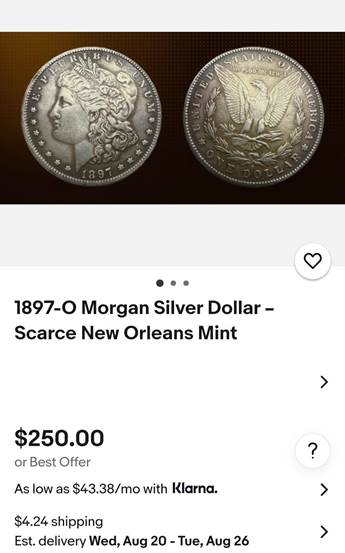
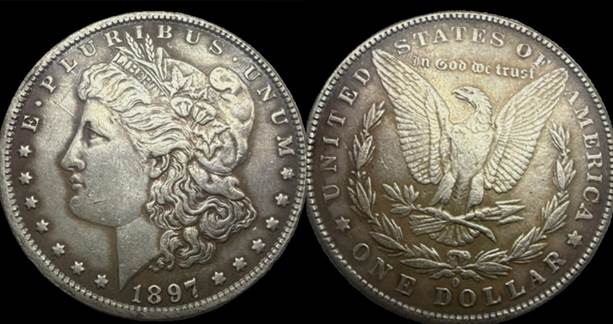
In Numismatics, authenticity generally serves as the foundation in which all other qualities–such as grade, variety, and historical importance–are evaluated. Without certainty of authenticity, a coin’s value is nullified. This article was prompted by a recent eBay listing for an 1897-O Morgan Dollar offered at $250, which upon review, was determined to be counterfeit. For ethical reasons, the seller’s identity will remain undisclosed. After being contacted, the seller acted responsibly by immediately removing the listing and clarifying that they had been unaware of the coin’s illegitimacy. Their swift response and willingness to prevent the sale of a counterfeit merits recognition.
Here is a closer view of the coin in question. Immediately noticing the “Oval O” reverse which is not seen on 1897 dated coins, one can see something is wrong!
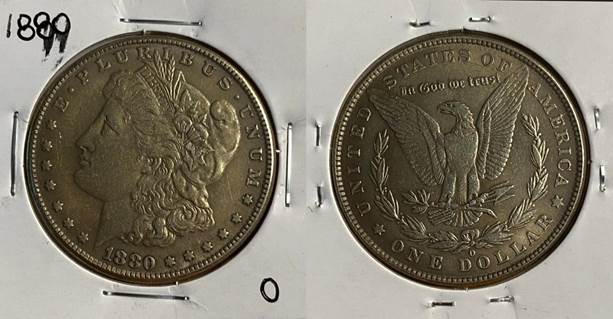
Image from an 1880-O courtesy of my friend Dave Jordan that shares a common reverse to the 1897-O listed on eBay.
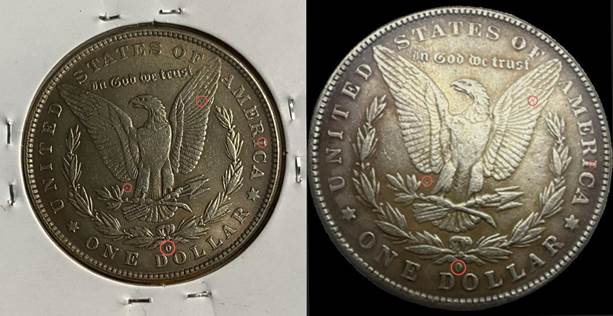
A side by side comparison shows common markers related to this “Family.” Noteworthy markers include:
Oval O set left
Indent above the 2 berries below the right wing
Depression mark in the eagles left wing (viewers right) just above the tip of the wreath
Minor depression mark of the “I” in America
It is worth mentioning this reverse has been seen on 1895-O dated coins with an additional crack through the “T” of United. These are better quality counterfeits than many you may come across.
By understanding how die markers are used and by carefully examining coins for inconsistencies, coin collectors can increase their ability to identify counterfeit coins.
If you like posts like this, please go to our counterfeit archive with reports from Jack Riley, Jack D. Young and Michael Bugeja. Also, please subscribe so you can get our weekly newsletter and be informed whenever there is a new article or column.
Proxiblog also has thousands of followers on Facebook Coin Groups, YouTube and social media. To get the latest discussion and commentary, be sure to friend us by clicking here.
You can find more information about errors and varieties as well as buying and bidding on coins in Coin News Updated: The Essential Guide to Online Bidding. Please consider purchasing the work for yourself or a friend, as it underwrites this hobbyist website. Thank you.
The key date of the Wheat Cent series is not only among the most popular of U.S. coins but also one of the most counterfeited ones, too, due to its value, rarity and ease of alteration. This is why Proxiblog recommends that collectors authenticate their raw coins with a top third-party grader. There are just too many fake coins out there.
But how to tell?
This article provides several die markers so that you can verify whether a coin is real before you purchase it. But before introducing them, we need to revisit coin history.
Controversial Initials
Fake 1909-S VDB cents have sullied the hobby ever since the U.S. Mint called attention to it by repositioning the designer’s initials from the reverse to the obverse in a much less conspicuous place.
Secretary of the Treasury Franklin MacVeagh disliked the prominence of Victor David Brenner’s initials and stopped production in August of that year, removing initials entirely on the remaining 1909 and 1909-S cents. That is why you only find the initials on some 1909 and 1909-S examples. In fact, those initials did not appear again until 1918 when the VDB appears below Lincoln’s shoulders. That’s how angry MacVeagh was. But he wasn’t thinking about counterfeits at the time even though his actions inadvertently made altered dates easy.
Scammers realized they stood to make big profits merely by adding:
An “S” to a 1909 VDB cent.
VDB to a 1909-S cent.
An “S” and “V.D.B” to a 1909 cent.
Rationale to do this concerned the scant 484,000 mintage of the key date 1909-S VDB and the high mintage of the Philadelphia coins (72,702,618 regular 1909 cents and 27,995,000 1909 VDB cents). The 1909-S NO VDB has a small mintage of 1,825,000 and is considered a semi-key date. But even these have been used in altered coins.
Values are synced with mintages. An EF45 1909 regular retails for about $7; 1909 VDB, $20; 1909-S, $200; and 1909-S VDB, $1,450.
In addition to the tens of thousands of altered dates over the years, current hobbyists have to contend with Chinese counterfeits and replicas sold as authentic on eBay and other venues.
This is why it is essential to know attributes of the dies that struck the rarity.
1909-S VDB Markers
There are four major ones:
Nodule on S mintmark.
Position of mintmark.
Slanted crossbar of the B in VDB.
Types I and II reverses.
Let’s get into it.
As NGC reported in 2016 that just one “S” mintmark punch was used on all San Francisco Lincoln cent issues from 1909 to 1916. This is the first step in identifying a fake.
Real “S” mintmarks have a nodule here:
Now compare mintmarks with a genuine, added mintmark and cast replica mintmark:
As you can see, the real mintmark has a Roman font with serif. The added mintmark doesn’t. The replica has a serif but no nodule.
There are also four mintmark positions with respect to the date, with each edging a tad lower from the first 9 and 0 of 1909.
Mintmark 1 has the highest “S” with the top close to the first 9 of the date.
Mintmark 2 has the top of the “S” equal distance between the first 9 and 0 of the date.
Mintmark 3 also has the top of the “S” closer to the 0 of the date than the first 9.
Mintmark 4 has the lowest position with top of the “S” nearly flush under the 0 of the date.
Another die marker concerns the initials themselves. The “B” in VDB has a slanted crossbar; fakes usually forget this.
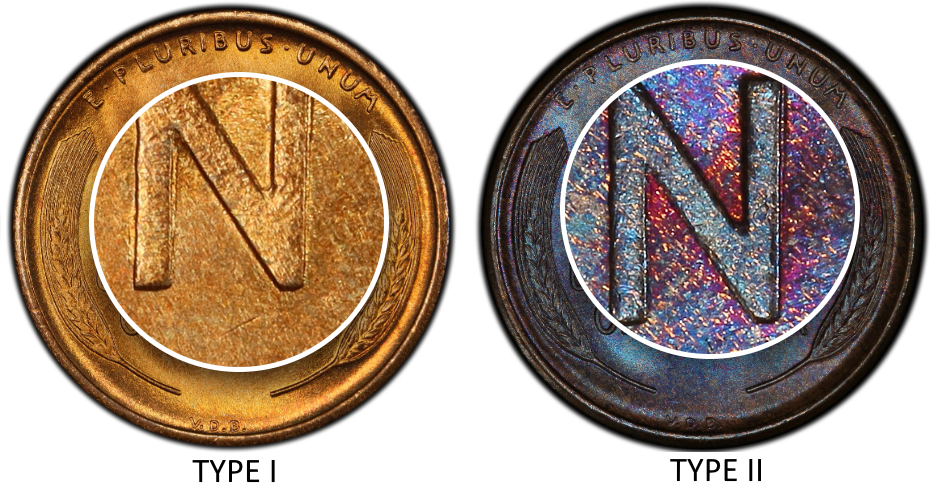
The last die marker concerns the extra thick stem of the letter “N” in “United.” A fake coin often forgets this minor detail.
The above features a Type I reverse. There is also a Type II reverse. Again, the letter N is critical in identifying this marker:
You can readily see the difference if you draw two lines from the top of the N stem to the bottom of the E stem. Parallel lines will show the gap wider in Type II. This is better shown than described:
If you like posts like this, you can read more articles on buying, selling and collecting at Proxiblog.org. Also, please subscribe to be informed whenever there is a new article or column.
Proxiblog also has hundreds of followers on Facebook Coin Groups. To get the latest discussion and commentary, be sure to friend us by clicking here.
You can find more information about errors and varieties as well as buying and bidding on coins in Coin News Updated: The Essential Guide to Online Bidding. Please consider purchasing the work for yourself or a friend, as it underwrites this hobbyist website. Thank you.
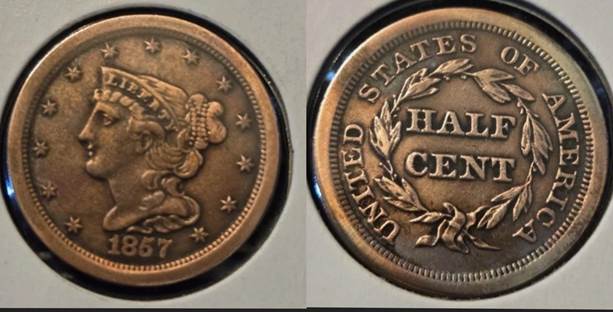
The saga continues of “new” counterfeits popping up on the market. In my downtime I enjoy browsing online sites and forums. In my search I stumbled across this 1857 half cent listed by what I would consider an average seller. Plenty of listings, with a number of them being genuine coins.
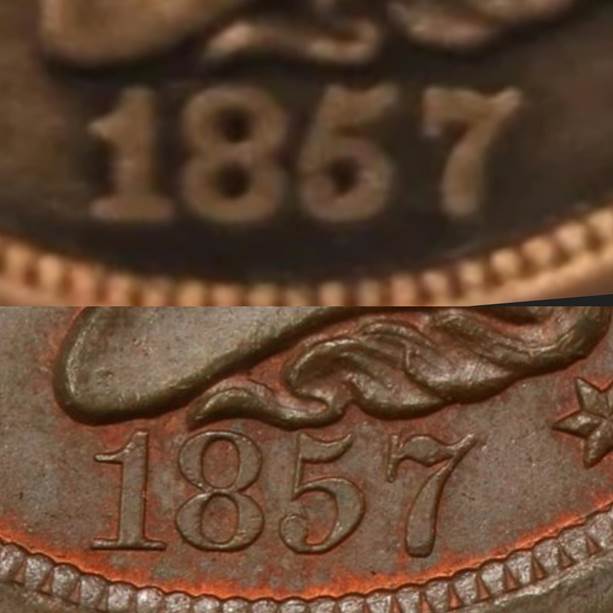
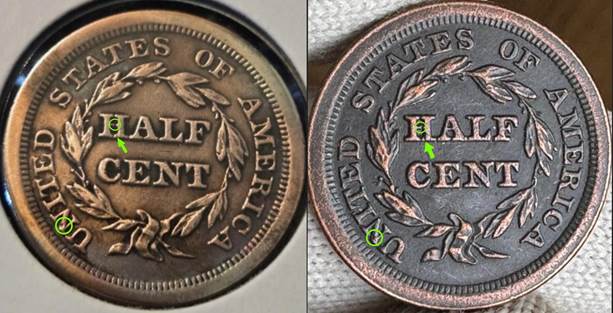
With only one die marriage being the C-1 for circulation issues, this should be a simple coin to attribute. Bay listing (Top) compared to a PCGS certified example (bottom). Clearly the date doesn’t attribute!
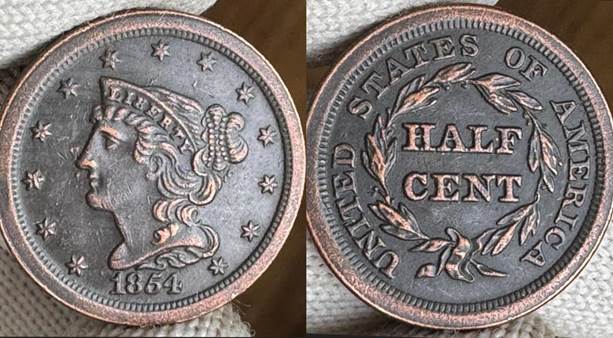
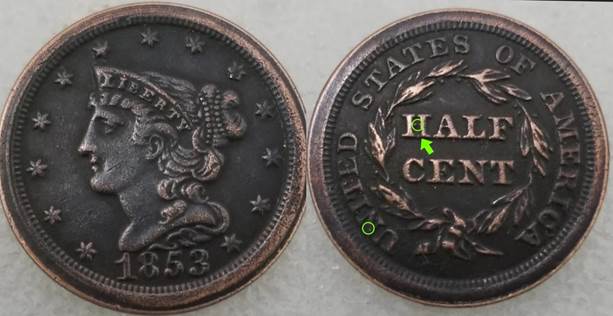
Following this, I set out to find more of the “family.” It didn’t take long to stumbled upon this 1854 example that shares a common reverse!
Both coins share this reverse with a large depression in the “N” and a line through the H of “Half.”
Fellow Proxiblog contributor Jack Young sent an eBay link of a spurious seller, and within the listings, it yielded another date sharing this reverse!
There seems to always be a “new one” weekly!
Because of that, I urge collectors to attribute a coin if they intend to buy it or at minimal ask a second opinion.
Attribution of a coin can be done by anyone, even without books! PCGS CoinFacts app as well as NGC’s variety plus are great tools that show images of many die marriages for most series. Compare your coin to the known varieties and determine if it matches. Many things play a factor such as date position relative to the denticles, star orientation, reverse lettering spacing.
Recognizing these differences will prepare you to attribute tougher varieties!
If you like posts like this, you can read more articles on counterfeit coins by Jack D. Young, Jack Riley and Michael Bugeja at this URL. Also, please subscribe so you can be informed whenever there is a new article or column.
Proxiblog also has thousands of followers on Facebook Coin Groups, YouTube and social media. To get the latest discussion and commentary, be sure to friend us by clicking here.
You can find more information about errors and varieties as well as buying and bidding on coins in Coin News Updated: The Essential Guide to Online Bidding. Please consider purchasing the work for yourself or a friend, as it underwrites this hobbyist website. Thank you.
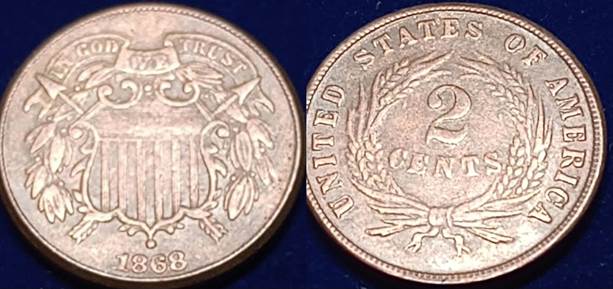
This 1868 2 Cent piece surfaced on a Facebook group and raised eyebrows. The coin didn’t appear as a genuine struck coin and sparked a conversation on the piece, as wont to happen on the platform, with comments proclaiming “fake” and others “get it graded” and so on.
This was the conversation piece:
Before we get into specifics here, some basics. Two cent coins were produced between the years 1864 to 1873. The denomination was introduced during the Civil War to address a coin shortage and filled the gap left by other denominations being hoarded. The 1964 two-cent coin was the first to use the motto, “In God We Trust.”
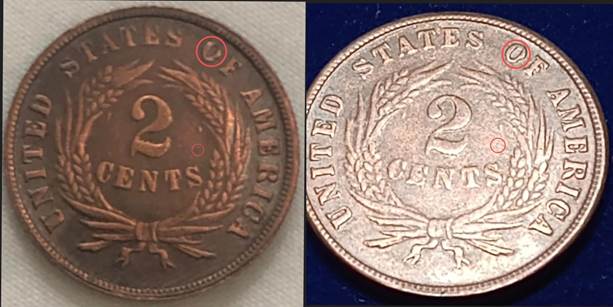
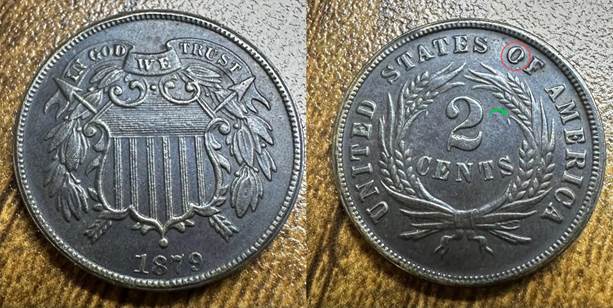
Back to the issue at hand. In my internet browsing I found yet another 1868 2 Cent piece that is a pretty clear cast counterfeit. Both share a common reverse which I would call the “Notched O.” Also, there is a small lump above “cents,” highlighted in red. It is worth mentioning the leaves are disconnected but not highlighted.
What could add to this “Family” you may ask? A fantasy date 1879! The Notched O is still represented however the small lump is gone. Green arrow points to the disconnected leaf referenced earlier. This example sports a small field lump below “OF” awell.
The addition of the 1879 shows that this can and will be “mix matched” with any date. It would be of no surprise if this already exists on every date of the 2 Cent series!
If you like posts like this, you can read more articles on counterfeit coins by Jack Riley, Jack D. Young and Michael Bugeja at this URL. Also, please subscribe so you can be informed whenever there is a new article or column.
Proxiblog also has hundreds of followers on Facebook Coin Groups. To get the latest discussion and commentary, be sure to friend us by clicking here.
You can find more information about errors and varieties as well as buying and bidding on coins in Coin News Updated: The Essential Guide to Online Bidding. Please consider purchasing the work for yourself or a friend, as it underwrites this hobbyist website. Thank you.