Numismatic posts about grading, identifying, buying, selling and bidding on coins
Category Archives: Counterfeit
These posts provide methods to detect Chinese and other fake coins and holders, bringing awareness to the thousands of counterfeit coins being sold on eBay and other platforms.
The most counterfeited coin is the 1909-S VDB; but the 1914-D Lincoln Cent actually has a smaller surviving population. This makes the 1914-D a prime target for counterfeiters.
The 1914-D Lincoln cent, scarce in high grades, is often faked by altering dates (i.e. 1944-D) or adding mint marks.
Look for a large gap between the “9” and the second “1” in date. 1944-D cents are commonly altered to appear as 1914-D cents, but this leaves too much space between the first two digits and the last two digits.
See this example from NGC:
Weight is important. a genuine 1914-D should weigh in at 3.11 grams. Counterfeits are usually lighter or heavier based on the metal used for the fake coin.
Key die markers include a diamond-shaped or crisp “D” mint mark.
Here is what an authentic D mintmark should look like:
Here is a counterfeit mintmark:
Let’s see them together so you can tell how to identify a counterfeirt:
The genuine mintmark is crisp; the counterfeit, mushy.
Compare the position and shape of the mintmark to known genuine examples. Added “D” counterfeiters often use wrong mintmark style and position. Example:
Also look for evidence of die polishing, especially on Lincoln’s coat lapel, common for this date.
Finally, authentic 1914-D cents do not have VDB anywhere. Those initials used to appear on the reverse in some 1909 cents; but that was removed because it called too much attention to itself. No designer initials appear in 1914. The VDB was restored under the shoulder of Lincoln in 1918.
If you have any doubt about a raw 1914-D, do not purchase it because of the predominance of counterfeits. Spend your money on a slabbed example from PCGS, ANACS, CAC or NGC. If you have a raw 1914-D Cent, send it in for authentication. That will ensure a sale when you are ready to sell.
If you like posts like this, subscribe so you can be informed whenever there is a new article or column.
Proxiblog also has thousands of followers on Facebook Coin Groups and across social media. To get the latest discussion and commentary, be sure to friend us by clicking here.
You can find more information about types, varieties, errors, grading, bidding and buying in Coin News Updated: The Essential Guide to Online Bidding. Please consider buying or gifting the work for a friend, as it underwrites this hobbyist blog. Thank you.
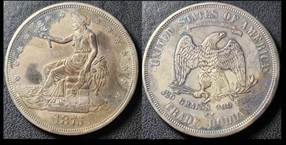
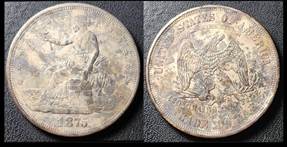
This started on December 26, 2024, when I stumbled across an eBay listing of two Trade Dollars. Both “Bodybagged” by two separate TPG services. NGC returned one as “altered surfaces” and PCGS as “questionable authenticity.” Upon reviewing the images and referencing John Coxe’s attribution guide to Trade Dollar varieties, they didn’t match any known variety.
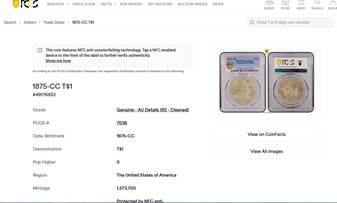
After a while of internet browsing I stumbled across a Heritage Auction listing of this previously unknown variety. After correspondence with John Coxe, I learned this new genuine variety is to be listed as the 1875cc C-17 when the SSDC site is updated as the last update was in 2022.
NGC example
PCGS example
Now to the coins! Not only did these two match a C-17 but they shared a number of circulation marks indicative of counterfeits. Interestingly both passed a sigma test for 90% silver, along with weight and dimensions being within tolerance of genuine Trade Dollars.
Sigma Metalytics test
Upon review of the obverse, I found there are a number of characteristics indicating these are struck counterfeits. I highlight three primary pickup points of the obverse to distinguish these from genuine counterparts.
Indentation in the denticle below the base of 1
Depression in the center below Liberty’s knew
Field depression adjacent to the star and forehead
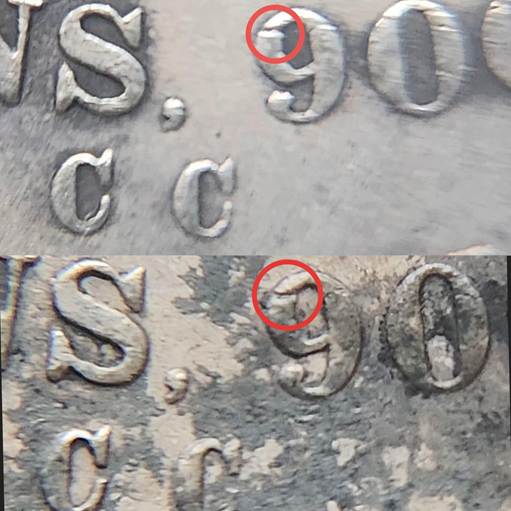
Reviewing both examples, the reverse shares a number of repeating circulation marks. However, many are minute and difficult to photograph. Primary pickups are as followed:
Linear depression of the 9 in “900”
Diagonal line through “R” in the motto
After sharing these with my friend Jack Young another example surfaced on Ebay a short time later. Now residing in a private collection it is safe from the market!
In preparation of this updated article an example surfaced on eBay certified by PCGS. This is the only example I have seen of this in an authentic TPG holder. It is noteworthy to mention the certification photo indicates it was certified in PCGS’s Chinese facility.
With only a few of these struck counterfeits being seen within the last year, it is safe to assume more exist and may already be in private collections. While the genuine variety itself appears to be scarce, it is unlikely to stumble across one of the struck counterfeits, but nothing is impossible. Actually a very easy variety to spot with CC set further right than any other variety of the date along with a hub break of the “I” of “UNITED”.
If you like posts like this, you can read more articles on counterfeit coins by Jack D. Young, Jack Riley and Michael Bugeja at this URL. Also, please subscribe so you can be informed whenever there is a new article or column.
Proxiblog also has thousands of followers on Facebook Coin Groups and across social media. To get the latest discussion and commentary, be sure to friend us by clicking here.
You can find more information about errors and varieties as well as buying and bidding on coins in Coin News Updated: The Essential Guide to Online Bidding. Please consider purchasing the work for yourself or a friend, as it underwrites this hobbyist website. Thank you.
Recently a Facebook coin group member posted a notice stating that he had found the coveted 1982-D Small Date bronze cent–verified by PCGS! Only two have been discovered, in 1916 and 1919, although social media has used the rarity to lure newbies into thinking that have the variety or that it can easily be found.
Here is what he wrote:
“This right here is for everyone that doubted me … chew that up and swallow it. no I’m not gonna be a jerk. I’m super excited. I have proved the 1982D small date with the weak D mint mark and a QDO. And a TDR it has now been verified and authenticated by PCGS as a new variety.”
He provided this proof:
Some 180 Facebook coin group members commented on his post. Here’s a snippet with Tyler Broughton noting the inconsistencies of his supposed PCGS email:
True, the person may be just hoping his submission brings the desired result. We all have been there. But what to make of the letter? It is seemingly informed and may have convinced viewers that indeed, the person did find the rarity. Many commentators congratulated him on his lottery-level find.
Without divulging his name, or the Facebook post and email, I contacted PCGS. A representative confirmed that the company would never send an email like this in advance of encapsulation. There is no Express/Gold service level. There is no Variety/Plus team (that’s NGC). Neither would it divulge internal means of certification.
Let’s take a breath.
It may be that this person indeed found a rarity. For his sake, let’s give him the benefit of the doubt. Perhaps he so believes in his diagnostics that he is sharing the good news before he gets any news. That, however, is not the point of this article. This is: How do we as hobbyists deal with a verification email that might sway us to believe that a coin, indeed, is an ultra rarity? Suppose we saw an email like this on a coin that we might want to purchase? Is this a new way to fool hobbyists?
Let’s see if AI can pretend to be from PCGS and report a rare find.
I used ChatGPT. I fed AI a few basic facts, the rarity, the date of submission, the service level and a few other details. It took me 2 minutes. Here’s what I received:
This is a chilling discovery–not of a rarity–but of how a rarity can be disguised with a fake email or letter, courtesy of AI. I won’t do this, but I could have found PCGS letterhead and pasted the above there. I could invent an email from PCGS–even with an employee name. I could no any number of things, and machine intelligence would help me.
We as hobbyists have to be on top of every new method to beguile us. This may only be the start with AI providing fictional text, video and images of our fondest numismatic desires.
If you like posts like this, subscribe so you can be informed whenever there is a new article or column.
Proxiblog also has thousands of followers on Facebook Coin Groups and other social media. To get the latest discussion and commentary, be sure to friend us by clicking here.
You can find more information about types, varieties, errors, grading, bidding and buying in Coin News Updated: The Essential Guide to Online Bidding. Please consider buying or gifting the work for a friend, as it underwrites this hobbyist blog. Thank you.
My daily internet browsing yields some interesting finds. Occasionally some nice varieties and of course a number of counterfeits. On my routine search of counterfeit 1909s VDB cents this example surfaced.
As we recommended to all collectors when looking at third party graded coins to always check the cert number. The cert matches an NGC authenticated example.
I shared the images with fellow Proxiblog contributor Jack Young and he made this collage image. eBay counterfeit example on the left and genuine NGC example on the right. Quoting Jack “A swing and a miss.”
So this obviously is not a genuine NGC authenticated example, nor is this a legitimate NGC holder! So one may ask “Is the coin real?” Well, no it isn’t. The images provided were very blurry and difficult to distinguish which related “family” it belonged to. What is visible and discernible is it shares a common obverse that is mismatched across the series with an indentation on Lincoln’s lapel.
The 1909-S VDB is the most counterfeited coin exported from China. In addition to fakes, they make die stuck replicas–sometimes with all die markers, sometimes not. It takes an expert eye to detect them. And as I now show, they sometimes come in NGC and PCGS fake holders.
Checking the cert is important. NGC shows photos of its slabbed coins. PCGS shows photos only if TrueView accompanies the coin. That makes China fakes in PCGS holders suspect. Often, however, the counterfeit holders lack accurate bar codes and other insignia.
The best way to guard against buying a counterfeit coin is to purchase one from a reputable dealer. Barring that, view my and Jack Young’s and Michael Bugeja’s articles on counterfeit coins published by Proxiblog.
If you like posts like this, please subscribe so you can be informed whenever there is a new article or column.
Proxiblog also has more than a thousand friends and followers on Facebook Coin Groups and thousands more across YouTube and social media. To get the latest discussion and commentary, be sure to friend us by clicking here.
You can find more information about errors and varieties as well as buying and bidding on coins in Coin News Updated: The Essential Guide to Online Bidding. Please consider purchasing the work for yourself or a friend, as it underwrites this hobbyist website. Thank you.
This article examines two counterfeit 1908-S Indian Head Cents identified from listings by a single seller on eBay . In addition to these examples, the same seller also offered a counterfeit 1877 Indian Cent alongside a small selection of genuine coins. It remains unclear whether the seller was aware of the inauthentic nature of these pieces. Presented below are images of the two counterfeit coins in question, along with a confirmed counterfeit specimen provided courtesy of NGC for reference.
Subject example #1
Subject example #2
Images Courtesy of NGC
This specimen is one I had previously encountered but had not formally documented until the preparation of this article. It is important to mention the NGC example exhibits a different reverse from the other five examples illustrated, suggesting the existence of an extensive “Family” with interchanged dates paired with various reverses. This focus of this study is specifically on the 1908-S.
As illustrated in the comparative images below, all examples display several consistent repeating marks. Most prominently, a deformation of the “T”, in “LIBERTY”–wherefrom this counterfeit derived its informal moniker, the “Droopy T.” That serves as a key diagnostic.
Additional recurring characteristics include two incuse lines through the base of “AMERICA”, a raised dot right of “O” and a small spike protruding from the bust. The reverse has been observed paired with multiple obverse combinations, one of which is anticipated to be featured on Proxiblog in the near future.
Additional examples–three in total–have surfaced on various online marketplaces, with some proving considerably more deceptive than their counterparts.
A detailed close-up collage below illustrates the previously noted repeating obverse diagnostics, including:
The distinctive “Droopy T” in STATES
Dot right of the letter “O”
Intersecting lines through the base of “AM”
Large prominent spike protruding from Liberty’s bust
Once again, this counterfeit family reminds me to advise newer collectors to follow these general guidelines:
If you are ready to bid hundreds of dollars on a coin, resist buying a raw one and shop for one holdered by PCGS, NGC, ANACS and CAC.
Be especially careful when purchasing raw coins from eBay and other online venues. TAI bots cannot detect counterfeits, so you are on your own.
Make sure the seller takes returns and has good reviews. Also, the number of positive reviews is a good indicator. If someone has 0 sales or even fewer than 100, do not take a chance.
Weigh the coin and go to PCGS CoinFacts for the date and mintmark, checking your coin against weights and dimensions.
If you like posts like this, you can read more articles on counterfeit coins by Jack Riley, Jack D. Young and Michael Bugeja at this URL. Also, please subscribe so you can get our weekly newsletter and be informed whenever there is a new article or column.
Proxiblog also has more than a thousand friends and followers on Facebook Coin Groups and thousands more across YouTube and social media. To get the latest discussion and commentary, be sure to friend us by clicking here.
You can find more information about errors and varieties as well as buying and bidding on coins in Coin News Updated: The Essential Guide to Online Bidding. Please consider purchasing the work for yourself or a friend, as it underwrites this hobbyist website. Thank you.
Increasingly, hobbyists are relying on artificial intelligence to identify fake coins exported by the hundreds of thousands by manufacturing facilities in China. Too often, however, AI is wrong, relying on false training data from the internet.
Machine and numismatist analyze fake coins according to different protocols. AI relies on images scraped from the internet. Its learning models rely on high-resolution images so that it can analyze subtle flaws in surface detail, texture, and edge features that are difficult to replicate.
But what if high-resolution images are not available or, in worst case scenarios, doctored via photography software?
This is why human intelligence trumps machine intelligence. Before we proceed two definitions are in order. What is a Contemporary Circulating Counterfeit and what is a Modern Forgery?
A Contemporary Circulating Counterfeit (CCC) is a coin that was illegally produced during the same period as the genuine issue and entered everyday commerce alongside authentic coins. CCCs were often made to mimic official currency closely enough to pass in trade, and they typically show signs of real circulation, regional wear patterns, and period-appropriate alloy substitutions. Many CCCs are now valued by collectors for their historical context, diagnostic quirks, and the insight they offer into economic conditions and minting practices of their time.
In contrast, a Modern Chinese Forgery refers to a deceptive replica produced in recent decades—often using CNC machining or digital dies—with the intent to defraud collectors or simulate numismatic value. These forgeries frequently match regal weight and dimensions too precisely, use non-period alloys like Fe/Ni or German Silver, and may feature fantasy legends, artificial toning, or blank or overly sharp edges. Unlike CCCs, they show no genuine circulation history and are typically absent from community catalogs like CCC–Good Ones.
I am cataloging here for Proxiblog sophisticated techniques that counterfeit detectives use in identifying fakes.
Here are the methods.
For Historical Contemporary Circulating Counterfeits
1. Edge diagnostics (third side) show hand-cut, irregular milling, or worn reeding consistent with circulation and non-regal production.
2. Weightslightly off regal specs, often 5–10% under, but consistent across known examples (families of fakes) and plausible for the era of counterfeiting.
3. Surface silvering or wash may be present on brass or copper cores, often worn through naturally with age.
4. Alloy matches period substitutions: wartime brass, nickel-silver, or low-grade steel confirmed via X-ray fluorescence (XRF), a “non-destructive analytical technique used to determine the exact elemental composition of a coin’s metal.
5. Die style mimics contemporary minting: hand-cut or worn dies with plausible irregularities and regional quirks.
6. Legends match genuine types with subtle errors: spacing, font, or punctuation off — verified against Stacks Bowers and Heritage Auctions.
7. Strike pressure and rim formation match era: weak or uneven, often with off-center or double strikes.
8. Known provenance or regional clustering: tied to specific towns, wartime zones, or trade routes; often supported by field card documentation.
9. Diagnostic die markers (e.g., die cracks, repunched dates, filled letters) shared across multiple specimens.
10. Natural toning and patina: sulfur-induced browns, thin-film interference, or oxidation consistent with age and storage.
For Modern Chinese Forgeries:
1. Bad Chinese Modern Forgery Non-CCC deceptive fantasy, often manufactured by Computer Numerical Control (CNC), computer-controlled lathes or milling machines to create the dies used to produce fake coins that are chemically aged.
2. Edge shows CNC reeding, lathe chatter, or repeating patterns, often too perfect or mechanically uniform. (Sometimes edges are blank or show no reeding at all, especially on fake silver types — a major red flag.)
3. Edge wear often absent or artificially applied, lacking the smooth abrasion of genuine circulation.
4. Weight matches regal specs too precisely, suggesting CNC replication or fantasy intent.
5. Use of iron-nickel alloys, Fe/Ni or “German Silver” common in fake “silver” types — confirmed via XRF as non-period and non-circulating.
6. Surface silvering often artificial, with flaking, bubbling, or chemical residue under magnification.
7. Die style overly sharp or digital, lacking the nuance of hand-cut or worn dies; often shows mirrored fields or laser-like precision.
8. Legends include anachronisms, fantasy elements, or mismatched fonts, often failing comparison with Stacks Bowers and Heritage Auctions.
9. Strike pressure and die alignment too perfect, lacking flaws of hand-struck CCCs; often shows full rim and centered strike.
10. Absence from CCC analyzed by community consensus, often flagged as deceptive or fantasy.
To be sure, these are red flags that veteran hobbyists use and learn from. But it is never too early for beginning and intermedia collectors to scroll through these red flags, look up terms that you do not fully understand, and continue learning how to identify counterfeits.
For beginning collectors
Here are simple techniques:
If you are ready to bid hundreds of dollars on a coin, resist buying a raw one and shop for one holdered by PCGS, NGC, ANACS and CAC.
Be especially careful when purchasing raw coins from eBay and other online venues. TAI bots cannot detect counterfeits, so you are on your own.
Make sure the seller takes returns and has good reviews. Also, the number of positive reviews is a good indicator. If someone has 0 sales or even fewer than 100, do not take a chance.
Weigh the coin and go to PCGS CoinFacts for the date and mintmark, checking your coin against weights and dimensions.
If you like posts like this, you can read more articles on counterfeit coins by Jack Riley, Jack D. Young and Michael Bugeja at this URL. Also, please subscribe so you can get our weekly newsletter and be informed whenever there is a new article or column.
Proxiblog also has thousands of followers on Facebook Coin Groups, YouTube and other social media. To get the latest discussion and commentary, be sure to friend us by clicking here.
You can find more information about errors and varieties as well as buying and bidding on coins in Coin News Updated: The Essential Guide to Online Bidding. Please consider purchasing the work for yourself or a friend, as it underwrites this hobbyist website. Thank you.
I enjoy browsing through various Facebook coin groups and seeing what collectors have acquired and enjoy. While scrolling through a rather large group I came across a post where a fellow collector had completed his Lincoln Wheat Cent collection. A major milestone for any collector! In the mix was a 1909s Cent, about which I commented, and later had a private message conversation explaining that this was a counterfeit and showed proof.
He stated it was bought on eBay from a non-reputable seller in a “shotgun roll.” These are rolls of wheat cents hand assembled with generally a nicer condition coin or key date on the ends. This fell within the 30-day return policy so the collector should get his money back after returning the coins to the seller.
Another online venue offered this counterfeit 1909s. Both coins share a common reverse that has been known for awhile.
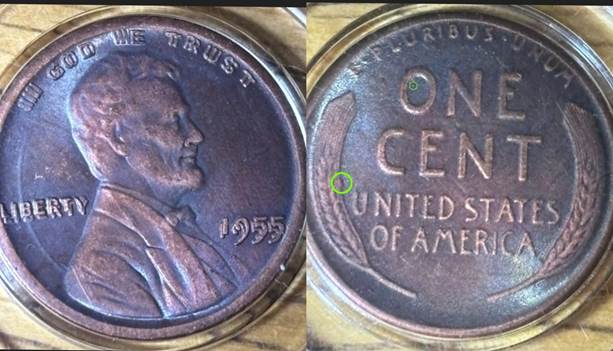
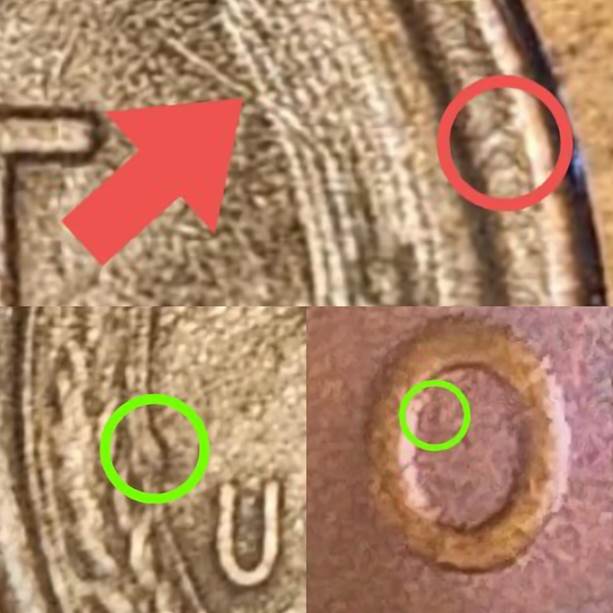
Image comparison of both coins show many repeating marks. Highlighted in green are common to all coins with this reverse and include:
Lump at the edge of wheat stalk
Small lump inside of ONE
Highlighted in red are common but not seen on all examples.
Crack from the rim to Wheat stalk
Extending Crack through the stalk to the field
Being the Lincoln Cent series is one of the most popular to collectors and many key/semi key dates are needed to complete the set, it is of no surprise this counterfeit family is extensive. Other dates that have been seen from this family include the 1931s, 1955 “DDO”, and 1924D cents imaged below.
A close-up collage of identifying marks.
If anyone thought it was just key/semi key dates that are counterfeited, you would be wrong. Here is a common date 1958 exhibiting the “Lumped reverse.”
For more information, including die markers, see Michael Bugeja’s post, titled, “Identifying Fake 1909-S VDB Cents.” Now collectors have two comprehensive articles about this key date. Proxiblog strongly encourages any Lincoln cent collector to read and refer to these two articles before bidding on any raw 1909-S VDB. Also, make sure to check the certification to ensure that the holder also is not counterfeit.
Proxiblog advises newer collectors to follow these general guidelines:
If you are ready to bid hundreds of dollars on a coin, resist buying a raw one and shop for one holdered by PCGS, NGC, ANACS and CAC.
Be especially careful when purchasing raw coins from eBay and other online venues. AI bots cannot detect counterfeits, so you are on your own.
Make sure the seller takes returns and has good reviews. Also, the number of positive reviews is a good indicator. If someone has 0 sales or even fewer than 100, do not take a chance.
If you already bought the coin, weigh it and go to PCGS CoinFacts for the date and mintmark, checking your coin against weights and dimensions.
If you like posts like this, you can read more articles on counterfeit coins by Jack Riley, Jack D. Young and Michael Bugeja at this URL. Also, please subscribe so you can get our weekly newsletter and be informed whenever there is a new article or column.
Proxiblog also has more than a thousand friends and followers on Facebook Coin Groups and thousands more across YouTube and social media. To get the latest discussion and commentary, be sure to friend us by clicking here.
You can find more information about errors and varieties as well as buying and bidding on coins in Coin News Updated: The Essential Guide to Online Bidding. Please consider purchasing the work for yourself or a friend, as it underwrites this hobbyist website. Thank you.
Prompting this article is a counterfeit 1878-P Morgan Dollar previously listed in an eBay auction. The coin immediately caught my attention due to a well known counterfeit C3 reverse. Interestingly, 1878-P Morgan Dollars can feature a C3 reverse paired with a broken right fourth star–a detail that makes this particular counterfeit especially noteworthy.
In a comparison with this 1884-P example we can see the reverse is a match. The 1884 coin also shows clear signs of being cast and weighs less than 23 grams. The weight further reinforces the conclusion that is a counterfeit.
A detailed comparison of the reverses reveal repeating circulation marks:
A noticeable depression of the “N” in the Motto.
Two small circular lumps positioned above above the wreath.
A distinct indentation adjacent to the eagle’s head.
This counterfeit “Family” is extensive, encompassing nearly every date within the Morgan Dollar series.
Markers highlighted in Red indicate additional markers that are not presented on all specimens of this reverse but have been observed across several known examples.
Markers highlighted in Green denote consistent features found on every instance of this “common reverse”, serving as the most reliable identifiers.
Remarkably, while drafting this article, yet another 1878 Morgan Dollar appeared for sale on eBay, further underscoring the prevalence of this counterfeit operation.
The obverse is crudely executed, whereas the reverse presents a more convincing appearance. Though the listing features blurred and seemingly edited photographs, raising questions of intent. In this instance, the images are presented without highlighted markers to allow readers to examine these features in their unaltered form. Observant readers will recognize that this reverse is identical to that of the 1879-P example illustrated above.
Once again, these counterfeits remind me to advise newer collectors to follow these general guidelines:
If you are ready to bid hundreds of dollars on a coin, resist buying a raw one and shop for one holdered by PCGS, NGC, ANACS and CAC.
Be especially careful when purchasing raw coins from eBay and other online venues. TAI bots cannot detect counterfeits, so you are on your own.
Make sure the seller takes returns and has good reviews. Also, the number of positive reviews is a good indicator. If someone has 0 sales or even fewer than 100, do not take a chance.
Weigh the coin and go to PCGS CoinFacts for the date and mintmark, checking your coin against weights and dimensions.
If you like posts like this, you can read more articles on counterfeit coins by Jack Riley, Jack D. Young and Michael Bugeja at this URL. Also, please subscribe so you can get our weekly newsletter and be informed whenever there is a new article or column.
Proxiblog also has thousands of friends and followers on Facebook Coin Groups. To get the latest discussion and commentary, be sure to friend us by clicking here.
You can find more information about errors and varieties as well as buying and bidding on coins in Coin News Updated: The Essential Guide to Online Bidding. Please consider purchasing the work for yourself or a friend, as it underwrites this hobbyist website. Thank you.
Often, I joke about the counterfeiters apparently being ahead of the genuine releases–if not ahead, they are certainly keeping up with the latest “not-PCGS” slabbed fakes!
In this exclusive Proxiblog article I will review 3 really special 2025 “numismatic treasures” showing up in different selling venues.
So, without further ado I will start with a first strike 2025 230th anniversary flowing hair:
OK, so what is the issue with this one? Well, the 230th anniversary of the flowing hair dollar was 2024 and as noted the “year of issue”!!!
So, the following example actually came across the counter of a famous Chicago Coin Shop and a friend there posted it in one of our groups.
A counterfeit walks into a coin shop …
These were also the subject of a short on another friend’s popular coin YouTube channel:
“Frostbyte Coins” short on the subject
Not to be outdone, eBay sellers jumped on the bandwagon as well…
eBay listed 2025 230 Anniversary “Medal Coin”
A second eBay listing
And of course, one more on the Bay:
And a 3rd bay listing at the time
One thing to notice, all sport different cert numbers versus many we have seen with common certs used; and the cert for the Chicago example pulls up as:
Pretty silly at this point…
And what’s next? How about the 2025-S First Strike proof Morgan set!
This example posted in a Face Book Group I sometimes visit:
FB Group post image
The answer to his question is “it’s fake!” and the cert number is actually for a 2022 Australian 50c piece! And again, not to be outdone another listed for sale on the Bay:
eBay listing of similar counterfeit 2025-S and fake PCGS slab
As most of these, the actual barcode on the label does not scan, but checking the cert number for the listed example (48248428) gives this result on PCGS’ cert website:
And what could possibly be next?
How about a 2025“PCGS” MS70 First Strike Silver Eagle? This from a FB group post as well:
Interesting, the cert comes up as:
PCGS on-line cert for 51841365 shows the coin type as “971094”
So, coin type 971094 in PCGS’ system is as follows:
PCGS definition of the 2025 First Strike
While 2025 (W) S1 silver eagles are designated as “971544”:
PCGS definition of the 2025 (W) First Strike at West Point
I often state the counterfeiters are NOT Numismatists. (They are crooks.)
And finding a genuine (W) example to compare to shows the following differences on the obverse slab and label:
Counterfeit on left, genuine First Strike (W) on the right
So, the “Fun” never ends with the counterfeits, and one can only wonder what they have in store for 2026!
If you like posts like this, you can read more articles on counterfeit coins by Jack D. Young, Jack Riley and Michael Bugeja at this URL. Also, please subscribe so you can get our weekly newsletter and be informed whenever there is a new article or column.
Proxiblog also has thousands of followers on Facebook Coin Groups, YouTube and social media. To get the latest discussion and commentary, be sure to friend us by clicking here.
You can find more information about errors and varieties as well as buying and bidding on coins in Coin News Updated: The Essential Guide to Online Bidding. Please consider purchasing the work for yourself or a friend, as it underwrites this hobbyist website. Thank you.
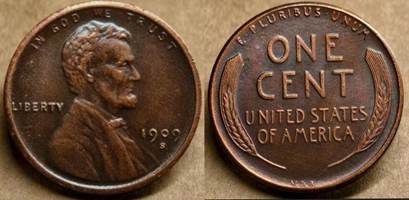
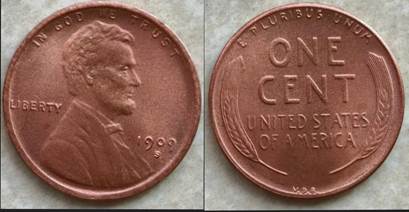
The Lincoln cent series is arguably the most popular in numismatics, with many young collectors getting their start filling Whitman Folders in hopes to find the “key dates.” With such a popular series and many expensive coins to complete the set, one would expect to see many counterfeits. Many types of fake wheat cents exist, including altered dates, added mintmarks, cast coins, and plated cents. This article dives into a modern counterfeit common reverse used interchangeably on mainly key date coins that I refer to as the “IN-Line” reverse.
Images of two counterfeit 1909s VDB cents offered on eBay.
Both coins showcase a Deep N reverse (Type 2) which was used in 1909 and followed through the end of the series in 1958; however, all genuine 1909s VDB cents have a Shallow N (Type 1).
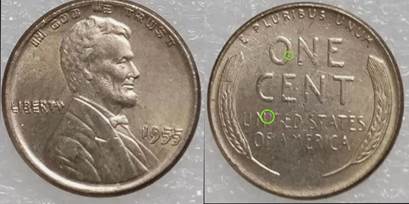
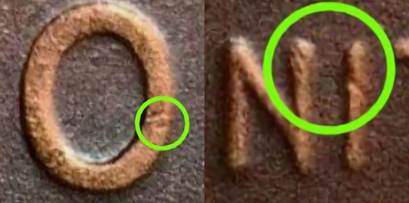
A comparison of the reverse shows common circulation marks between the two. A dent in the “O” culminating with the “IN” slash.
Interestingly this reverse was utilized with and without the “VDB” initials! This 1914-D and 1955 DDO share the “IN-Line” reverse with no remnants of the VDB initials.
This extensive family even consist of struck counterfeit common date “Off-center” errors!
Since viewing can be a challenge to the readers, I assembled close-up collage of the highlighted markers.
This has primarily been used to create counterfeit key date and semi key date coins. However, with the addition of the off-center strike 1946s, it is clear this can be found on common dates as well as counterfeit error coins.
If you are collecting key dates, especially the 1909-S VDB, be sure as well to view Michael Bugeja’s article with all the requisite die markers.
If you like posts like this, you can read more articles on buying, selling and collecting at Proxiblog.org. Also, please subscribe to be informed whenever there is a new article or column.
Proxiblog also has thousands of followers on Facebook Coin Groups. To get the latest discussion and commentary, be sure to friend us by clicking here.
You can find more information about errors and varieties as well as buying and bidding on coins in Coin News Updated: The Essential Guide to Online Bidding. Please consider purchasing the work for yourself or a friend, as it underwrites this hobbyist website. Thank you.