By Jack Riley
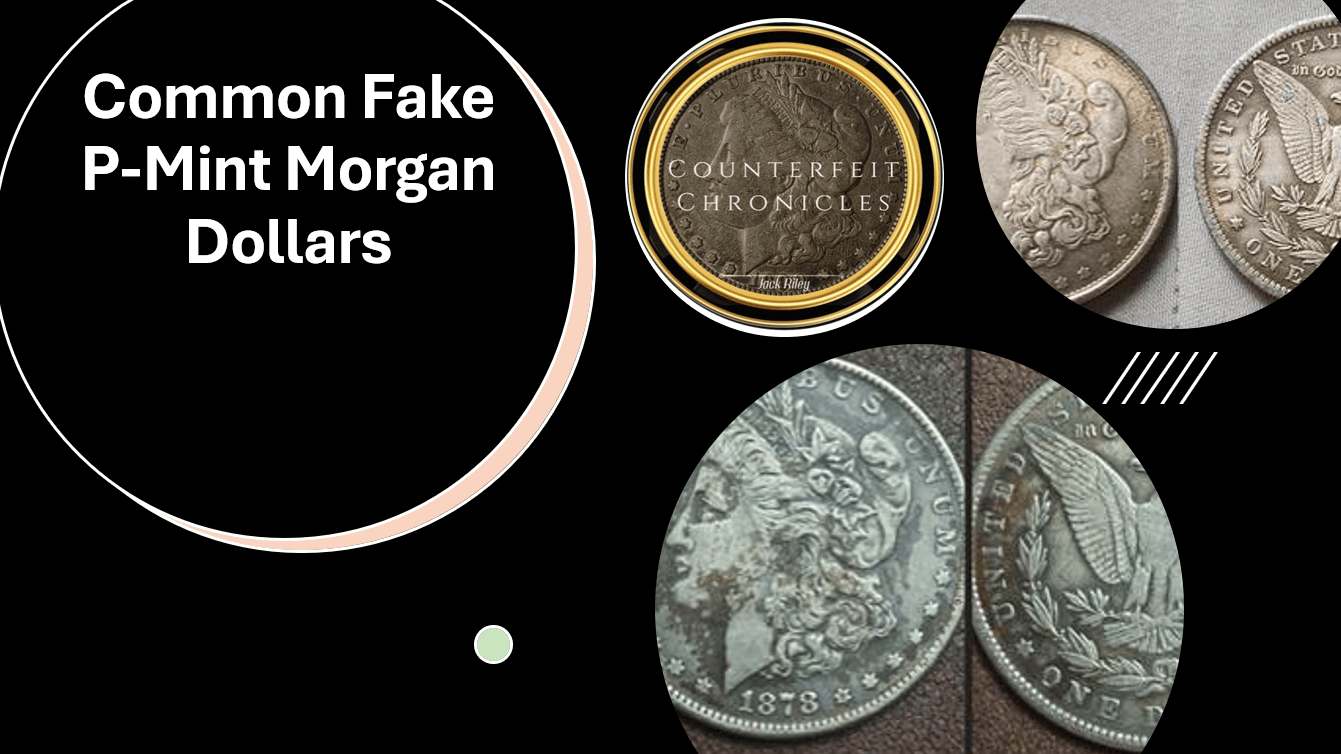
Prompting this article is a counterfeit 1878-P Morgan Dollar previously listed in an eBay auction. The coin immediately caught my attention due to a well known counterfeit C3 reverse. Interestingly, 1878-P Morgan Dollars can feature a C3 reverse paired with a broken right fourth star–a detail that makes this particular counterfeit especially noteworthy.

In a comparison with this 1884-P example we can see the reverse is a match. The 1884 coin also shows clear signs of being cast and weighs less than 23 grams. The weight further reinforces the conclusion that is a counterfeit.

A detailed comparison of the reverses reveal repeating circulation marks:
- A noticeable depression of the “N” in the Motto.
- Two small circular lumps positioned above above the wreath.
- A distinct indentation adjacent to the eagle’s head.


This counterfeit “Family” is extensive, encompassing nearly every date within the Morgan Dollar series.
Markers highlighted in Red indicate additional markers that are not presented on all specimens of this reverse but have been observed across several known examples.
Markers highlighted in Green denote consistent features found on every instance of this “common reverse”, serving as the most reliable identifiers.


Remarkably, while drafting this article, yet another 1878 Morgan Dollar appeared for sale on eBay, further underscoring the prevalence of this counterfeit operation.

The obverse is crudely executed, whereas the reverse presents a more convincing appearance. Though the listing features blurred and seemingly edited photographs, raising questions of intent. In this instance, the images are presented without highlighted markers to allow readers to examine these features in their unaltered form. Observant readers will recognize that this reverse is identical to that of the 1879-P example illustrated above.

Once again, these counterfeits remind me to advise newer collectors to follow these general guidelines:
- If you are ready to bid hundreds of dollars on a coin, resist buying a raw one and shop for one holdered by PCGS, NGC, ANACS and CAC.
- Be especially careful when purchasing raw coins from eBay and other online venues. TAI bots cannot detect counterfeits, so you are on your own.
- Make sure the seller takes returns and has good reviews. Also, the number of positive reviews is a good indicator. If someone has 0 sales or even fewer than 100, do not take a chance.
- Weigh the coin and go to PCGS CoinFacts for the date and mintmark, checking your coin against weights and dimensions.
- Read this article about detecting counterfeits.
If you like posts like this, you can read more articles on counterfeit coins by Jack Riley, Jack D. Young and Michael Bugeja at this URL. Also, please subscribe so you can get our weekly newsletter and be informed whenever there is a new article or column.
Proxiblog also has thousands of friends and followers on Facebook Coin Groups. To get the latest discussion and commentary, be sure to friend us by clicking here.
You can find more information about errors and varieties as well as buying and bidding on coins in Coin News Updated: The Essential Guide to Online Bidding. Please consider purchasing the work for yourself or a friend, as it underwrites this hobbyist website. Thank you.
