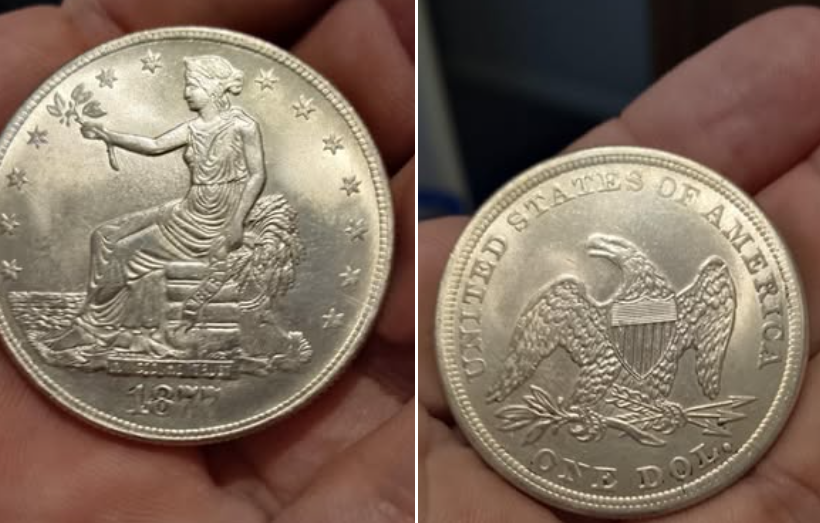
As if the Chinese counterfeit coins in fake PCGS slabs isn’t bad enough, now there appears to be a fake Chinese PCGS website to verify them.
A friend alerted me to the following listing on the Bay:
Past eBay listed counterfeit in a counterfeit not-PCGS slab:
The listing included these interesting other images:
Images from the seller’s listing
The seller had ended the listing based on being told it is a counterfeit, and I started a review to try to determine what was going on here!
So, I started with the “PCGS” slab and some quick checks. Using my on-line barcode scanner I checked the front barcode:
Like many similar bad slabs, the barcode was gibberish and would not scan. Next, I went to the PCGS website to check the noted cert number:
Note from the genuine PCGS site for the cert # look-up
And another bad sign, that cert # “was not found”. So, my next step was to try to read the reverse label QR code. And just a note, many of the previous counterfeits we have documented similar to this one had a QR code that read the cert # correctly but noted the genuine PCGS CN site. A previous example read like this:
Typical previous QR code to pcgs.cn site
And then this one:
Note different website for this cert!
Different result than expected! I do NOT recommend readers going to the site shown, but if you did, this is what comes up:
Fake “PCGS” site, image
WOW, now we have something apparently new to be concerned about with these.
I did notify my contacts at PCGS for a heads-up as well as post it on their CU Forum:
My contacts at PCGS acknowledged they were now aware and reviewing; a check of the fake site Christmas evening indicated it was now unavailable– a nice Christmas present if it lasts…
I did continue to dig a bit and found the following domain information; seemed ironic the “Registrar” has Alibaba in the name!
The best way to guard against buying a counterfeit coin is to purchase an authentic one from a reputable dealer. Barring that, view Jack Young’s Jack Riley’s and my articles on counterfeit coins published by Proxiblog.
If you like posts like this, please subscribe so you can get our weekly newsletter and be informed whenever there is a new article or column.
Proxiblog also has more than a thousand friends and followers on Facebook Coin Groups and thousands more across YouTube and social media. To get the latest discussion and commentary, be sure to friend us by clicking here.
You can find more information about errors and varieties as well as buying and bidding on coins in Coin News Updated: The Essential Guide to Online Bidding. Please consider purchasing the work for yourself or a friend, as it underwrites this hobbyist website. Thank you.
Increasingly, hobbyists are relying on artificial intelligence to identify fake coins exported by the hundreds of thousands by manufacturing facilities in China. Too often, however, AI is wrong, relying on false training data from the internet.
Machine and numismatist analyze fake coins according to different protocols. AI relies on images scraped from the internet. Its learning models rely on high-resolution images so that it can analyze subtle flaws in surface detail, texture, and edge features that are difficult to replicate.
But what if high-resolution images are not available or, in worst case scenarios, doctored via photography software?
This is why human intelligence trumps machine intelligence. Before we proceed two definitions are in order. What is a Contemporary Circulating Counterfeit and what is a Modern Forgery?
A Contemporary Circulating Counterfeit (CCC) is a coin that was illegally produced during the same period as the genuine issue and entered everyday commerce alongside authentic coins. CCCs were often made to mimic official currency closely enough to pass in trade, and they typically show signs of real circulation, regional wear patterns, and period-appropriate alloy substitutions. Many CCCs are now valued by collectors for their historical context, diagnostic quirks, and the insight they offer into economic conditions and minting practices of their time.
In contrast, a Modern Chinese Forgery refers to a deceptive replica produced in recent decades—often using CNC machining or digital dies—with the intent to defraud collectors or simulate numismatic value. These forgeries frequently match regal weight and dimensions too precisely, use non-period alloys like Fe/Ni or German Silver, and may feature fantasy legends, artificial toning, or blank or overly sharp edges. Unlike CCCs, they show no genuine circulation history and are typically absent from community catalogs like CCC–Good Ones.
I am cataloging here for Proxiblog sophisticated techniques that counterfeit detectives use in identifying fakes.
Here are the methods.
For Historical Contemporary Circulating Counterfeits
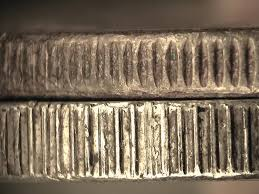
1. Edge diagnostics (third side) show hand-cut, irregular milling, or worn reeding consistent with circulation and non-regal production.
2. Weightslightly off regal specs, often 5–10% under, but consistent across known examples (families of fakes) and plausible for the era of counterfeiting.
3. Surface silvering or wash may be present on brass or copper cores, often worn through naturally with age.
4. Alloy matches period substitutions: wartime brass, nickel-silver, or low-grade steel confirmed via X-ray fluorescence (XRF), a “non-destructive analytical technique used to determine the exact elemental composition of a coin’s metal.
5. Die style mimics contemporary minting: hand-cut or worn dies with plausible irregularities and regional quirks.
6. Legends match genuine types with subtle errors: spacing, font, or punctuation off — verified against Stacks Bowers and Heritage Auctions.
7. Strike pressure and rim formation match era: weak or uneven, often with off-center or double strikes.
8. Known provenance or regional clustering: tied to specific towns, wartime zones, or trade routes; often supported by field card documentation.
9. Diagnostic die markers (e.g., die cracks, repunched dates, filled letters) shared across multiple specimens.
10. Natural toning and patina: sulfur-induced browns, thin-film interference, or oxidation consistent with age and storage.
For Modern Chinese Forgeries:
1. Bad Chinese Modern Forgery Non-CCC deceptive fantasy, often manufactured by Computer Numerical Control (CNC), computer-controlled lathes or milling machines to create the dies used to produce fake coins that are chemically aged.
2. Edge shows CNC reeding, lathe chatter, or repeating patterns, often too perfect or mechanically uniform. (Sometimes edges are blank or show no reeding at all, especially on fake silver types — a major red flag.)
3. Edge wear often absent or artificially applied, lacking the smooth abrasion of genuine circulation.
4. Weight matches regal specs too precisely, suggesting CNC replication or fantasy intent.
5. Use of iron-nickel alloys, Fe/Ni or “German Silver” common in fake “silver” types — confirmed via XRF as non-period and non-circulating.
6. Surface silvering often artificial, with flaking, bubbling, or chemical residue under magnification.
7. Die style overly sharp or digital, lacking the nuance of hand-cut or worn dies; often shows mirrored fields or laser-like precision.
8. Legends include anachronisms, fantasy elements, or mismatched fonts, often failing comparison with Stacks Bowers and Heritage Auctions.
9. Strike pressure and die alignment too perfect, lacking flaws of hand-struck CCCs; often shows full rim and centered strike.
10. Absence from CCC analyzed by community consensus, often flagged as deceptive or fantasy.
To be sure, these are red flags that veteran hobbyists use and learn from. But it is never too early for beginning and intermedia collectors to scroll through these red flags, look up terms that you do not fully understand, and continue learning how to identify counterfeits.
For beginning collectors
Here are simple techniques:
If you are ready to bid hundreds of dollars on a coin, resist buying a raw one and shop for one holdered by PCGS, NGC, ANACS and CAC.
Be especially careful when purchasing raw coins from eBay and other online venues. TAI bots cannot detect counterfeits, so you are on your own.
Make sure the seller takes returns and has good reviews. Also, the number of positive reviews is a good indicator. If someone has 0 sales or even fewer than 100, do not take a chance.
Weigh the coin and go to PCGS CoinFacts for the date and mintmark, checking your coin against weights and dimensions.
If you like posts like this, you can read more articles on counterfeit coins by Jack Riley, Jack D. Young and Michael Bugeja at this URL. Also, please subscribe so you can get our weekly newsletter and be informed whenever there is a new article or column.
Proxiblog also has thousands of followers on Facebook Coin Groups, YouTube and other social media. To get the latest discussion and commentary, be sure to friend us by clicking here.
You can find more information about errors and varieties as well as buying and bidding on coins in Coin News Updated: The Essential Guide to Online Bidding. Please consider purchasing the work for yourself or a friend, as it underwrites this hobbyist website. Thank you.
The U.S. Mint manufactured trade dollars to promote silver mines in America and to compete with large silver coins used in trade in Asia.
The diameter of these dollars is 38.1 mm (1.5 in) 90% silver, 10% copper weighing 27.2 grams with a reeded edge, produced between 1873-85.
They are so much in demand, especially in higher grades bringing hundreds and thousands of dollars, that China–which originally inspired the manufacturing of this coin–exports thousands of fakes to America.
The first image here is of one of the bad not-PCGS slabbed examples from my collection; both the coin and the slab are fakes. The second shows the common reverse I nicknamed the “dotted N.”
Counterfeit coin and fake “PCGS” slab; image courtesy author
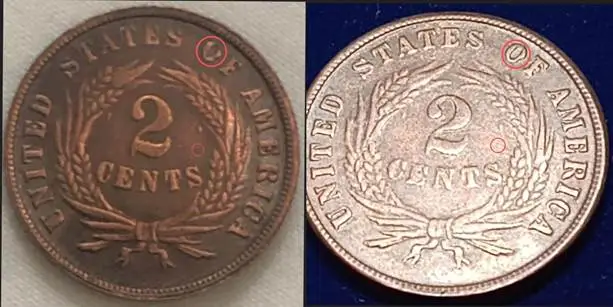
The obverse had several marks I noted in white circles and was used early on but seemed to be abandoned for a different die going forward.
eBay listing example
Some of the obvious features are the “die chip” over the “N” of UNITED, the long “spaghetti hair,” a dent at the top of the “A” of TRADE, a common “CC” not attributable to a genuine example, and a couple others that may or may not show in all of the images.
And a simple attribution note about the reverse type for a particular date Trade dollar, I use this image as reference:
This common “dotted N” reverse is Type 1 and should NOT be seen on any coins dated 1877 and later.
In my regular eBay coin listing review I found the next example:
Reviewing the images I found this common reverse; I notified the seller, and he pulled the listing. After more discussion, he alerted me to this follow-up listing, which I “won”:
eBay listings of this 1875 “dotted N” reverse Trade Dollar
Having this example in hand afforded the opportunity to take some higher resolution images of the main counterfeit attribution points.
”Dotted N” image of author’s 1875-CC example
”Dented A” image of author’s 1875-CC example
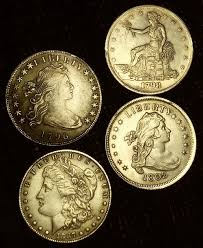
Another of what I term “family counterfeits” is included here with images of other dates I have documented so far–including a bizarre “1791”!
As I often do during the research phase of an article, I post in several forums I frequent for other hobbyist’s opinions.
The following image was a response to my post in PCGS’ CU forum; The poster stated the image goes back to February 2023. It appears to be the same (common) reverse.
Image (used by permission) from the PCGS CU Forum OP
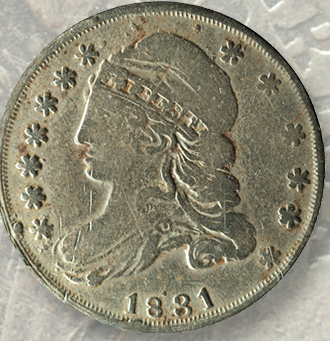
The next group of images are for other dates that would have genuine examples with the Type 1 reverse, but of course not this one!
And a date that should only have the type 2 reverse:
eBay listed 1877-CC “Dotted N” example
Interestingly, I do not have images of an 1878 dated example.
But the counterfeiters continue to create improbable examples like this “P” (no mint mark) 1877 with the otherwise common reverse:
eBay listed “Dotted N” non-CC mintmark example
Continuing with their improbable “numismatic creations” is this “1791” Trade with the “dotted N” reverse! The image isn’t great, but the dotted feature is plain enough.
eBay listed 1791 “Dotted N” counterfeit Trade Dollar
We have documented several different “families” of current counterfeits based on reuse of the same reverse die with different dated obverses. They continue to use these, often creating improbable die varieties that collectors experienced with the series can flush out.
But that takes experience and learning over time. Articles like this are intended to alert collectors about the current counterfeit threat of these coveted, historical coins.
If you like posts like this, please subscribe so you can get our weekly newsletter and be informed whenever there is a new article or column.
Proxiblog also has hundreds of followers on Facebook Coin Groups. To get the latest discussion and commentaries, click here.
You can find more information about errors and varieties as well as buying and bidding on coins in Coin News Updated: The Essential Guide to Online Bidding. Please consider purchasing the work for yourself or a friend, as it underwrites this hobbyist website. Thank you.
It’s bad enough there are so many counterfeits in the marketplace but now you have to be on the lookout for stolen and/or photoshopped images as well–basically, these are “virtual counterfeits”!
The bad 1928 Peace dollars continue to hit listings, with my previous Proxiblog article on these published this past week. One of the sellers using photoshopped images for a 1928-S listing had these three listed in her selling history:
3 Past eBay listings of PCGS Gold Buffalos
A friend who helps me report bad eBay listings for removal often talks about “fake sales”–sales shown to make the seller appear more successful or “trustworthy” than they may actually be. These can be done by friends and/or the same seller under a different seller ID. Often the same item shown sold then shows “relisted.”…
So, starting with the 2017, it shows sold twice but with a relist, so who knows? May have been the only bid the 1st time. Images used originally came from the Heritage auction listed on the PCGS online cert.
PCGS online cert; no TrueView image but lists auction appearance
The Bay seller’s 2nd listing used the same images as well; no way to know what actually sold, as the seller stated she was “selling them for a friend.”…
Some additional searching found an AliExpress example for sale:
AliExpress listing for the 2017 Buff using Heritages auction images
Both “sellers” are using Heritage’s images without authorization, and I did notify my contact there. Ali description is clearly not of a genuine coin, so again who knows what one is buying!
And then the 2018; this one just looks bad! I would guess the Bay lister photoshopped a genuine coin into the bad slab/ label. The reverse image used is of the previous Heritage 2017 example!
eBay listed “2018 PCGS” gold Buff; same reverse as “2017” above
The PCGS online cert has an image of the genuine coin but not one in the slab; it certainly doesn’t look like this one. …
PCGS on-line cert and TrueView image
Comparison image of the Bay listed example obverse to the genuine example from the PCGS cert shows the Bay example image is not a good choice:
Bad Bay example on the left, genuine example on the right
And I also found the Ali offering for this one!
AliExpress listing for the 2018 Buff using their images
Looks like the AliExpress 2018 Buff is the only listed example here that a buyer would actually receive. …
I did check the seller’s feedback and she had received 1 for the three “sold” Buffs:
Seller Feedback for the “2018” gold buffalo listing
I was curious about the note “verified purchase” and looked it up. Per eBay, “We’ve added this text to remove any doubt that the person leaving the feedback was involved in the transaction.”
Wow! The coin imaged in the positive feedback doesn’t look anything like the seller’s listing image, so “verified” obviously didn’t mean what I initially thought!
eBay feedback image of the coin received?
Love the little dog, the “coin” not so much, as I have seen a number of fakes like this in fake NGC holders. Image isn’t clear enough to check the cert, but clear enough to see it isn’t the PCGS one!
It is getting harder to keep up with all the ways scammers and the like are challenging collectors and the Hobby.
If you like posts like this, please subscribe so you can be informed whenever there is a new article or column.
Proxiblog also has thousands of followers on Facebook Coin Groups, YouTube and social media. To get the latest discussion and commentaries, click here.
You can find more information about errors and varieties as well as buying and bidding on coins in Coin News Updated: The Essential Guide to Online Bidding. Please consider purchasing the work for yourself or a friend, as it underwrites this hobbyist website. Thank you.