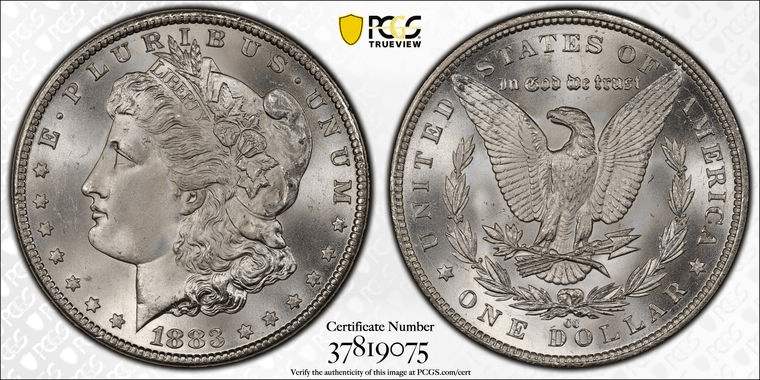
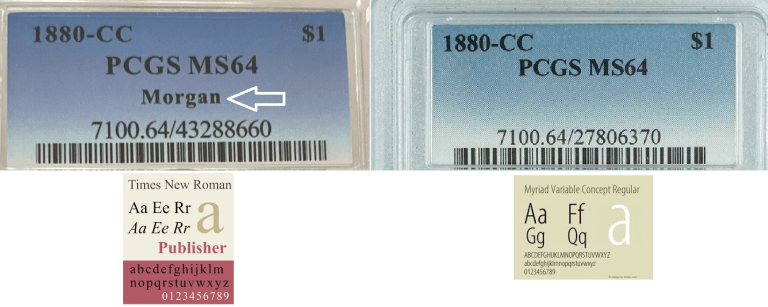
This video documents the various ways to identify fake Chinese holders and coins, including lack of logos on slab, pasted Gold Shield sticker, wrong fonts, wrong 1921 label, wrong reverse and so much more. Below the video is a an example of a Carson City Morgan dollar with six significant problems signifying a counterfeit. But there are other fake coins and slabs you need to know.
Bad Condition for Grade
The surface area lacks a cartwheel and good eye appeal and would never be graded MS66+. Check certification before buying any slabbed coin by PCGS and NGC, especially. See below for difference.
Wrong Font
Missing NFC Logo
QR Code Opens to Chinese Fake Certification Site
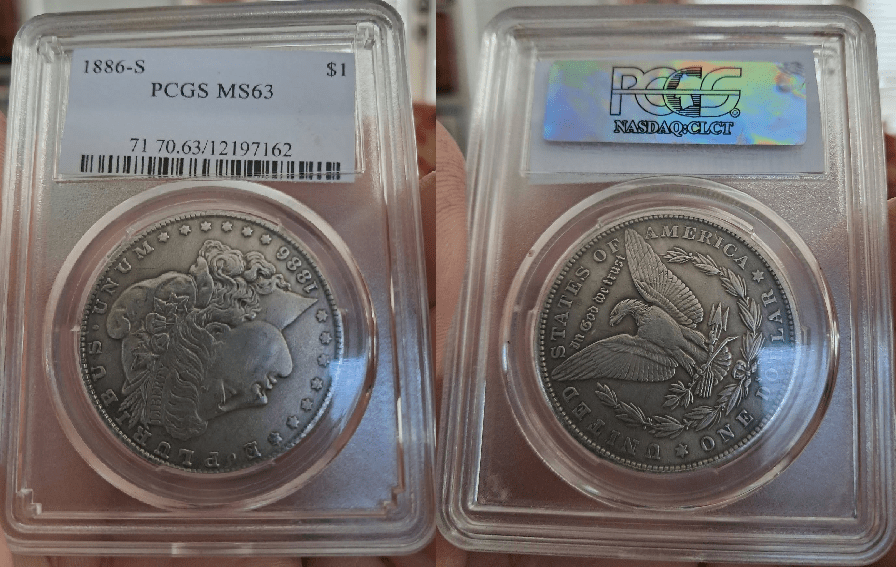
Everything is Wrong
Wrong cert, mistake “Morgan” on non 1921 coin, thin holder, misplaced sticker, missing logo.
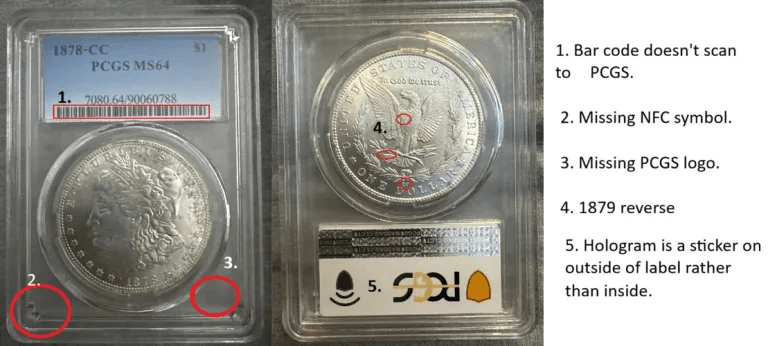
Another Messed Up “Everything Wrong” Example
Wrong bar code, missing symbol and logo, wrong reverse, misplaced sticker.
Genuine Sticker Inserted into Fake PCGS Holder
Cracked open fake holder (no PCGS logo, wrong sticker) with genuine sticker and fake coin stuck inside it.
Counterfeit Coin Via Verification Check with Fake GreatCollections Holder
Fake coin detected via checking certification that also has a fake GreatCollections label.
If you like posts like this, you can read more articles on counterfeit coins by Jack D. Young, Jack Riley and Michael Bugeja at this URL. Also, please subscribe so you can be informed whenever there is a new article or column.
Proxiblog also has thousands of followers on Facebook Coin Groups, YouTube and other venues. To get the latest discussion and commentary, be sure to friend us by clicking here.
You can find more information about errors and varieties as well as buying and bidding on coins in Coin News Updated: The Essential Guide to Online Bidding. Please consider purchasing the work for yourself or a friend, as it underwrites this hobbyist website. Thank you.
The ever growing saga of new counterfeits continues. This 1872 S Seated Dollar below was recently brought to our attention in a Facebook group.
That’s an example of how counterfeit investigations begin.
A quick glance tells the story.
The 1872-S was only produced with one die marriage and that is referred to as an OC-1. Below is an image of the mintmark location of a genuine coin.
The coin clearly isn’t attributable to a genuine variety. The next step to me is looking for anything that may standout as a notable marker to find additional “bad” coins. Another example offered by Aliexpress shows us just where this came from.
Both coins show both a common obverse and reverse. Highlighted markers in red include a raised lump on the center of the obverse, misplaced mintmark, gouge in the shield, small indent on the R as well as an overall weakness of the U.
To be sure, a poorly executed cast; but as always there is a potential to see this on numerous dates.
Join the Fight
As we become experienced numismatists, we have an obligation to expose fakes and to share the methods to identify them.
As in the case of the counterfeit Seated Dollar, numismatists study die markers for one common sense reason. If counterfeiters are going to invest time, effort and funds to manufacture fake coins, they are going to use the same die for multiple mintages. That’s when inconsistences occur, ranging from suspicious mintmarks to unique features that deviate from authentic examples.
For instance, there can be deviations in lettering and design, weight and size, metal composition and edge details. I analyze all of these and more.
I will continue to share these details in my articles for Proxiblog and other publications as well as Facebook’s “Fun with Fakes” (FwF).
By understanding how die markers are used and by carefully examining coins for inconsistencies, coin collectors can increase their ability to identify counterfeit coins.
If you like posts like this, please go to our counterfeit archive with reports from Jack Riley, Jack D. Young and Michael Bugeja. Also, please subscribe so you can be informed whenever there is a new article or column.
Proxiblog also has hundreds of followers on Facebook Coin Groups. To get the latest discussion and commentary, be sure to friend us by clicking here.
You can find more information about errors and varieties as well as buying and bidding on coins in Coin News Updated: The Essential Guide to Online Bidding. Please consider purchasing the work for yourself or a friend, as it underwrites this hobbyist website. Thank you.
Today we explore the Trade Dollar’s common obverse matched with various (and improbable) reverses–an 1874-P, 1873-S and 1874-S–all sharing the same obverse.
The U.S. Mint began producing Trade Dollars in 1873 in the hope to boost trade, especially in East Asia, and to compete with the Mexican Peso.
The Trade Dollar is heavier than the Morgan silver dollar, again to compete with the Mexican counterpart. The Peso weights 27.07 grams with 90.27% silver compared to the Morgan Dollar’s 26.73 grams, 90% silver content.
There are two Trade Dollar reverse types. The Type 2 Reverse was used on Trade dollars between 1875 and 1876 and on all Trade dollars beginning in 1877. The latter design is missing a berry under the eagle’s claw:
First fake up in this article is an 1874-P Trade Dollar with a Type 2 reverse! This reverse wasn’t used until 1875 at the Philadelphia mint. I like to call this the “Dented Denticles” as the obverse denticles are nearly missing below the date. A dent above the foot and on Liberty’s neck are common markers shared on these counterfeits (highlighted in red). Below the subject coin is a reference photo to identify Type1 and Type2 reverses.
Next up we have an 1873-S! Same obverse as the counterfeit 1874-P but with a different reverse, this time paired with the correct Type.
In my search for more of these mix matched dates I landed on the “CoinHelpU” forum. This time we see a counterfeit 1874S. Same obverse but yet another reverse!
It’s apparent that the counterfeiters will use anything at their disposal to create more. Swapping out the dates and changing the reverses to anything they can find. It’s never been more important to attribute a coin that you intend to purchase.
Attributing coins requires learning–the type of which you get when reading Proxiblog and other reputable coin sites. Concerning Trade Dollars, examine devices, weigh the metal and measure the diameter, comparing it to an authentic example. I recommend going online to find a PCGS-attributed coin with TrueView, which can be expanded on your screen.
Pay attention to the coin’s condition and grade, using PCGS Photograde.
So ends the latest journey of more “Fun with Fakes” (FwF) and Proxiblog. It is getting really hard to keep up with all the ways scammers and their ilk continue to challenge the hobby.
For more information about counterfeit trade dollars, see Jack D. Young’s article about fake trade dollars in counterfeit TPG holders, as these coins illustrate:
If you like articles like these, please friend us on Facebook and subscribe to Proxiblog.
Proxiblog also has thousands of followers on Facebook Coin Groups, YouTu.be and social media. To get the latest discussion and commentaries, click here.
You can find more information about errors and varieties as well as buying and bidding on coins in Coin News Updated: The Essential Guide to Online Bidding. Please consider purchasing the work for yourself or a friend, as it underwrites this hobbyist website. Thank you.
Is it me, or has eBay gotten worse recently with bad listings and counterfeits? Their “reporting” feature seems to just be a façade.
I use the Bay as a counterfeit research tool and post about fakes in several Face Book Groups. Recently I posted an obvious bad fake in a fake “PCGS” slab and asked folk to report it as such to eBay through their standard process.
I had a huge response, with NO ONE getting a favorable return; it seems no matter what, the resulting response was … ”We looked into your report and didn’t find the listing to be in violation of our policy.” These are noted as either by their “AI,” which I call the “BayBots,” or the unknown “customer service agent.” A real shame, as eBay did have a method for a select group to direct report bad listings, and I can confirm MANY listings were removed daily, but that channel has apparently dried up.
To illustrate the current state of the Bay, view the following image of listings found via a standard search for “1881-CC Morgan Dollars,” chosen due to proliferation of counterfeits with that date and mintmark:
A brief description of what is shown here:
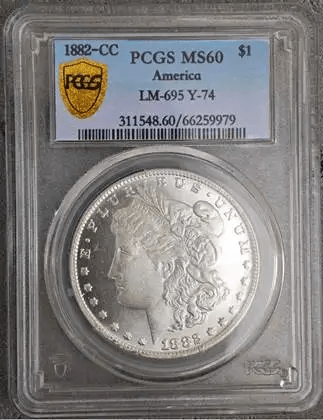
#1 is a bad CN counterfeit in a fake PCGS holder; it clearly doesn’t match the genuine example shown on the PCGS site and uses the latest scam, a GreatCollections sticker from an actual auction. I reported this, but a second listing for the same fake showed up from a different seller. This, too, was reported as fake.
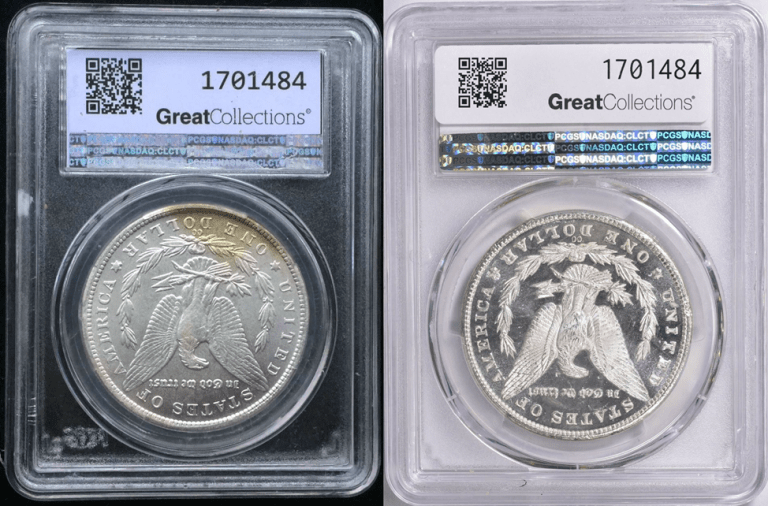
I previously wrote an article on this latest scam for Proxiblog and the same coin, different seller (now-counterfeit-greatcollections-labels); the counterfeit’s QR code takes one to the PCGS CN site for the cert, the GC QR takes one to their auction for the genuine example. Comparison image as follows:
Chinese counterfeit, left, and genuine “GC sold” example, right
And #’s 2 and 3, again examples shown shipping from China, these use stock images of genuine coins to sell their fakes.
I have direct experience with these type listings, having purchased a large cent with images of a genuine example in the listing only to receive a common current CN counterfeit. The seller offered a return with shipping costing more than I paid for the “coin.”
#4 is another of the bad CN counterfeit Morgans in a fake PCGS holder. I have written articles as well as participated in an on-line podcast discussing these as they proliferate eBay and other sites currently.
This particular example and listing was reported several times and repeatedly eBay responded it was OK; listing finally ended only to have the seller relist it unchecked for another round.
Relisted/ current Bay listing
The genuine PCGS coin is shown on their cert site with an image that this one isn’t even close to, but it was still active for sale on the Bay.
#’s 5 and 6 are more of a CN seller’s listings using genuine stock images of someone else’s coin and listing. I personally would pick #6 to purchase because it is 4 cents cheaper.
And #7! This seller has a whole boatload of fakes labeled as “Commemorative Coins”; give me a break eBay!
Multiple bad listings from the same Bay CN seller
And his description of his “1885-CC”:
Seller’s listing description
I reported the listing and the seller multiple times and apparently the Bay approves of both.
And so, #8, the real “star” of this group! Another of the “Morgan” Morgan fakes in a counterfeit PCGS holder. This one is currently posted on my personal Face Book page and is also being mass reported by my friends:
Current eBay listed bad “Morgan” Morgan
We have been notified that the listing is A-OK, evidenced by this response to my report:
This all does lead one to wonder if eBay has changed its “Coin Policy” without actually formally stating it, as ALL of these types of listings were previously considered violations? Good for the sellers, bad for the buyers? And what affect does it have on the Hobby at this time? I suppose one can only speculate.
One thing that is not speculation–at one time listings could be reported and REMOVED. And the following are images of fake coins identified in one day’s effort:
Is this a sign of the times for eBay or did someone just fall asleep at the wheel? We’ll continue to watch and report “more fun with fakes” for Proxiblog as we see them!
If you like posts like this, please go to Jack Young’s page on Proxiblog. Also, please subscribe so you can be informed whenever there is a new article or column.
Proxiblog also has thousands of followers on Facebook Coin Groups, YouTube and other social media. To get the latest discussion and commentary, be sure to friend us by clicking here.
You can find more information about errors and varieties as well as buying and bidding on coins in Coin News Updated: The Essential Guide to Online Bidding. Please consider purchasing the work for yourself or a friend, as it underwrites this hobbyist website. Thank you.
Today’s report is about a recent eBay interaction concerning a counterfeit 1881-CC “Morgan” Morgan dollar.
Recent eBay listing
When I checked, already there was a bid of $585.00 on a “fake in a fake”! And should you not know what I mean by that phrase, see my Live Coin Q&A podcast with numismatist Paula Schommer-Bluhm on this current CN family of fakes:
This particular coin cert has a PCGS TrueView image as well as images in the genuine slab available from a past listed auction as indicated on the PCGS website:
Obviously not a match; so I posted about it in a Facebook Group as Paula did as well, and we both reached out to the seller. My note, images and response as follows:
Kind of a “where’s Waldo” of bad marks, I highlighted each one for the seller in RED.
Counterfeit, left; genuine, right (image courtesy Heritage Auctions)
Paula sent him a link to our joint podcast, and as I didn’t hear back from him initially, I also went through the motions of “reporting’ it to eBay. Recent reports to eBay have been futile, but I tried anyway:
And I received a quick response:
So, the “BayBots” like it–pretty sad for an obvious fake in a fake! But the silver lining was the seller did respond after reviewing the video and pulled both this and his bad 1883-CC Morgan listings.
So, my lesson here is forget eBay. Continuing with education is the best defense against these for buyers and sellers alike, which is why I do this, and forums like Proxiblog are gaining viewership as we try to continue to “get the word out”!
PS: After the fact, eBay removed the cancelled listing.
If you like posts like this, please go to Jack Young’s page on Proxiblog. Also, please subscribe so you can be informed whenever there is a new article or column.
Proxiblog also has thousands of followers on Facebook Coin Groups, YouTube and social media. To get the latest discussion and commentary, be sure to friend us by clicking here.
You can find more information about errors and varieties as well as buying and bidding on coins in Coin News Updated: The Essential Guide to Online Bidding. Please consider purchasing the work for yourself or a friend, as it underwrites this hobbyist website. Thank you.
New waves of counterfeit coins continue to show up routinely and can be a challenge to keep up with! A recent counterfeit 1851 half cent surfaced online and caught some attention. Pictured below is the counterfeit example (top image) compared to a genuine example (bottom image).
Genuine image courtesy of PCGS
With only one die pair being the C-1 to compare it to, something is clearly off. The reverse letters appear “bubbly” while the letters are not crisp. The obverse stars show similar features, combing that with minor surface issues tells the story. The rims also appear filed down.
Searching more photos led to identifying a total of 4 coins from this potential “family,” with two being offered on various online sites. One example was posted to an online forum in 2018. The subject example for this article was presented on Facebook.
As always in this situation, I search for “Sister Marks” as counterfeit expert Jack Young would call them, repeating circulation marks that are not identifiers for a genuine die pair. That search did not disappoint!
Two obverse depressions on the chin and neck are quick to notice, which led to me referring to this as “Dimple Chin”. The reverse markers include a major depression mark in the “i” of “America” and the “O” in “OF.” A damaged area on the left leg of “H” in “Half” and lump above “A.” The line through A may not be seen on examples with false circulation wear.
Below are the original example and from an online forum. All markers noted are highlighted in red.
Here we have two examples exhibiting false circulation wear. Note the A “Slash” may not be seen.
One may ask “Where do these come from?” You too can purchase one on eBay that ships directly from China!
I’ve personally only seen this on coins dated 1851. It’s very likely other Braided Hair Half Cents exist with both this counterfeit obverse and reverse. Stay diligent friends!
Proxiblog also has thousands of followers on Facebook Coin Groups, YouTube and social media. To get the latest discussion and commentary, be sure to friend us by clicking here.
Subscribe so you can be informed whenever there is a new article.
You can find more information about errors and varieties as well as buying and bidding on coins in Coin News Updated: The Essential Guide to Online Bidding. Please consider purchasing the work for yourself or a friend, as it underwrites this hobbyist website. Thank you.
If you are a novice scouring Facebook coin groups, you’ll see dozens of fakes and replicas and might be tempted to like or even buy them, only later to learn you have been snookered.
In a few hours on the platform, I found the following counterfeits and tracked where so called ultra rarities were purchased.
1882-CC Morgan Dollar
The 1882-CC Morgan on the left is fake, due to the misplacement and wrong font size of the mintmark. The surface has that cheap base metal look along with casting bubbles. Morgan dollars are struck, not cast.
When focusing on Carson City dollars, always compare the raw coin with a PCGS example, which you can find on PCGS CoinFacts. The mint mark placement should be the same along with the size and sharpness of the CC.
You can also check die markers at VAMworld. If you are unfamiliar with VAMs, see our beginners guide to learn the basics.
Also look for any distortion of the devices and identify any tool marks or uneven surfaces.
1955 DDO Cent
If you are considering a doubled die coin, especially a rarity, carefully study and compare the raw coin with a holdered example. Inspect every letter, number or device. If you see any deviation, you have a fake.
The doubling on the counterfeit is south of the legend, “Liberty,” while the authentic doubling is north. There are also slight deviations on other letters of the motto and date.
1969-S DDO
If ever you see an ultra rarity on Facebook, eBay or other site, you are almost certainly looking at a fake. The problem here, though, are click-bait social media sites that claim you can still find the coins listed below in pocket change.
This coin appeared on a Facebook coin site:
The U.S. Mint estimated that a mere 50 or so of the doubled die 1969-S cent were released. Hobbyists have been searching for these for decades. Consider this: Between PCGS and NGC, 52 have been holdered.
Concerning the above fake, deviations exist on the legend and motto. Also, the date font is thick with no doubling, and the mintmark is misplaced.
Copies
There are three types of copies:
Coins with the word “COPY” altered or erased.
Coins with plating to match that of an ultra rarity.
Restruck coins with the correct metal and weight of an authentic one.
Kellogg Eagle
Any veteran hobbyist would know immediately that the coin below is a copy with the wrong metal and deviations in about every device, date and legend. Also, the word “Liberty” is missing and “copy” has been scraped away.
The motivation here concerns the rarity, an 1854 Kellogg Ten Dollar Gold piece, of which a mere 180-200 have been found. Kellogg & Co. was a private mint that produced gold coins in California during the Gold Rush. They sell for thousands and even tens of thousands of dollars, depending on the condition.
So the scammer learned about that and scraped, thinking someone on Facebook would buy it.
1943 P-D-S Copper Cents
The cents below are plated with the metal that matches the ultra rarity, with copper on the 1943 Philadelphia, Denver and San Francisco mintmarks. You can also get plated 1944 steel cents, all mints.
1944-D Restrike
These same ultra rarities (and many more on the above chart) are struck with the same metal and weight. When FB coin members are informed, often they become arrogant, probably because they have buyer’s remorse.
Here’s an example:
Join “FwF” FB Coin Group
If you are a Facebook coin group member, be sure to join “Fun with Fakes” moderated by counterfeit expert Jack D. Young who also writes for Proxiblog. You can find his articles on the archive tab of the website.
If you like posts like this, please subscribe so you can be informed whenever there is a new article or column.
Proxiblog also has thousands of followers on Facebook Coin Groups, YouTube and other venues. To get the latest discussion and commentaries, click here.
You can find more information about errors and varieties as well as buying and bidding on coins in Coin News Updated: The Essential Guide to Online Bidding. Please consider purchasing the work for yourself or a friend, as it underwrites this hobbyist website. Thank you.
In my normal dumpster diving on the internet I ran into a rather nasty counterfeit on Etsy.
Just looked off to my “fake” eye, I started my usual due diligence starting with the PCGS cert look up. The image of the genuine one does NOT match which then lead me to the slab and inserts themselves.
Etsy listed example on the left, Genuine certed example on the right
PCGS on-line cert with image
Bar code scans of the Etsy example- as usual the front barcode read an entirely different cert #. In fact it doesn’t even exist in the PCGS on-line data base!
And the reverse–typical read for these fake holders, the QR code scans as the correct Cert number but for the “CN” (Chinese) PCGS site!
On-line bar code reader image of the reverse QR code
So, I sent the seller a note; that went well.
Back and forth messages with the seller
So now what? Well I remembered that “Report this item to Etsy” link on the listing and took that approach.
Reported through their process
Really no way to know if this would get any interest at Etsy. I waited and continued to check the site for this item and seller. But the seller appeared to just add more bad items to his listings.
Only $599.99 for the Walton 1913 Liberty nickel!!! But I also noticed he now started to hide the cert number with his new 1883-CC listing.
OK, let’s try this again.
Reporting process for Etsy
Just a note, “Counterfeit” is a reportable violation on Etsy unlike AliExpress!
And another report through their process
At this point I decided to let PCGS know about these. I contacted my contact there as well as posted on their CU Forum. Like many of my posts there I don’t appear to get much traction although someone did alert the Mod there to my post.
My post on PCGS’ CU Forum
I also notified some friends involved in counterfeit reporting as well, and then waited. I even considered purchasing one of these to see what I actually would receive, had it in my cart but couldn’t pull the trigger. Didn’t want to aid the seller with no assurance I would get my price of admission back…
I did take another shot at reporting through Etsy on his bad Trade Dollar.
Bad Trade form the same seller; now he tried to partially block “PCGS”
Waiting, checking and then this!
Really? Success? And how or why may always escape me but the seller is GONE. I looked up my saved links for his bad wares and all are now gone.
So, I tried to message the seller, and guess what? He’s GONE as well; hopefully in a cell block somewhere!
Persistence or stubbornness? Not sure, but I’ll keep on keeping on as the Beatles said “with a little help from my Friends”!
If you like posts like this, please subscribe so you can be informed whenever there is a new article or column.
Proxiblog also has thousands of followers on Facebook Coin Groups, YouTube and social media. To get the latest discussion and commentaries, click here.
You can find more information about errors and varieties as well as buying and bidding on coins in Coin News Updated: The Essential Guide to Online Bidding. Please consider purchasing the work for yourself or a friend, as it underwrites this hobbyist website. Thank you.
In my previous Proxiblog article “Don’t Judge a Book by its Cover: 2 TPG Certified ‘Coins,’” I reported that we no longer can rely on the “sacred cow” of trusting the slab, as there not only are many counterfeit coins in counterfeit holders, but on occasion a counterfeit in a genuine TPG holder.
“This is what keeps me up at night,” I wrote.
Well, disclosures in this article add to the insomnia.
Since my 2017 Coin Week article on the deceptive 1807 draped bust dime counterfeits, I have documented 2 more TPG certified examples. Of the now 8 appearances I have boiled down the “known” examples to five, as one example is only known by the on-line cert (no TPG images) and 2 pairs match for toning and other unique marks. And as in my previous articles on these deceptive counterfeits I start with a timeline of imaged examples like this:
The known five start with the damaged source example from a 2013 eBay listing.
2013 eBay holed genuine “source” coin
The resulting repairs do not match a genuine example in the following areas but do match the next 4 following distinct examples along with other common marks!
Images from my previous Coin Week article
The “famous four”:
NGC “Plugged XF Details slabbed example sold Dec 2015 eBay
NGC “Plugged XF Details 2nd image
And the updated cert:
NGC 2657329-011 “QUESTIONABLE AUTHENTICITY” from initial bad submission of known sellers including several early coppers (Fall of 2015)- high res images courtesy NGC:
NGC “Questionable Authenticity; not slabbed
This one from the known bad sellers in Texas; sold Dec 2016 on the Bay raw.
The next one surfaced from a friend after my article was published; it was returned in 2017 to the TPG on their guarantee and as far as I know is still there.
PCGS certified and returned back for review
Owner’s images as listed on eBay of the same example
The next one just surfaced; a gentleman from a major auction house received it as a consignment for an upcoming auction and was concerned when he reviewed it. He cited my CW article and sent me a message about his concerns.
TPG certified example circa 2015, submitted as an auction consignment
Note from the auction house:
I did make a bid to purchase this latest example, but it appears PCGS wants it back more.
And the example PCGS bought back originally? I found my archives and it appears they determined it to be the genuine example:
I would expect the genuine one to have the correct edge!
So, that means at least 3 of the 4 are very deceptive counterfeits!
If you like posts like this, please subscribe so you can be informed whenever there is a new article or column.
Proxiblog also has thousands of followers on Facebook Coin Groups, YouTube and social media. To get the latest discussion and commentaries, click here.
You can find more information about errors and varieties as well as buying and bidding on coins in Coin News Updated: The Essential Guide to Online Bidding. Please consider purchasing the work for yourself or a friend, as it underwrites this hobbyist website. Thank you.
Both of these “coins” were certified as genuine by the noted third party grading company, so they have to be genuine, right?
Authors images of both obverse slabs
Not so fast! Look up the cert on the PCGS example, you get a clue. The IGC cert is apparently still active.
TPG’s on-line cert verification
Both TPGs are aware these are “not-genuine” and both noted similar timelines for submission. Both indicated these were submitted in the 2008-2009 time period. Additional images of both:
So, what ties these 2 together? Went to my low-cost microscope to see and after scanning closeup sections of both I developed these combination images; the effort here is to determine if there are any common “circulation” marks:
Circulation marks in the same area of the 2 different coins
I have circled in red obvious common markers between these two different dated coins starting with the reverse at UNITED. As I move on to other areas you will note I start running out of red ink! And again, the significance of this is these are not die state markers of a genuine die/ coin, they are circulation marks, dings, dents, scratches that should only be on one genuine coin. NOT 2, and certainly NOT 2 different dates!
I continue now with 3 other areas of the reverse.
Highlighted common circulation marks around the “R”
Highlighted common circulation marks around the DOLLAR
And some pretty significant ones around the eagle’s head:
Highlighted common circulation marks around the eagle’s head
Many of these marks are visible to the naked eye or with a light glass. They were obvious to my friends at my local Coin Shop, where they both tested 90% silver.
And what about the obverses? Well, my images aren’t great, and my microscope scan didn’t show any notable common marks, but the strike comparison is apparent even in these images:
The two subject coins obverses
As one of my TPG contacts stated, “the obverse rim looks wider on the left than on the right. This is a characteristic found on fakes.”
This is my 2nd Proxiblog article on bad Trade Dollars, one of the historically most counterfeited coins in the US series. Not only should collectors know the series should they collect them but also keep a keen eye out for the many fakes out there.
Finally, we can’t rely on the “sacred cow” of trusting the slab, as there not only are many counterfeit coins in counterfeit holders, but on occasion a counterfeit in a genuine TPG holder certified as genuine.
This is what keeps me up at night.
If you like posts like this, please subscribe so you can be informed whenever there is a new article or column.
Proxiblog also has hundreds of followers on Facebook Coin Groups. To get the latest discussion and commentaries, click here.
You can find more information about errors and varieties as well as buying and bidding on coins in Coin News Updated: The Essential Guide to Online Bidding. Please consider purchasing the work for yourself or a friend, as it underwrites this hobbyist website. Thank you.