Counterfeit 1872-S Seated Dollar


By Jack Riley

The ever growing saga of new counterfeits continues. This 1872 S Seated Dollar below was recently brought to our attention in a Facebook group.

That’s an example of how counterfeit investigations begin.


A quick glance tells the story.

The 1872-S was only produced with one die marriage and that is referred to as an OC-1. Below is an image of the mintmark location of a genuine coin.


The coin clearly isn’t attributable to a genuine variety. The next step to me is looking for anything that may standout as a notable marker to find additional “bad” coins. Another example offered by Aliexpress shows us just where this came from.

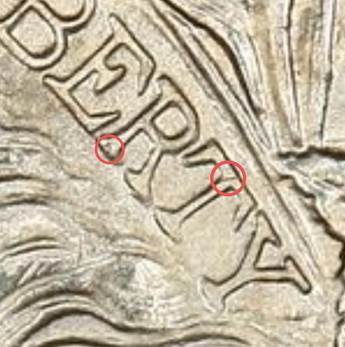
Both coins show both a common obverse and reverse. Highlighted markers in red include a raised lump on the center of the obverse, misplaced mintmark, gouge in the shield, small indent on the R as well as an overall weakness of the U.


To be sure, a poorly executed cast; but as always there is a potential to see this on numerous dates.

Join the Fight

As we become experienced numismatists, we have an obligation to expose fakes and to share the methods to identify them.

As in the case of the counterfeit Seated Dollar, numismatists study die markers for one common sense reason. If counterfeiters are going to invest time, effort and funds to manufacture fake coins, they are going to use the same die for multiple mintages. That’s when inconsistences occur, ranging from suspicious mintmarks to unique features that deviate from authentic examples.

For instance, there can be deviations in lettering and design, weight and size, metal composition and edge details. I analyze all of these and more.

I will continue to share these details in my articles for Proxiblog and other publications as well as Facebook’s “Fun with Fakes” (FwF).

By understanding how die markers are used and by carefully examining coins for inconsistencies, coin collectors can increase their ability to identify counterfeit coins. 

If you like posts like this, please go to our counterfeit archive with reports from Jack Riley, Jack D. Young and Michael Bugeja. Also, please subscribe so you can be informed whenever there is a new article or column.

Proxiblog also has hundreds of followers on Facebook Coin Groups. To get the latest discussion and commentary, be sure to friend us by clicking here.

You can find more information about errors and varieties as well as buying and bidding on coins in Coin News Updated: The Essential Guide to Online Bidding. Please consider purchasing the work for yourself or a friend, as it underwrites this hobbyist website. Thank you.

Counterfeit PCGS 1893-S Morgan


By Jack Riley

The 1893-S Morgan, a key date in the series, is the third most counterfeited coin after the 1909-S VDB Cent and the 1916-D Mercury dime. That is why numismatists scrutinize raw coins offered online where most fakes are offered for sale as genuine.

The 1893-S Morgan Dollar below was sent to PCGS and returned as counterfeit. This is cast and not die struck. Surely it was a new collector with a PCGS membership who sent it in, hoping to authenticate it.

Let’s investigate.


The suspect coin weighed 26.75 grams with a diameter of 37.7mm and a thickness of 2.8mm. The standard for Morgan dollars is 26.73 grams with a diameter of 38.1 millimeters and a thickness of 2.4mm.

One would expect a cast to be thick if the weight is near that of a genuine coin. Some raised lumps show on the surface left of “i” and 3 raised lines in “A”.


I had previously logged this particular cast in my running doc sheet of “common cast Morgans.” I use this sheet as a reference point for new collectors of identifying various cast counterfeits via pictures. I’ve only seen this particular reverse on this 1893-S and one 1900-S.


These are still fooling collectors as evident regarding the fake coin sent to PCGS.

Always attribute your coins!

The 1893-S was produced using 1 obverse die and 2 reverse dies. The date position doesn’t change on any! All coins have a “far date” with the left of the 1 parallel to the right side of the 3rd denticle.


A few die markers on the obverse include a line through T and the “rabbits foot” on the R which may be difficult to see on lower grades so the T marker is the primary pickup point.


On to the reverse! Two reverses used with VAM-1 having a centered S and VAM-2 having a mint mark tilted right.

VAM stands for Van Allen and Mallis, referring to Leroy Van Allen and A. George Mallis, researchers who cataloged Morgan dollar and Peace dollar die varieties. The VAM system is a way to identify specific die variations on these coins. 


To identify counterfeit coins, you should understand the role that die markers and dimensions play.

Die markers are imperfections on the die transferred to the coin during striking. As documented earlier in this article, such markers can be die chips, die breaks and die polish marks.

Coin dimensions include weight, diameter and thickness, as we used in documenting this 1893-S fake.

If you like posts like this, please subscribe so you can be informed whenever there is a new article or column.

Proxiblog also has thousands of followers on Facebook Coin Groups, YouTube and social media. To get the latest discussion and commentaries, click here.

You can find more information about errors and varieties as well as buying and bidding on coins in Coin News Updated: The Essential Guide to Online Bidding. Please consider purchasing the work for yourself or a friend, as it underwrites this hobbyist website. Thank you.