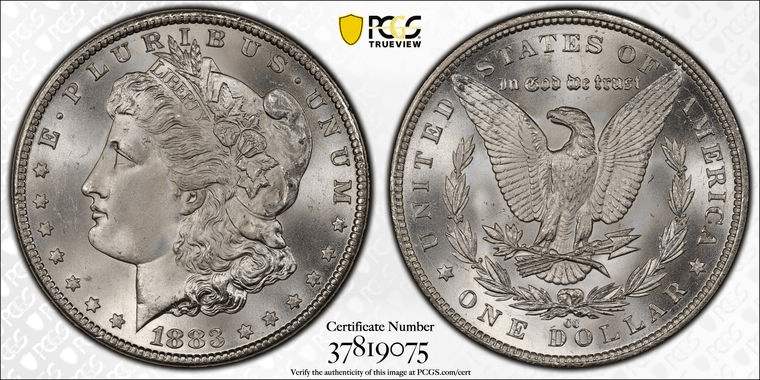
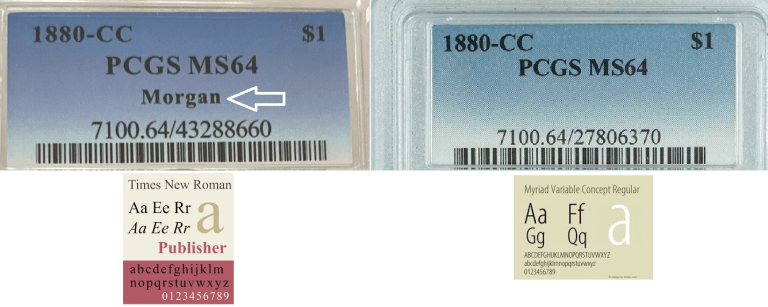
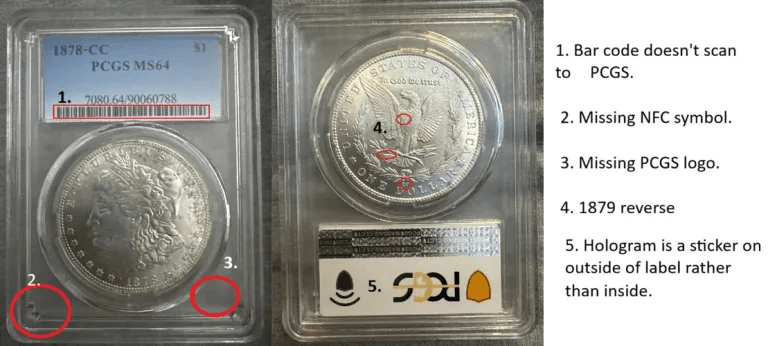
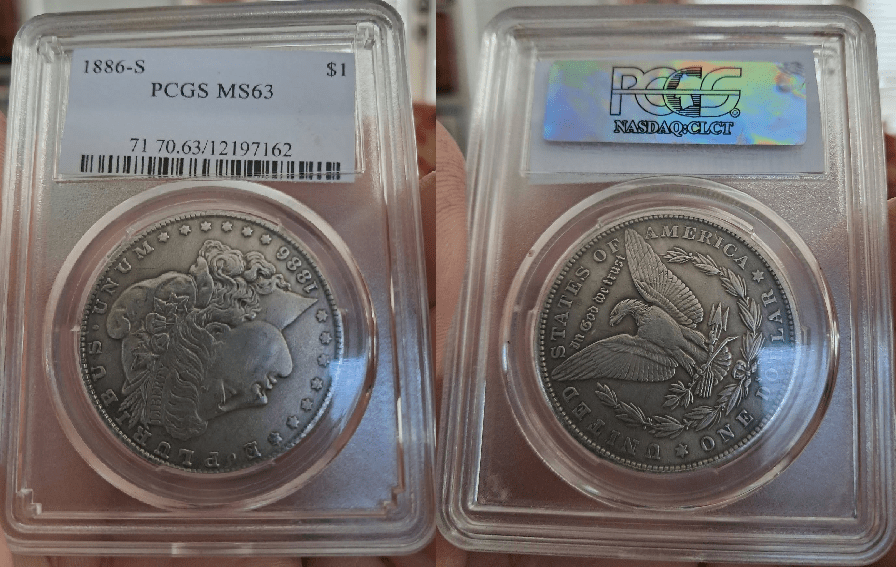
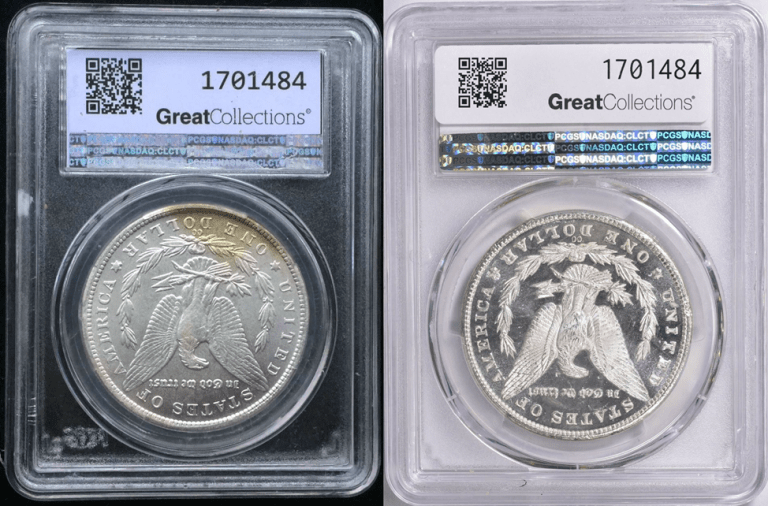
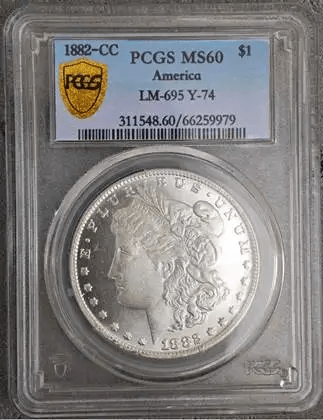
This video documents the various ways to identify fake Chinese holders and coins, including lack of logos on slab, pasted Gold Shield sticker, wrong fonts, wrong 1921 label, wrong reverse and so much more. Below the video is a an example of a Carson City Morgan dollar with six significant problems signifying a counterfeit. But there are other fake coins and slabs you need to know.
Bad Condition for Grade
The surface area lacks a cartwheel and good eye appeal and would never be graded MS66+. Check certification before buying any slabbed coin by PCGS and NGC, especially. See below for difference.
Wrong Font
Missing NFC Logo
QR Code Opens to Chinese Fake Certification Site
Everything is Wrong
Wrong cert, mistake “Morgan” on non 1921 coin, thin holder, misplaced sticker, missing logo.
Another Messed Up “Everything Wrong” Example
Wrong bar code, missing symbol and logo, wrong reverse, misplaced sticker.
Genuine Sticker Inserted into Fake PCGS Holder
Cracked open fake holder (no PCGS logo, wrong sticker) with genuine sticker and fake coin stuck inside it.
Counterfeit Coin Via Verification Check with Fake GreatCollections Holder
Fake coin detected via checking certification that also has a fake GreatCollections label.
If you like posts like this, you can read more articles on counterfeit coins by Jack D. Young, Jack Riley and Michael Bugeja at this URL. Also, please subscribe so you can be informed whenever there is a new article or column.
Proxiblog also has thousands of followers on Facebook Coin Groups, YouTube and other venues. To get the latest discussion and commentary, be sure to friend us by clicking here.
You can find more information about errors and varieties as well as buying and bidding on coins in Coin News Updated: The Essential Guide to Online Bidding. Please consider purchasing the work for yourself or a friend, as it underwrites this hobbyist website. Thank you.
The ever growing saga of new counterfeits continues. This 1872 S Seated Dollar below was recently brought to our attention in a Facebook group.
That’s an example of how counterfeit investigations begin.
A quick glance tells the story.
The 1872-S was only produced with one die marriage and that is referred to as an OC-1. Below is an image of the mintmark location of a genuine coin.
The coin clearly isn’t attributable to a genuine variety. The next step to me is looking for anything that may standout as a notable marker to find additional “bad” coins. Another example offered by Aliexpress shows us just where this came from.
Both coins show both a common obverse and reverse. Highlighted markers in red include a raised lump on the center of the obverse, misplaced mintmark, gouge in the shield, small indent on the R as well as an overall weakness of the U.
To be sure, a poorly executed cast; but as always there is a potential to see this on numerous dates.
Join the Fight
As we become experienced numismatists, we have an obligation to expose fakes and to share the methods to identify them.
As in the case of the counterfeit Seated Dollar, numismatists study die markers for one common sense reason. If counterfeiters are going to invest time, effort and funds to manufacture fake coins, they are going to use the same die for multiple mintages. That’s when inconsistences occur, ranging from suspicious mintmarks to unique features that deviate from authentic examples.
For instance, there can be deviations in lettering and design, weight and size, metal composition and edge details. I analyze all of these and more.
I will continue to share these details in my articles for Proxiblog and other publications as well as Facebook’s “Fun with Fakes” (FwF).
By understanding how die markers are used and by carefully examining coins for inconsistencies, coin collectors can increase their ability to identify counterfeit coins.
If you like posts like this, please go to our counterfeit archive with reports from Jack Riley, Jack D. Young and Michael Bugeja. Also, please subscribe so you can be informed whenever there is a new article or column.
Proxiblog also has hundreds of followers on Facebook Coin Groups. To get the latest discussion and commentary, be sure to friend us by clicking here.
You can find more information about errors and varieties as well as buying and bidding on coins in Coin News Updated: The Essential Guide to Online Bidding. Please consider purchasing the work for yourself or a friend, as it underwrites this hobbyist website. Thank you.
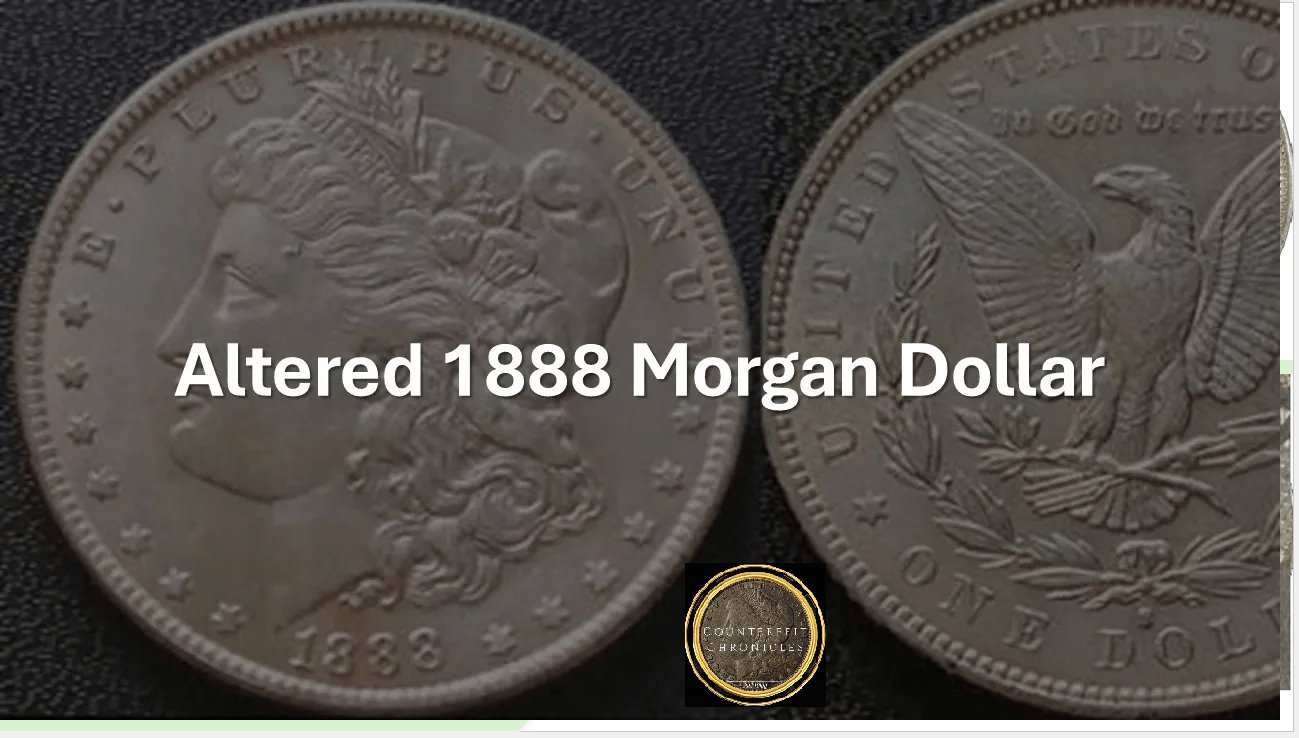
When it comes to raw coins it is very important to inspect them thoroughly. Start with learning how to grade coins and then learn more about counterfeits on Proxiblog. The coin featured here is altered and as such, a prime example of how learning the hobby saves time and expense. You will learn that everything isn’t always as it seems!
The coin pictured below looks like any other Morgan Dollar on the surface but there are many things hidden.
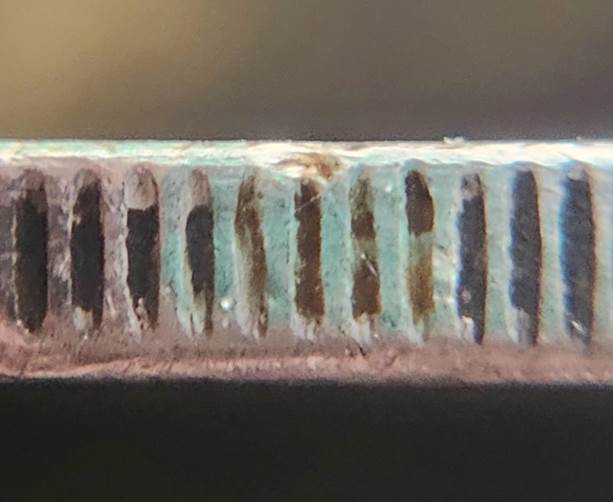
The edge view directly in line shows some “tampering.” The discoloration and infrequent width and grooves of the reeding is indicative for an “Embossed mintmark.”
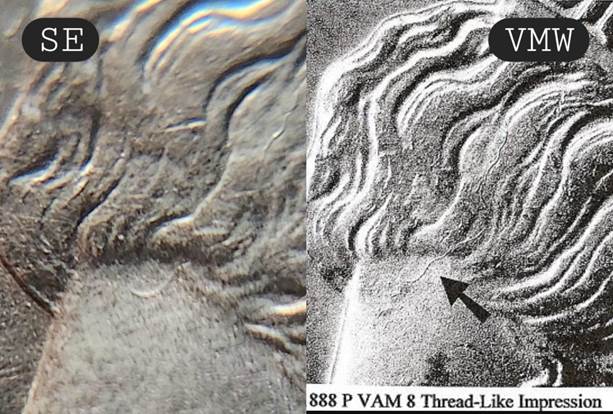
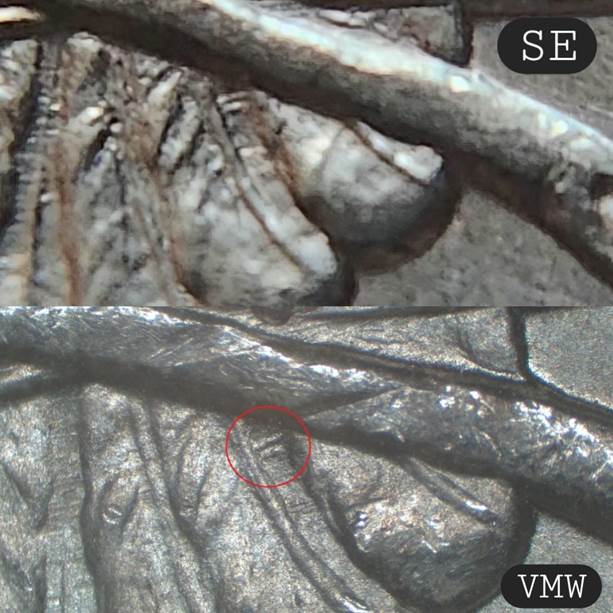
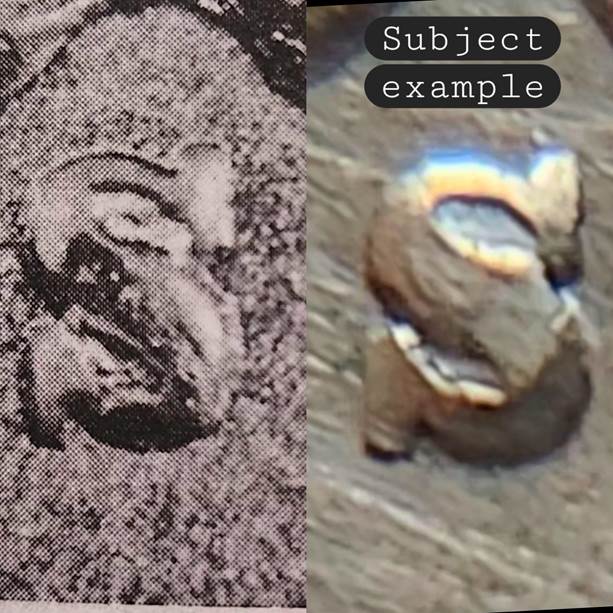
The obvious step here is to attribute this coin and what is found is rather surprising. The die marriage attributes to a Philadelphia struck 1888 VAM-8! The following photos compare the subject example (SE) compared to VAMworld plate photos of a genuine 1888P. The thread-like impression on the forehead and reverse marker between the tailfeathers stand out and prove this to be a Philadelphia strike NOT a San Francisco struck coin.
The correct type IV mintmark shape was used in making this as well! Making it even more convincing and difficult to discern. This style mintmark was used throughout the series from 1879 to 1900.
This was a fairly well executed added mintmark with attention to detail. Making it ever so important to attribute coins you plan to purchase or currently have in your collection.
If you like posts like this, please subscribe so you can be informed whenever there is a new article or column.
Proxiblog also has hundreds of followers on Facebook Coin Groups. To get the latest discussion and commentary, be sure to friend us by clicking here.
You can find more information about errors and varieties as well as buying and bidding on coins in Coin News Updated: The Essential Guide to Online Bidding. Please consider purchasing the work for yourself or a friend, as it underwrites this hobbyist website. Thank you.
An intriguing counterfeit 1920 Standing Liberty Quarter was recently posted to eBay and sparked this article. Pictured below is the Bay example with highlighted repeating marks found on this “family.” The “speared wing,” if you will, is a major pickup for this as well as the lump above “C.”
This “family” shares a common reverse and mixes the obverse of various dates and types including Type 1 and Type 2 obverse designs as well as common and rare dates. Virtually every date of the series has been found linked to this family.
The reverse design of the Standing Liberty quarter changed in mid-1917. The initial design, minted in 1916 and part of 1917, featured Liberty with a bare breast and a low-flying eagle. The redesigned reverse, starting mid-1917, showed the eagle higher and more centered, with three stars below and five on each side.
A 1921 example was previously shared in a Facebook group which reviewed mixed reviews on the coin. Once again 3 common markers show on the reverse.
While the first two examples could be deceiving to collectors, these next two should not be! A 1919 with a Type1 obverse and a poor attempt at a 1916 SLQ.
This is becoming detrimental as the counterfeits are pouring into the “constitutional silver” and can be much more difficult to discern than series that are cataloged by die marriages. This also serves as a good reminder to be diligent on any purchases online as you only have the photos provided and the words of the seller to go by.
Consider this seller showing a 1916 obverse with a latter 1917 reverse (three bottom stars):
Note that the seller is using “HeritCoin, an AI-powered app that helps users identify and value coins. So much for accuracy. But great for scammers.
If you like articles like these, please friend us on Facebook and subscribe to Proxiblog.
Proxiblog also has thousands of followers on Facebook Coin Groups, YouTube and social media. To get the latest discussion and commentaries, click here.
You can find more information about errors and varieties as well as buying and bidding on coins in Coin News Updated: The Essential Guide to Online Bidding. Please consider purchasing the work for yourself or a friend, as it underwrites this hobbyist website. Thank you.
There is nothing more disappointing for veteran hobbyists as to see people with little numismatic knowledge posting microscopic photos of pocket change, believing they have discovered rare coins, errors and varieties.
Often they just show damaged coins, machine doubled ones from worn dies, miniscule die chips from metal dust, rings of death from sorting machines, slightly misaligned collars or rotated reverses within Mint tolerance, zinc rot from core deterioration, or just plain pareidolia.
If you didn’t understand the above paragraph, you shouldn’t be using a coin microscope.
This article explains when to use one, encouraging you to:
Realize that most valuable errors can be seen with the naked eye or a loupe with only a relative few requiring up-close analysis.
View surfaces of coins for evidence of cleaning, distinguishing the differences between hairlines, slide marks and dipping.
Identify dates, types or devices that are indistinct because of wear or acid treatment.
Document flaws of doctored coins whose sellers used PhotoShop or AI to hide flaws.
Research die markers to identify counterfeit, replica and restruck coins.
Photograph coins without investing in expensive light equipment, lenses and cameras.
Because of clickbait social media, thousands of new collectors post photos of coins asking veterans to identify non-existent errors and varieties.
Below are a few examples.
This person has discovered machine doubling caused when a die becomes slightly loose and begins to deteriorate. In his favor, he posts a photo of the actual coin. Many newbies do not. The machine doubling here isn’t visible without magnification. It’s just a cent.
How about this post?
For the grammarians out there, this person’s run-on sentence implies that he, and not the coin, “wasn’t circulated until the late 2000s.” (I believe him.) He fishes for affirmation claiming the coin has “great errors” and doubling. It does not.
This next guy believes his nickel has “multiple errors” and, of course, doesn’t mention what they are. He is primarily concerned about value.
If you pretend you have discovered “multiple errors” and ask about values, you may get snarky answers.
Let’s learn when and how to use that coin microscope.
Select Errors and Varieties
If you know in advance what you are looking for–again, see this directory–you may need a microscope for certain types and denominations.
For instance, if you are looking for extra trees in the 2005 P-D-S Minnesota State quarters, you might need a microscope to spot the faint outline of doubling. Here’s a close-up of an extra tree on the 2005-D quarter:
Evidence of Cleaning
It is important to identify dipping, which strips away a thin layer of metal so as to make the coin appear uncirculated. It does that to a degree, but then leaves tell-tale micro bubbles that dull luster. Hairlines occur when a person uses an abrasive leaving marks with each stroke.
Slide marks are not caused by cleaning but by storage in albums with sliding plastic covers. You pull out a cover, leaving marks as it “slides” out so the coin can be extracted.
Dipping and cleaning greatly decrease the value of the coin. However, third-party grading companies allow slide marks when awarding numerical grades. Not so if a submission was dipped or cleaned.
Here’s a photo of dipped, cleaned and slide-marked coins:
Restored Dates and Devices
Some coins are so worn that a microscope may be needed to see the date, type, mintmark, device or die marker.
Here’s a worn example:
Here’s an acid treated nickel:
These two coins would require microscopic analyses.
Flawed or Doctored Coins
The Morgan Dollar below has a magnificent patina, greatly enhancing value if holdered by PCGS, NGC, ANACS or CAC. Say you bid high on that prospect and won the coin. But when when you receive it, you notice a pin scratch hidden by the toning. This would earn a details grade. If you want to return the coin, you can send as proof a microscoped photo (right).
Researching Die Markers
Counterfeit experts know how coins are minted–so much so, in fact, that they can identify fake coins based on a comparison of die markers from genuine ones.
In the photo below, Riley identifies a counterfeit coin by the markers circled in red:
While many hobbyists would use a loupe to identify those markers, a coin microscope also is appropriate in this case.
Photographing Coins
There are many reliable brands of coin microscopes. Veteran collectors use them to photograph their coins without investing in expensive light boxes and lenses. If you buy a microscope with a pole less than 10 inches, you won’t be able to photograph large coins like Morgan dollars in their natural state with top-notch clarity.
The TOMLOV microscope below has that longer pole.
Proxiblog uses a TOMLOV DM4S Microscope 4.3″ LCD Digital Microscope. You can learn more about that by clicking here.
If you like posts like this, please subscribe so you can be informed whenever there is a new article or column.
Proxiblog also has thousands of followers on Facebook Coin Groups, YouTube and social media. To get the latest discussion and commentary, be sure to friend us by clicking here.
You can find more information about errors and varieties as well as buying and bidding on coins in Coin News Updated: The Essential Guide to Online Bidding. Please consider purchasing the work for yourself or a friend, as it underwrites this hobbyist website. Thank you.
Today we explore the Trade Dollar’s common obverse matched with various (and improbable) reverses–an 1874-P, 1873-S and 1874-S–all sharing the same obverse.
The U.S. Mint began producing Trade Dollars in 1873 in the hope to boost trade, especially in East Asia, and to compete with the Mexican Peso.
The Trade Dollar is heavier than the Morgan silver dollar, again to compete with the Mexican counterpart. The Peso weights 27.07 grams with 90.27% silver compared to the Morgan Dollar’s 26.73 grams, 90% silver content.
There are two Trade Dollar reverse types. The Type 2 Reverse was used on Trade dollars between 1875 and 1876 and on all Trade dollars beginning in 1877. The latter design is missing a berry under the eagle’s claw:
First fake up in this article is an 1874-P Trade Dollar with a Type 2 reverse! This reverse wasn’t used until 1875 at the Philadelphia mint. I like to call this the “Dented Denticles” as the obverse denticles are nearly missing below the date. A dent above the foot and on Liberty’s neck are common markers shared on these counterfeits (highlighted in red). Below the subject coin is a reference photo to identify Type1 and Type2 reverses.
Next up we have an 1873-S! Same obverse as the counterfeit 1874-P but with a different reverse, this time paired with the correct Type.
In my search for more of these mix matched dates I landed on the “CoinHelpU” forum. This time we see a counterfeit 1874S. Same obverse but yet another reverse!
It’s apparent that the counterfeiters will use anything at their disposal to create more. Swapping out the dates and changing the reverses to anything they can find. It’s never been more important to attribute a coin that you intend to purchase.
Attributing coins requires learning–the type of which you get when reading Proxiblog and other reputable coin sites. Concerning Trade Dollars, examine devices, weigh the metal and measure the diameter, comparing it to an authentic example. I recommend going online to find a PCGS-attributed coin with TrueView, which can be expanded on your screen.
Pay attention to the coin’s condition and grade, using PCGS Photograde.
So ends the latest journey of more “Fun with Fakes” (FwF) and Proxiblog. It is getting really hard to keep up with all the ways scammers and their ilk continue to challenge the hobby.
For more information about counterfeit trade dollars, see Jack D. Young’s article about fake trade dollars in counterfeit TPG holders, as these coins illustrate:
If you like articles like these, please friend us on Facebook and subscribe to Proxiblog.
Proxiblog also has thousands of followers on Facebook Coin Groups, YouTu.be and social media. To get the latest discussion and commentaries, click here.
You can find more information about errors and varieties as well as buying and bidding on coins in Coin News Updated: The Essential Guide to Online Bidding. Please consider purchasing the work for yourself or a friend, as it underwrites this hobbyist website. Thank you.
New waves of counterfeit coins continue to show up routinely and can be a challenge to keep up with! A recent counterfeit 1851 half cent surfaced online and caught some attention. Pictured below is the counterfeit example (top image) compared to a genuine example (bottom image).
Genuine image courtesy of PCGS
With only one die pair being the C-1 to compare it to, something is clearly off. The reverse letters appear “bubbly” while the letters are not crisp. The obverse stars show similar features, combing that with minor surface issues tells the story. The rims also appear filed down.
Searching more photos led to identifying a total of 4 coins from this potential “family,” with two being offered on various online sites. One example was posted to an online forum in 2018. The subject example for this article was presented on Facebook.
As always in this situation, I search for “Sister Marks” as counterfeit expert Jack Young would call them, repeating circulation marks that are not identifiers for a genuine die pair. That search did not disappoint!
Two obverse depressions on the chin and neck are quick to notice, which led to me referring to this as “Dimple Chin”. The reverse markers include a major depression mark in the “i” of “America” and the “O” in “OF.” A damaged area on the left leg of “H” in “Half” and lump above “A.” The line through A may not be seen on examples with false circulation wear.
Below are the original example and from an online forum. All markers noted are highlighted in red.
Here we have two examples exhibiting false circulation wear. Note the A “Slash” may not be seen.
One may ask “Where do these come from?” You too can purchase one on eBay that ships directly from China!
I’ve personally only seen this on coins dated 1851. It’s very likely other Braided Hair Half Cents exist with both this counterfeit obverse and reverse. Stay diligent friends!
Proxiblog also has thousands of followers on Facebook Coin Groups, YouTube and social media. To get the latest discussion and commentary, be sure to friend us by clicking here.
Subscribe so you can be informed whenever there is a new article.
You can find more information about errors and varieties as well as buying and bidding on coins in Coin News Updated: The Essential Guide to Online Bidding. Please consider purchasing the work for yourself or a friend, as it underwrites this hobbyist website. Thank you.