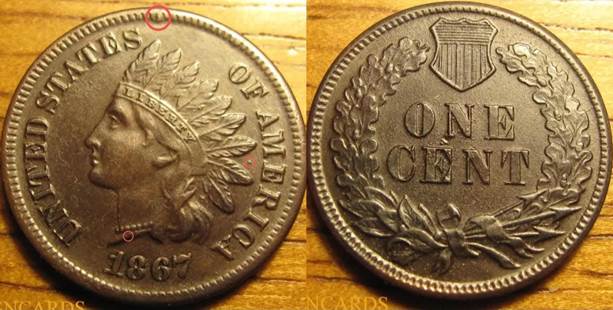
It is relatively easy to authenticate a 1909-S Indian Head Cent, primarily by the shape and position of the “S” mintmark, along with the denticles. Also look at the coin’s edge. It should be beveled and not square cut flat.
The 1909-S is a key date in the series, with only 309,000 struck. Conversely, millions of 1909 Philadelphia cents were minted, tempting counterfeiters to glue or affix a fake “S” onto a 1909-P coin.
Take a close look at the shape of the “S” mintmark.
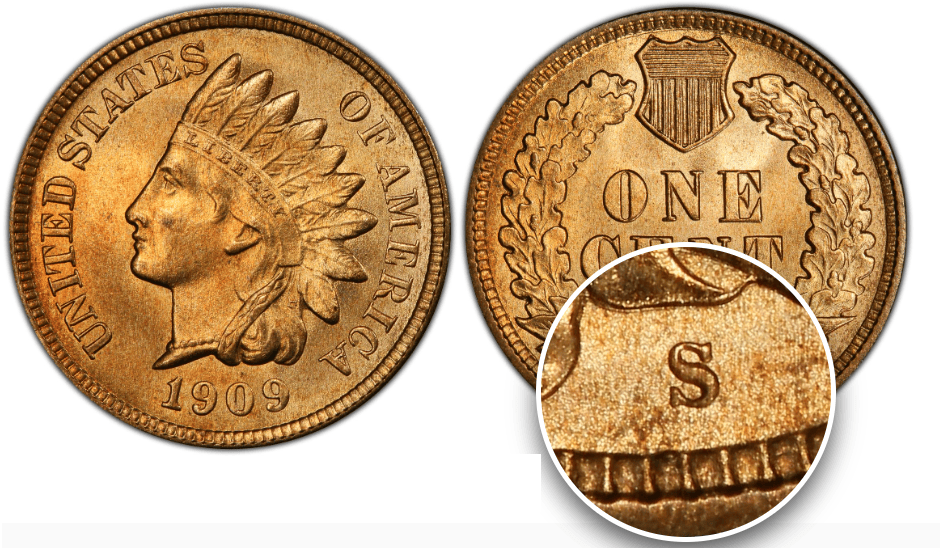
San Francisco used only two reverse dies for the 1909-S, and both share the exact same “S” punch used on the 1908-S Indian Cent. Because the 1908-S Cent is valuable and also a key date, scammers typically try to affix an “S” from an early Lincoln Cent.
Note the difference in shape:

An authentic “S” has a thick middle and tapered and thin top and bottom stems with a sharp pronounced serif on each end.
You can also check the alignment. Look at “ONE CENT.” Focus on the the bottom left stem of the “N” and go straight down to the mintmark. It should be directly below it.

You can also count denticles. As mentioned earlier, only two reverse dies exist. Die 1 struck the vast majority of the 309,000 mintage, so almost every 1909-S should have the same marker as below. Count those denticles. The “S” should be over the sixth one.

On both genuine reverse dies, the “S” points directly toward the center of a denticle below it. Counting denticles is important because counterfeits adding an “S” typically misplace the mintmark. It’s the best way to determine a fake.
There is a handy way to identify fakes. The 1909-S Indian Cent has a beveled edge, as do all in the series. Set the coin upright on its edge on a flat surface. It should tip over. If it balances upright, it has a squared off edge and is counterfeit.
Proxiblog has featured die markers for major rarities like this one. Visit it to test your other key dates.

If you like posts like this, please subscribe so you can be informed whenever there is a new article or column.
Proxiblog also has thousands of followers on Facebook Coin Groups, YouTube and other social media. To get the latest discussion and commentaries, click here.
You can find more information about errors and varieties as well as buying and bidding on coins in Coin News Updated: The Essential Guide to Online Bidding. Please consider purchasing the work for yourself or a friend, as it underwrites this hobbyist website. Thank you.