
By Jack Riley
With an ever growing amount of counterfeit coins being produced it can be a challenge to keep up with them. Tens of thousands of fake coins, replicas and copies flood the hobby market each month.
Numismatic News and other sources have reported these sobering results:
- One factory along in China produces over 100,000 forged coins per month.
- Annual figures of fakes range in the billions with entire cities or districts in China manufacturing them.
- Flooding of fakes on eBay remains one of the biggest concerns.
The frenetic manufacturing rate now includes common 90% silver coinage to be counterfeit. Nothing is safe!
After a previous article of what one could call the “Spiked wing” counterfeit Standing Liberty quarters, a second family arose on different online venues.
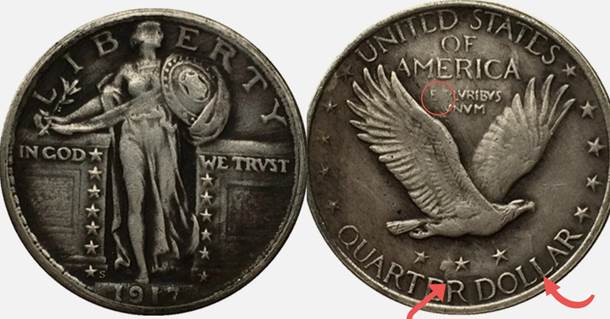
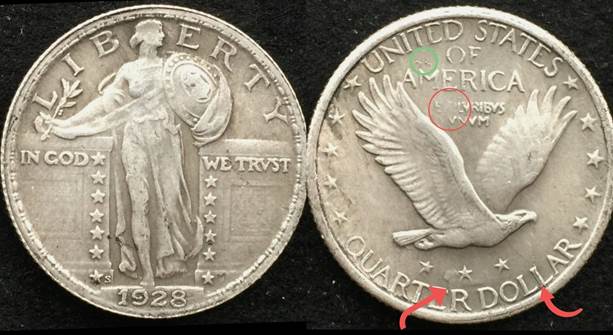
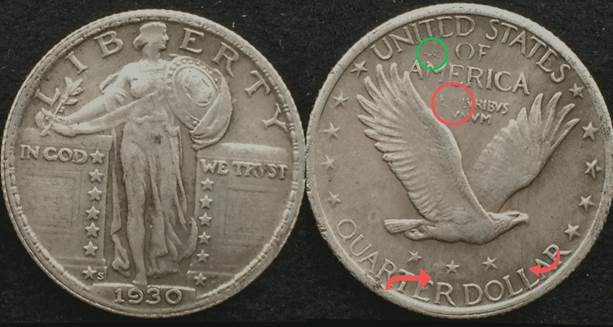
I have three images comparing this new “Family.” Two of which have a major casting flaws above “America” and will be highlighted in green since it isn’t seen on all examples. All markers highlighted in red have been on all examples seen as of the time of this article.
So to the Family! Three coins dated 1917, 1928, and 1930 showed up all sporting a San Francisco mintmark. Though this likely could be seen on any date/mintmark combination since the counterfeiters pay no mind to design changes or the series itself. First up is this 1917s Type 2 SLQ that shows a weak E-P highlighted in red as well as two cracks through “Quarter Dollar”.
Another seller offered two coins (1928s and 1930s) which share the same reverse but a different obverse as the 1917s. Additionally the raised lumps from a poor cast show on both of these examples.
It would seem a new “Family” surfaces regularly! Making it ever more important to be diligent in vetting who/where you purchase coins from and how you make that purchase, especial ly if buying on eBay, as counterfeit expert Jack D. Young has reported for Proxiblog.
Granted, even experienced hobbyists are scammed by purchasing counterfeits. As such, newer collectors should follow these general guidelines:
- If you are ready to bid hundreds of dollars on a coin, resist buying a raw one and shop for one holdered by PCGS, NGC, ANACS and CAC.
- Be especially careful when purchasing raw coins from eBay and other online venues. TAI bots cannot detect counterfeits, so you are on your own.
- Make sure the seller takes returns and has good reviews. Also, the number of positive reviews is a good indicator. If someone has 0 sales or even fewer than 100, do not take a chance.
- Weigh the coin and go to PCGS CoinFacts for the date and mintmark, checking your coin against weights and dimensions.
- Read this article about detecting counterfeits.
If you like posts like this, you can read more articles on counterfeit coins by Jack Riley, Jack D. Young and Michael Bugeja at this URL. Also, please subscribe so you can get our weekly newsletter and be informed whenever there is a new article or column.
Proxiblog also has thousands of followers on Facebook Coin Groups, YouTube and social media. To get the latest discussion and commentary, be sure to friend us by clicking here.
You can find more information about errors and varieties as well as buying and bidding on coins in Coin News Updated: The Essential Guide to Online Bidding. Please consider purchasing the work for yourself or a friend, as it underwrites this hobbyist website. Thank you.
