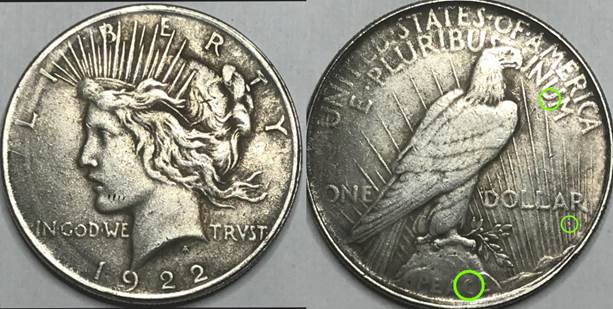
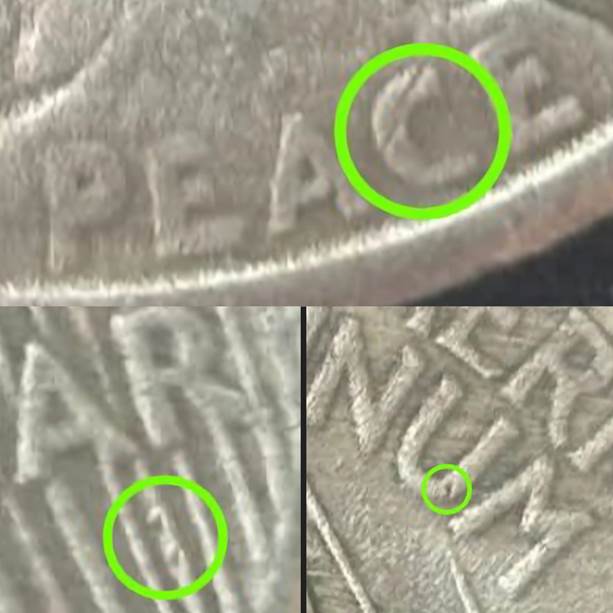
Fake Oval O on 1897-O Morgan


By Jack Riley

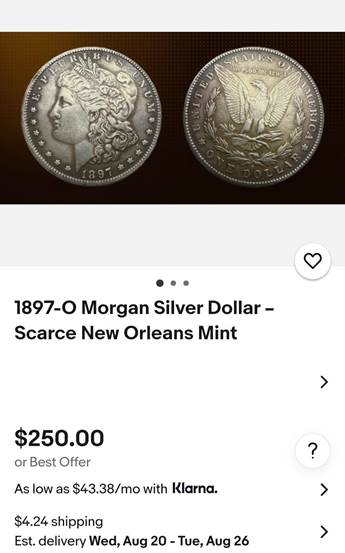
In Numismatics, authenticity generally serves as the foundation in which all other qualities–such as grade, variety, and historical importance–are evaluated. Without certainty of authenticity, a coin’s value is nullified. This article was prompted by a recent eBay listing for an 1897-O Morgan Dollar offered at $250, which upon review, was determined to be counterfeit. For ethical reasons, the seller’s identity will remain undisclosed. After being contacted, the seller acted responsibly by immediately removing the listing and clarifying that they had been unaware of the coin’s illegitimacy. Their swift response and willingness to prevent the sale of a counterfeit merits recognition.


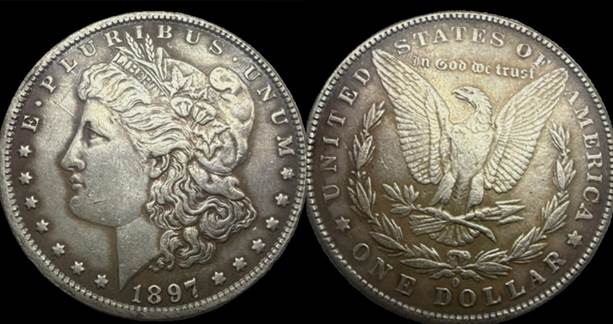
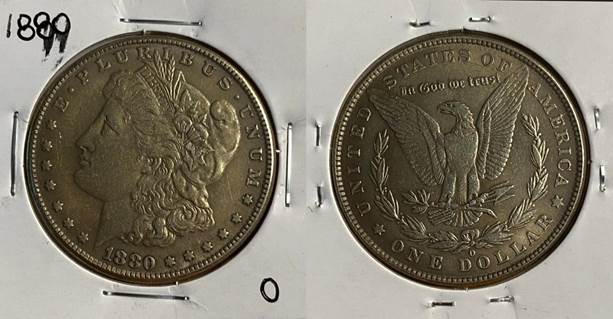
Here is a closer view of the coin in question. Immediately noticing the “Oval O” reverse which is not seen on 1897 dated coins, one can see something is wrong!


Image from an 1880-O courtesy of my friend Dave Jordan that shares a common reverse to the 1897-O listed on eBay.


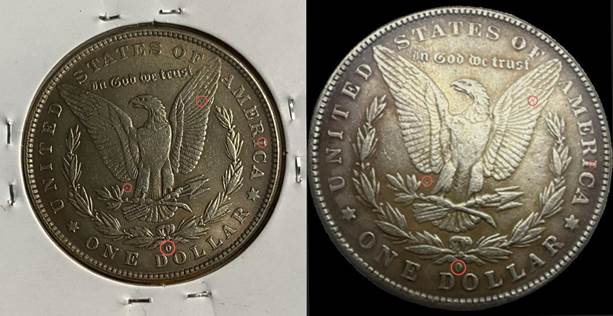
A side by side comparison shows common markers related to this “Family.” Noteworthy markers include:

  • Oval O set left
  • Indent above the 2 berries below the right wing
  • Depression mark in the eagles left wing (viewers right) just above the tip of the wreath
  • Minor depression mark of the “I” in America

It is worth mentioning this reverse has been seen on 1895-O dated coins with an additional crack through the “T” of United. These are better quality counterfeits than many you may come across.

By understanding how die markers are used and by carefully examining coins for inconsistencies, coin collectors can increase their ability to identify counterfeit coins. 

If you like posts like this, please go to our counterfeit archive with reports from Jack Riley, Jack D. Young and Michael Bugeja. Also, please subscribe so you can get our weekly newsletter and be informed whenever there is a new article or column.

Proxiblog also has thousands of followers on Facebook Coin Groups, YouTube and social media. To get the latest discussion and commentary, be sure to friend us by clicking here.

You can find more information about errors and varieties as well as buying and bidding on coins in Coin News Updated: The Essential Guide to Online Bidding. Please consider purchasing the work for yourself or a friend, as it underwrites this hobbyist website. Thank you.

Family of Fake Half Cents


By Jack Riley

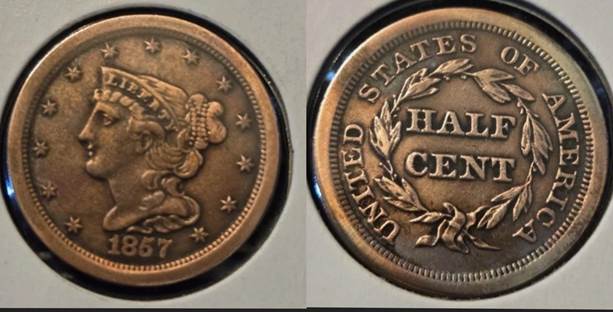
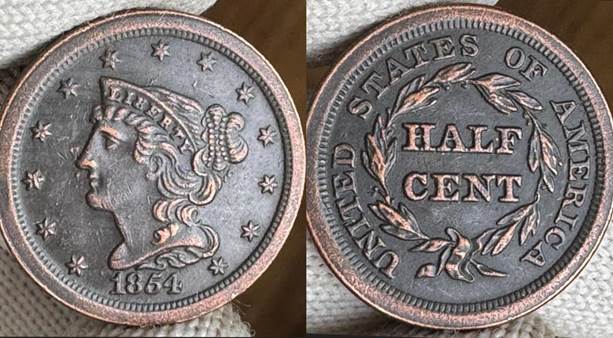
The saga continues of “new” counterfeits popping up on the market. In my downtime I enjoy browsing online sites and forums. In my search I stumbled across this 1857 half cent listed by what I would consider an average seller. Plenty of listings, with a number of them being genuine coins.


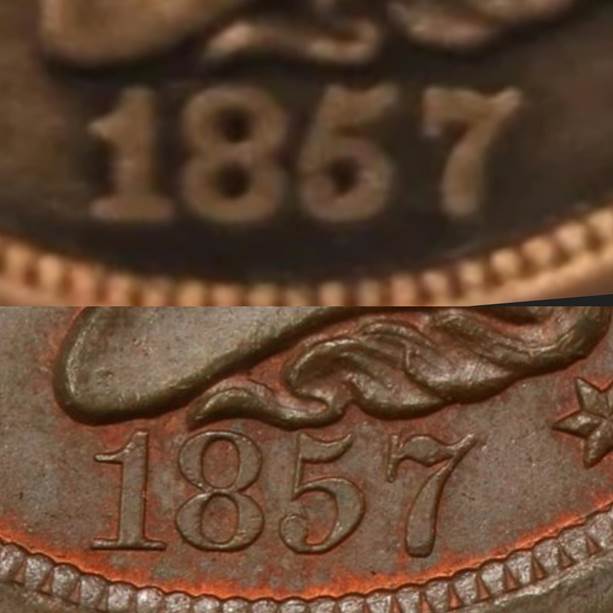
With only one die marriage being the C-1 for circulation issues, this should be a simple coin to attribute. Bay listing (Top) compared to a PCGS certified example (bottom). Clearly the date doesn’t attribute!


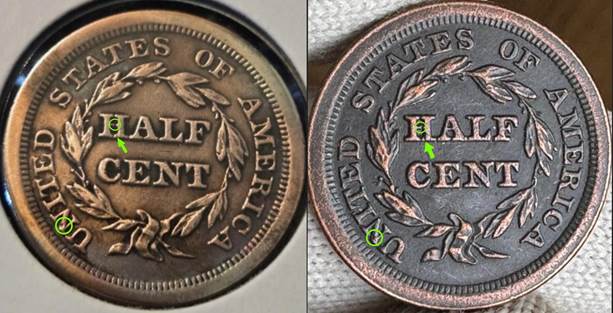
Following this, I set out to find more of the “family.” It didn’t take long to stumbled upon this 1854 example that shares a common reverse!


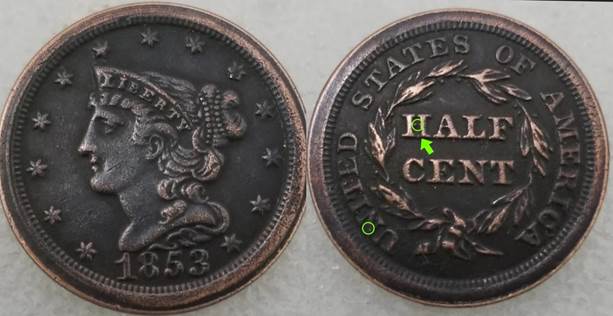
Both coins share this reverse with a large depression in the “N” and a line through the H of “Half.”


Fellow Proxiblog contributor Jack Young sent an eBay link of a spurious seller, and within the listings, it yielded another date sharing this reverse!


There seems to always be a “new one” weekly!

Because of that, I urge collectors to attribute a coin if they intend to buy it or at minimal ask a second opinion.

Attribution of a coin can be done by anyone, even without books! PCGS CoinFacts app as well as NGC’s variety plus are great tools that show images of many die marriages for most series. Compare your coin to the known varieties and determine if it matches. Many things play a factor such as date position relative to the denticles, star orientation, reverse lettering spacing.

Recognizing these differences will prepare you to attribute tougher varieties!

If you like posts like this, you can read more articles on counterfeit coins by Jack D. Young, Jack Riley and Michael Bugeja at this URL. Also, please subscribe so you can get our weekly newsletter and be informed whenever there is a new article or column.

Proxiblog also has thousands of followers on Facebook Coin Groups, YouTube and social media. To get the latest discussion and commentary, be sure to friend us by clicking here.

You can find more information about errors and varieties as well as buying and bidding on coins in Coin News Updated: The Essential Guide to Online Bidding. Please consider purchasing the work for yourself or a friend, as it underwrites this hobbyist website. Thank you.

New Counterfeit Discovery on 1921 Peace Dollar

By Jack Riley

In a previous article I discussed a large “family” of counterfeit Type A reverse Peace Dollars. The majority of the coins encountered were dated 1921. This article is about a counterfeit 1921 Peace Dollar with a B2 reverse! This reverse type wasn’t used until 1922.

Before diving into the specifics, let’s have a short review:

Let’s look at the two reverse for 1921 and 1922 Peace Dollars:

On the 1921 Type A reverse, 4 rays appear below “ONE” and on the Type B reverse, three.

There is one more distinction on Type B reverses, which we label B1 and B2. As illustrated below, B1 reverses show two mountain peaks while the B2 reverse has 3.

Image below Courtesy of VAMworld showing the 3rd peak, B2

So now we progress to that 1921 counterfeit with a B2 reverse! See below.


This is the only example of this counterfeit I have seen as of now. The coin is a cast counterfeit evident by the images and the weight of 23 grams. You can see grainy surfaces and many “lumps” throughout the fields. I make note of two possible markers if this is identified on various dates.

There is a prominent dot about the A of “DOLLAR” on the reverse that may be a helpful indicator and a small crack running through the eagles mouth/head.

While this particular coin shouldn’t fool a veteran hobbyist, it is very possible this is interchanged with various dates and an unknown “family of fakes” is out there. Variety attribution on Peace Dollars can be tricky even for experienced collectors.

But this article provides the basics from which all of us can learn.

If you like posts like this, you can read more articles on counterfeit coins by Jack Riley, Jack D. Young and Michael Bugeja at this URL. Also, please subscribe so you can be informed whenever there is a new article or column.

Proxiblog also has thousands of followers on Facebook Coin Groups, YouTube and social media. To get the latest discussion and commentary, be sure to friend us by clicking here.

You can find more information about errors and varieties as well as buying and bidding on coins in Coin News Updated: The Essential Guide to Online Bidding. Please consider purchasing the work for yourself or a friend, as it underwrites this hobbyist website. Thank you.

Fake Family of Type A Reverse Peace Dollars


By Jack Riley

Today we discuss an extensive family of Type A fake reverse Peace Dollars, otherwise known as the 1921 High Relief reverse. We will investigate minor differences in the Type A and B (“Low Relief”) reverses whose diagnostics are key in identifying counterfeits.

First, some background: About 35,401 business strike High Relief 1922 Peace dollars were produced. All but one were melted. Also, 10-20 High Relief proof 1922 coins were made. These are not included in our discussion. Type B reverses appear on Peace dollars dated 1922-28 and 1934-35.

On the 1921 Type A reverse there are 4 rays below “ONE” and on the Type B reverse there are three. Secondly the shape of the leaf cluster is dramatically different. There are other subtle changes but we will use these two as the quick identifiers.


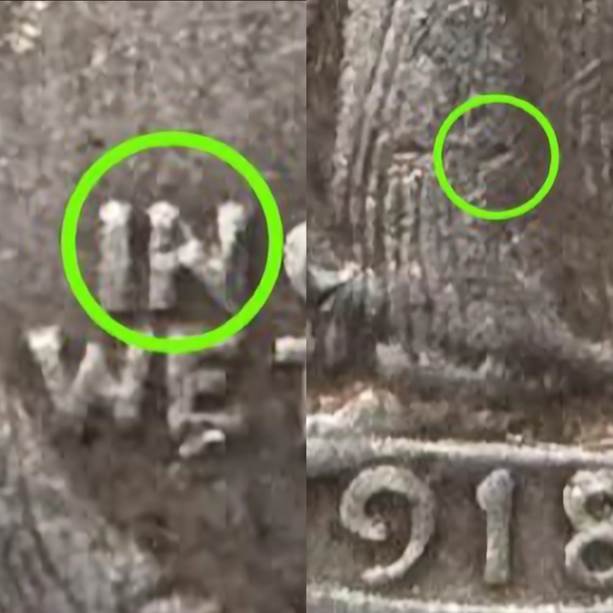
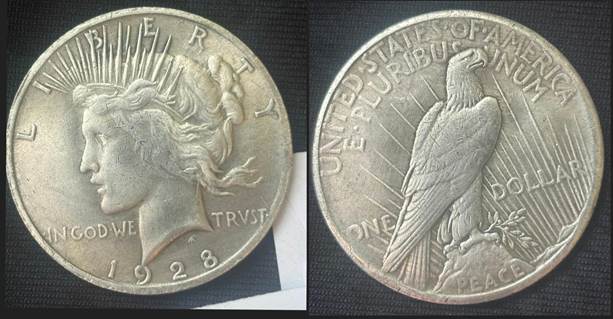
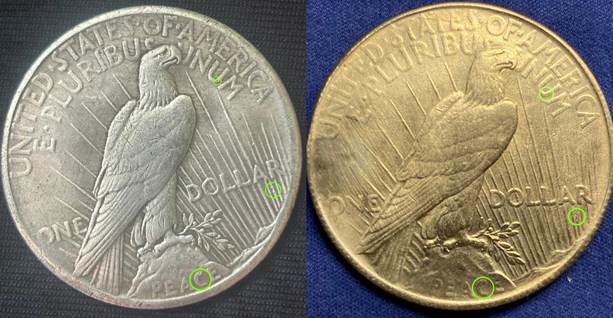
Now onto the “Fake Family”! This is an extensive group of counterfeits spanning various dates with improbable die pairings. The first image is the author’s example with highlighted markers in red. View the strong spread of one, small circular and raised lump between the rays below “L,” and a raised flaw below R. There are additional small depressions in many letters but minute.


The next set of images are dated “1921” and from various online sources.


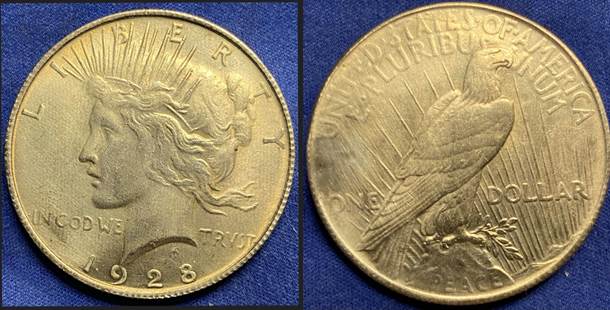
The next image was offered on Ebay by a seller who genuinely wasn’t aware the coin was counterfeit. The listing received a number of bids! I messaged the seller and had a brief discussion and they removed it. Owner stated it had been in the family’s collection since the late 1990’s.


On to our “1921” dated pieces. This is an image from fellow counterfeit researcher Jack Young.


Various dates have been seen mismatched with this common reverse.


Behold one of the more fascinating pieces below. A fellow collector friend Winston Zack shared his 1925 showcasing the common counterfeit reverse and the catch? This piece scanned as 63.5% copper, 28.3% zinc, 7% nickel, 1.2% silver, and traces of iron!


Finally to round out this article, we present two matching counterfeit 1921 Peace Dollar in fake PCGS holders! One which was offered for sale through a Facebook group.


So once again a few of these bypassed numerous collectors who already purchased them or were in the process of doing that. Proxiblog hopes this information gets disseminated so no one purchases any of these counterfeit Peace Dollars!

If you like posts like this, you can read more articles on counterfeit coins by Jack Riley, Jack D. Young and Michael Bugeja at this URL. Also, please subscribe so you can get our weekly newsletter and be informed whenever there is a new article or column.

Proxiblog also has hundreds of followers on Facebook Coin Groups. To get the latest discussion and commentary, be sure to friend us by clicking here.

You can find more information about errors and varieties as well as buying and bidding on coins in Coin News Updated: The Essential Guide to Online Bidding. Please consider purchasing the work for yourself or a friend, as it underwrites this hobbyist website. Thank you.

Fake Family, Type 2, Standing Liberty Quarters


By Jack Riley

With an ever growing amount of counterfeit coins being produced it can be a challenge to keep up with them. Tens of thousands of fake coins, replicas and copies flood the hobby market each month.

Numismatic News and other sources have reported these sobering results:

  • One factory along in China produces over 100,000 forged coins per month.
  • Annual figures of fakes range in the billions with entire cities or districts in China manufacturing them.
  • Flooding of fakes on eBay remains one of the biggest concerns.

The frenetic manufacturing rate now includes common 90% silver coinage to be counterfeit. Nothing is safe!

After a previous article of what one could call the “Spiked wing” counterfeit Standing Liberty quarters, a second family arose on different online venues.

I have three images comparing this new “Family.” Two of which have a major casting flaws above “America” and will be highlighted in green since it isn’t seen on all examples. All markers highlighted in red have been on all examples seen as of the time of this article.

So to the Family! Three coins dated 1917, 1928, and 1930 showed up all sporting a San Francisco mintmark. Though this likely could be seen on any date/mintmark combination since the counterfeiters pay no mind to design changes or the series itself. First up is this 1917s Type 2 SLQ that shows a weak E-P highlighted in red as well as two cracks through “Quarter Dollar”.


Another seller offered two coins (1928s and 1930s) which share the same reverse but a different obverse as the 1917s. Additionally the raised lumps from a poor cast show on both of these examples.


It would seem a new “Family” surfaces regularly! Making it ever more important to be diligent in vetting who/where you purchase coins from and how you make that purchase, especial ly if buying on eBay, as counterfeit expert Jack D. Young has reported for Proxiblog.

Granted, even experienced hobbyists are scammed by purchasing counterfeits. As such, newer collectors should follow these general guidelines:

  1. If you are ready to bid hundreds of dollars on a coin, resist buying a raw one and shop for one holdered by PCGS, NGC, ANACS and CAC.
  2. Be especially careful when purchasing raw coins from eBay and other online venues. TAI bots cannot detect counterfeits, so you are on your own.
  3. Make sure the seller takes returns and has good reviews. Also, the number of positive reviews is a good indicator. If someone has 0 sales or even fewer than 100, do not take a chance.
  4. Weigh the coin and go to PCGS CoinFacts for the date and mintmark, checking your coin against weights and dimensions.
  5. Read this article about detecting counterfeits.

If you like posts like this, you can read more articles on counterfeit coins by Jack Riley, Jack D. Young and Michael Bugeja at this URL. Also, please subscribe so you can get our weekly newsletter and be informed whenever there is a new article or column.

Proxiblog also has hundreds of followers on Facebook Coin Groups. To get the latest discussion and commentary, be sure to friend us by clicking here.

You can find more information about errors and varieties as well as buying and bidding on coins in Coin News Updated: The Essential Guide to Online Bidding. Please consider purchasing the work for yourself or a friend, as it underwrites this hobbyist website. Thank you.

Counterfeit 1872-S Seated Dollar


By Jack Riley

The ever growing saga of new counterfeits continues. This 1872 S Seated Dollar below was recently brought to our attention in a Facebook group.

That’s an example of how counterfeit investigations begin.


A quick glance tells the story.

The 1872-S was only produced with one die marriage and that is referred to as an OC-1. Below is an image of the mintmark location of a genuine coin.


The coin clearly isn’t attributable to a genuine variety. The next step to me is looking for anything that may standout as a notable marker to find additional “bad” coins. Another example offered by Aliexpress shows us just where this came from.

Both coins show both a common obverse and reverse. Highlighted markers in red include a raised lump on the center of the obverse, misplaced mintmark, gouge in the shield, small indent on the R as well as an overall weakness of the U.


To be sure, a poorly executed cast; but as always there is a potential to see this on numerous dates.

Join the Fight

As we become experienced numismatists, we have an obligation to expose fakes and to share the methods to identify them.

As in the case of the counterfeit Seated Dollar, numismatists study die markers for one common sense reason. If counterfeiters are going to invest time, effort and funds to manufacture fake coins, they are going to use the same die for multiple mintages. That’s when inconsistences occur, ranging from suspicious mintmarks to unique features that deviate from authentic examples.

For instance, there can be deviations in lettering and design, weight and size, metal composition and edge details. I analyze all of these and more.

I will continue to share these details in my articles for Proxiblog and other publications as well as Facebook’s “Fun with Fakes” (FwF).

By understanding how die markers are used and by carefully examining coins for inconsistencies, coin collectors can increase their ability to identify counterfeit coins. 

If you like posts like this, please go to our counterfeit archive with reports from Jack Riley, Jack D. Young and Michael Bugeja. Also, please subscribe so you can get our weekly newsletter and be informed whenever there is a new article or column.

Proxiblog also has hundreds of followers on Facebook Coin Groups. To get the latest discussion and commentary, be sure to friend us by clicking here.

You can find more information about errors and varieties as well as buying and bidding on coins in Coin News Updated: The Essential Guide to Online Bidding. Please consider purchasing the work for yourself or a friend, as it underwrites this hobbyist website. Thank you.

Counterfeit PCGS 1893-S Morgan


By Jack Riley

The 1893-S Morgan, a key date in the series, is the third most counterfeited coin after the 1909-S VDB Cent and the 1916-D Mercury dime. That is why numismatists scrutinize raw coins offered online where most fakes are offered for sale as genuine.

The 1893-S Morgan Dollar below was sent to PCGS and returned as counterfeit. This is cast and not die struck. Surely it was a new collector with a PCGS membership who sent it in, hoping to authenticate it.

Let’s investigate.


The suspect coin weighed 26.75 grams with a diameter of 37.7mm and a thickness of 2.8mm. The standard for Morgan dollars is 26.73 grams with a diameter of 38.1 millimeters and a thickness of 2.4mm.

One would expect a cast to be thick if the weight is near that of a genuine coin. Some raised lumps show on the surface left of “i” and 3 raised lines in “A”.


I had previously logged this particular cast in my running doc sheet of “common cast Morgans.” I use this sheet as a reference point for new collectors of identifying various cast counterfeits via pictures. I’ve only seen this particular reverse on this 1893-S and one 1900-S.


These are still fooling collectors as evident regarding the fake coin sent to PCGS.

Always attribute your coins!

The 1893-S was produced using 1 obverse die and 2 reverse dies. The date position doesn’t change on any! All coins have a “far date” with the left of the 1 parallel to the right side of the 3rd denticle.


A few die markers on the obverse include a line through T and the “rabbits foot” on the R which may be difficult to see on lower grades so the T marker is the primary pickup point.


On to the reverse! Two reverses used with VAM-1 having a centered S and VAM-2 having a mint mark tilted right.

VAM stands for Van Allen and Mallis, referring to Leroy Van Allen and A. George Mallis, researchers who cataloged Morgan dollar and Peace dollar die varieties. The VAM system is a way to identify specific die variations on these coins. 


To identify counterfeit coins, you should understand the role that die markers and dimensions play.

Die markers are imperfections on the die transferred to the coin during striking. As documented earlier in this article, such markers can be die chips, die breaks and die polish marks.

Coin dimensions include weight, diameter and thickness, as we used in documenting this 1893-S fake.

If you like posts like this, please subscribe so you can get our weekly newsletter and be informed whenever there is a new article or column.

Proxiblog also has hundreds of followers on Facebook Coin Groups. To get the latest discussion and commentaries, click here.

You can find more information about errors and varieties as well as buying and bidding on coins in Coin News Updated: The Essential Guide to Online Bidding. Please consider purchasing the work for yourself or a friend, as it underwrites this hobbyist website. Thank you.

Altered 1888 Morgan Dollar


By Jack Riley

When it comes to raw coins it is very important to inspect them thoroughly. Start with learning how to grade coins and then learn more about counterfeits on Proxiblog. The coin featured here is altered and as such, a prime example of how learning the hobby saves time and expense. You will learn that everything isn’t always as it seems!

The coin pictured below looks like any other Morgan Dollar on the surface but there are many things hidden.


The edge view directly in line shows some “tampering.” The discoloration and infrequent width and grooves of the reeding is indicative for an “Embossed mintmark.”


The obvious step here is to attribute this coin and what is found is rather surprising. The die marriage attributes to a Philadelphia struck 1888 VAM-8! The following photos compare the subject example (SE) compared to VAMworld plate photos of a genuine 1888P. The thread-like impression on the forehead and reverse marker between the tailfeathers stand out and prove this to be a Philadelphia strike NOT a San Francisco struck coin.


The correct type IV mintmark shape was used in making this as well! Making it even more convincing and difficult to discern. This style mintmark was used throughout the series from 1879 to 1900.


This was a fairly well executed added mintmark with attention to detail. Making it ever so important to attribute coins you plan to purchase or currently have in your collection.

As a regular contributor to Proxiblog, you can read more of my investigative work on the Counterfeit Category tab.

If you like posts like this, please subscribe so you can get our weekly newsletter and be informed whenever there is a new article or column.

Proxiblog also has hundreds of followers on Facebook Coin Groups. To get the latest discussion and commentary, be sure to friend us by clicking here.

You can find more information about errors and varieties as well as buying and bidding on coins in Coin News Updated: The Essential Guide to Online Bidding. Please consider purchasing the work for yourself or a friend, as it underwrites this hobbyist website. Thank you.

Family of Fake Standing Liberty Quarters


By Jack Riley

An intriguing counterfeit 1920 Standing Liberty Quarter was recently posted to eBay and sparked this article. Pictured below is the Bay example with highlighted repeating marks found on this “family.” The “speared wing,” if you will, is a major pickup for this as well as the lump above “C.”


This “family” shares a common reverse and mixes the obverse of various dates and types including Type 1 and Type 2 obverse designs as well as common and rare dates. Virtually every date of the series has been found linked to this family.

The reverse design of the Standing Liberty quarter changed in mid-1917. The initial design, minted in 1916 and part of 1917, featured Liberty with a bare breast and a low-flying eagle. The redesigned reverse, starting mid-1917, showed the eagle higher and more centered, with three stars below and five on each side. 


A 1921 example was previously shared in a Facebook group which reviewed mixed reviews on the coin. Once again 3 common markers show on the reverse.


While the first two examples could be deceiving to collectors, these next two should not be! A 1919 with a Type1 obverse and a poor attempt at a 1916 SLQ.


This is becoming detrimental as the counterfeits are pouring into the “constitutional silver” and can be much more difficult to discern than series that are cataloged by die marriages. This also serves as a good reminder to be diligent on any purchases online as you only have the photos provided and the words of the seller to go by.

Consider this seller showing a 1916 obverse with a latter 1917 reverse (three bottom stars):

Note that the seller is using “HeritCoin, an AI-powered app that helps users identify and value coins. So much for accuracy. But great for scammers.

If you like articles like these, please friend us on Facebook and subscribe to Proxiblog.

Proxiblog also has thousands of followers on Facebook Coin Groups, YouTube and social media. To get the latest discussion and commentaries, click here.

You can find more information about errors and varieties as well as buying and bidding on coins in Coin News Updated: The Essential Guide to Online Bidding. Please consider purchasing the work for yourself or a friend, as it underwrites this hobbyist website. Thank you.


Mismatched Counterfeit Trade Dollars


By Jack Riley

Today we explore the Trade Dollar’s common obverse matched with various (and improbable) reverses–an 1874-P, 1873-S and 1874-S–all sharing the same obverse.
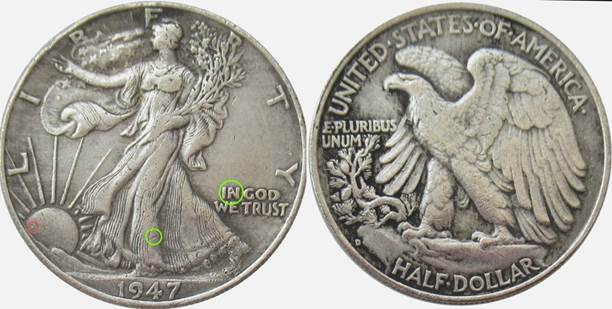
The U.S. Mint began producing Trade Dollars in 1873 in the hope to boost trade, especially in East Asia, and to compete with the Mexican Peso. 

The Trade Dollar is heavier than the Morgan silver dollar, again to compete with the Mexican counterpart. The Peso weights 27.07 grams with 90.27% silver compared to the Morgan Dollar’s 26.73 grams, 90% silver content.


There are two Trade Dollar reverse types. The Type 2 Reverse was used on Trade dollars between 1875 and 1876 and on all Trade dollars beginning in 1877. The latter design is missing a berry under the eagle’s claw:


First fake up in this article is an 1874-P Trade Dollar with a Type 2 reverse! This reverse wasn’t used until 1875 at the Philadelphia mint. I like to call this the “Dented Denticles” as the obverse denticles are nearly missing below the date. A dent above the foot and on Liberty’s neck are common markers shared on these counterfeits (highlighted in red). Below the subject coin is a reference photo to identify Type1 and Type2 reverses.


Next up we have an 1873-S! Same obverse as the counterfeit 1874-P but with a different reverse, this time paired with the correct Type.

In my search for more of these mix matched dates I landed on the “CoinHelpU” forum. This time we see a counterfeit 1874S. Same obverse but yet another reverse!


It’s apparent that the counterfeiters will use anything at their disposal to create more. Swapping out the dates and changing the reverses to anything they can find. It’s never been more important to attribute a coin that you intend to purchase.

Attributing coins requires learning–the type of which you get when reading Proxiblog and other reputable coin sites. Concerning Trade Dollars, examine devices, weigh the metal and measure the diameter, comparing it to an authentic example. I recommend going online to find a PCGS-attributed coin with TrueView, which can be expanded on your screen.

Pay attention to the coin’s condition and grade, using PCGS Photograde.

So ends the latest journey of more “Fun with Fakes” (FwF) and Proxiblog. It is getting really hard to keep up with all the ways scammers and their ilk continue to challenge the hobby.

For more information about counterfeit trade dollars, see Jack D. Young’s article about fake trade dollars in counterfeit TPG holders, as these coins illustrate:


If you like articles like these, please friend us on Facebook and subscribe to Proxiblog.

Proxiblog also has thousands of followers on Facebook Coin Groups, YouTu.be and social media. To get the latest discussion and commentaries, click here.

You can find more information about errors and varieties as well as buying and bidding on coins in Coin News Updated: The Essential Guide to Online Bidding. Please consider purchasing the work for yourself or a friend, as it underwrites this hobbyist website. Thank you.