Fake Family, Type 2, Standing Liberty Quarters


By Jack Riley

With an ever growing amount of counterfeit coins being produced it can be a challenge to keep up with them. Tens of thousands of fake coins, replicas and copies flood the hobby market each month.

Numismatic News and other sources have reported these sobering results:

  • One factory along in China produces over 100,000 forged coins per month.
  • Annual figures of fakes range in the billions with entire cities or districts in China manufacturing them.
  • Flooding of fakes on eBay remains one of the biggest concerns.

The frenetic manufacturing rate now includes common 90% silver coinage to be counterfeit. Nothing is safe!

After a previous article of what one could call the “Spiked wing” counterfeit Standing Liberty quarters, a second family arose on different online venues.

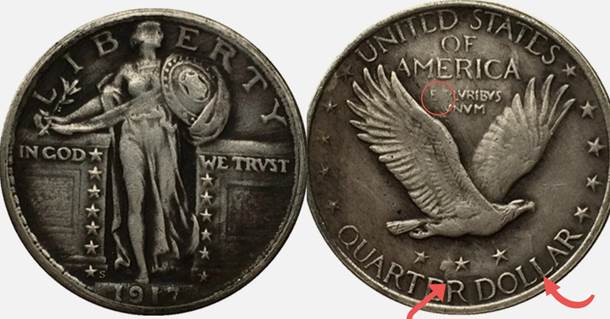
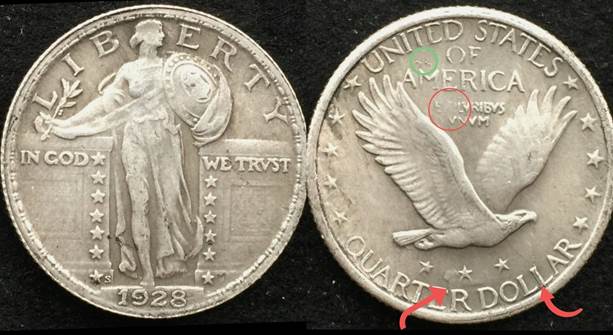
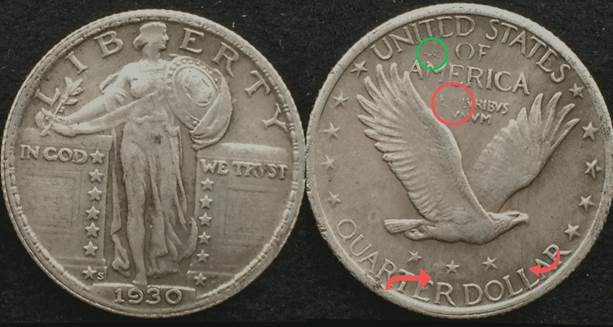
I have three images comparing this new “Family.” Two of which have a major casting flaws above “America” and will be highlighted in green since it isn’t seen on all examples. All markers highlighted in red have been on all examples seen as of the time of this article.

So to the Family! Three coins dated 1917, 1928, and 1930 showed up all sporting a San Francisco mintmark. Though this likely could be seen on any date/mintmark combination since the counterfeiters pay no mind to design changes or the series itself. First up is this 1917s Type 2 SLQ that shows a weak E-P highlighted in red as well as two cracks through “Quarter Dollar”.

Another seller offered two coins (1928s and 1930s) which share the same reverse but a different obverse as the 1917s. Additionally the raised lumps from a poor cast show on both of these examples.
It would seem a new “Family” surfaces regularly! Making it ever more important to be diligent in vetting who/where you purchase coins from and how you make that purchase, especial ly if buying on eBay, as counterfeit expert Jack D. Young has reported for Proxiblog.

Granted, even experienced hobbyists are scammed by purchasing counterfeits. As such, newer collectors should follow these general guidelines:

  1. If you are ready to bid hundreds of dollars on a coin, resist buying a raw one and shop for one holdered by PCGS, NGC, ANACS and CAC.
  2. Be especially careful when purchasing raw coins from eBay and other online venues. TAI bots cannot detect counterfeits, so you are on your own.
  3. Make sure the seller takes returns and has good reviews. Also, the number of positive reviews is a good indicator. If someone has 0 sales or even fewer than 100, do not take a chance.
  4. Weigh the coin and go to PCGS CoinFacts for the date and mintmark, checking your coin against weights and dimensions.
  5. Read this article about detecting counterfeits.

If you like posts like this, you can read more articles on counterfeit coins by Jack Riley, Jack D. Young and Michael Bugeja at this URL. Also, please subscribe so you can get our weekly newsletter and be informed whenever there is a new article or column.

Proxiblog also has thousands of followers on Facebook Coin Groups, YouTube and social media. To get the latest discussion and commentary, be sure to friend us by clicking here.

You can find more information about errors and varieties as well as buying and bidding on coins in Coin News Updated: The Essential Guide to Online Bidding. Please consider purchasing the work for yourself or a friend, as it underwrites this hobbyist website. Thank you.

Counterfeit 1872-S Seated Dollar


By Jack Riley

The ever growing saga of new counterfeits continues. This 1872 S Seated Dollar below was recently brought to our attention in a Facebook group.

That’s an example of how counterfeit investigations begin.


A quick glance tells the story.

The 1872-S was only produced with one die marriage and that is referred to as an OC-1. Below is an image of the mintmark location of a genuine coin.


The coin clearly isn’t attributable to a genuine variety. The next step to me is looking for anything that may standout as a notable marker to find additional “bad” coins. Another example offered by Aliexpress shows us just where this came from.

Both coins show both a common obverse and reverse. Highlighted markers in red include a raised lump on the center of the obverse, misplaced mintmark, gouge in the shield, small indent on the R as well as an overall weakness of the U.


To be sure, a poorly executed cast; but as always there is a potential to see this on numerous dates.

Join the Fight

As we become experienced numismatists, we have an obligation to expose fakes and to share the methods to identify them.

As in the case of the counterfeit Seated Dollar, numismatists study die markers for one common sense reason. If counterfeiters are going to invest time, effort and funds to manufacture fake coins, they are going to use the same die for multiple mintages. That’s when inconsistences occur, ranging from suspicious mintmarks to unique features that deviate from authentic examples.

For instance, there can be deviations in lettering and design, weight and size, metal composition and edge details. I analyze all of these and more.

I will continue to share these details in my articles for Proxiblog and other publications as well as Facebook’s “Fun with Fakes” (FwF).

By understanding how die markers are used and by carefully examining coins for inconsistencies, coin collectors can increase their ability to identify counterfeit coins. 

If you like posts like this, please go to our counterfeit archive with reports from Jack Riley, Jack D. Young and Michael Bugeja. Also, please subscribe so you can be informed whenever there is a new article or column.

Proxiblog also has hundreds of followers on Facebook Coin Groups. To get the latest discussion and commentary, be sure to friend us by clicking here.

You can find more information about errors and varieties as well as buying and bidding on coins in Coin News Updated: The Essential Guide to Online Bidding. Please consider purchasing the work for yourself or a friend, as it underwrites this hobbyist website. Thank you.

Counterfeit PCGS 1893-S Morgan


By Jack Riley

The 1893-S Morgan, a key date in the series, is the third most counterfeited coin after the 1909-S VDB Cent and the 1916-D Mercury dime. That is why numismatists scrutinize raw coins offered online where most fakes are offered for sale as genuine.

The 1893-S Morgan Dollar below was sent to PCGS and returned as counterfeit. This is cast and not die struck. Surely it was a new collector with a PCGS membership who sent it in, hoping to authenticate it.

Let’s investigate.


The suspect coin weighed 26.75 grams with a diameter of 37.7mm and a thickness of 2.8mm. The standard for Morgan dollars is 26.73 grams with a diameter of 38.1 millimeters and a thickness of 2.4mm.

One would expect a cast to be thick if the weight is near that of a genuine coin. Some raised lumps show on the surface left of “i” and 3 raised lines in “A”.


I had previously logged this particular cast in my running doc sheet of “common cast Morgans.” I use this sheet as a reference point for new collectors of identifying various cast counterfeits via pictures. I’ve only seen this particular reverse on this 1893-S and one 1900-S.


These are still fooling collectors as evident regarding the fake coin sent to PCGS.

Always attribute your coins!

The 1893-S was produced using 1 obverse die and 2 reverse dies. The date position doesn’t change on any! All coins have a “far date” with the left of the 1 parallel to the right side of the 3rd denticle.


A few die markers on the obverse include a line through T and the “rabbits foot” on the R which may be difficult to see on lower grades so the T marker is the primary pickup point.


On to the reverse! Two reverses used with VAM-1 having a centered S and VAM-2 having a mint mark tilted right.

VAM stands for Van Allen and Mallis, referring to Leroy Van Allen and A. George Mallis, researchers who cataloged Morgan dollar and Peace dollar die varieties. The VAM system is a way to identify specific die variations on these coins. 


To identify counterfeit coins, you should understand the role that die markers and dimensions play.

Die markers are imperfections on the die transferred to the coin during striking. As documented earlier in this article, such markers can be die chips, die breaks and die polish marks.

Coin dimensions include weight, diameter and thickness, as we used in documenting this 1893-S fake.

If you like posts like this, please subscribe so you can be informed whenever there is a new article or column.

Proxiblog also has thousands of followers on Facebook Coin Groups, YouTube and social media. To get the latest discussion and commentaries, click here.

You can find more information about errors and varieties as well as buying and bidding on coins in Coin News Updated: The Essential Guide to Online Bidding. Please consider purchasing the work for yourself or a friend, as it underwrites this hobbyist website. Thank you.

Altered 1888 Morgan Dollar


By Jack Riley

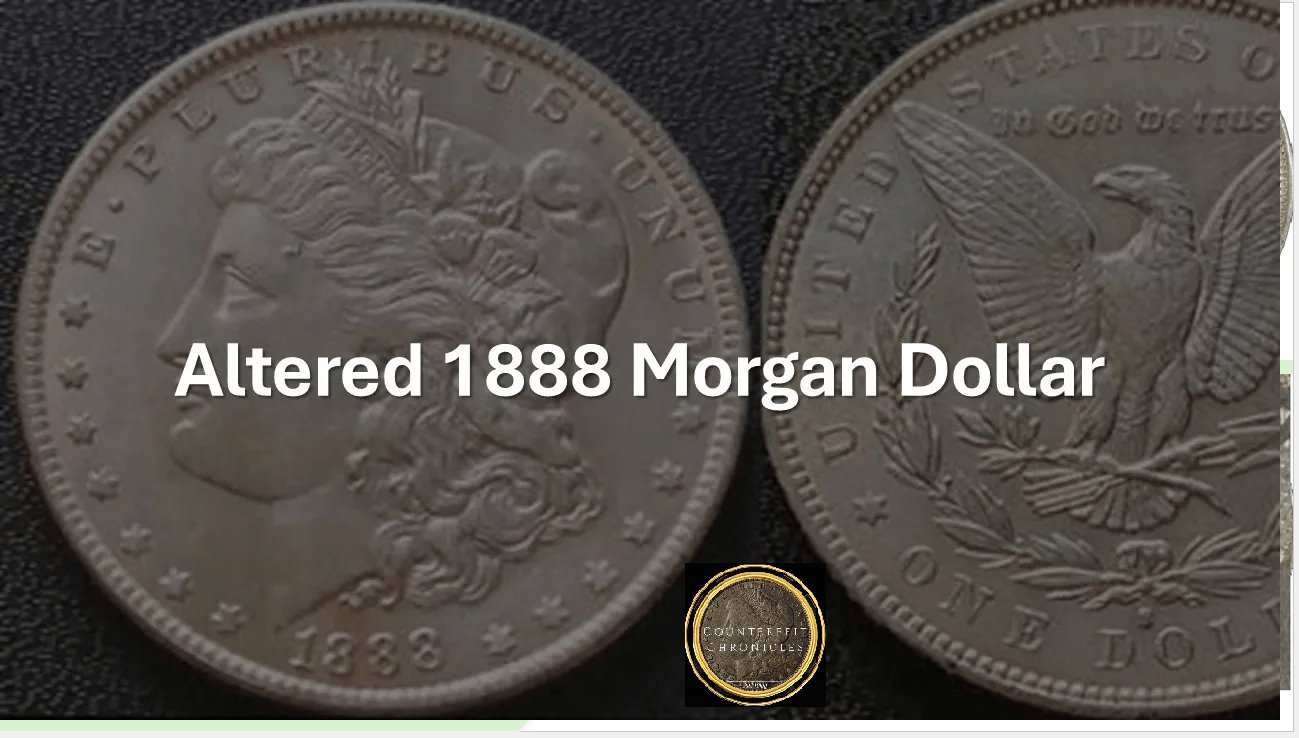
When it comes to raw coins it is very important to inspect them thoroughly. Start with learning how to grade coins and then learn more about counterfeits on Proxiblog. The coin featured here is altered and as such, a prime example of how learning the hobby saves time and expense. You will learn that everything isn’t always as it seems!

The coin pictured below looks like any other Morgan Dollar on the surface but there are many things hidden.


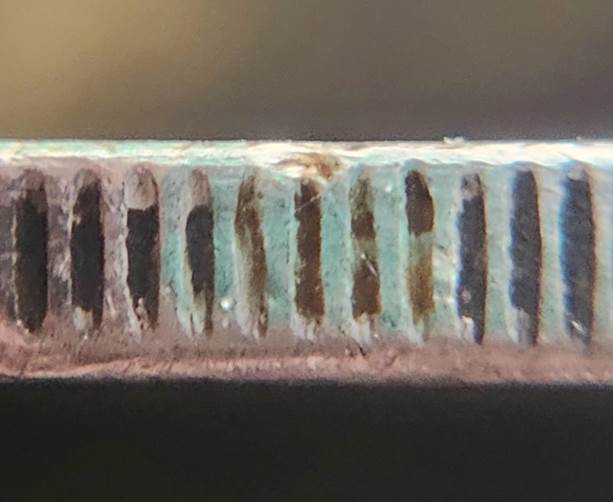
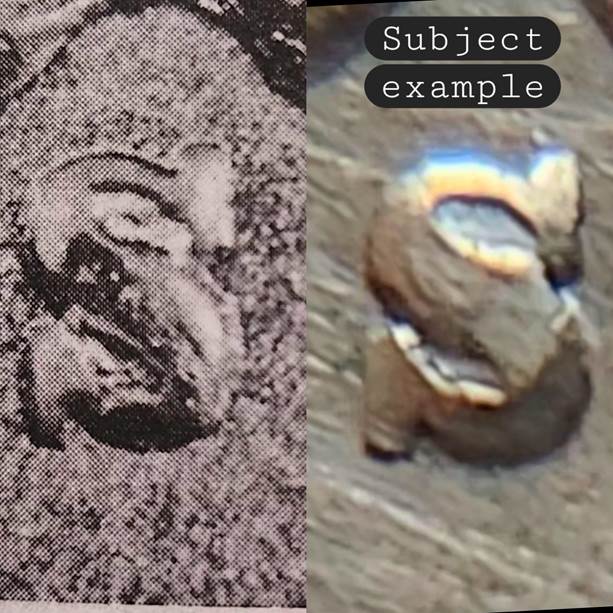
The edge view directly in line shows some “tampering.” The discoloration and infrequent width and grooves of the reeding is indicative for an “Embossed mintmark.”


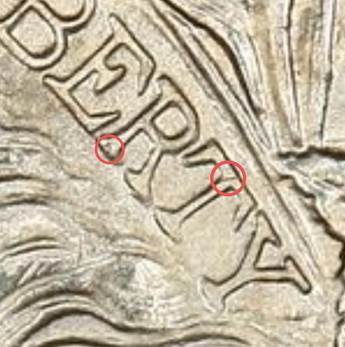
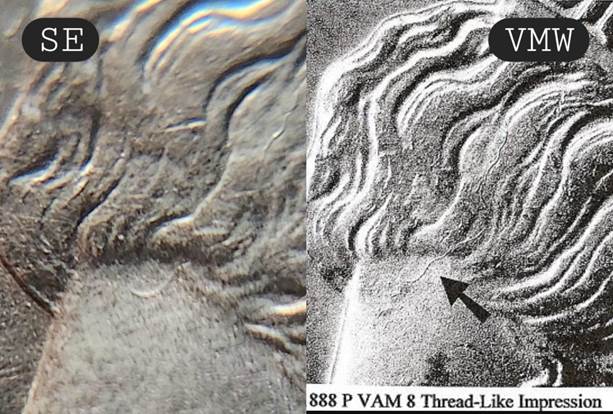
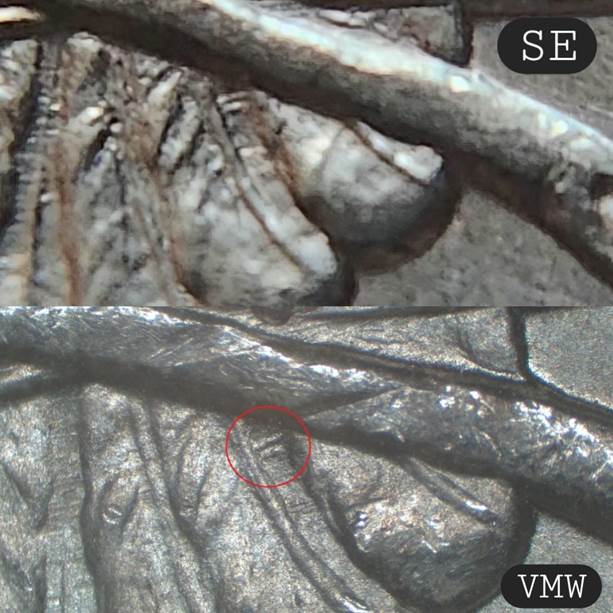
The obvious step here is to attribute this coin and what is found is rather surprising. The die marriage attributes to a Philadelphia struck 1888 VAM-8! The following photos compare the subject example (SE) compared to VAMworld plate photos of a genuine 1888P. The thread-like impression on the forehead and reverse marker between the tailfeathers stand out and prove this to be a Philadelphia strike NOT a San Francisco struck coin.


The correct type IV mintmark shape was used in making this as well! Making it even more convincing and difficult to discern. This style mintmark was used throughout the series from 1879 to 1900.


This was a fairly well executed added mintmark with attention to detail. Making it ever so important to attribute coins you plan to purchase or currently have in your collection.

As a regular contributor to Proxiblog, you can read more of my investigative work on the Counterfeit Category tab.

If you like posts like this, please subscribe so you can be informed whenever there is a new article or column.

Proxiblog also has hundreds of followers on Facebook Coin Groups. To get the latest discussion and commentary, be sure to friend us by clicking here.

You can find more information about errors and varieties as well as buying and bidding on coins in Coin News Updated: The Essential Guide to Online Bidding. Please consider purchasing the work for yourself or a friend, as it underwrites this hobbyist website. Thank you.

Family of Fake Standing Liberty Quarters


By Jack Riley

An intriguing counterfeit 1920 Standing Liberty Quarter was recently posted to eBay and sparked this article. Pictured below is the Bay example with highlighted repeating marks found on this “family.” The “speared wing,” if you will, is a major pickup for this as well as the lump above “C.”


This “family” shares a common reverse and mixes the obverse of various dates and types including Type 1 and Type 2 obverse designs as well as common and rare dates. Virtually every date of the series has been found linked to this family.

The reverse design of the Standing Liberty quarter changed in mid-1917. The initial design, minted in 1916 and part of 1917, featured Liberty with a bare breast and a low-flying eagle. The redesigned reverse, starting mid-1917, showed the eagle higher and more centered, with three stars below and five on each side. 


A 1921 example was previously shared in a Facebook group which reviewed mixed reviews on the coin. Once again 3 common markers show on the reverse.


While the first two examples could be deceiving to collectors, these next two should not be! A 1919 with a Type1 obverse and a poor attempt at a 1916 SLQ.


This is becoming detrimental as the counterfeits are pouring into the “constitutional silver” and can be much more difficult to discern than series that are cataloged by die marriages. This also serves as a good reminder to be diligent on any purchases online as you only have the photos provided and the words of the seller to go by.

Consider this seller showing a 1916 obverse with a latter 1917 reverse (three bottom stars):

Note that the seller is using “HeritCoin, an AI-powered app that helps users identify and value coins. So much for accuracy. But great for scammers.

If you like articles like these, please friend us on Facebook and subscribe to Proxiblog.

Proxiblog also has thousands of followers on Facebook Coin Groups, YouTube and social media. To get the latest discussion and commentaries, click here.

You can find more information about errors and varieties as well as buying and bidding on coins in Coin News Updated: The Essential Guide to Online Bidding. Please consider purchasing the work for yourself or a friend, as it underwrites this hobbyist website. Thank you.


Mismatched Counterfeit Trade Dollars


By Jack Riley

Today we explore the Trade Dollar’s common obverse matched with various (and improbable) reverses–an 1874-P, 1873-S and 1874-S–all sharing the same obverse.

The U.S. Mint began producing Trade Dollars in 1873 in the hope to boost trade, especially in East Asia, and to compete with the Mexican Peso. 

The Trade Dollar is heavier than the Morgan silver dollar, again to compete with the Mexican counterpart. The Peso weights 27.07 grams with 90.27% silver compared to the Morgan Dollar’s 26.73 grams, 90% silver content.


There are two Trade Dollar reverse types. The Type 2 Reverse was used on Trade dollars between 1875 and 1876 and on all Trade dollars beginning in 1877. The latter design is missing a berry under the eagle’s claw:


First fake up in this article is an 1874-P Trade Dollar with a Type 2 reverse! This reverse wasn’t used until 1875 at the Philadelphia mint. I like to call this the “Dented Denticles” as the obverse denticles are nearly missing below the date. A dent above the foot and on Liberty’s neck are common markers shared on these counterfeits (highlighted in red). Below the subject coin is a reference photo to identify Type1 and Type2 reverses.


Next up we have an 1873-S! Same obverse as the counterfeit 1874-P but with a different reverse, this time paired with the correct Type.

In my search for more of these mix matched dates I landed on the “CoinHelpU” forum. This time we see a counterfeit 1874S. Same obverse but yet another reverse!


It’s apparent that the counterfeiters will use anything at their disposal to create more. Swapping out the dates and changing the reverses to anything they can find. It’s never been more important to attribute a coin that you intend to purchase.

Attributing coins requires learning–the type of which you get when reading Proxiblog and other reputable coin sites. Concerning Trade Dollars, examine devices, weigh the metal and measure the diameter, comparing it to an authentic example. I recommend going online to find a PCGS-attributed coin with TrueView, which can be expanded on your screen.

Pay attention to the coin’s condition and grade, using PCGS Photograde.

So ends the latest journey of more “Fun with Fakes” (FwF) and Proxiblog. It is getting really hard to keep up with all the ways scammers and their ilk continue to challenge the hobby.

For more information about counterfeit trade dollars, see Jack D. Young’s article about fake trade dollars in counterfeit TPG holders, as these coins illustrate:


If you like articles like these, please friend us on Facebook and subscribe to Proxiblog.

Proxiblog also has thousands of followers on Facebook Coin Groups, YouTu.be and social media. To get the latest discussion and commentaries, click here.

You can find more information about errors and varieties as well as buying and bidding on coins in Coin News Updated: The Essential Guide to Online Bidding. Please consider purchasing the work for yourself or a friend, as it underwrites this hobbyist website. Thank you.

Counterfeit 1851 C-1 Half Cent


By Jack Riley

New waves of counterfeit coins continue to show up routinely and can be a challenge to keep up with! A recent counterfeit 1851 half cent surfaced online and caught some attention. Pictured below is the counterfeit example (top image) compared to a genuine example (bottom image).

Genuine image courtesy of PCGS

With only one die pair being the C-1 to compare it to, something is clearly off. The reverse letters appear “bubbly” while the letters are not crisp. The obverse stars show similar features, combing that with minor surface issues tells the story. The rims also appear filed down.

Searching more photos led to identifying a total of 4 coins from this potential “family,” with two being offered on various online sites. One example was posted to an online forum in 2018. The subject example for this article was presented on Facebook.

As always in this situation, I search for “Sister Marks” as counterfeit expert Jack Young would call them, repeating circulation marks that are not identifiers for a genuine die pair. That search did not disappoint!

Two obverse depressions on the chin and neck are quick to notice, which led to me referring to this as “Dimple Chin”. The reverse markers include a major depression mark in the “i” of “America” and the “O” in “OF.” A damaged area on the left leg of “H” in “Half” and lump above “A.” The line through A may not be seen on examples with false circulation wear.

Below are the original example and from an online forum. All markers noted are highlighted in red.


Here we have two examples exhibiting false circulation wear. Note the A “Slash” may not be seen.


One may ask “Where do these come from?” You too can purchase one on eBay that ships directly from China!


I’ve personally only seen this on coins dated 1851. It’s very likely other Braided Hair Half Cents exist with both this counterfeit obverse and reverse. Stay diligent friends!

Visit Proxiblog for more articles about counterfeit coins by Michael Bugeja, Jack D. Young and Jack Riley.

Proxiblog also has thousands of followers on Facebook Coin Groups, YouTube and social media. To get the latest discussion and commentary, be sure to friend us by clicking here.

Subscribe so you can be informed whenever there is a new article.

You can find more information about errors and varieties as well as buying and bidding on coins in Coin News Updated: The Essential Guide to Online Bidding. Please consider purchasing the work for yourself or a friend, as it underwrites this hobbyist website. Thank you.

Meet the Micro O Counterfeit Family!


By Jack Riley

There exists a family of counterfeits that fooled collectors and grading services for decades. The “Micro O” varieties have always been scarce coins to come by, and in 2005, these were deemed counterfeit by PCGS when 3 examples showed repeating circulation marks between the 1896 O VAM-4, 1900 O VAM-5, and 1902 O VAM-3.

Pictured below shows the repeating marks found on the three dates, indicative of transfer die counterfeits.

Images courtesy of PCGS

Along with the announcement that these varieties were counterfeit, PCGS offered “buy backs” for coins it had authenticated. Some 95 examples were certified among the three dates. PCGS no longer will authenticate 1896-O, 1900-O, and 1902-O with micro mintmarks.

Here is what the company stated in a news release:

“Grading and variety experts at PCGS have recently uncovered undeniable evidence that three of the so-called Micro O’ Morgan varieties, the 1896-O, 1900-O, and 1902-O, are actually contemporary counterfeits, most probably struck outside the US Mint sometime in the early 20th century. This is a significant discovery and one that will certainly have an impact on Morgan dollar variety collectors.”


This begs the question of how many such fakes exist today in PCGS holders? Prior to 2005 the market exceeded $1,000 per coin in many cases and up to $5,000 in higher grades. Assuming PCGS paid fair market value then surely most of these were sold back!

This 1902 O VAM-3 sold at Heritage Auctions on November 19th, 2002 and realized a price of $192.


Two years later the price for these coins exploded with a VF20 example selling for $2,070 on November 4th, 2004.

Images courtesy of Heritage Auctions

Later another 1902 O VAM-3 in VF30 for $5,100 in a Superior Galleries auction. That was auction lot#871 in January of 2005. (No photos of this coin.)

These coins still exist in ANACS holders with most available ones in Gen5 and Gen6 slabs. I had purchased this 1900 O VAM-5 VG Details example in August of 2024 for $150. This coin resides in a Gen6 ANACS holder that was used from 1999-2005. During the same time my friend and fellow counterfeit researcher Jack Young acquired one as well. Both of which have consecutive certification numbers pictured below. My example (top) and Jack Young’s example (bottom).


Recently an 1896 O VAM-4 appeared in a Great Collections auction in a Gen5 ANACS holder. After buyers fees this coin landed at $200. I was fortunate to acquire this example.


At the same time of this listing was also another 1900 O VAM-5 that sold the same night as the 1896. I happened to be the underbidder and the coin sold for $140 prior to fees. Later that night I received a message that a friend and fellow collector had won and the coin found a good home! This coin also resides in a Gen5 holder which was used between 1996-1999 to put a time-frame to when this coin was certified.


I hope to see these coins grow in popularity! The exact story is unclear as to who made these or when although a few theories are posed. A likely theory was disgruntled mint employees after the New Orleans Mint closed in 1909. These coins circulated indicating they were struck in a time when the price of silver was still well below the face value of the coin.

Since the discovery of these “Micro O” counterfeits, 32 die varieties have been linked to this massive operation. Two other Micro O varieties exist (1901 O VAM-42 and 1902 O VAM-96). Those were omitted from this article due to having a different reverse than the three discussed. Many of the varieties associated with this “family” are readily available and can be cherrypicked for the price of an average Morgan Dollar.

These contemporary counterfeits will pass virtually every test including measurement, weight, and Sigma Metalytics examination since these scan closer to sterling silver. The “mix matched” dies make telling many varieties easy to spot at a  glance by using incorrect reverse hub types for the years.

If you like posts like this, please subscribe so you can be informed whenever there is a new article or column.

Proxiblog also has hundreds of followers on Facebook Coin Groups. To get the latest discussion and commentaries, click here.

You can find more information about errors and varieties as well as buying and bidding on coins in Coin News Updated: The Essential Guide to Online Bidding. Please consider purchasing the work for yourself or a friend, as it underwrites this hobbyist website. Thank you.