eBay Seller’s comments to “Your Baby’s Ugly”


By Jack D. Young

Proxiblog asked me to consider doing an article on “how eBay sellers react when we report their coins as fake? I know some take down the lots. Others don’t.” I was intrigued by the thought and decided to write the following!

When I explain a Bay listing is counterfeit sellers can react a number of ways–in disbelieve, argumentatively (Grandpa owned it), accepting and thankful, combative (I’ll meet you in a parking lot dude…) or just “crickets.”. In my experience the larger the seller the higher the probability of crickets.

So, moving on I will not lower our standards here and report the combative ones but several of recent experiences I have had of the other types of reactions.

Let’s start with an interesting Trade dollar. This example just caught my eye, and the images led me to believe the coin was not genuine. The images in the listing were not definitive, and I asked the seller for better ones. He agreed and that was all it took! The common reverse used for a family of fakes I nicknamed the “notched R.” I wrote an article on these published in a recent LSCC Gobrecht Journal. I actually own one returned to a seller by NGC as counterfeit, so well versed on these:

eBay recent listing

So, I asked the seller about the coin and that I had concerns about its authenticity. He responded that he looked up the cert and the “PCGS verification”.

I responded there were no images on the on-line cert, so no help there. I included images from my coin and article and that I was sure it was counterfeit.

And he responded with a thank you and that he would remove the listing immediately, which he did!


So, a win, except who knows were the coin ends up, as he responded he is taking it back to the previous seller… And then another listing and another message:


Seller actually had two bad Morgans in fake PCGS slabs listed:


As he stated in his message, he ended both!

So, two with likely the best results we could hope for. And then this one:


Another counterfeit coin in a counterfeit slab, this one gets a little complicated if you really evaluate this one properly.

First, the obverse barcode scans as a 1989 $10 gold eagle. Then, the images of the genuine example for the cert# on the PCGS site are a completely different coin. And third, the interesting twist for this one is fakes of this type typically have a reverse QR code that scans to the genuine PCGS cert site in CHINA (cnpcgs), BUT this one scans to pcgseurope! A separate article on this one in the works.


So, I notified the owner, but he is in denial, and his response and then silence:


Silent until this😎:


So, good luck to all eBayer’s with that one!

And now the crickets; my friend Jack Riley posted the next example in our Face Book group:


Pretty bad counterfeit in a counterfeit slab again, the surprise was it is a large well respected Bay coin seller. Several of us sent messages to the seller with no response, so I took a risk and purchased it with the intention of asking for a return for it being a counterfeit.

Refund granted, never heard from the seller…


And eBay removed the listing:


Shortly thereafter my eBay account was permanently suspended.

If you like posts like this, you can read more articles on counterfeit coins by Jack D. Young, Jack Riley and Michael Bugeja at this URL. Also, please subscribe so you can get our weekly newsletter and be informed whenever there is a new article or column.

Proxiblog also has thousands of followers on Facebook Coin Groups, YouTube and other venues. To get the latest discussion and commentary, be sure to friend us by clicking here.

You can find more information about errors and varieties as well as buying and bidding on coins in Coin News Updated: The Essential Guide to Online Bidding. Please consider purchasing the work for yourself or a friend, as it underwrites this hobbyist website. Thank you.
Fake Eisenhower Dollars


By Jack Riley

As most collectors know, Chinese counterfeits have flooded the market. Often many buyers are “burned” on key date and semi key date coins of many series. We have stressed that nothing is safe and that includes Eisenhower Dollars! These are readily available at banks for face value and yet here we have counterfeits.

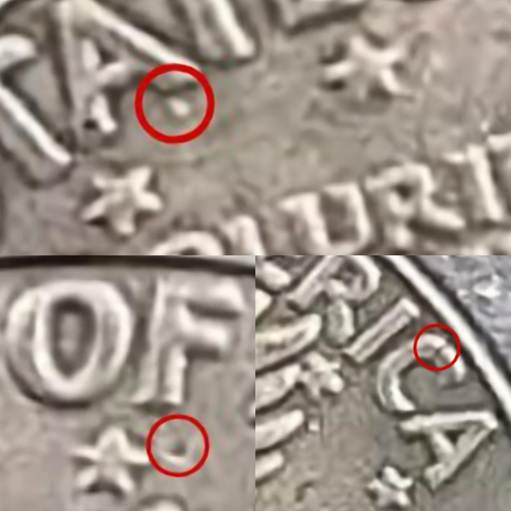
Diving straight into repeating markers of these two “coins,” a 1971-P and 1977-P show commonalities between the two. Both share matching obverses and reverses indicated in Red.


Obverse markers:

  • Diagonal depression of L
  • Depression in front of the eye

Reverse markers:

  • Raised lump below A1
  • Indent below OF
  • Line through C

China produces counterfeits of common coins like the Eisenhower dollar if a small profit can be made. These scammers may not be expert numismatists; but they are professional marketers who know about profit margins. Their profits expand with bulk production, flooding eBay and Facebook with fakes. China knows the coin collectors will just assume that low-value common coins like Ike dollars are genuine.

They are polluting the hobby.

If you suspect that one of your coins might be fake, see “Detecting Counterfeits” for methods.

If you like posts like this, you can read more articles on counterfeit coins by Jack D. Young, Jack Riley and Michael Bugeja at this URL. Also, please subscribe so you can get our weekly newsletter and be informed whenever there is a new article or column.

Proxiblog also has thousands of followers on Facebook Coin Groups, YouTube and other venues. To get the latest discussion and commentary, be sure to friend us by clicking here.

You can find more information about errors and varieties as well as buying and bidding on coins in Coin News Updated: The Essential Guide to Online Bidding. Please consider purchasing the work for yourself or a friend, as it underwrites this hobbyist website. Thank you.

3 Types of Doubling


With the popularity of coin microscopes, hobbyists are finding all manner of doubled dies, but only one really is valuable. Nevertheless, it is important to identify the three main types so that you can tell whether you have a valuable or face value coin.

Types of doubling covered in this article:

  • Hub doubling.
  • Machine doubling.
  • Die deterioration doubling.

By becoming familiar with the various types of doubling, you not only will be able to increase your knowledge of numismatics but also can help others with their finds.

Hub Doubling

This is the most important kind of doubling, always valuable because most kinds have a decent spread of letters, numbers and devices. You usually do not need a microscope. You can see these with a loupe or naked eye.

This type of doubling is produced by a misaligned hub that engraves the defect directly into the working die, meaning the image will be evident in every coin struck by that working die. That is why the result is called a variety, and not an error.

Here is the most famous doubled die resulting from a misaligned working die:


Some 40,000 of the 1955 DDO were initially struck, with about half of the run caught and destroyed, leaving about 24,000 that made it into circulation.

The key distinction of hub doubling is separated, raised and rounded doubling. Older coins typically have this kind of doubling. In the 1990s, the US Mint introduced what is called a Single Squeeze Process, reducing the number of doubled dies with less of a spread and with doubling occurring more toward the middle of the coin.

If you want to learn more about hub doubling and the minting process, see “How Does Hub Doubling Happen.”

Machine Doubling

Machine doubling occurs when the die moves slightly during the striking process, distinguishing it from hub doubling, which is associated with the working die.

Because machine doubling happens during a strike, its “double” image is flat and shelf-like and not raised enveloping the letter or number like hub doubling,

Compare the two in this comparison image:


Machine doubling, which often requires a microscope to see, is common because the Mint uses extraordinarily high-speed machinery whose vibration often causes the working die to bounce on impact.

Machine doubling typically is caused by a single strike, meaning not all coins of that run will have the same impression, as happens with hub doubling. That is why machine doubling is a mechanical error and not a variety.

It also has no collector value.

Die Deterioration Doubling (DDD)

Like any manufacturing facility, the US Mint uses its equipment on a cost-saving basis, meaning working dies are used until they begin to deteriorate. The striking process is high-speed and powerful. When a die is overused, some of the lettering, numbering or devices begin to erode slightly with metal flows entering the degraded areas.

That’s why die deterioration doubling is common, without value, even though at times this mechanical error looks stretched rather than flat. This is how you distinguish between machine doubling and DDD. (Also, die deterioration appears to be a weak strike.)


When the US Mint started producing copper-plated zinc coins with pressure to produce billions of them each year, mint operators over-extended the lives of working dies, producing millions of DDDs.

There are two other types of doubling, “Split Plate Doubling” and “Reduction Lathe Doubling.” The former also is associated with copper-plated zinc cents with the plating eroding in what looks like doubling, especially on mintmarks that people confuse with repunched mintmarks (RPMs).


The final type is “Reduction Lathe Doubling,” really a production issue that happens when a design is transferred to a master hub by a lathe vibrating slightly. The doubling is subtle and again, not valuable. It looks like machine doubling and really is just a category of it.

If you would like to learn more about the minting process, click here.

If you like posts like this, subscribe so you can be informed whenever there is a new article or column. You’ll also receive a free newsletter each week.

Proxiblog also has thousands of followers on Facebook Coin Groups and across social media. To get the latest discussion and commentary, be sure to friend us by clicking here.

You can find more information about types, varieties, errors, grading, bidding and buying in Coin News Updated: The Essential Guide to Online Bidding. Please consider buying or gifting the work for a friend, as it underwrites this hobbyist blog. Thank you.

Counterfeit 1881-S Morgan Dollars


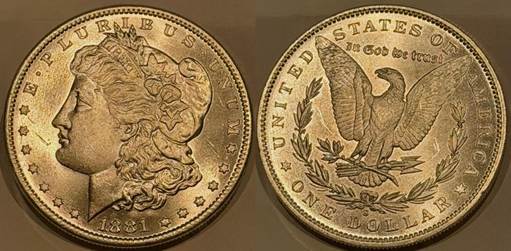
A recent eBay listing of a counterfeit 1909-S VDB cent sparked me to look at the rest of this particular seller’s offerings. They had nearly half of a dozen 1881-S Morgan Dollars along with a few counterfeits of other series. The 1881-S is a relatively common coin and easily found in high mint state grades; one wouldn’t expect to stumble across a counterfeit. The first image is of one of the represented coins.


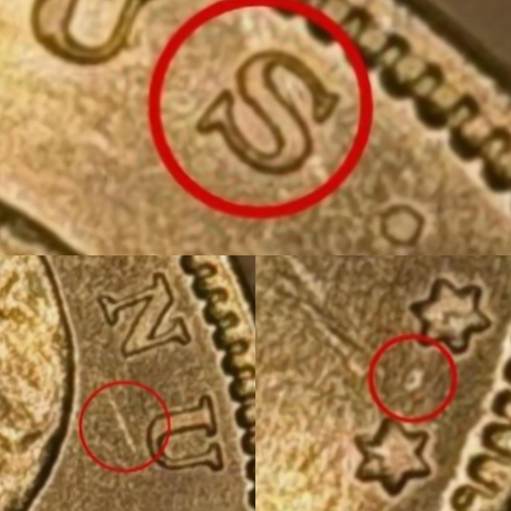
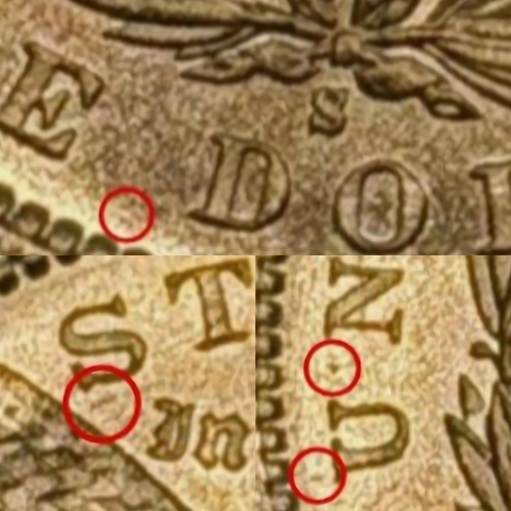
A comparison of three of the coins tells the tale. Given the scratches, dings and random “circulation” marks, this isn’t a mix up of images. There are three separate coins.

Anyone who does a lot of variety attributions of Morgan Dollars will know that 1881-S is a difficult year to attribute and generally won’t be done just by a glance like some dates. All examples from this eBay seller exhibit the same repeated contact marks.


Notable obverse marks:

  • Line through S
  • Surface scratch left of U
  • Small surface mark between right star 5 and 6

Notable reverse marks:

  • Small scratch below the base of S
  • Field dot between U-N and above U
  • Minute surface flaws between E-D

If you like posts like this, you can read more articles on counterfeit coins by Jack D. Young, Jack Riley and Michael Bugeja at this URL. Also, please subscribe so you can get our weekly newsletter and be informed whenever there is a new article or column.

Proxiblog also has thousands of followers on Facebook Coin Groups, YouTube and other venues. To get the latest discussion and commentary, be sure to friend us by clicking here.

You can find more information about errors and varieties as well as buying and bidding on coins in Coin News Updated: The Essential Guide to Online Bidding. Please consider purchasing the work for yourself or a friend, as it underwrites this hobbyist website. Thank you.

Fake CC and P mint Double Eagles


By Jack Riley

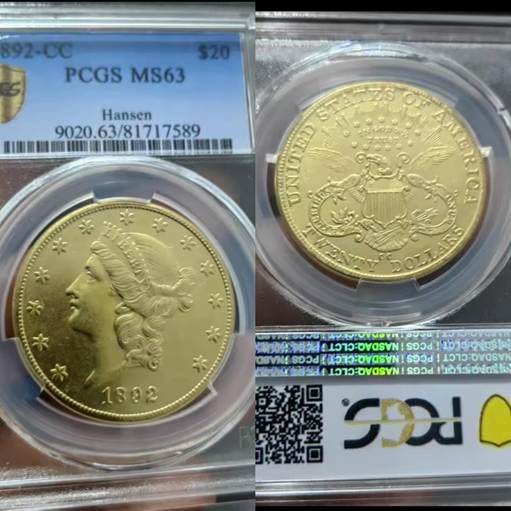
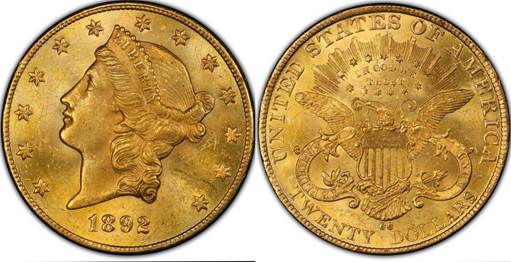
Counterfeiters aren’t numismatists. They often use incorrect design types that are impossible for a given coin and do not understand how third party grading services holder the coins they certify. This example may take the cake! A counterfeit 1892-CC $20 Gold piece in a fake PCGS holder. Not just any holder, a holder pedigreed to D.L. Hansen!

Let’s view the counterfeit example compared to the genuine one below that from Hansen’s collection.


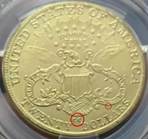
When you compare the two, it is very clear that they are not the same coin. One can see the CC position is incorrect along with a large lump on the ribbon.


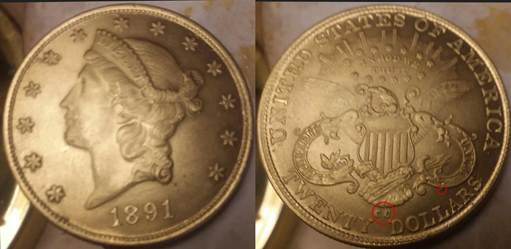
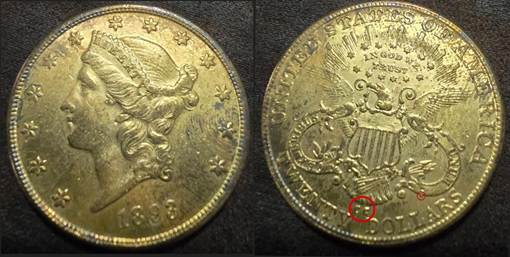
The “Family” is likely very extensive and many dates have been noted sharing this common reverse. Additional images shared below are from an 1891-CC coin as well as an 1893-CC. These were recently shared to a large Facebook group where they got mixed reviews.


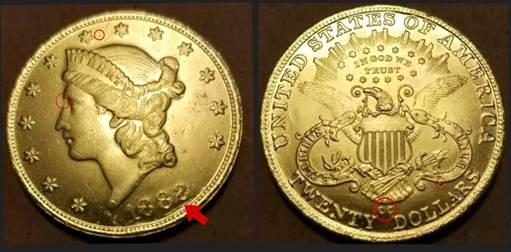
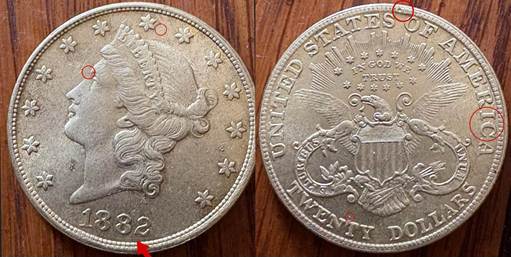
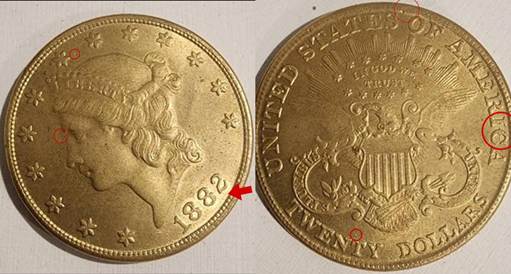
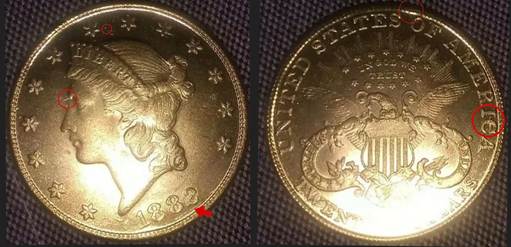
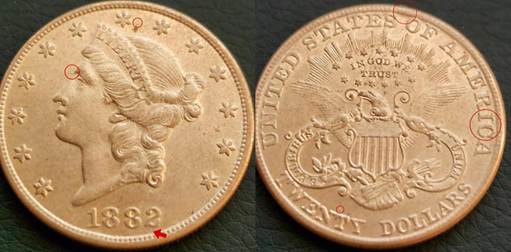
Now to the connection between the common reverses. This 1882-CC shares the “common reverse.” The obverse is very distinct as well for this date. The 1882 date was interchanged with both P and CC mint reverses. Noteworthy: the surface lump above Liberty’s head, spike protruding from the bridge of the nose, and a raised line under the date.


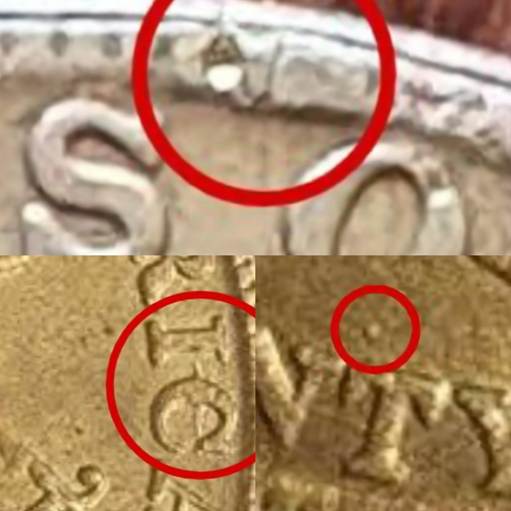
Interesting occurrence with the Philadelphia reverse is that it was later tooled to repair the denticles. The first two images show a depression along with the deformation of the denticles at approximately K12.


The next two images show the deformed denticles but no indentation within them.


“Common” P reverse

Closeup images of markers include:

  • Deformed Denticles with a depression, later was repaired
  • Spike through “C
  • Small field dot above “T

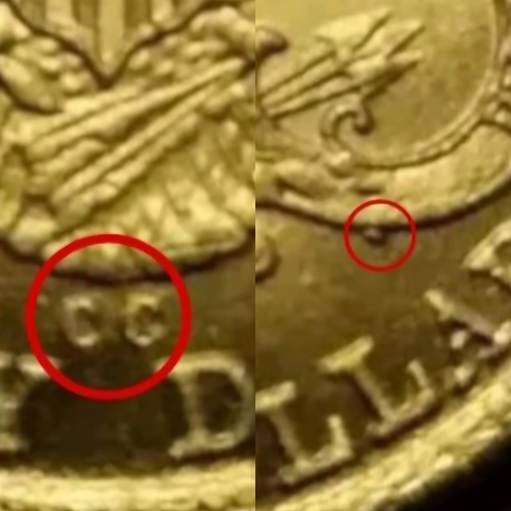
“Common” CC reverse

Closeup image of repeating marks include:

  • CC centered above denomination
  • Small chip above “DOLLARS”

If you purchase a counterfeit coin, especially one as expensive as a $20 gold one, contact the seller for a refund. If the seller refuses to accept a return for a counterfeit coin, immediately initiate a dispute with the payment platform (eBay, PayPal, or credit card company) for an “item not as described,” as counterfeit items are illegal to sell. Document the fraud with professional authentication, and if necessary, report the seller to the U.S. Secret Service or local law enforcement.

If a dispute cannot be resolved, and you report the fraud to the U.S. Secret Service, you may be required to turn the coin over to authorities. In any case, never attempt to re-sell the coin, even if you disclose that it is a counterfeit.

If you like posts like this, you can read more articles on counterfeit coins by Jack D. Young, Jack Riley, John Lorenzo and Michael Bugeja at this URL. Also, please subscribe so you can get our weekly newsletter and be informed whenever there is a new article or column.

Proxiblog also has thousands of followers on Facebook Coin Groups, YouTube and other venues. To get the latest discussion and commentary, be sure to friend us by clicking here.

You can find more information about errors and varieties as well as buying and bidding on coins in Coin News Updated: The Essential Guide to Online Bidding. Please consider purchasing the work for yourself or a friend, as it underwrites this hobbyist website. Thank you.

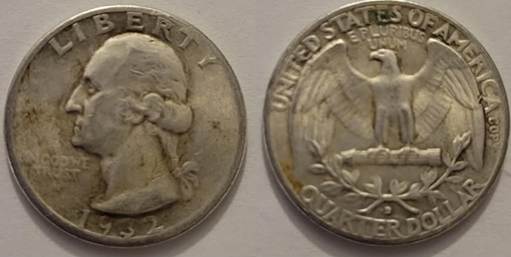
An extensive “Family” of counterfeit Washington Quarters


By Jack Riley

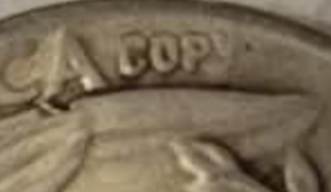
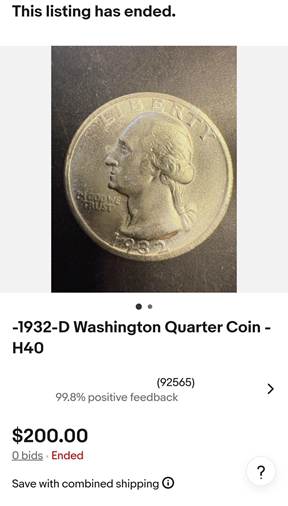
This article stems from a “copy” stamped key date 1932-D Washington Quarter. This abides by the Hobby Protection Act and isn’t to deceive anyone. As we know, counterfeiters don’t abide by the law!


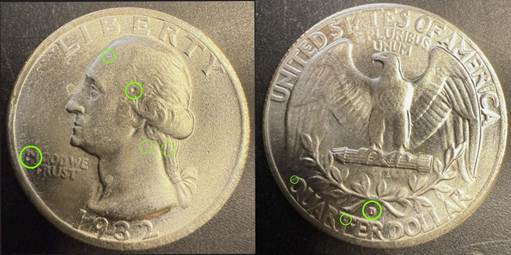
The next example was sent to me by a friend. Highlighted obverse markers match the previous “copy.”


An example surfaced on eBay from a rather large seller. After a brief discussion with them showing this to be a counterfeit they removed the listing. The obverse shares a couple repeating marks, but we see additional ones to be used in the future. The reverse is a match to the example shared to be by a fellow collector.


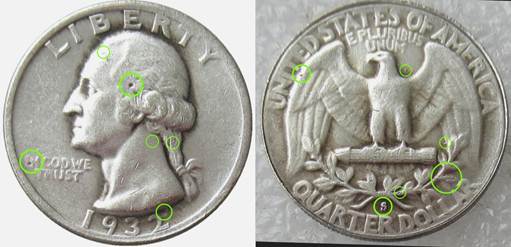
Another internet venue provides us images of a 1932-S that shares this “common obverse.” Highlighted in green are repeating marks for this reverse.


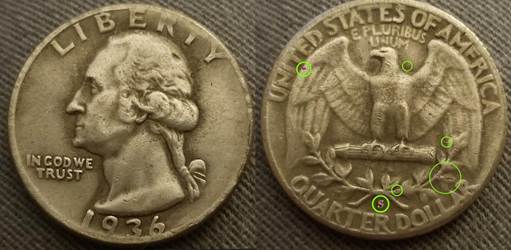
It isn’t only key date coins that counterfeiters target! This 1936-S shares the same reverse as the aforementioned 1932s.


Keep in mint that shopping venues Temu and Etsy sell thousands of replicas, some die struck, further eroding the hobby market.


It is also important to learn die markers for the 1932-D and S key dates. Click here for that.

f you like posts like this, you can read more articles on counterfeit coins by Jack D. Young, Jack Riley and Michael Bugeja at this URL. Also, please subscribe so you can get our weekly newsletter and be informed whenever there is a new article or column.

Proxiblog also has thousands of followers on Facebook Coin Groups, YouTube and other venues. To get the latest discussion and commentary, be sure to friend us by clicking here.

You can find more information about errors and varieties as well as buying and bidding on coins in Coin News Updated: The Essential Guide to Online Bidding. Please consider purchasing the work for yourself or a friend, as it underwrites this hobbyist website. Thank you.
Primer on “Not PCGS” Fakes

This video documents the various ways to identify fake Chinese holders and coins, including lack of logos on slab, pasted Gold Shield sticker, wrong fonts, wrong 1921 label, wrong reverse and so much more. Below the video is a an example of a Carson City Morgan dollar with six significant problems signifying a counterfeit.


This coin was posted on a Facebook coin group feed.


WRONG FONT


Missing NFC Logo


PCGS Cert Shows Different Coin


QR Code Opens to Chinese Fake Certification Site


For more in-depth analysis, see “Detecting Counterfeit Coins.

If you like posts like this, you can read more articles on counterfeit coins by Jack D. Young, Jack Riley and Michael Bugeja at this URL. Also, please subscribe so you can get our weekly newsletter and be informed whenever there is a new article or column.

Proxiblog also has thousands of followers on Facebook Coin Groups, YouTube and other venues. To get the latest discussion and commentary, be sure to friend us by clicking here.

You can find more information about errors and varieties as well as buying and bidding on coins in Coin News Updated: The Essential Guide to Online Bidding. Please consider purchasing the work for yourself or a friend, as it underwrites this hobbyist website. Thank you.

Trifecta, CN Counterfeit Coin, Slab and Website


By Jack D. Young

As if the Chinese counterfeit coins in fake PCGS slabs isn’t bad enough, now there appears to be a fake Chinese PCGS website to verify them.

A friend alerted me to the following listing on the Bay:


Past eBay listed counterfeit in a counterfeit not-PCGS slab:


The listing included these interesting other images:

Images from the seller’s listing

The seller had ended the listing based on being told it is a counterfeit, and I started a review to try to determine what was going on here!

So, I started with the “PCGS” slab and some quick checks. Using my on-line barcode scanner I checked the front barcode:


Like many similar bad slabs, the barcode was gibberish and would not scan. Next, I went to the PCGS website to check the noted cert number:

Note from the genuine PCGS site for the cert # look-up

And another bad sign, that cert # “was not found”. So, my next step was to try to read the reverse label QR code. And just a note, many of the previous counterfeits we have documented similar to this one had a QR code that read the cert # correctly but noted the genuine PCGS CN site. A previous example read like this:

Typical previous QR code to pcgs.cn site

And then this one:


Note different website for this cert!

Different result than expected! I do NOT recommend readers going to the site shown, but if you did, this is what comes up:

Fake “PCGS” site, image

WOW, now we have something apparently new to be concerned about with these.

I did notify my contacts at PCGS for a heads-up as well as post it on their CU Forum:

The Trifecta, CN Counterfeit Coin, Slab and Website ! — Collectors Universe

My contacts at PCGS acknowledged they were now aware and reviewing; a check of the fake site Christmas evening indicated it was now unavailable– a nice Christmas present if it lasts…


I did continue to dig a bit and found the following domain information; seemed ironic the “Registrar” has Alibaba in the name😎!


The best way to guard against buying a counterfeit coin is to purchase an authentic one from a reputable dealer. Barring that, view Jack Young’s Jack Riley’s and my articles on counterfeit coins published by Proxiblog.

If you like posts like this, please subscribe so you can get our weekly newsletter and be informed whenever there is a new article or column.

Proxiblog also has more than a thousand friends and followers on Facebook Coin Groups and thousands more across YouTube and social media. To get the latest discussion and commentary, be sure to friend us by clicking here.

You can find more information about errors and varieties as well as buying and bidding on coins in Coin News Updated: The Essential Guide to Online Bidding. Please consider purchasing the work for yourself or a friend, as it underwrites this hobbyist website. Thank you.

Struck Counterfeit 1875cc C-17 Trade Dollars


By Jack Riley

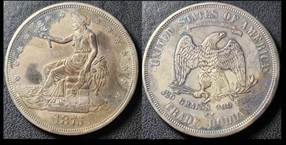
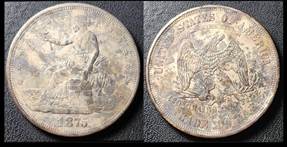
This started on December 26, 2024, when I stumbled across an eBay listing of two Trade Dollars. Both “Bodybagged” by two separate TPG services. NGC returned one as “altered surfaces” and PCGS as “questionable authenticity.” Upon reviewing the images and referencing John Coxe’s attribution guide to Trade Dollar varieties, they didn’t match any known variety.


After a while of internet browsing I stumbled across a Heritage Auction listing of this previously unknown variety. After correspondence with John Coxe, I learned this new genuine variety is to be listed as the 1875cc C-17 when the SSDC site is updated as the last update was in 2022.

NGC example

PCGS example


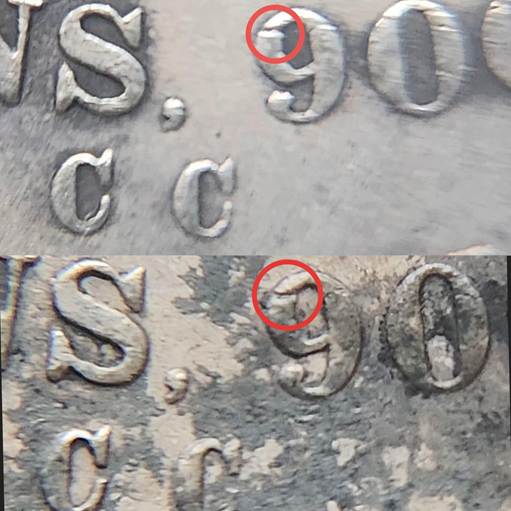
Now to the coins! Not only did these two match a C-17 but they shared a number of circulation marks indicative of counterfeits. Interestingly both passed a sigma test for 90% silver, along with weight and dimensions being within tolerance of genuine Trade Dollars.

Sigma Metalytics test


Upon review of the obverse, I found there are a number of characteristics indicating these are struck counterfeits. I highlight three primary pickup points of the obverse to distinguish these from genuine counterparts.

  • Indentation in the denticle below the base of 1
  • Depression in the center below Liberty’s knew
  • Field depression adjacent to the star and forehead

Reviewing both examples, the reverse shares a number of repeating circulation marks. However, many are minute and difficult to photograph. Primary pickups are as followed:

  • Linear depression of the 9 in “900”
  • Diagonal line through “R” in the motto

After sharing these with my friend Jack Young another example surfaced on Ebay a short time later. Now residing in a private collection it is safe from the market!


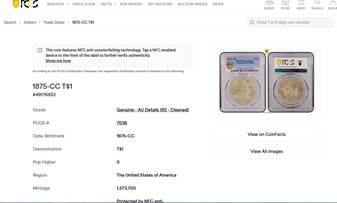
In preparation of this updated article an example surfaced on eBay certified by PCGS. This is the only example I have seen of this in an authentic TPG holder. It is noteworthy to mention the certification photo indicates it was certified in PCGS’s Chinese facility.


With only a few of these struck counterfeits being seen within the last year, it is safe to assume more exist and may already be in private collections. While the genuine variety itself appears to be scarce, it is unlikely to stumble across one of the struck counterfeits, but nothing is impossible. Actually a very easy variety to spot with CC set further right than any other variety of the date along with a hub break of the “I” of “UNITED”.

If you like posts like this, you can read more articles on counterfeit coins by Jack D. Young, Jack Riley and Michael Bugeja at this URL. Also, please subscribe so you can get our weekly newsletter and be informed whenever there is a new article or column.

Proxiblog also has thousands of followers on Facebook Coin Groups and across social media. To get the latest discussion and commentary, be sure to friend us by clicking here.

You can find more information about errors and varieties as well as buying and bidding on coins in Coin News Updated: The Essential Guide to Online Bidding. Please consider purchasing the work for yourself or a friend, as it underwrites this hobbyist website. Thank you.

AI can compose false rarity affirmation


Recently a Facebook coin group member posted a notice stating that he had found the coveted 1982-D Small Date bronze cent–verified by PCGS! Only two have been discovered, in 1916 and 1919, although social media has used the rarity to lure newbies into thinking that have the variety or that it can easily be found.
Here is what he wrote:

“This right here is for everyone that doubted me … chew that up and swallow it. no I’m not gonna be a jerk. I’m super excited. I have proved the 1982D small date with the weak D mint mark and a QDO. And a TDR it has now been verified and authenticated by PCGS as a new variety.”

He provided this proof:


Some 180 Facebook coin group members commented on his post. Here’s a snippet with Tyler Broughton noting the inconsistencies of his supposed PCGS email:


True, the person may be just hoping his submission brings the desired result. We all have been there. But what to make of the letter? It is seemingly informed and may have convinced viewers that indeed, the person did find the rarity. Many commentators congratulated him on his lottery-level find.

Without divulging his name, or the Facebook post and email, I contacted PCGS. A representative confirmed that the company would never send an email like this in advance of encapsulation. There is no Express/Gold service level. There is no Variety/Plus team (that’s NGC). Neither would it divulge internal means of certification.

Let’s take a breath.

It may be that this person indeed found a rarity. For his sake, let’s give him the benefit of the doubt. Perhaps he so believes in his diagnostics that he is sharing the good news before he gets any news. That, however, is not the point of this article. This is: How do we as hobbyists deal with a verification email that might sway us to believe that a coin, indeed, is an ultra rarity? Suppose we saw an email like this on a coin that we might want to purchase? Is this a new way to fool mhobbyists?

My answer was ChatGPT. I fed AI a few basic facts, the rarity, the date of submission, the service level and a few other details. It took me 2 minutes. Here’s what I received:


This is a chilling discovery–not of a rarity–but of how a rarity can be disguised with a fake email or letter, courtesy of AI. I won’t do this, but I could have found PCGS letterhead and pasted the above there. I could invent an email from PCGS–even with an employee name. I could no any number of things, and machine intelligence would help me.

We as hobbyists have to be on top of every new method to beguile us. This may only be the start with AI providing fictional text, video and images of our fondest numismatic desires.

If you like posts like this, subscribe so you can be informed whenever there is a new article or column.

Proxiblog also has thousands of followers on Facebook Coin Groups and other social media. To get the latest discussion and commentary, be sure to friend us by clicking here.

You can find more information about types, varieties, errors, grading, bidding and buying in Coin News Updated: The Essential Guide to Online Bidding. Please consider buying or gifting the work for a friend, as it underwrites this hobbyist blog. Thank you.