Full Step 1968-1970-S Jefferson Nickels


Jefferson Nickel role hunters should be on the lookout for valuable 1968-S through 1970-S full-step rarities, often overlooked and sometimes even confused with proof strikes. True, these are ultra rarities; but looking for them sharpens the eye and several dozen or more may still be at large in bank rolls.

In 1968, the “S” mintmark for Jefferson nickels was reintroduced for circulating coinage after a hiatus from 1965 to 1967. During that time, the Mint prohibited mintmarks due to coin hoarding, pursuant to  Coinage Act of 1965, meant to alleviate a coin shortage and to discourage hoarding of silver coins.

Mintmarks were restored to circulating coins in 1968. In 1971, the San Francisco Mint struck only proof nickels.

The purpose of this article is to call attention to values associated with business strikes for those critical years. Also, newer hobbyists in general should be able to distinguish the difference between mint state business strikes and proof strikes.


Let’s begin with proof strikes for these years. These largely have no value unless PR69 deep cameo.


The San Francisco mint was extraordinarily busy making business strikes: 1968-S mintage: 103,437,510; 1969-S mintage: 123,009,631; and 1970-S mintage: 214,464,814.

Because of huge quotas, dies weren’t swapped out as they normally would, meaning deterioration limited the number of full-step coins. Only those at the beginning of the manufacturing process produced those rarities.

In fact, you will not find a 1969-S nickel with full steps. f you find one, you bagged the unicorn. None are thought to exist, although this ANACS example was offered in 2009 by Heritage Auctions. A reserve of $1200 was put on the coin, but it did not sell.


There is a reason it did not sell. I question whether this even has full steps. It definitely would not crossover to PCGS or NGC:


That said, PCGS has holdered 25 full-step 1968-S and 106 full-step 1970-S. NGC has holdered 13 1968-S FS and 36 1970-S FS.

See this PCGS chart for values:


True, you might not be able to find a full-step 1968-S through 1970-S. Nevertheless, knowing the rarities of these dates and the enormous mintages of each, it still is worth checking, even if only to distinguish the business strike from the proof strike.

Concerning other denominations:

The San Francisco Mint struck business strike and proof cents from 1968-74, with the facility shifting to producing proof coinage for collectors after 1975. The San Francisco Mint also produced business strike Roosevelt dimes from 1946-55 but did not produce circulating dimes between 1968 and 1974. The facility produced quarters and half dollars from 1968 through 1974. After 1975, the California Mint produced proof coinage, with business strikes in some years for collectors.

Finally, the San Francisco Mint made Eisenhower dollars from 1971 to 1978, but did not produce copper-nickel business strikes during all of those years. It also minted business strike dollars later with the Susan B. Anthony series.

If you like posts like this, please go to our counterfeit archive with reports from Jack Riley, Jack D. Young and Michael Bugeja. Also, please subscribe so you can get our weekly newsletter and be informed whenever there is a new article or column.

Proxiblog also has hundreds of followers on Facebook Coin Groups. To get the latest discussion and commentary, be sure to friend us by clicking here.

You can find more information about errors and varieties as well as buying and bidding on coins in Coin News Updated: The Essential Guide to Online Bidding. Please consider purchasing the work for yourself or a friend, as it underwrites this hobbyist website. Thank you.

AI can compose false rarity affirmation


Recently a Facebook coin group member posted a notice stating that he had found the coveted 1982-D Small Date bronze cent–verified by PCGS! Only two have been discovered, in 1916 and 1919, although social media has used the rarity to lure newbies into thinking that have the variety or that it can easily be found.

Here is what he wrote:

“This right here is for everyone that doubted me … chew that up and swallow it. no I’m not gonna be a jerk. I’m super excited. I have proved the 1982D small date with the weak D mint mark and a QDO. And a TDR it has now been verified and authenticated by PCGS as a new variety.”

He provided this proof:


Some 180 Facebook coin group members commented on his post. Here’s a snippet with Tyler Broughton noting the inconsistencies of his supposed PCGS email:


True, the person may be just hoping his submission brings the desired result. We all have been there. But what to make of the letter? It is seemingly informed and may have convinced viewers that indeed, the person did find the rarity. Many commentators congratulated him on his lottery-level find.

Without divulging his name, or the Facebook post and email, I contacted PCGS. A representative confirmed that the company would never send an email like this in advance of encapsulation. There is no Express/Gold service level. There is no Variety/Plus team (that’s NGC). Neither would it divulge internal means of certification.

Let’s take a breath.

It may be that this person indeed found a rarity. For his sake, let’s give him the benefit of the doubt. Perhaps he so believes in his diagnostics that he is sharing the good news before he gets any news. That, however, is not the point of this article. This is: How do we as hobbyists deal with a verification email that might sway us to believe that a coin, indeed, is an ultra rarity? Suppose we saw an email like this on a coin that we might want to purchase? Is this a new way to fool mhobbyists?

My answer was ChatGPT. I fed AI a few basic facts, the rarity, the date of submission, the service level and a few other details. It took me 2 minutes. Here’s what I received:


This is a chilling discovery–not of a rarity–but of how a rarity can be disguised with a fake email or letter, courtesy of AI. I won’t do this, but I could have found PCGS letterhead and pasted the above there. I could invent an email from PCGS–even with an employee name. I could no any number of things, and machine intelligence would help me.

We as hobbyists have to be on top of every new method to beguile us. This may only be the start with AI providing fictional text, video and images of our fondest numismatic desires.

If you like posts like this, subscribe so you can be informed whenever there is a new article or column.

Proxiblog also has thousands of followers on Facebook Coin Groups and other social media. To get the latest discussion and commentary, be sure to friend us by clicking here.

You can find more information about types, varieties, errors, grading, bidding and buying in Coin News Updated: The Essential Guide to Online Bidding. Please consider buying or gifting the work for a friend, as it underwrites this hobbyist blog. Thank you.

5 top 1880-P VAM Rarities


Five valuable VAMs exist for the 1880-P Morgan dollar whose working dies differed from each other significantly, resulting in their being listed among popular “Top 100” VAM list.

For those unfamiliar with VAMs, a directory of die markers named after numismatists Van Allen and Mallis, see this introductory article by Jack Riley.

Not all VAMs are valuable; thousands exist across the Morgan dollar series, but only a fraction command significant premiums.

The specific 1880-P Morgan VAMs covered in this article–each with their own unique PCGS number–are:

  • 1880 VAM 6 8/7 Spikes
  • 1880 VAM 7 8/7 Crossbar
  • 1880 VAM 8 8/7 Ears
  • 1880 VAM 9 8/7 Stem
  • 1880 VAM 11 Checkmark

We will look at each one with photos from VAMWORLD and information about value.

1880 VAM 6 8/7 Spikes


The “spikes” are readily seen above the “8” with another die marker on the “0.” This retails for about $65 in XF40; $180, AU55; and $1,140, MS63.

1880 VAM 7 8/7 Crossbar


1880-P VAM-7 Crossbar overdate is one of the most difficult to identify and rarely found in high grades. VAMWORLD advises to look for the horizontal line crossing the top of the second 8 of the date. Values are XF40, $185; AU55, $485; and MS63, $5,500.

1880 VAM 8 8/7 Ears


The second 8 in the date has two short ears on top. Values are XF40, $1,250; AU55, $5,500; and MS62, $15,500.

1880 VAM 9 8/7 Stem


VAMWORLD states the second 8 has raised metal on right side of upper loop and bottom loop has faint outline 7 stem with raised metal at top right. Values are XF40, $65; AU55, $100; and MS63, $240.

1880 VAM 11 Checkmark


Note the doubled “880” with remains of 7 showing on the upper left surface of the second 8, creating that checkmark. Values are AU55, $90; MS63, $185.

While many 1880-P coins exist in circulated condition, the above VAM varieties are rare in pristine mint state, prooflike and deep mirror.

Also, if seeking to purchase one of these varieties, your best option is to find one slabbed by PCGS. NGC, ANACS or CAC.

If you like posts like this, please subscribe so you can get our weekly newsletter and be informed whenever there is a new article or column.

Proxiblog also has more than a thousand friends and followers on Facebook Coin Groups and thousands more across YouTube and social media. To get the latest discussion and commentary, be sure to friend us by clicking here.

You can find more information about errors and varieties as well as buying and bidding on coins in Coin News Updated: The Essential Guide to Online Bidding. Please consider purchasing the work for yourself or a friend, as it underwrites this hobbyist website. Thank you.

Top Pop 1863 Restrike $1 Cal Gold


Proxiblog’s Michael Bugeja has one of the top California Fractional Gold collections, but his highest rated coin in that category is actually a restrike: 1863 $1, minted with the original dies in 1906. His restrike, depicted above, came in at MS66, a top pop.

PCGS has only authenticated 2 of the original 1863 $1. In fact, only a handful have ever come up for auction, with this MS62 as the highest rated.


The original 1863 California fractional gold coin has slightly less gold purity than the 1906 restrike, at 88%. Here are main differences:

Feature Original 1863 California Gold $1 (BG-1307)Knoll 1906 Restrike (BG-1307A)
Gold FinenessMade from native California gold, which is approximately 0.880 fine.Struck from gold of a finer quality than the originals.
Strike QualityCharacterized by a “business strike” quality. Can exhibit signs of wear, die clash marks, or weak areas due to the small size and era of production.Struck with fresher dies and often displays sharper details and higher quality.
Rarity and ValueA very scarce and expensive coin, with relatively few examples known to exist.Considered common relative to the original. Values are significantly lower.
Collector PurposeCreated for commercial circulation to meet the demand for small-denomination coins in California during the Civil War.Produced for the collector market using original or reworked dies long after the 1864 act made private coin production illegal.
Expert IdentificationIdentification can rely on the quality of the strike, the level of wear, and die varieties, sometimes requiring expert examination.Attributed by experts based on specific die characteristics and the known provenance from Herman Kroll.

An original 1863 at MS62 retails for about $700 whereas the MS66 top pop restrike sells for about half of that.

Hobbyists collect California Fractional Gold because of its Americana pioneer history. However, many newer collectors confuse latter 20th century inexpensive charms and souvenirs for the latter.

Here’s a souvenir token billed as an 1852 ½ dollar California gold coin.


Every word of that description is wrong. The token was not manufactured in 1852; is not a half dollar; not a coin; not gold; and does not come from California. Many of these are manufactured in China or sold by a U.S. tourist shop. They typically are gold plated or brass, as these samples:

Unscrupulous sellers buy these replicas, take them out of the holder, and then offer or consign them individually as California fractional gold. (See “California Gold Scam.”) Authentic pioneer gold has a denomination on it, such as 1/4, 1/2 and 1 DOLLAR. The word “dollar” is sometimes abbreviated as D. or DOL.

Here’s is an example of a token vs. a real coin:


If your small coin has a bear on the reverse, it is probably brass or gold plated; you do not have pioneer gold.

To learn more about small and token gold, visit Mike Locke’s California Gold website. He describes dozens of tokens and their values.

If you like posts like this, subscribe so you can be informed whenever there is a new article or column.

Proxiblog also has hundreds of followers on Facebook Coin Groups. To get the latest discussion and commentary, be sure to friend us by clicking here.

You can find more information about types, varieties, errors, grading, bidding and buying in Coin News Updated: The Essential Guide to Online Bidding. Please consider buying or gifting the work for a friend, as it underwrites this hobbyist blog. Thank you.

Identifying Contemporary Circulating Counterfeits


By John Lorenza

Increasingly, hobbyists are relying on artificial intelligence to identify fake coins exported by the hundreds of thousands by manufacturing facilities in China. Too often, however, AI is wrong, relying on false training data from the internet.

Machine and numismatist analyze fake coins according to different protocols. AI relies on images scraped from the internet. Its learning models rely on high-resolution images so that it can analyze subtle flaws in surface detail, texture, and edge features that are difficult to replicate.

But what if high-resolution images are not available or, in worst case scenarios, doctored via photography software?

This is why human intelligence trumps machine intelligence. Before we proceed two definitions are in order. What is a Contemporary Circulating Counterfeit and what is a Modern Forgery?

A Contemporary Circulating Counterfeit (CCC) is a coin that was illegally produced during the same period as the genuine issue and entered everyday commerce alongside authentic coins. CCCs were often made to mimic official currency closely enough to pass in trade, and they typically show signs of real circulation, regional wear patterns, and period-appropriate alloy substitutions. Many CCCs are now valued by collectors for their historical context, diagnostic quirks, and the insight they offer into economic conditions and minting practices of their time.

In contrast, a Modern Chinese Forgery refers to a deceptive replica produced in recent decades—often using CNC machining or digital dies—with the intent to defraud collectors or simulate numismatic value. These forgeries frequently match regal weight and dimensions too precisely, use non-period alloys like Fe/Ni or German Silver, and may feature fantasy legends, artificial toning, or blank or overly sharp edges. Unlike CCCs, they show no genuine circulation history and are typically absent from community catalogs like CCC–Good Ones.

I am cataloging here for Proxiblog sophisticated techniques that counterfeit detectives use in identifying fakes.

Here are the methods.

For Historical Contemporary Circulating Counterfeits

1. Edge diagnostics (third side) show hand-cut, irregular milling, or worn reeding consistent with circulation and non-regal production.


2. Weight slightly off regal specs, often 5–10% under, but consistent across known examples (families of fakes) and plausible for the era of counterfeiting.

3. Surface silvering or wash may be present on brass or copper cores, often worn through naturally with age.

4. Alloy matches period substitutions: wartime brass, nickel-silver, or low-grade steel confirmed via X-ray fluorescence (XRF), a “non-destructive analytical technique used to determine the exact elemental composition of a coin’s metal.

5. Die style mimics contemporary minting: hand-cut or worn dies with plausible irregularities and regional quirks.

6. Legends match genuine types with subtle errors: spacing, font, or punctuation off — verified against Stacks Bowers and Heritage Auctions.


7. Strike pressure and rim formation match era: weak or uneven, often with off-center or double strikes.

8. Known provenance or regional clustering: tied to specific towns, wartime zones, or trade routes; often supported by field card documentation.

9. Diagnostic die markers (e.g., die cracks, repunched dates, filled letters) shared across multiple specimens.


10. Natural toning and patina: sulfur-induced browns, thin-film interference, or oxidation consistent with age and storage.

For Modern Chinese Forgeries:

1. Bad Chinese Modern Forgery Non-CCC deceptive fantasy, often manufactured by Computer Numerical Control (CNC), computer-controlled lathes or milling machines to create the dies used to produce fake coins that are chemically aged.

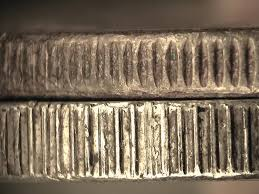
2. Edge shows CNC reeding, lathe chatter, or repeating patterns, often too perfect or mechanically uniform. (Sometimes edges are blank or show no reeding at all, especially on fake silver types — a major red flag.)

3. Edge wear often absent or artificially applied, lacking the smooth abrasion of genuine circulation.

4. Weight matches regal specs too precisely, suggesting CNC replication or fantasy intent.

5. Use of iron-nickel alloys, Fe/Ni or “German Silver” common in fake “silver” types — confirmed via XRF as non-period and non-circulating.


6. Surface silvering often artificial, with flaking, bubbling, or chemical residue under magnification.

7. Die style overly sharp or digital, lacking the nuance of hand-cut or worn dies; often shows mirrored fields or laser-like precision.

8. Legends include anachronisms, fantasy elements, or mismatched fonts, often failing comparison with Stacks Bowers and Heritage Auctions.


9. Strike pressure and die alignment too perfect, lacking flaws of hand-struck CCCs; often shows full rim and centered strike.

10. Absence from CCC analyzed by community consensus, often flagged as deceptive or fantasy.

To be sure, these are red flags that veteran hobbyists use and learn from. But it is never too early for beginning and intermedia collectors to scroll through these red flags, look up terms that you do not fully understand, and continue learning how to identify counterfeits.

For beginning collectors

Here are simple techniques:

  1. If you are ready to bid hundreds of dollars on a coin, resist buying a raw one and shop for one holdered by PCGS, NGC, ANACS and CAC.
  2. Be especially careful when purchasing raw coins from eBay and other online venues. TAI bots cannot detect counterfeits, so you are on your own.
  3. Make sure the seller takes returns and has good reviews. Also, the number of positive reviews is a good indicator. If someone has 0 sales or even fewer than 100, do not take a chance.
  4. Weigh the coin and go to PCGS CoinFacts for the date and mintmark, checking your coin against weights and dimensions.
  5. Read this article about detecting counterfeits.

If you like posts like this, you can read more articles on counterfeit coins by Jack Riley, Jack D. Young and Michael Bugeja at this URL. Also, please subscribe so you can get our weekly newsletter and be informed whenever there is a new article or column.

Proxiblog also has thousands of followers on Facebook Coin Groups, YouTube and other social media. To get the latest discussion and commentary, be sure to friend us by clicking here.

You can find more information about errors and varieties as well as buying and bidding on coins in Coin News Updated: The Essential Guide to Online Bidding. Please consider purchasing the work for yourself or a friend, as it underwrites this hobbyist website. Thank you.

How does hub doubling happen?


It’s called “hub doubling” for a reason. Before we get into what causes hub doubling, let’s define what the hub actually is and its role in the minting process.

Role of the Hub

A coin hub is a steel tool or punch with “positive,” or raised images of a coin’s design. The Mint uses the hub to create working dies (which have the negative, or sunken, image). The working dies are what actually strike the coin blanks to create the coins of all denominations. Here is an example.


As you can see, a hub is a master tool in the die-making process, ensuring that multiple working dies can be made consistently.

Its life, however, goes through many hands at the Mint. For starters, a design is created by an artist. That process involves dozens of people. A master hub is then made from this design. That creates all the working dies. One pair of working dies can produce hundreds of thousands of coins, and multiple working dies are created from hubs to keep up with large production runs.

Here is an example of working dies made by the hub.


Hub doubling occurs when the working die is misaligned or mismatched with the planchet. Every coin struck from that flawed die will exhibit the same doubling. That is why you cannot find a one-of-a-kind error.

Causes of Doubling

Before the mid 1990s, multiple impressions, or strikes, were required to transfer the complete design from the hub to the working die. A single press wasn’t powerful enough. The die blank had to be repeatedly heated and pressed. This issue often was the cause of doubled dies.

During this process, the hub and the die blank may not have been perfectly aligned during subsequent hubbings. This misalignment results in a duplicated image on the die face deviating from the approved design.

Errors and varieties happen when the hub or die inadvertently expands, contracts or tilts between hubbings due to improper annealing (heating) or pressure issues.

You won’t find many true and prominent modern doubled dies because the Mint now uses what is called “Single-Squeeze Process.” In other words, a high-pressure squeeze creates the die without all that warming and striking.

Here’s an example of that machine.


Doubling can still occur in the single-squeeze process if the hub slightly rotates or shifts under the extreme pressure before settling into place.

Also, the new machinery also virtually eliminated what used to be called “repunched mintmark.”

Hub doubling is a flaw in the die itself, so all coins produced by that die will show identical doubling. This is different from machine doubling, which is a minor, flat, shelf-like doubling that occurs during the actual coin striking process due to the die bouncing or shifting. As the working die deteriorates and is not changed for a new one by a Mint employee, you also will get machine doubling due to die deterioration.

Here’s an example of hub doubling featuring raised and rounded impressions v. machine doubling’s flat impressions.

Now let’s see how a true hub doubled die looks with the most famous example below.


Most Famous Example: 1955 DDO


The 1955 DDO is one of the most pronounced examples of hub doubling. You are not apt to see another like this because of the new improved machinery at the Mint. But this happened then because of pressure on the Mint to produce more cents in a high intensity work environment for the employees.

The night shift was so busy that many of the doubled die cents were mixed with other cents and released into circulation before the error was discovered. Employees and supervisors who learned about the mistake were not coin collectors. They actually believed the defective items had no special value.

The 1955 DDO is the top doubled die, with values between $1,000 to $300,000+ (depending on condition). Here are other Lincoln Cent doubled dies:

1969-S DDO

Clear doubling on the date, “LIBERTY,” and “IN GOD WE TRUST” ($13,000 to $600,000 depending on condition).

For more information, see Proxiblog’s article “Illusive 1969-S DDO.”


1972 DDO

Noticeable doubling on all obverse elements, especially “IN GOD WE TRUST” and “LIBERTY” ($175 to $23,500+ depending on condition).


For more information, see Proxiblog article: “9 1972 DDO Cents.”

1983 DDR

Doubling visible on the reverse side, particularly on “ONE CENT” and “UNITED STATES OF AMERICA” ($100 to $15,000+ depending on condition).

For more information, see Proxiblog’s “3 Must-Have Doubled Die Cents.”

1984 DDO

Doubling on Lincoln’s earlobe ($100 to $15,000+ depending on condition)

For more information, see Proxiblog’s “3 Must-Have Doubled Die Cents.”

1995 DDO

Strong doubling in the words “LIBERTY” and “IN GOD WE TRUST” ($5 to 3,200+ depending on condition).

For more information, see Proxiblog’s “3 Must-Have Doubled Die Cents.”


There is also an ultra-rare 1958 doubled die penny, but only three have been found to date.

Numismatic News reported in 2023 that GreatCollections of Irvine, Calif., handled the sale of the above coin. It received 117 bids and was hammered at $1,136,250 with buyer’s fee.

If you like posts like this, subscribe to Proxiblog so you can be informed whenever there is a new article or column.

Proxiblog also has thousands of followers on Facebook Coin Groups, YouTube and social media. To get the latest discussion and commentary, be sure to friend us by clicking here.

You can find more information about types, varieties, errors, grading, bidding and buying in Coin News Updated: The Essential Guide to Online Bidding. Please consider buying or gifting the work for a friend, as it underwrites this hobbyist blog. Thank you.

Tips for Making Money in Rare Coin Collecting

Editor’s Note: John Lorenzo is author of “Un-Real Counterfeit 8 Reales & Forgotten Coins of the North American Colonies” and is a researcher at World Numismatics. We are delighted to publish his views on the hobby.


John Lorenza, one of the top numismatists, has several recommendations for beginners and veterans about making money in coin collecting. His recommendations are so succinct that we will just illustrate his content.

Basic Hobby Recommendations

1. Educate yourself first. Build a strong foundation in grading, authentication, and market history before spending heavily. See this post about grading.

2. Buy the best quality you can afford. Coins with superior eye appeal and originality appreciate more reliably than average examples

Look at the eye appeal of this coin, previously owned by Michael Bugeja:


3. Focus on rarity and demand. Low‑mintage issues, historically significant coins, and series with strong collector bases tend to hold value.

4. Think long‑term, not short‑term. Coins are illiquid compared to stocks; meaningful appreciation often takes 10–20 years.

5. Buy from reputable sources. Stick to trusted dealers, major auction houses, or certified coins (PCGS/NGC) to reduce risk.

6. Diversify your collection. Spread across different series, eras, or regions to balance risk and opportunity.

7. Track market trends. Follow auction results, price guides, and collector forums to spot shifts in demand.

Click the photo below to see various holdering companies and their quality.


8. Protect and store properly. use correct holders, avoid cleaning, and maintain stable storage conditions to preserve value.

9. Network with other collectors. Join clubs, attend shows, and engage online to gain access to private deals and insider knowledge.

10. Be patient and enjoy the hobby. The best returns come from years of appreciation; passion for history and artistry makes the wait worthwhile.

Key takeaway: Rare coins reward patience. Their value grows as generations of collectors compete for limited supply, as historical narratives deepen, and as registry set competition heats up. Treat it like planting a tree—you profit when it matures, not the day you plant it. It’s a lifetime endeavor.

Collecting for Profit and Enjoyment After 60

1. Prioritize quality over quantity. Focus on a smaller number of high‑grade, desirable coins rather than building a massive collection that takes decades to mature.

2. Focus on established demand. Buy coins with proven collector bases (e.g., key dates, classic U.S. gold, popular world crowns) rather than speculative modern issues.

3. Think about liquidity. Choose coins that are easy to sell through major auction houses or dealer networks. This ensures your collection can be converted to cash if needed.

See Michael Bugeja’s past offerings at GreatCollections.com.


4. Certification matters even more. Stick to PCGS/NGC graded coins, since authentication and marketability are critical for heirs or future resale.

5. Enjoy the history and artistry. At this stage, the journey is as valuable as the financial return. The stories behind the coins can be as rewarding as the appreciation.

6. Plan for estate and legacy. Document your collection clearly, with purchase records and notes. This helps family members or executors maximize value later.

7. Network actively. Join clubs, attend shows, and connect online. Relationships can lead to better deals and trusted buyers when it’s time to sell.

8. Consider shorter‑term appreciation niches. Registry set competition, low‑population coins, or coins tied to anniversaries can see value rise in 3–5 years, not just decades.

9. Protect and preserve. Proper storage ensures your coins don’t lose value due to mishandling or environmental damage.

10. Balance profit with passion. The most successful collectors at any age are those who buy what they love. That way, even if the market is slow, the collection is still deeply rewarding.

Key perspective: At 60, you may not be holding coins for 30 years, but you can still see meaningful appreciation in 5–15 years—especially if you focus on quality, rarity, and liquidity. And unlike many investments, coins give you daily enjoyment while you own them. Stay away from modern U.S. Mint products whether 6 years old or 60 years old. Good Luck.

If you like posts like this, subscribe so you can be informed whenever there is a new article or column.

Proxiblog also has thousands of followers on Facebook Coin Groups and other social media. To get the latest discussion and commentary, be sure to friend us by clicking here.

You can find more information about types, varieties, errors, grading, bidding and buying in Coin News Updated: The Essential Guide to Online Bidding. Please consider buying or gifting the work for a friend, as it underwrites this hobbyist blog. Thank you.

Check those Certs!

PCGS, NGC, ANACS, CAC, ICGS have certification web sites. You’ll gain knowledge about everything from counterfeit detection to retail, wholesale and auction values.


New collectors and others who have inherited coins typically ask Facebook coin group members what their holdered coins are worth. There is no need to do this. In fact, the question alone indicates that you do not know what you have, opening you up to low-ball offers and scam buyers.

This Facebook member posts photos of PCGS-graded coins and wonders what they are worth.


All he had to do was go to the PCGS certification site for the information. Just input the numbers and you get all the facts.


Did you catch what happened here? If so, you are beginning to understand why checking certs of ANY slabbed coin is worthwhile.

His coin is counterfeit. The label is the giveaway: “Morgan.” The Chinese forgot that the only time PCGS states the dollar is a Morgan is on labels for 1921 coins because the Peace Dollar was introduced in that year!


The person’s coins are counterfeit.

Here is another person asking about worth for this NGC coin:


You can go to the NGC certification site and check this one.


NGC is not nearly as reliable with updating current value as PCGS. Note that this cert states “Price Guide Not Available.” NGC has been negligent with this for years, one of the reasons I prefer PCGS and CoinFacts. But you can still check the retail price by hitting the “Research this coin” tab.


Here are lookup sites for ANACS, CAC and ICG. Follow the same procedure.

If you want an estimate about what a coin dealer might pay you, you can access that information on the Greysheet wholesale website, requiring a subscription.

A better option to ascertain what a dealer might pay you, once again, is PCGS CoinFacts, an indispensable directory.

Let’s look up the retail and latest auction values (better than wholesale values because these states what people will pay) for that 1880-S MS64 Morgan mentioned earlier.


You get all the data for this coin, including mintages, which also play a role in value. But lower on the page you get population date and more specific details.


Better still, you can click the link for each auction. The first link, most recent sale 08/25, states someone paid a retail price in a Stacks Bowers auction. Why? Hit the link, and you get this superb coin, again with tons of data.


The ability to know retail and wholesale/auction values is a mandatory skill if you collect coins. Many just opt to go to a coin dealer who probably will use Greysheet wholesale and then deduct even more, especially if he owns a brick-and-mortar shop (he has to pay expenses, don’t you know).

Here is a typical advertisement promising to appraise coins and showing ones whose values are readily available online.


Wouldn’t it make sense, if this were your collection, to know what the retail and wholesale/auction values are before allowing someone else to tell you?

As you can see, checking certs guards against fakes and informs you in detail about your coin. Over time, you will learn not only the values but also all those data, helping you become the numismatist you were meant to be!

If you like posts like this, subscribe so you can be informed whenever there is a new article or column.

Proxiblog also has thousands of followers on Facebook Coin Groups, YouTube and social media. For the latest discussion and commentary, be sure to friend us by clicking here.

You can find more information about types, varieties, errors, grading, bidding and buying in Coin News Updated: The Essential Guide to Online Bidding. Please consider buying or gifting the work for a friend, as it underwrites this hobbyist blog. Thank you.

Not PCGS 2025 Silver!


Jack D. Young

Often, I joke about the counterfeiters apparently being ahead of the genuine releases–if not ahead, they are certainly keeping up with the latest “not-PCGS” slabbed fakes!

In this exclusive Proxiblog article I will review 3 really special 2025 “numismatic treasures” showing up in different selling venues.

So, without further ado I will start with a first strike 2025 230th anniversary flowing hair:


OK, so what is the issue with this one? Well, the 230th anniversary of the flowing hair dollar was 2024 and as noted the “year of issue”!!!


So, the following example actually came across the counter of a famous Chicago Coin Shop and a friend there posted it in one of our groups.

A counterfeit walks into a coin shop 😎

These were also the subject of a short on another friend’s popular coin YouTube channel:

“Frostbyte Coins” short on the subject

Not to be outdone, eBay sellers jumped on the bandwagon as well…


eBay listed 2025 230 Anniversary “Medal Coin”

A second eBay listing

And of course, one more on the Bay:

And a 3rd bay listing at the time

One thing to notice, all sport different cert numbers versus many we have seen with common certs used; and the cert for the Chicago example pulls up as:


Pretty silly at this point…

And what’s next? How about the 2025-S First Strike proof Morgan set!

This example posted in a Face Book Group I sometimes visit:

FB Group post image

The answer to his question is “it’s fake!” and the cert number is actually for a 2022 Australian 50c piece! And again, not to be outdone another listed for sale on the Bay:

eBay listing of similar counterfeit 2025-S and fake PCGS slab

As most of these, the actual barcode on the label does not scan, but checking the cert number for the listed example (48248428) gives this result on PCGS’ cert website:


And what could possibly be next😎?

How about a 2025“PCGS” MS70 First Strike Silver Eagle? This from a FB group post as well:


Interesting, the cert comes up as:


PCGS on-line cert for 51841365 shows the coin type as “971094”

So, coin type 971094 in PCGS’ system is as follows:

PCGS definition of the 2025 First Strike

While 2025 (W) S1 silver eagles are designated as “971544”:

PCGS definition of the 2025 (W)  First Strike at West Point

I often state the counterfeiters are NOT Numismatists. (They are crooks.)

And finding a genuine (W) example to compare to shows the following differences on the obverse slab and label:

Counterfeit on left, genuine First Strike (W) on the right

So, the “Fun” never ends with the counterfeits, and one can only wonder what they have in store for 2026!

If you like posts like this, you can read more articles on counterfeit coins by Jack D. Young, Jack Riley and Michael Bugeja at this URL. Also, please subscribe so you can get our weekly newsletter and be informed whenever there is a new article or column.

Proxiblog also has thousands of followers on Facebook Coin Groups, YouTube and social media. To get the latest discussion and commentary, be sure to friend us by clicking here.

You can find more information about errors and varieties as well as buying and bidding on coins in Coin News Updated: The Essential Guide to Online Bidding. Please consider purchasing the work for yourself or a friend, as it underwrites this hobbyist website. Thank you.

1992/92-D Close scAM

Only a handful of 1992/92-D Close AM coins have been found in the past decades, making these high-value variations extremely desired and also relatively easy to dupe both the buyer and eBay (when sellers do not accept returns). In the video below, Proxiblog’s Michael Bugeja shows how a person can photograph the obverse of a typical 1992/92-D Wide AM and the reverse of a 1993-2000 Close AM and depict them side by side as if one coin.

Now comes the hard part for the unfortunate buyer. He receives a 1992/92-D Wide AM. He may not know the die markers (disclosed in the video) or he may, leaving him with the distressing chore of trying to explain die markers to eBay when the seller doesn’t accept returns. While arguing counterfeit with eBay sometimes works, good luck when it comes to die markers. This is why Proxiblog recommends never buying or bidding on unholdered rarities.

If you like posts like this, please subscribe so you can get our weekly newsletter and be informed whenever there is a new article or column.

Proxiblog also has thousands of followers on Facebook Coin Groups, YouTube and social media. To get the latest discussion and commentaries, click here.

You can find more information about errors and varieties as well as buying and bidding on coins in Coin News Updated: The Essential Guide to Online Bidding. Please consider purchasing the work for yourself or a friend, as it underwrites this hobbyist website. Thank you.