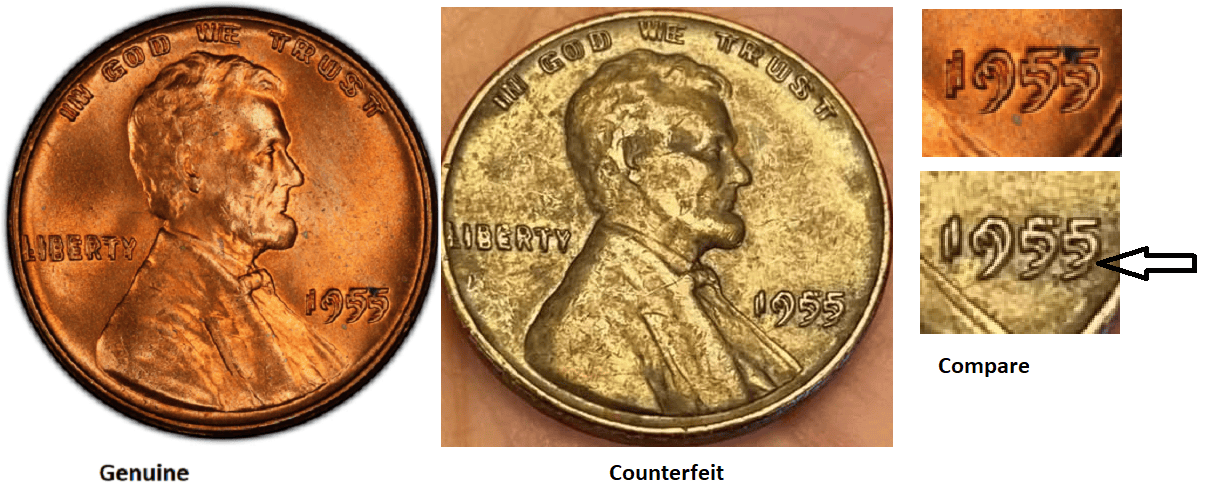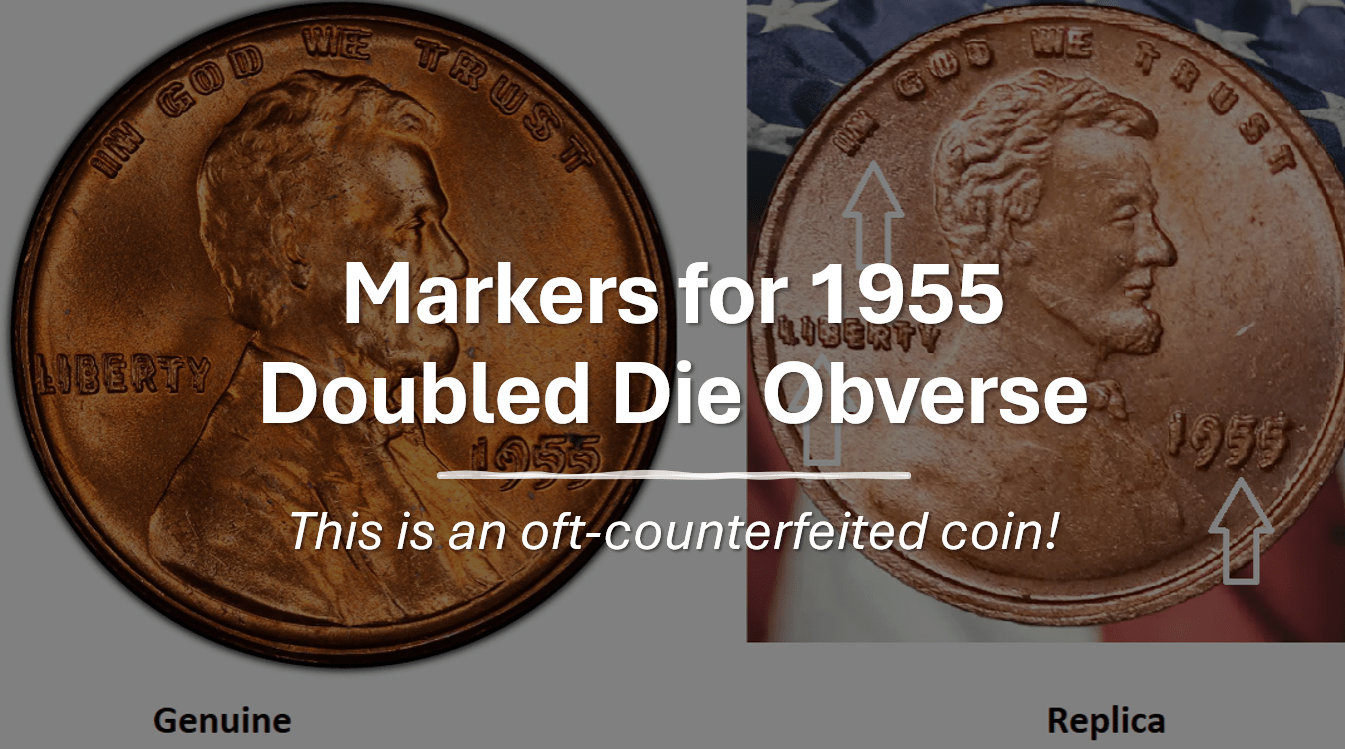
Markers for 1955 Doubled Die Obverse


This spectacular coin is the most famous mint variety, and as a consequence, also is one of the most counterfeited of U.S. coins. This article covers how it happened and then illustrates how you can tell if your coin is genuine.

To begin with, the 1955 DDO is dramatic! So much is doubled on the obverse. See:
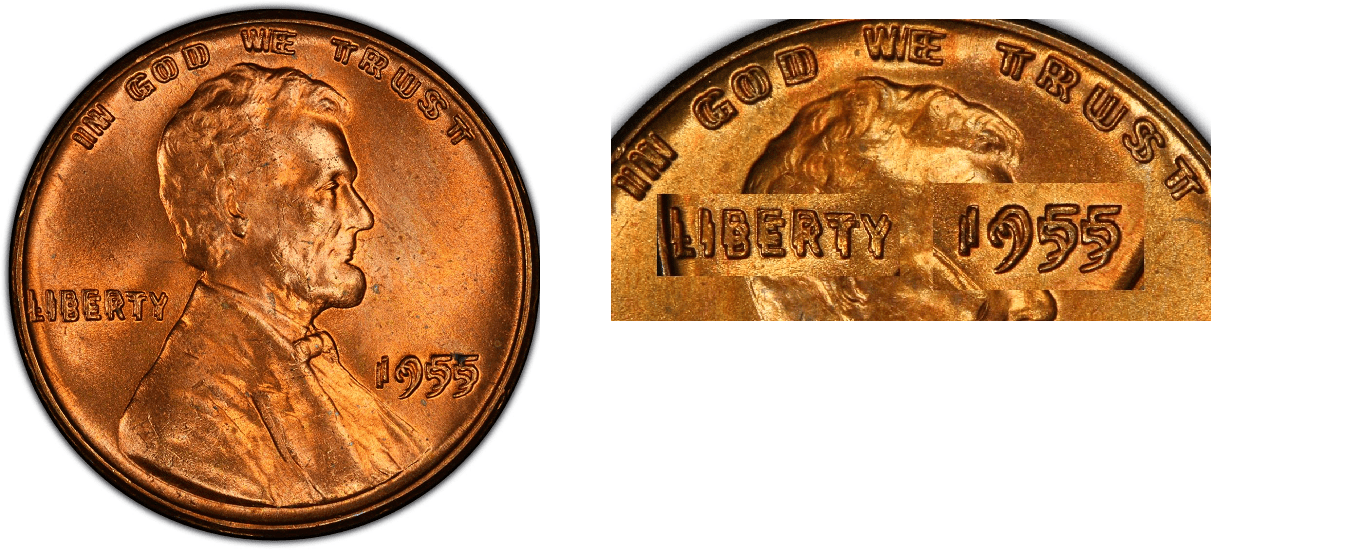

The 1955 doubled die is a die variety. Even though employees at the mint made an error and did not stop production, this is a variety. The planchet was only struck once by the coining press, but the die used to strike it already had a doubled image.

In this case, during production, the hub and the die were misaligned and rotated slightly counter-clockwise, accounting for the large spread of lettering and numbers.

Coinage operators, under pressure to produce 1955 cents, failed to notice the mistake, allowing this defective die to be used in striking. Estimates are 24,000 to 40,000 coins were released being discovered.

That was the first error. The second had to do with mint officials releasing the doubled die into circulation to avoid a regional coin shortage.

Because this coin is considered an ultra rarity, it is one of the most counterfeited and replicated U.S. coins.

In genuine coins, the doubling has a large spread and is sharp, as if carved by a knife. Be wary of soft doubling and pay attention to the exact separation.

Here’s the difference between a genuine and replica, as offered by Etsy and Temu.
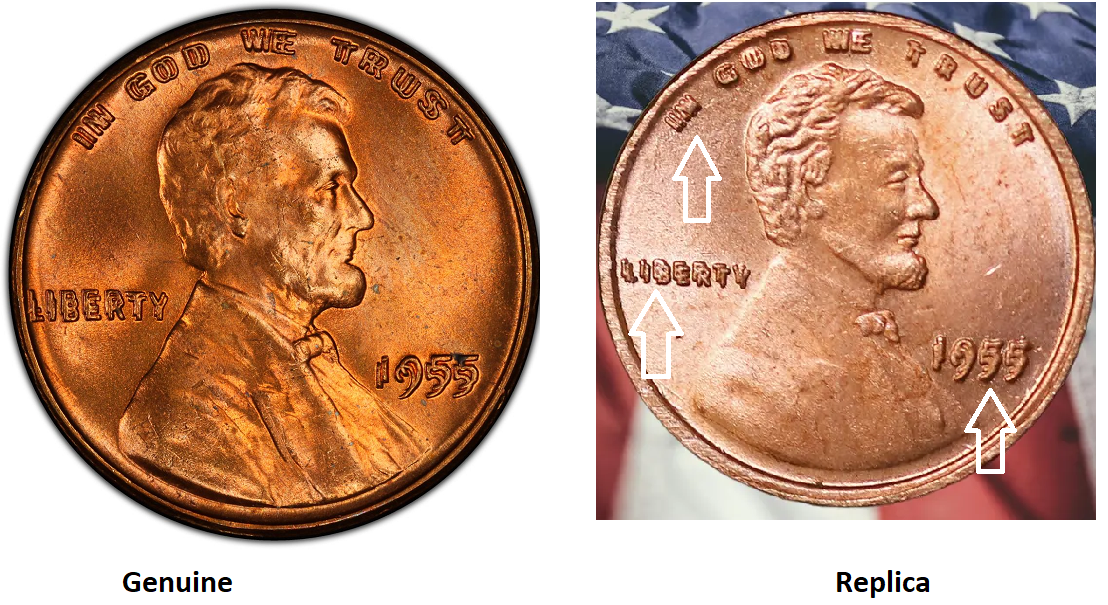

Note the mushy quality of the replica as well as difference in font sizes and orientation of “Liberty” and “In God We Trust.”

One more marker: In genuine coins, the portrait of Lincoln is sharp with no doubling or distortion. The above replica fails in this regard.
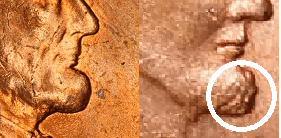

Any deviation or doubling on the portrait is a fake.

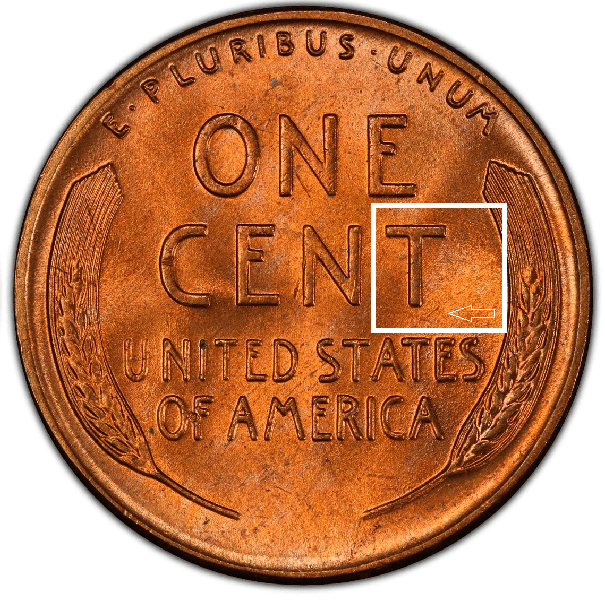
Only one pair of dies was used to strike the original batch, so every genuine 1955 DDO has the exact same reverse markings.

One other marker. You would need a microscope to see this, but tiny vertical and polishing lines are present on the reverse in this area, along with die scratches.

Also take care to understand the difference between machine doubling and hub doubling.

FeatureGenuine 1955 DDOMachine Doubling (“Poor Man’s”)
CauseError is engraved directly onto the die.The die slipped or vibrated while striking the coin.
AppearanceBoth sets of details are raised, rounded, and fully formed.The second image looks like a flat, shaved-down “shelf”.
ScaleExtends across the date and all letters.Usually only visible on the last digit of the date.
ValueWorth thousands of dollars.Worthless face value (under $2).

Also on the reverse, a genuine 1955 Doubled Die should have a 5% slight misalignment on the die. You would need to identify that yourself.

Please do not be fooled by 1955 DDO errors as in this dramatically misaligned copy from Etsy.
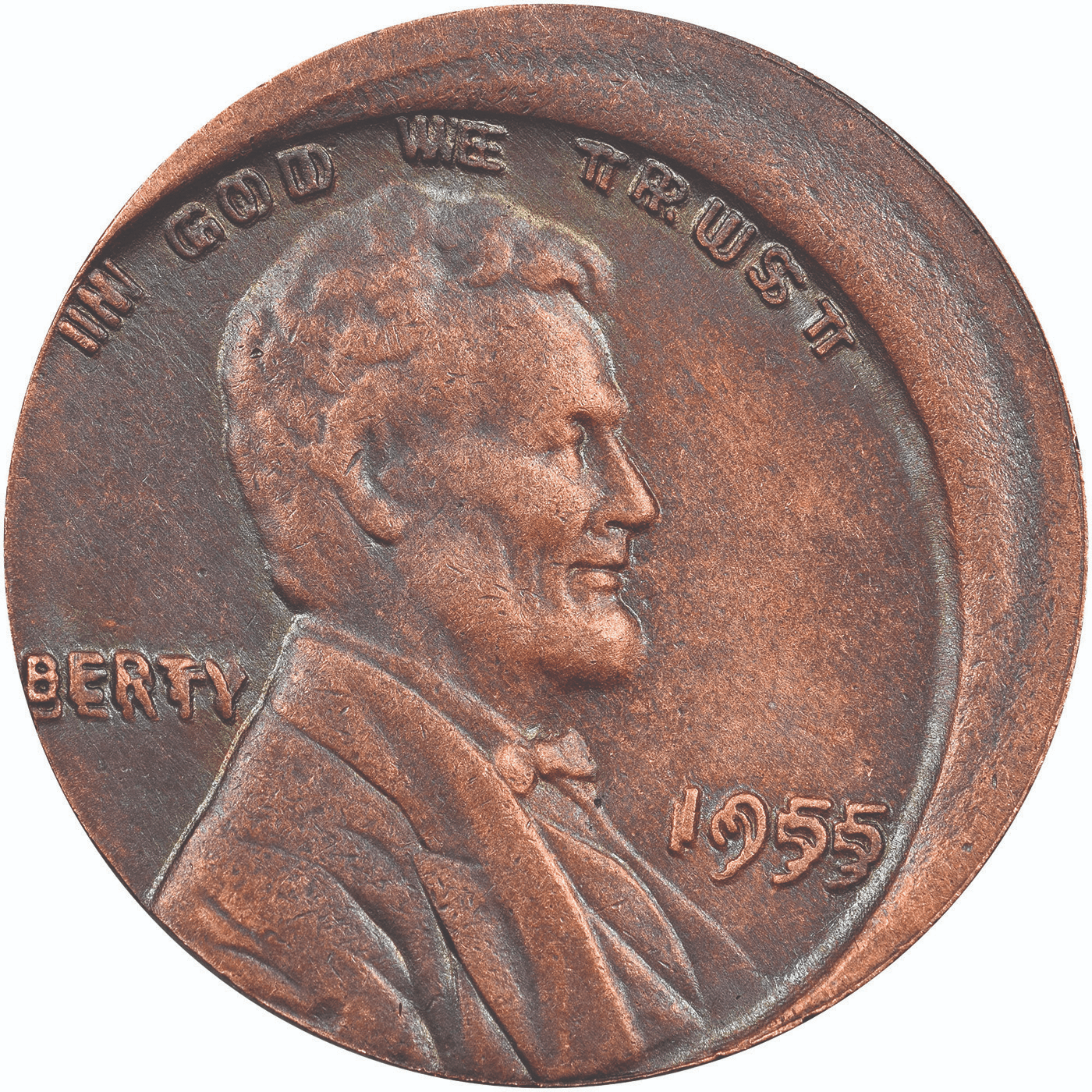

All the markers in the above replica are wrong.

If you have or inherited or plan to bid on a raw 1955 DDO, make sure to check all the markers. These are expensive coins!
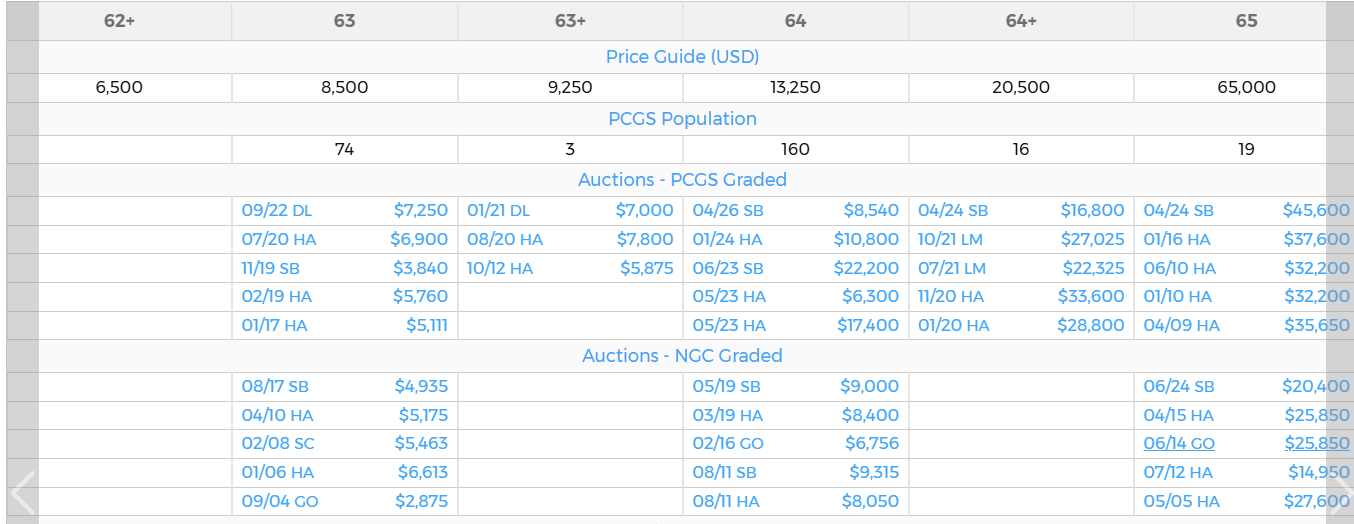

Holdering 1955 DDO cents is imperative to showcase authenticity. China exports tens of thousands of fake and replica examples. So if you have a raw example, or bought one, send to PCGS, NGC, ANACS or CAC for authentication.

If you like posts like this, subscribe so you can be informed whenever there is a new article or column.

Proxiblog also has thousands of followers on Facebook Coin Groups, YouTube and social media. To get the latest discussion and commentary, be sure to friend us by clicking here.

You can find more information about types, varieties, errors, grading, bidding and buying in Coin News Updated: The Essential Guide to Online Bidding. Please consider buying or gifting the work for a friend, as it underwrites this hobbyist blog. Thank you.

How does hub doubling happen?


It’s called “hub doubling” for a reason. Before we get into what causes hub doubling, let’s define what the hub actually is and its role in the minting process.

Role of the Hub

A coin hub is a steel tool or punch with “positive,” or raised images of a coin’s design. The Mint uses the hub to create working dies (which have the negative, or sunken, image). The working dies are what actually strike the coin blanks to create the coins of all denominations. Here is an example.


As you can see, a hub is a master tool in the die-making process, ensuring that multiple working dies can be made consistently.

Its life, however, goes through many hands at the Mint. For starters, a design is created by an artist. That process involves dozens of people. A master hub is then made from this design. That creates all the working dies. One pair of working dies can produce hundreds of thousands of coins, and multiple working dies are created from hubs to keep up with large production runs.

Here is an example of working dies made by the hub.


Hub doubling occurs when the working die is misaligned or mismatched with the planchet. Every coin struck from that flawed die will exhibit the same doubling. That is why you cannot find a one-of-a-kind error.

Causes of Doubling

Before the mid 1990s, multiple impressions, or strikes, were required to transfer the complete design from the hub to the working die. A single press wasn’t powerful enough. The die blank had to be repeatedly heated and pressed. This issue often was the cause of doubled dies.

During this process, the hub and the die blank may not have been perfectly aligned during subsequent hubbings. This misalignment results in a duplicated image on the die face deviating from the approved design.

Errors and varieties happen when the hub or die inadvertently expands, contracts or tilts between hubbings due to improper annealing (heating) or pressure issues.

You won’t find many true and prominent modern doubled dies because the Mint now uses what is called “Single-Squeeze Process.” In other words, a high-pressure squeeze creates the die without all that warming and striking.

Here’s an example of that machine.


Doubling can still occur in the single-squeeze process if the hub slightly rotates or shifts under the extreme pressure before settling into place.

Also, the new machinery also virtually eliminated what used to be called “repunched mintmark.”

Hub doubling is a flaw in the die itself, so all coins produced by that die will show identical doubling. This is different from machine doubling, which is a minor, flat, shelf-like doubling that occurs during the actual coin striking process due to the die bouncing or shifting. As the working die deteriorates and is not changed for a new one by a Mint employee, you also will get machine doubling due to die deterioration.

Here’s an example of hub doubling featuring raised and rounded impressions v. machine doubling’s flat impressions.

Now let’s see how a true hub doubled die looks with the most famous example below.


Most Famous Example: 1955 DDO


The 1955 DDO is one of the most pronounced examples of hub doubling. You are not apt to see another like this because of the new improved machinery at the Mint. But this happened then because of pressure on the Mint to produce more cents in a high intensity work environment for the employees.

The night shift was so busy that many of the doubled die cents were mixed with other cents and released into circulation before the error was discovered. Employees and supervisors who learned about the mistake were not coin collectors. They actually believed the defective items had no special value.

The 1955 DDO is the top doubled die, with values between $1,000 to $300,000+ (depending on condition). Here are other Lincoln Cent doubled dies:

1969-S DDO

Clear doubling on the date, “LIBERTY,” and “IN GOD WE TRUST” ($13,000 to $600,000 depending on condition).

For more information, see Proxiblog’s article “Illusive 1969-S DDO.”


1972 DDO

Noticeable doubling on all obverse elements, especially “IN GOD WE TRUST” and “LIBERTY” ($175 to $23,500+ depending on condition).


For more information, see Proxiblog article: “9 1972 DDO Cents.”

1983 DDR

Doubling visible on the reverse side, particularly on “ONE CENT” and “UNITED STATES OF AMERICA” ($100 to $15,000+ depending on condition).

For more information, see Proxiblog’s “3 Must-Have Doubled Die Cents.”

1984 DDO

Doubling on Lincoln’s earlobe ($100 to $15,000+ depending on condition)

For more information, see Proxiblog’s “3 Must-Have Doubled Die Cents.”

1995 DDO

Strong doubling in the words “LIBERTY” and “IN GOD WE TRUST” ($5 to 3,200+ depending on condition).

For more information, see Proxiblog’s “3 Must-Have Doubled Die Cents.”


There is also an ultra-rare 1958 doubled die penny, but only three have been found to date.

Numismatic News reported in 2023 that GreatCollections of Irvine, Calif., handled the sale of the above coin. It received 117 bids and was hammered at $1,136,250 with buyer’s fee.

If you like posts like this, subscribe to Proxiblog so you can be informed whenever there is a new article or column.

Proxiblog also has thousands of followers on Facebook Coin Groups, YouTube and social media. To get the latest discussion and commentary, be sure to friend us by clicking here.

You can find more information about types, varieties, errors, grading, bidding and buying in Coin News Updated: The Essential Guide to Online Bidding. Please consider buying or gifting the work for a friend, as it underwrites this hobbyist blog. Thank you.

Machine v. Hub Doubling


With the emphasis now on error coins, thanks in part to coin microscope sales and hyperbolic coin values on social media, it is important to know the difference between machine and hub doubling.

This is a tutorial. It is basic, meant for beginning collectors. If you want to know more about hub doubling, see “Three Types of Doubling” for intermediate collectors and “9 Official Illustrated Examples of Hub Doubling” for veteran collectors.

Let’s start with a photo showing a machined v. hub doubled 1969-S cent. Both look significant. Only one is. Can you tell the difference? (We’ll return to these coins momentarily.)


Machine doubling, the above left photo, adds no or little value to coins. It happens when a die at the Mint begins to deteriorate and so may bounce during a strike, creating a flat shelf-like image. The date, device, lettering and mintmark can appear to be doubled.

Hub doubling, valuable, indicates a flaw in the die itself. Unlike machine doubling, which happens during a strike, someone at the Mint made an etching mistake. Mintmarks before 1989 were punched into the die; but this is distinct from hub doubling. We call these deviations “repunched mintmarks” (RPM). Hub doubling produces a raised, rounded impression that follows the flow of the date, lettering or device.

Let’s illustrate this again more closely with the 1969-S DDO cent, one of the most illusive coins, worth a bundle. It is ultra rare with PCGS holdering only 30+ coins. You can read about that here.

Clickbait social media says you can find one in pocket change. Oh, and you’ll need to buy a coin microscope for that. Fat chance.


New collectors who routinely consult social media for any number of topics often believe these hyped posts. Odds are you will never find a 1969-S DDO in rolls or pocket change. But you can find dozens of machined doubled ones on eBay and elsewhere masquerading as an authentic 1969-S DDO with sellers asking hundreds and thousands for a faux coin:


Let’s return to the images mentioned earlier and show distinctions between machine doubled and authentic doubled dies:

Machine Doubling, Left; Hub Doubling, Right

The machine doubled cent has a flat, shelf-like doubling. The doubling does not mirror the individual numbers but seem pushed to the right. The hub doubled cent has raised rounded digits that follow the contours of the numbers.

In addition to the ability to distinguish between machine and hub doubling, veteran collectors know how to identify replicas flooding the market from China. You can buy these fake ultra rarities on venues like Etsy for less than $30.


These replicas are purchased by scammers and then posted on eBay as the real deal. Now you have to compare devices with genuine coins. To do that, google a genuine one in a PCGS holder and compare doubled devices.


The obvious difference is the word “Liberty.” Take a closer look:


The doubling on the replica is mushy and below the original letters of “Liberty”; the doubling on the authentic coin is above “Liberty” with each letter mirroring the original and shifted to the right.

If you like posts like this, please subscribe so you can be informed whenever there is a new article or column.

Proxiblog also has thousands of followers on Facebook Coin Groups, YouTube and social media. To get the latest discussion and commentaries, click here.

You can find more information about errors and varieties as well as buying and bidding on coins in Coin News Updated: The Essential Guide to Online Bidding. Please consider purchasing the work for yourself or a friend, as it underwrites this hobbyist website. Thank you.