Every 1922 cent should carry the “D” mintmark from Denver, which was the only facility to produce cents in 1922. But accidents happen, and a mint employee over polished a working die, erasing the “D.”
The Denver Mint struck a total of 7,160,000 Lincoln cents that year. Due to a shortage of coin dies, Denver workers polished and reused damaged, clogged dies. That is how the mistake happened.
Coin collectors know that the Philadelphia Mint typically does not use a mintmark for coinage. So the missing mintmark has the appearance of being struck at Philly.
Only about 15,000 examples exist of the missing mintmark cent, a key date for collectors and a rarity, worth hundreds and even thousands of dollars, depending on the die pairs.
That’s why identifying the rarity is important. We’ll explore that here.
The 1922 Cent is categorized as follows:
Standard 1922-D (Normal mint mark)
1922 “Weak D” (Faint, blurry, or partially filled mint mark)
1922 “No D” / Plain (Mint mark completely missing)
In addition, value is assessed by die pairs:
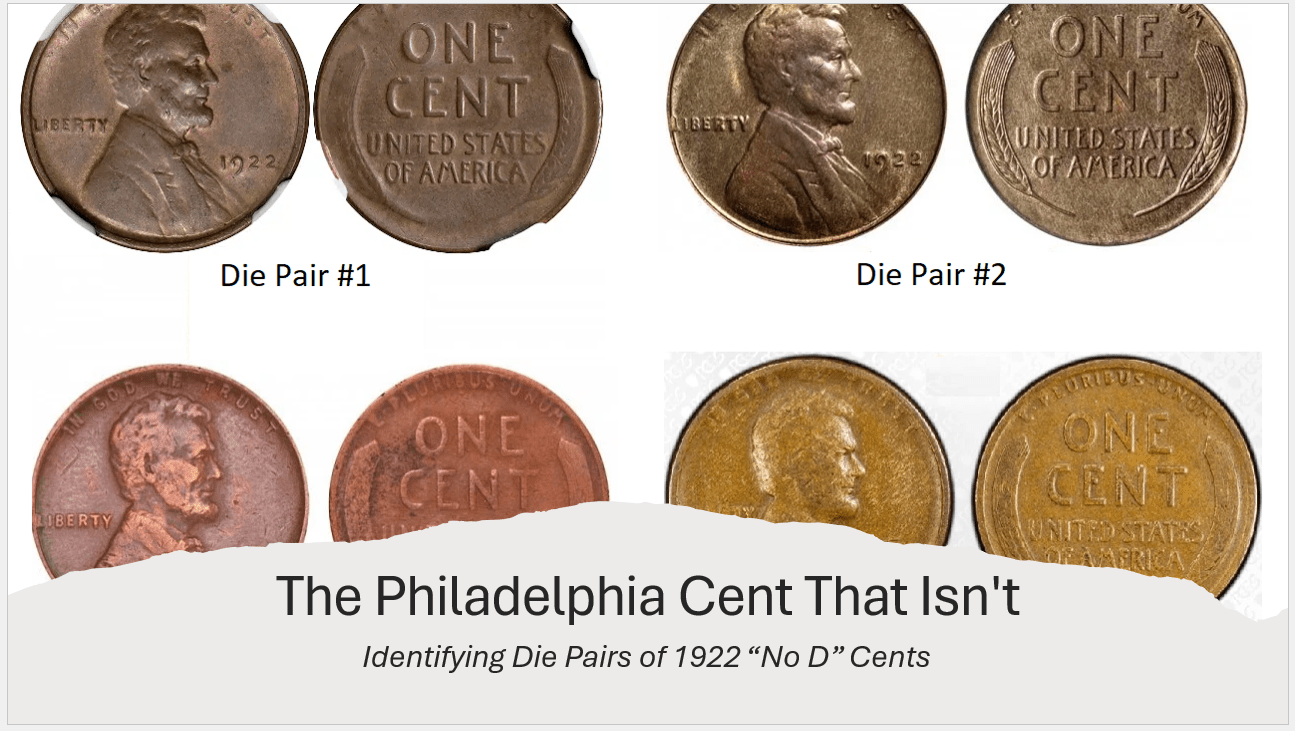
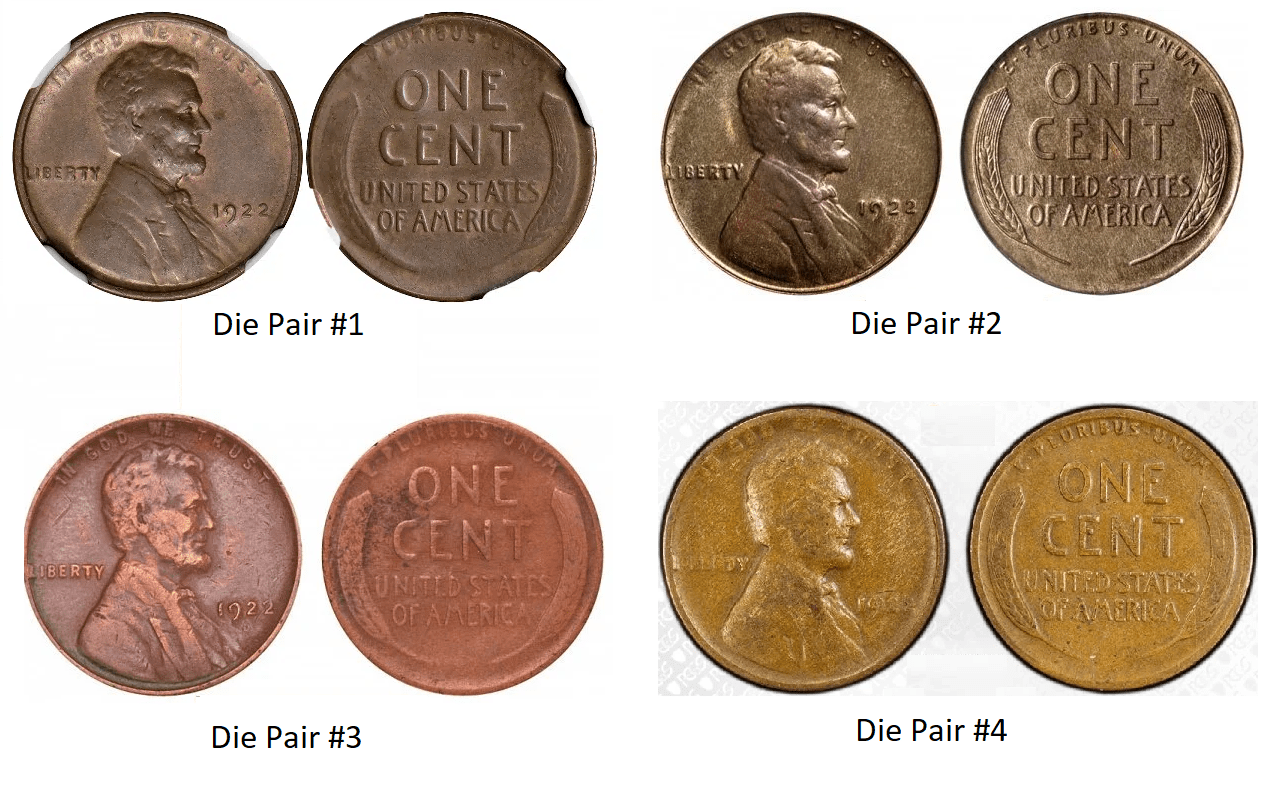
Die Pair #1 (Weak D / No D – Weak Reverse). Mushy or missing lines on wheat stalks. Die Pair #2 (“No D” Strong Reverse). Clear lines on wheat stalks. Die Pair #3 (Weak D / No D – Weak Reverse). The final “2” in the date is notably weaker than the first “2”. Die Pair #4 (Weak D / No D – Weak Reverse): Very similar to pair 3 but typically even mushier.
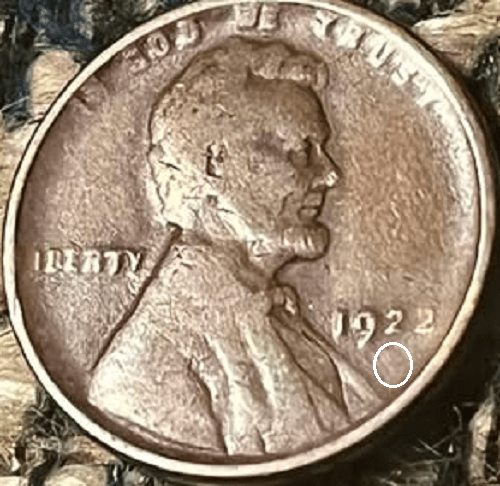
Scammers find it easy to erase the “D” on a well-defined 1922-D normal mintmark coin. They do so by tooling or filling the area where the mintmark should be. Here’s a suspicioius example:
This is one occasion to use a coin microscope. Any deviation on the surface is suspect.
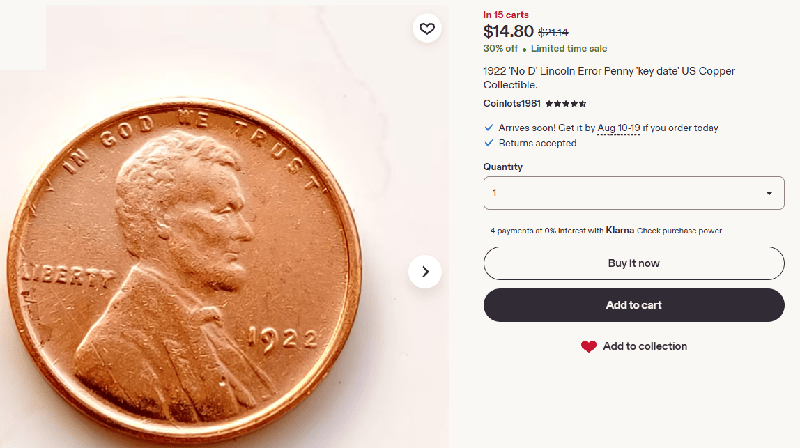
Also keep in mind that China mass produces replicas that dishonest sellers offer as authentic. Example:
As always, if you cannot distinguish die pairs, or are unsure, do not bid on or buy any unholdered coin.
As you might anticipate, die pair #2 values are expensive.
If you like posts like this, subscribe so you can be informed whenever there is a new article or column.
Proxiblog also has thousands of followers on Facebook Coin Groups, YouTube and social media. To get the latest discussion and commentary, be sure to friend us by clicking here.
You can find more information about types, varieties, errors, grading, bidding and buying in Coin News Updated: The Essential Guide to Online Bidding. Please consider buying or gifting the work for a friend, as it underwrites this hobbyist blog. Thank you.
In 2017, I won in an online auction a roll of Morgan dollars supposedly from a Carson City, Nev., bank. The date 1879 was on one end of the roll and the CC Mint mark of the Carson City Mint on the reverse. I paid $2,400 for the roll and reported the results for Coin World.
If the roll was actually from Carson City, with 1879-CCs therein, it would have been a magnificent score, worth tens of thousands. I knew that would not be the case. This was research for an article. As it turned out, there was one 1883-CC low mint state (the coin whose reverse showed on one end of the roll). The rest were sliders with a few uncirculated common date Morgans. A few, though, were toned, so I did recoup some of the investment. In the end, I lost more than $1,300.
That was a baited roll. In other words, someone had access to a Carson City bank paper roll and filled it so that one end had a CC, fooling optimists (fools) that other coins therein had the same rare mintmark.
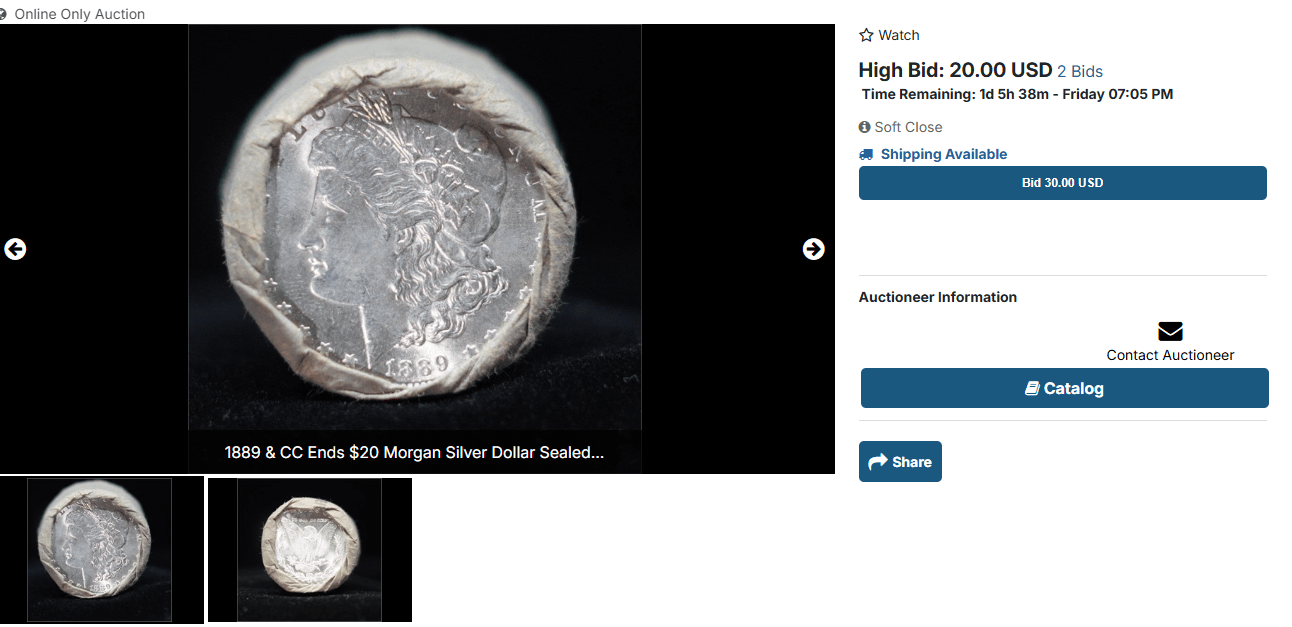
This article cautions against buying these rolls on eBay, HiBid or other auction venues. Not only because almost all of these have searched already; but because the specter of counterfeits in those rolls is increasing
For instance, Jack D. Young wrote an article titled “Bad Coin Rolls,” about a seller offering two mixed rolls of small cents with an apparent 1857 Flying Eagle counterfeit cent.
Here’s a clearly opened roll from HiBid. Note how loose the ends of the roll are, even though the seller states “SEALED. (For newbies, “sealed” does NOT mean “unopened.”)
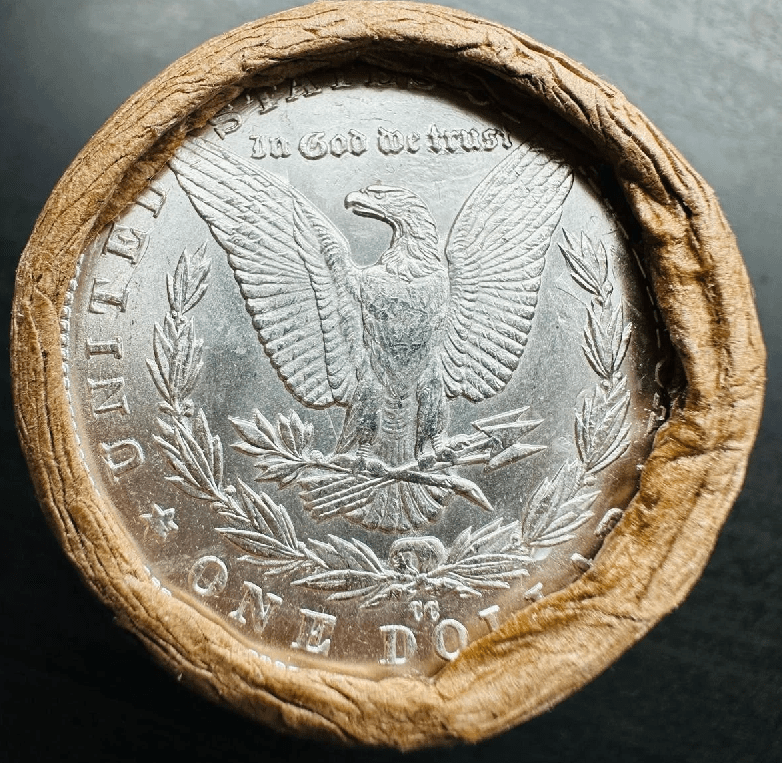
Learn what an opened roll looks like, with loose ends that the owner could not get back into original form. Example:
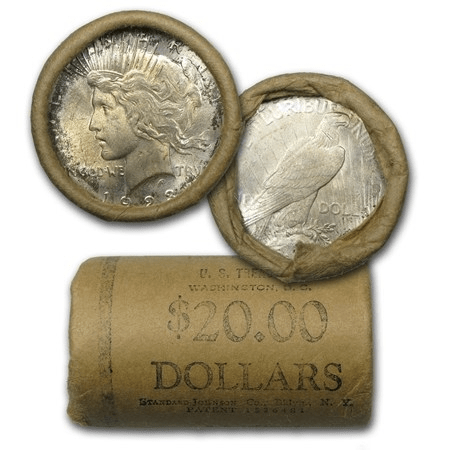
Proxiblog has written about photos of rolls, important before you bid or buy. You should see both ends in any offering to identify if they show evidence of being opened. Here’s a legitimate offering of Peace Dollars with one side (left) tight and original and the other (reverse side, right), opened.
Veteran hobbyists know that you should never bid on these rolls, even if both sides look tight and unopened. A good scammer can use an Exacto knife to open and reseal a roll so that it looks original. (I won’t share how to do that; I learned from my local coin dealer, decades ago, who showed me all the scammer tricks, pre Internet.)
But now, with the onslaught of Chinese fake Morgan dollars, the risk has increased. Many hobbyists cannot identify counterfeit coins. Consider this Etsy copy (right) if inserted into a Morgan roll. Would you be able to tell the difference?
In the past, scammers had to shell out for at least one uncirculated Carson City 1882-1884 Morgan dollars. Now, counterfeits are in play. This, in itself, is a good reason NOT to purchase these rolls.
Recommendations:
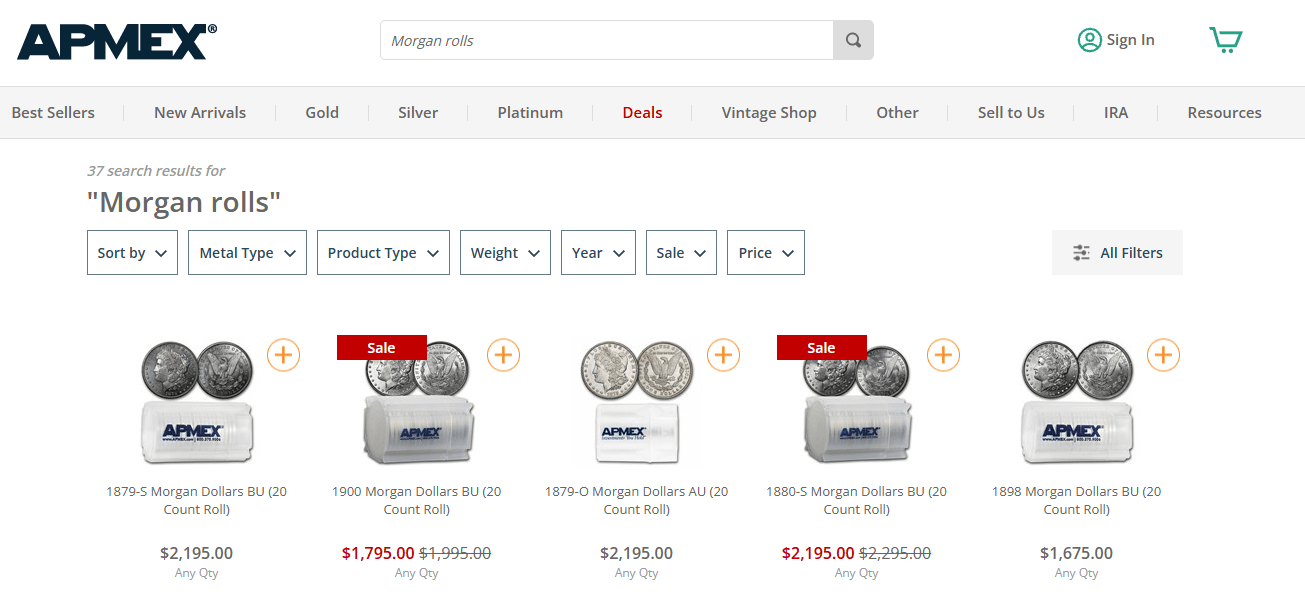
If you want to stack silver or buy Morgan and Peace rolls, purchase from reputable online sellers using their own plastic rolls, like APMEX:
2. Do not bid or buy any roll on eBay or other online venues if one end of the roll looks opened or if the seller doesn’t show both ends of that roll. Classic bad example with no ends of roll depicted:
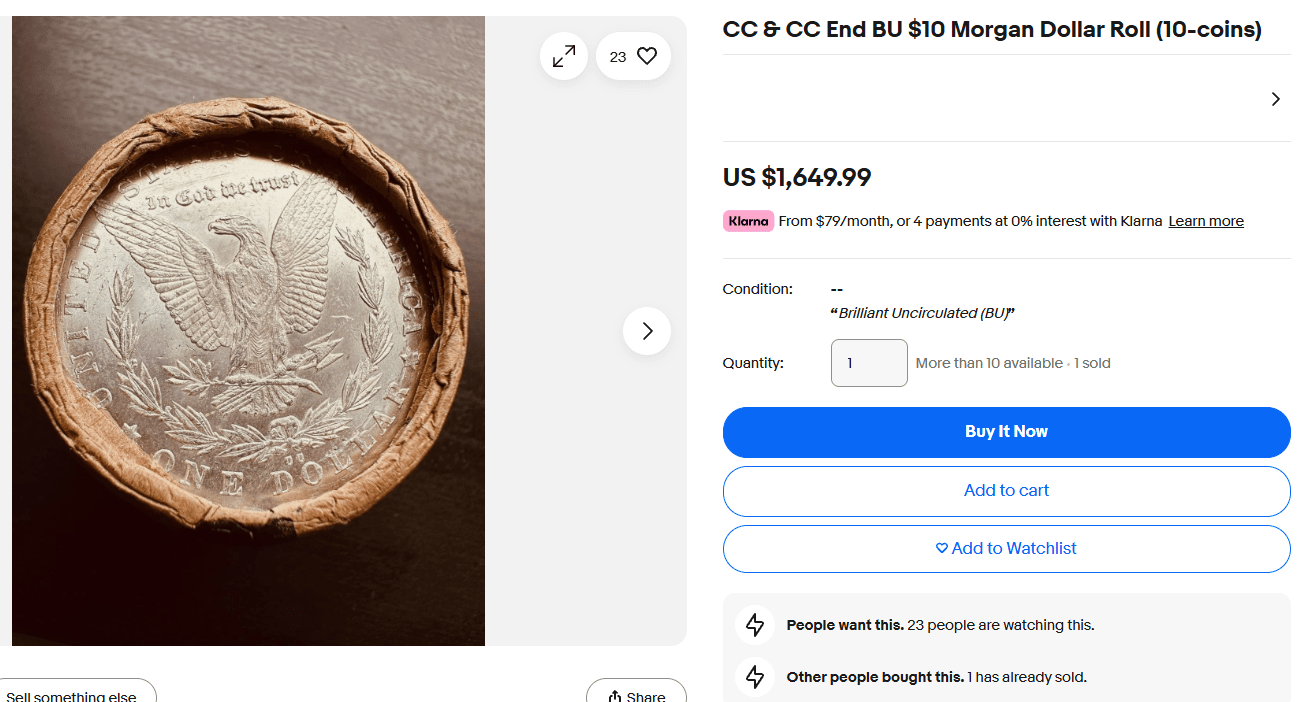
3. Do not fall for baited Carson City bank rolls. Those are almost always opened. Below is a 10-coin roll from eBay. (Note for newbies: Morgan and Peace dollars are routinely offered in 10-coin and 20-coin rolls. Do not assume all rolls have 20 coins.)
Finally, learn about Etsy replicas. Proxiblog has documented these in several articles. CLICK HERE FOR EXAMPLES.
The more you learn about coins, the less chance of your being snookered.
If you like posts like this, subscribe so you can be informed whenever there is a new article or column.
Proxiblog also has thousands of followers on Facebook Coin Groups, YouTube and social media. To get the latest discussion and commentary, be sure to friend us by clicking here.
You can find more information about types, varieties, errors, grading, bidding and buying in Coin News Updated: The Essential Guide to Online Bidding. Please consider buying or gifting the work for a friend, as it underwrites this hobbyist blog. Thank you.
For the veterans looking for specific classes of doubled dies, here are nine with illustrations. While it is important to know these, beginners are discouraged from trying to learn these via memorization. They should access the three main types of doubling. That said, they might still want to see the visuals to grasp all the types of hub doubling creating varieties in coin collecting.
Values of the above depend on rarity and condition. Check PCGS CoinFacts for particulars.
If you like posts like this, subscribe so you can be informed whenever there is a new article or column.
Proxiblog also has thousands of followers on Facebook Coin Groups, YouTube and social media. To get the latest discussion and commentary, be sure to friend us by clicking here.
You can find more information about types, varieties, errors, grading, bidding and buying in Coin News Updated: The Essential Guide to Online Bidding. Please consider buying or gifting the work for a friend, as it underwrites this hobbyist blog. Thank you.
True doubled dies are becoming difficult to find ever since the US Mint installed new machinery (sing-squeeze hubbing) in 1997, virtually eliminating true doubled dies. But they still occur because the machinery requires several presses per working die, and if that is improperly align, viola!: Doubled Dies.
Also, because of the power now of the coining machines, pressure can cause a slight slip and even result in a ghost image.
One of the first examples in the Lincoln Memorial Cent category is the 2004 DDR (also known as 2004 DDR FS-801).
Like the 2006 DDO cent, the misalignment of the 2004 DDR cannot always be easily spotted with a naked eye. You’ll need a loupe or, if you prefer, microscope.
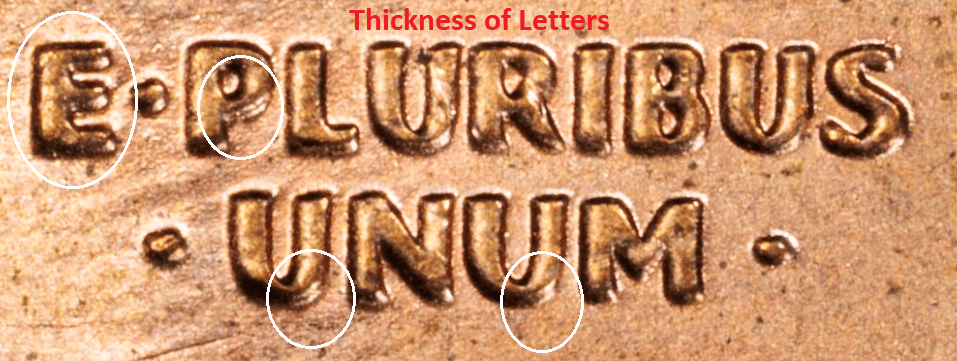
You will be looking for distorted, thick, somewhat bulb-like lettering in “UNITED STATES OF AMERICA” and “E PLURIBUS UNUM.”
Let’s review the markers.
Here are the main pickup points on “E PLURIBUS UNUM.”
After that, check the word “States” for thickness and doubling, as shown here:
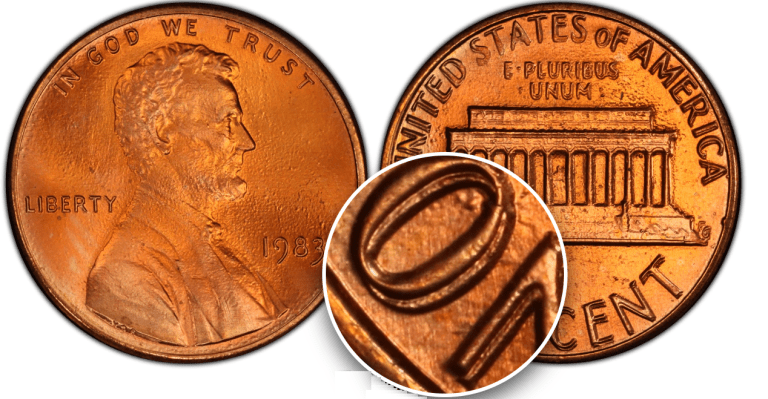
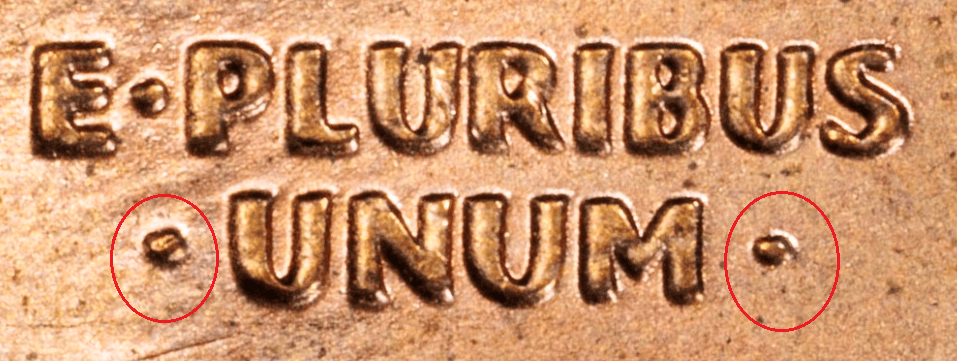
Also look for any deformed dots, as here:
To help you visualize differences, compare thickness and doubling next to a regular 2004 reverse.
Based on condition, PCGS Values range from $30 to $500+ in red uncirculated condition. Red-brown examples are exceedingly lower in worth.
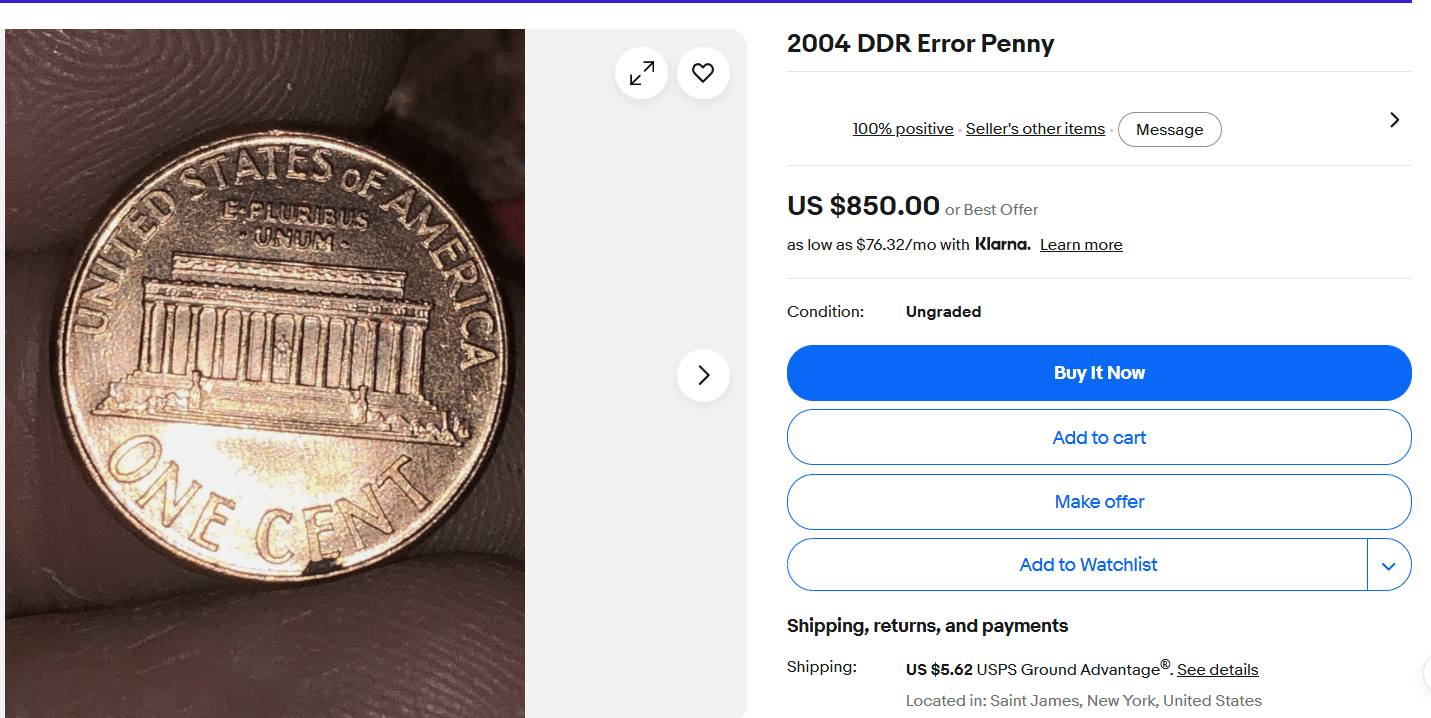
Because the markers may need magnification, we do not recommend buying raw examples from eBay and online auctions. Photos just cannot identify the above markers unless crisp and large. Never pay hundreds of dollars for any coin, especially a purported doubled die, unless holdered.
Here’s an example. No way to verify if this is a DDR.
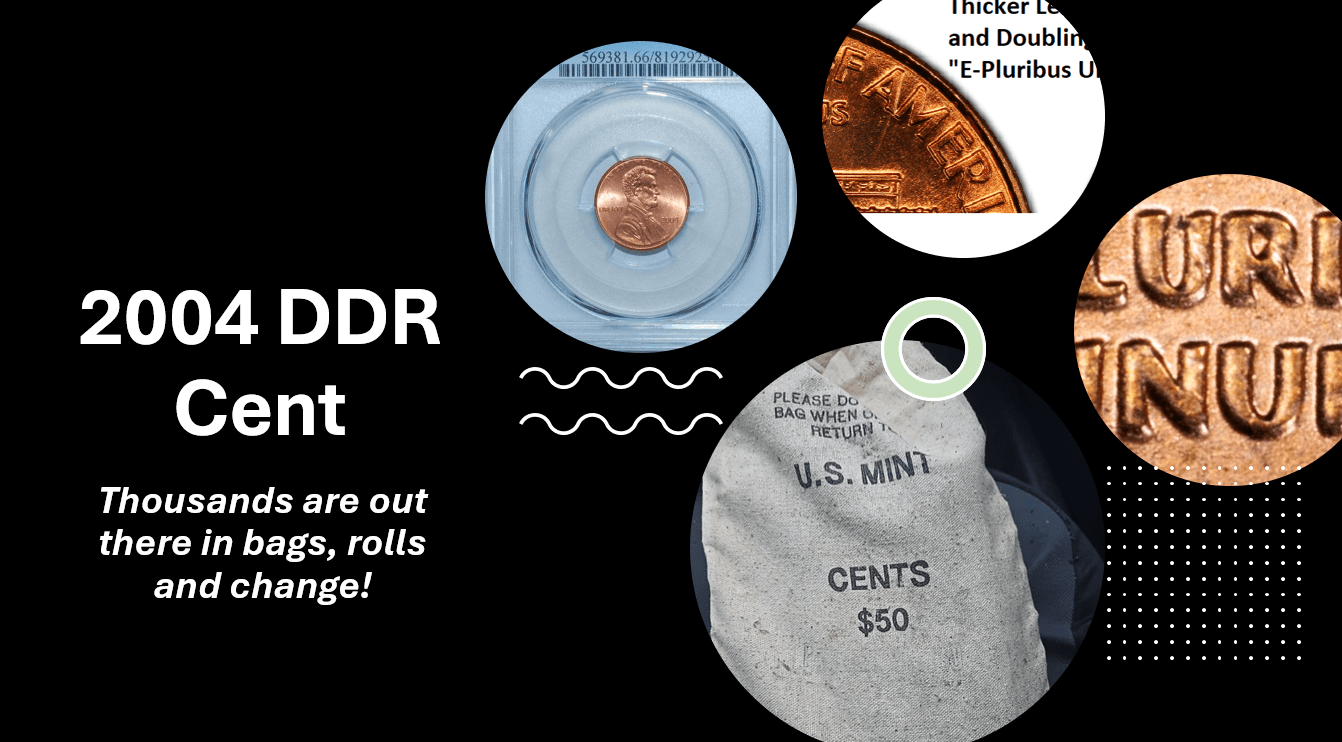
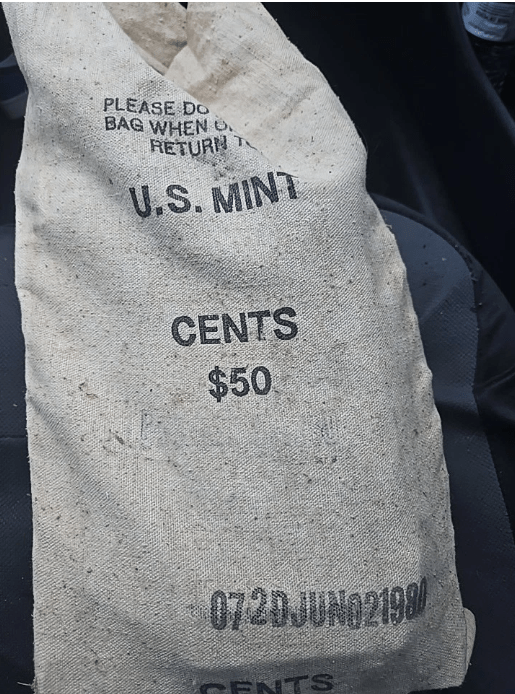
Mintage of the 2004 cent in Philly was 3,379,600,000; so thousands of these doubled dies should be in bags, rolls and circulation. Coin shops and eBay often sell unopened mint bags like this one, identified by date. My local coin dealer years ago had a $50 bag of 1995 DDO cents! Several years ago I bought an unopened 1982-D cent bag. Great grades but, you guessed it, no 1982-D Small Date 3.1 grams.
If you like posts like this, subscribe so you can be informed whenever there is a new article or column.
Proxiblog also has thousands of followers on Facebook Coin Groups, YouTube and social media. To get the latest discussion and commentary, be sure to friend us by clicking here.
You can find more information about types, varieties, errors, grading, bidding and buying in Coin News Updated: The Essential Guide to Online Bidding. Please consider buying or gifting the work for a friend, as it underwrites this hobbyist blog. Thank you.
I have known Ian Russell for a quarter century when he worked for Teletrade, an early pioneer in the certified coin market. He served as president of Teletrade from 2005-2010. He then founded GreatCollections Coin Auctions, which I whole-heartedly recommend. Good buyer and seller rates. I have used the site for years.
If you don’t known Russell, you can read his biography by clicking here.
Russell is treasurer of the Anti-Counterfeiting Educational Foundation, which raises awareness about counterfeit coins and bullion and works with authorities to track down sources of fake lots and sales.
I asked Russell to comment on what Jack D. Young, Jack Riley and I have been documenting on eBay and other online venues, i.e., counterfeit coins in fake PCGS holders whose certification numbers open to a Chinese site.
The Elements: The scam consists of three parts: a cheap base-metal counterfeit coin, a slab designed to mimic an authentic PCGS holder, and a fake URL/QR code.
The Fake Website: Scanning the QR code on the slab directs victims to a mirror website that falsely “verifies” the fake certification number as legitimate.
Prevalence: Investigated by numismatists on Proxiblog Coin News and Views, these scams heavily flood online marketplaces like eBay.
Proxiblog recommended these actions if encountering the sale of fake coins:
Verify Directly: Never use the QR code or URL printed on a suspicious slab’s label. Manually search the certification number on the Official PCGS Verification Portal.
Compare Markers: Scrutinize the coin’s die markers and weight, as counterfeiters often use stolen images of genuine coins for their listings.
Report Fakes: You can read investigative articles by numismatists at the Proxiblog Counterfeit Archive to stay up-to-date on current fakes.
The sheer number of “Not PCGS” counterfeits has reached epidemic proportions. See this video for examples:
Proxiblog recently contacted PCGS President Stephanie Sabin, who provided this statement:
“Since founding PCGS in 1986, our mission has been to protect collectors through leading authentication, grading, and the most secure holders in the industry. However, a powerful brand inevitably attracts counterfeiters, and we treat combating these fraudulent holders as an aggressive, ongoing priority. True security requires staying multiple steps ahead, which is why we continually invest in advanced overt and covert security features across all our product lines. We applaud the dedicated individuals and organizations within our community who work tirelessly to educate collectors on the dangers of counterfeit holders; their vigilance to eliminate altered and fraudulent collectibles is essential to protecting consumers and preserving the integrity of the numismatic marketplace.”
After that article ran, Proxiblog began getting emails and messages about whether their actual PCGS-holdered coins were legitimate. That shows the damage being done to the main reason that holdering companies exist: authentication. Proxiblog viewers also wanted to know what the big auction houses are doing to ensure that coins holdered by PCGS, NGC and other companies contain genuine coins.
So we contacted Russell to find out.
“The rise in counterfeit coins housed in fake PCGS holders has become one of the most serious threats facing the numismatic marketplace today,” Russell says. “At GreatCollections, every coin is carefully reviewed before it is offered for sale, and our team is highly experienced at identifying counterfeit holders, altered labels, and fraudulent verification schemes. Protecting bidders and maintaining confidence in third-party grading are top priorities.”
When questionable material is identified, GreatCollections removes it from consideration regardless of its source. While most consignors are acting in good faith and are often unaware they possess a counterfeit item, Russell says, “we will not offer any coin whose authenticity cannot be fully verified. The integrity of the marketplace depends on strict authentication standards and consistent enforcement.”
Russell is concerned about the growing sophistication of counterfeit holders. This has understandably caused some collectors to question genuine certified coins. “That is why auction houses, grading services, dealers and collectors must remain vigilant and work together to identify and remove counterfeit material whenever it appears. Confidence in certified coins is built on trust, and that trust must be protected.”
Jack D. Young also was among the first to report counterfeit coins in fake PCGS holders with GreatCollection labels. The label on the left side below is fake. Compare it to the real label, right.
Russell says, “We’ve also encountered counterfeit PCGS holders that use fake GreatCollections labels. Ironically, the counterfeiters often print a GreatCollections inventory label inside the sealed PCGS holder, as though it were inserted during the grading process. It’s almost comical, but it also illustrates how far these operations are willing to go to create a false sense of authenticity.”
As counterfeiters continue to refine their methods, Russell recommends reading Proxiblog and other numismatic publications, paying attention to careful examination and buying from reputable sources.
For an inventory of Proxiblog counterfeit articles, click here.
If you like posts like this, subscribe so you can be informed whenever there is a new article or column.
Proxiblog also has thousands of followers on Facebook Coin Groups, YouTube and social media. To get the latest discussion and commentary, be sure to friend us by clicking here.
You can find more information about types, varieties, errors, grading, bidding and buying in Coin News Updated: The Essential Guide to Online Bidding. Please consider buying or gifting the work for a friend, as it underwrites this hobbyist blog. Thank you.
The 2006 Lincoln Cent DDO FS-101 is one of the few true doubled dies since 1996 when the US Mint upgraded their machinery with what is called a “Single-Squeeze” hubbing process. The intent was to eliminate doubled dies altogether, but still we can see the method is not entirely fool proof.
The variety has its own PCGS number, meaning if you use it in the submission process you do not have request a special error variety label costing more money.
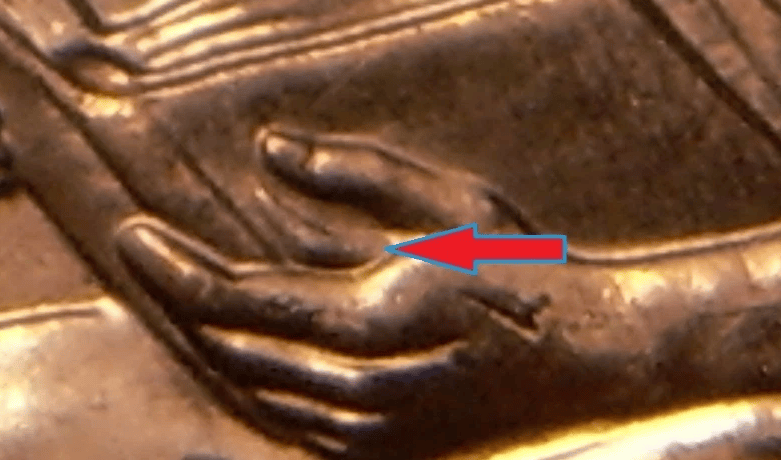
The key markers are a ghost image of an earlobe:
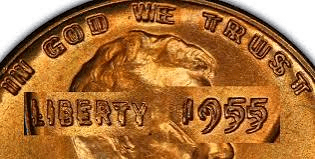
There is doubling on the date, thicker than regular strike, with noticeable spreading on the “6.”
It’s difficult to see, but there is also some doubling on the lower portion of Lincoln’s beard.
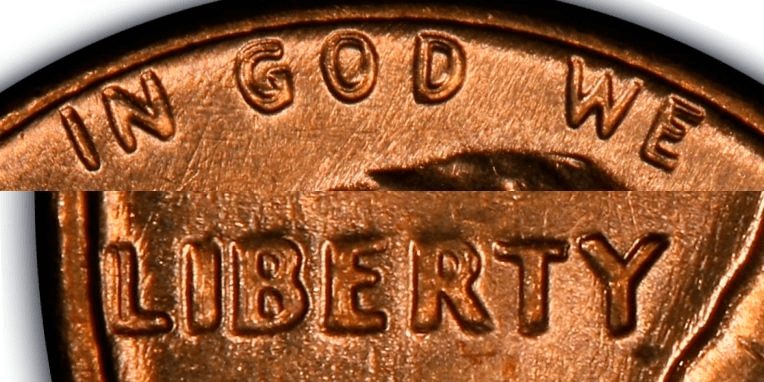
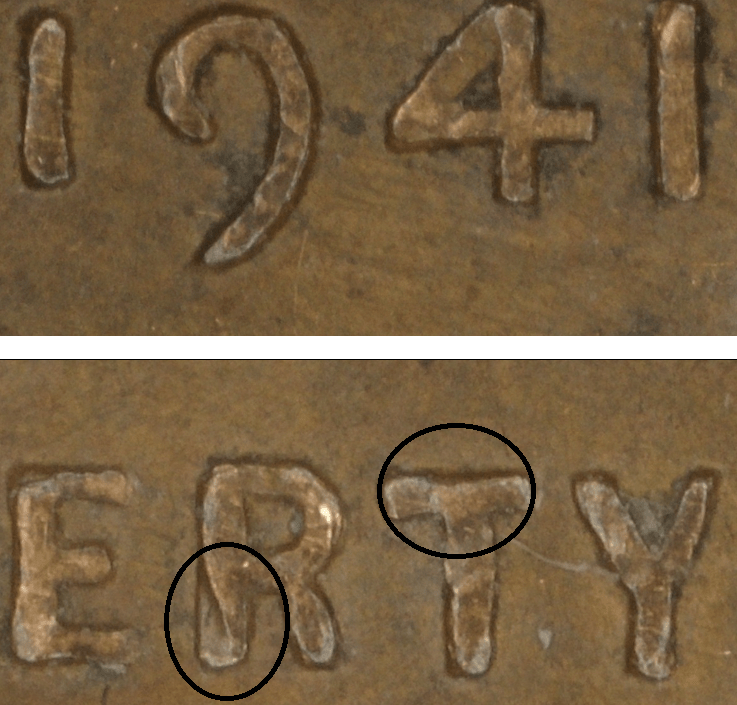
“Liberty” is a main marker, too, exhibiting extra thickness. Note the notch on the “T”:
The error happened when the working die was placed slightly out of alignment. Thousands are out there in rolls and pocket change.
There also is an FS-102 variety, lacking a clear ghost image of the earlobe. Markers are similar.
As you can see, PCGS shows significant values, based on condition, from about $30 in low mint state red to hundreds in super gem.
If you like posts like this, subscribe so you can be informed whenever there is a new article or column.
Proxiblog also has thousands of followers on Facebook Coin Groups, YouTube and social media. To get the latest discussion and commentary, be sure to friend us by clicking here.
You can find more information about types, varieties, errors, grading, bidding and buying in Coin News Updated: The Essential Guide to Online Bidding. Please consider buying or gifting the work for a friend, as it underwrites this hobbyist blog. Thank you.
A condition rarity is not associated with mintage but with other factors. Sometimes people neglected to save uncirculated examples, as in the 1884-S Morgan Dollar. The 1927-D Saint-Gaudens Double Eagle had a good mintage of 180,000; but almost all were melted. The 1953-S Franklin half dollar had a mintage of 4,148,000 but suffers from poor strikes due to worn working dies. As such, it is extremely rare to find one with full bell lines. There just wasn’t enough pressure to create the unbroken lines on the liberty bell.
But can strive to find an example with at least some of the lines on the reverse.
Let’s define FBL. The designation requires fully separated, uninterrupted lines at the bottom of the Liberty Bell on the reverse. The lower sets of horizontal lines on the bell must be complete and distinct. To qualify, coins must grade MS-60 or higher, with no major disruptions to the lines, which also must be free from major cuts, heavy marks, or disturbances.
The horizontal lines must be clear and readable. Let’s take a close look this FBL example:
You can find many uncirculated Franklin halves with full bell lines. But the 1953-S is the key date. The dozens of 1953-S halves that earned FBL were struck early in the production run before the dies deteriorated.
While you may not find the ultra rare 1953-S FBL, you might have luck with other San Francisco business strike half dollars, as these also bring premiums.
The San Francisco Mint made half dollars in these years: 1949, 1951, 1952, 1953 and 1954. Each one apart from the rare 1953-S brings a nice premium with FBL.
YEAR
1949-S
1951-S
1952-S
1953-S
1954-S
MS65
$130
$70
$125
$125
$50
MS65FBL
$475
$375
$1,050
$32,500
$225
The San Francisco Mint stopped making half dollars in 1954 so that its machinery could be updated. But you can still assemble a set of 1949-54 halves for a reasonable price. The goal is to get the FBL on 1949-52 and 1954 and a 1953-S half with at least some of the full bell lines.
This PCGS slabbed MS65 1953-S Sold for $100 at Stack’s Bowers. I consider this a score because so many of the lines are evident, apart from the middle.
You can find some with some distinguishable lines on eBay, but they often are overpriced, as this example. I drew the red circle showing this is NOT Full Bell Lines.
You also want to watch what 1953-S half dollars sell for on major auction houses, including GreatCollections, which sold this gem in 2019.
Assembling a set of Franklin halves is easily doable. Try for as many full bell lines as your budget allows.
If you like posts like this, subscribe so you can be informed whenever there is a new article or column.
Proxiblog also has thousands of followers on Facebook Coin Groups, YouTube and social media. To get the latest discussion and commentary, be sure to friend us by clicking here.
You can find more information about types, varieties, errors, grading, bidding and buying in Coin News Updated: The Essential Guide to Online Bidding. Please consider buying or gifting the work for a friend, as it underwrites this hobbyist blog. Thank you.
Clash marks are valuable, but people often try to mimic them with a vise, pressing two coins together. Other times, for one reason or another, glue creates an impression of one coin on another. Do not bid on any of these until you can tell them apart. As you might imagine, eBay and online auctions often label vise and glue coins as clash marks.
Here are all three:
You can easily distinguish them by looking for specific tells under a loupe or magnifying glass. You want to check if the extra impression is raised or sunken, and whether the lettering is oriented normally or backwards. If backward, you’re looking at a vise or glue coin.
TYPE
CLASH MARKS
VISE COIN
GLUE COIN
RELIEF
Raised Devices
Sunken Devices
Flat Layered
ORIENTATION
Normal
Backward/Reversed
Backward/Reversed
THICKNESS
Normal
Flat/Distorted
Thick/Sticky
A die clash happens at the Mint when erroneously the obverse and reverse dies strike each other without a blank planchet between them. The so-called “ghost” image will be raised, not sunken or flatly layered.
Vise coins are created by pressing two coins together with a vise or hammering them to mimic the clashed die. Because of the method, the lettering will be backward, flattened, distorted or damaged, especially by the rims.
A glue coin happens any number of ways when two coins are bonded by an adhesive. When separated, the ghost image appears flat and layered on the other coin.
Often the tone of the coin will be altered with a dried or amber look, as you might anticipate with glue. True, flat and layered can be confused with raised of a die clash. To be sure, dip the coin in acetone and the ghost will dissolve.
Sometimes people use a vise to create weird patterns, thinking those unfamiliar with how coins are minted will consider this an error or variety.
You’ll find many more examples of vise and glue coins on Facebook because few people know how to tell these apart from clashed dies. They find them in rolls, typically, because someone realized this wasn’t a mint error.
Sometimes glue takes strange shapes. Again, you need to know how coins are made to understand how this could never happen at the Mint.
Depending on the condition of the coin and the denomination, because clashed dies, vise jobs and glue coins happen across denominations, values vary from minor examples $30 to major ones in the hundreds or even thousands of dollars.
If you like posts like this, subscribe so you can be informed whenever there is a new article or column.
Proxiblog also has thousands of followers on Facebook Coin Groups, YouTube and other social media. To get the latest discussion and commentary, be sure to friend us by clicking here.
You can find more information about types, varieties, errors, grading, bidding and buying in Coin News Updated: The Essential Guide to Online Bidding. Please consider buying or gifting the work for a friend, as it underwrites this hobbyist blog. Thank you.
Doubled dies are valuable because you can usually readily see the spread without a coin microscope. The naked eye or loupe is all you need.
You can easily go down the rabbit hole checking Wexler or Variety Vista, both of which are dedicated to die markers and varieties, along with hub doubling. There are just too many entries with obtuse markers for the beginning collector. Focus on these first so you can see what hub doubling actually looks like.
1972 Lincoln Cent (DDO-001):Another famous modern cent variety with a huge spread. NOTE: Go to the link to see other 1972 doubled dies. You might need a microscope to see them.
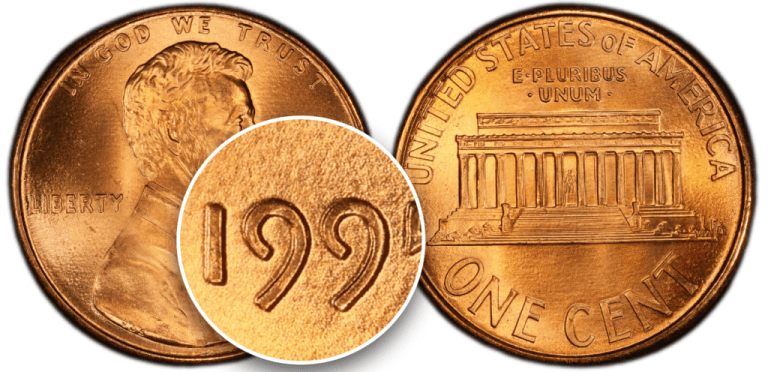
1995 Lincoln Cent (DDO-001): A popular modern find heavily distributed into regular circulation with easily seen doubling on “LIBERTY.”
1909 VDB Lincoln Cent (DDO-001): The first year of the Lincoln cent with doubling on the date and obverse text.
1917 Lincoln Cent (DDO-001): This cent features very strong, distinctive doubling on the date and the motto.
1936 Lincoln Cent (DDO-001): Philadelphia produced three separate DDOs this year, but Type 1 is famous for its wide, bold spread on the date and legends.
1970-S Lincoln Cent “Large Date” (DDO-001): A rare San Francisco variety with strong doubling on the mottoes and date.
1916 Buffalo Nickel (DDO-001): Heavily doubled and easy to see, one of the most coveted.
Veteran hobbyists forget that beginning collectors typically do not know VAMs for Morgan and Peace dollars and also for minor doubled dies–Wexler and Variety Vista is full of them.
Veteran hobbyists, especially on Facebook and social media, should remember that beginners do not know how to navigate those rabbit holds and think everything is a valuable doubled die. Few beginners and even long-time hobbyists may not know VAMs, obscure types of doubled dies (Classes I-IX), and common mint errors.
Keep it simple, as this article does.
If you are a collector of varieties and doubled dies, be sure to see our directory that features denominations that carry unique PCGS numbers. Articles there, too.
If you like posts like this, subscribe so you can be informed whenever there is a new article or column.
Proxiblog also has thousands of followers on Facebook Coin Groups, YouTube and other social media. To get the latest discussion and commentary, be sure to friend us by clicking here.
You can find more information about types, varieties, errors, grading, bidding and buying in Coin News Updated: The Essential Guide to Online Bidding. Please consider buying or gifting the work for a friend, as it underwrites this hobbyist blog. Thank you.
Today’s feature subject- the Trifecta all over again; counterfeit 1882-CC Morgan $, counterfeit PCGS slab, and counterfeit PCGS CN “authentication” website.
This article documents what is happening to our hobby. It is important for every collector to know what is happening on eBay and other venues with counterfeit coins, slabs and websites.
So, let’s start with the current one. I notified PCGS about this 1882-CC Morgan. As I have noted previously I use eBay for new material to write counterfeit articles on, and eBay apparently remembers me and my dumpster dive searches! The following is one page of a series of “inspiring” Bay offerings that came up the other day:
So the 1882-CC looked different and I thought worth taking a deeper dive on (notice the similar looking 1880-CC to the right as well). The original listing:
I have seen many odd listings on the Bay, but this one is notable. Starting with not-PCGS label the nomenclature seems bizarre; I have never seen a genuine one with the word “America” on it, making me think of others with “Morgan” on the label! And I had no clue what the “LM” and “Y” designations stands for; turns out they are attributions for Chinese coins!
The barcode doesn’t scan, the cert number doesn’t exist in the true PCGS database, and the gold shield looks like a child’s coloring book effort.
The seller shows front and back images and then a raw one on a scale while stating “With NFC C” for whatever that is supposed to mean.
And an old friend, “slash” the eagle! And where do you suppose the scale came from?
So bad cert #:
So, what about the reverse QR code? With that many “cn’s” in the address where do you suppose it will lead?
So a note for reference- the site we exposed at the beginning of the year was entirely different and was taken down quickly after notifying my contacts at PCGS and reporting on Proxiblog:
And the new site and images:
And like the previous site there is a “TrueView” type image to aid with authentication…
A little pricy to me at the time as I had 2 others going through the eBay refund/ return process then. Interestingly, both of them were reported through the Bay AI reporting process and came back AOK, but when I posted each on my Face Book sites and stated I bought one, they suddenly were removed along with the sellers…
So I reported this one and the bogus site to my contacts at PCGS and then posted on my personal FB page:
And poof, both the seller and listing were removed from the Bay…
From my post one can see there are Chinese coins included, as I went through the effort to find other ‘coins” on the site. Many CC Morgans and even more CN coins including this example:
Notice the cert #, 66259150 and the subject example, 66259979- each cert # in-between these shows another counterfeit. It goes on and on…
And an image of the ones I screen printed:
Saved images from the bad website
A true nightmare IMHO.
And the story continues, as after the subject listing and seller “disappeared”, more showed up to the party.
2 new sellers with the same appearing stuff, they now state “with grading box”.
I looked at the 1880-CC, and it matched the website examples but decided to purchase the 1882-CC.
And what about seller feedback? WOW, I didn’t know there was even such a thing as counterfeit perfume!
Yep, I took the chance of submitting feedback before receiving the item, so we will see how that worked for me.
And I did also report the 1880-CC, but both of these and the website are still up.
And eBay’s responses to both reports:
eBay’s report response states made by a “customer service agent” in both cases!
And the 1882-CC seller’s response to my feedback? Well, like another seller he cancelled my order stating I requested the cancellation.
And he added to the negative feedback chain and asked I contact them “directly to discuss”:
And an interesting anecdote, Paula Bluhm found a Chinese coin with the variety nomenclature used on this “Morgan” counterfeit! (Maybe a viewer can help with the Y and LM designations.)
I actually tried to purchase another one from the same seller, but he cancelled it after I paid for it; I was refunded by eBay.
And a 6-18 update- more sellers of these counterfeits hit the Bay, and they must have read my negative feedback and now obstruct the reverse QR code!
I purchased an 1880-CC, so we will see what I receive.
If you like posts like this, you can read more articles on counterfeit coins by Jack D. Young, Jack Riley and Michael Bugeja at this URL. Also, please subscribe so you can be informed whenever there is a new article or column.
Proxiblog also has thousands of followers on Facebook Coin Groups and across social media. To get the latest discussion and commentary, be sure to friend us by clicking here.
You can find more information about errors and varieties as well as buying and bidding on coins in Coin News Updated: The Essential Guide to Online Bidding. Please consider purchasing the work for yourself or a friend, as it underwrites this hobbyist website. Thank you.