Numismatic posts about grading, identifying, buying, selling and bidding on coins
Category Archives: Jack Riley Reports
These post are written by expert numismatist and counterfeit detective Jack Riley. He reports on how to detect fake coins. See his posts to learn how to authenticate coins.
Key date coins are commonly counterfeited and should be viewed with scrutiny. This subject example of a 1916-D Mercury Dime surfaced and what many would call a “one glance” counterfeit.
The mintmark punch for the 1916-D is easily recognizable, along with 4 mintmark positions for genuine coins. This clearly isn’t a genuine mintmark and as one can tell by the surface quality the coin itself is a counterfeit.
This is one seen routinely through various Facebook groups, you would be hard pressed not to see one of these shared weekly. It isn’t just the key dates targeted (although that is the primary targets). Image comparison of a 1916-D, 1921-D, and 1939-D pictured below. A common reverse with a “bad” mintmark and small surface lump to the right of E.
Common markers in Red:
Surface lump to the right of E of ONE
Deformed mintmark shape and placement
Markers In Green indicate features not present on all examples. In this case two cracks running though U in “UNITED” and the A in “STATES”.
If you would like to know more about 1916-D markers, click here.
If you like posts like this, please go to our counterfeit archive with reports from Jack Riley, Jack D. Young, John Lorenzo and Michael Bugeja. Also, please subscribe so you can get our weekly newsletter and be informed whenever there is a new article or column.
Proxiblog also has hundreds of followers on Facebook Coin Groups. To get the latest discussion and commentary, be sure to friend us by clicking here.
You can find more information about errors and varieties as well as buying and bidding on coins in Coin News Updated: The Essential Guide to Online Bidding. Please consider purchasing the work for yourself or a friend, as it underwrites this hobbyist website. Thank you.
Fugazi is an Italian slang term meaning “fake” or “bogus,” referring to a counterfeit object, a sham, or a fraudulent person. People who counterfeit coins are shams and frauds.
We “out” them on Proxiblog.
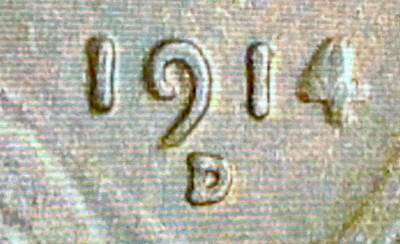
Prompting this article is a 1914-D cent that a friend shared in a large Facebook coin group. After I explained that this was not genuine, I received additional closeup images for analysis.
A closeup image of the date and mintmark shows this coin is not a genuine 1914-D. The shape and placement of the mintmark is incorrect. This, however, is not the case of an altered date or an added mintmark; the entire coin is counterfeit.
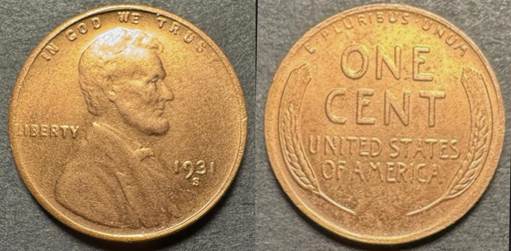
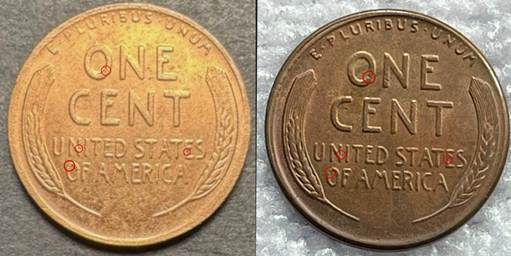
This 1931-S had surfaced on eBay within the last few months. Comparing both reverses it is clear these were produced from the same makers and related to a large “family” of counterfeits. I’m calling this family “Notched O.” More on that momentarily.
The image quality of the 1931-S is subpar, leaving blurry images, yet enough to discern the repeating marks.
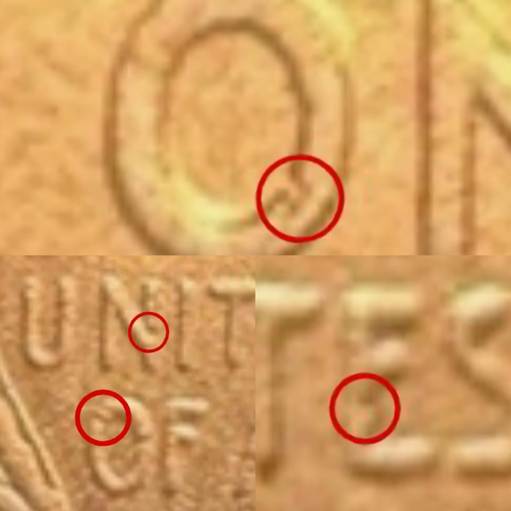
“Common marks” highlighted in Red:
Depression in O
Dent in “N” as well as the “O” in the word OF
Small indent of the “E”
At this writing I’ve only seen this on both 1914-D and 1931-S. Likely this exists on many key and semi key dates as well.
To check if your coin may belong to this “fugazi” (i.e. “fake”), look for those common marks highlighted above in red.
If you like posts like this, you can read more articles on counterfeit coins by Jack D. Young, Jack Riley and Michael Bugeja at this URL. Also, please subscribe so you can get our weekly newsletter and be informed whenever there is a new article or column.
Proxiblog also has thousands of followers on Facebook Coin Groups, YouTube and other venues. To get the latest discussion and commentary, be sure to friend us by clicking here.
You can find more information about errors and varieties as well as buying and bidding on coins in Coin News Updated: The Essential Guide to Online Bidding. Please consider purchasing the work for yourself or a friend, as it underwrites this hobbyist website. Thank you.
This video documents the various ways to identify fake Chinese holders and coins, including lack of logos on slab, pasted Gold Shield sticker, wrong fonts, wrong 1921 label, wrong reverse and so much more. Below the video is a an example of a Carson City Morgan dollar with six significant problems signifying a counterfeit.
This coin was posted on a Facebook coin group feed.
If you like posts like this, you can read more articles on counterfeit coins by Jack D. Young, Jack Riley and Michael Bugeja at this URL. Also, please subscribe so you can get our weekly newsletter and be informed whenever there is a new article or column.
Proxiblog also has thousands of followers on Facebook Coin Groups, YouTube and other venues. To get the latest discussion and commentary, be sure to friend us by clicking here.
You can find more information about errors and varieties as well as buying and bidding on coins in Coin News Updated: The Essential Guide to Online Bidding. Please consider purchasing the work for yourself or a friend, as it underwrites this hobbyist website. Thank you.
Internet venues often give rather interesting finds. In this case, modern counterfeit Lafayette Dollars.
The Lafayette Dollar was the first U.S. commemorative silver dollar, and the first coin to feature an American citizen (Lafayette; made honorary citizen by Congress) and a U.S. President (Washington) together. Add to that its scarcity in mint condition due to low sales and melting.
So this coin is a target of counterfeiters.
The image below is from a semi-large eBay seller who has a number of legitimate coins listed; however, in the mix of these there lies a counterfeit Lafayette Dollar. If anyone wants to authenticate a Lafayette Dollar there are 5 known DuVall varieties and that can be sourced from VAMWorld; these examples do not attribute.
A comparable example below is sourced from a larger Facebook coin group. Presented as s questionable, the coin at a glance looks suspicious.
Comparing the two “coins” we can see a few repeating marks highlighted in green:
Depression in A
Small circular dot behind the eye
Depression on the top of the tail
Two sporadic field dots above the date
This third example below clearly stated “copy” and was derived from another online source known for selling counterfeit U.S. coins. Additional markers in red denote common similarities; yet these did not appear present on the eBay example. They are present on the piece shared in the large group.
Highlighted repeating marks in red:
Lines protruding from ETT
Spike from T
Apparently scratch from behind the shoulder
“Boot Spur”
If you spot a counterfeit coin on eBay, report it immediately using the “Report Item” link on the listing to eBay’s Trust & Safety team.
If you like posthttps://www.amazon.com/dp/B0D131V2QRs like this, you can read more articles on counterfeit coins by Jack D. Young, Jack Riley and Michael Bugeja at this URL. Also, please subscribe so you can be informed whenever there is a new article or column.
Proxiblog also has hundreds of followers on Facebook Coin Groups. To get the latest discussion and commentary, be sure to friend us by clicking here.
You can find more information about errors and varieties as well as buying and bidding on coins in Coin News Updated: The Essential Guide to Online Bidding. Please consider purchasing the work for yourself or a friend, as it underwrites this hobbyist website. Thank you.
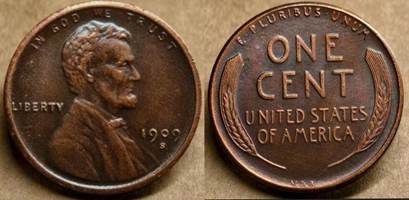
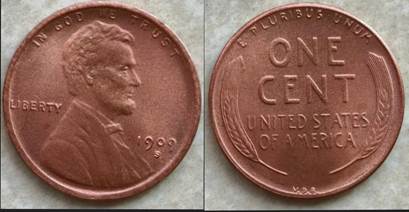
I enjoy browsing through various Facebook coin groups and seeing what collectors have acquired and enjoy. While scrolling through a rather large group I came across a post where a fellow collector had completed his Lincoln Wheat Cent collection. A major milestone for any collector! In the mix was a 1909s Cent, about which I commented, and later had a private message conversation explaining that this was a counterfeit and showed proof.
He stated it was bought on eBay from a non-reputable seller in a “shotgun roll.” These are rolls of wheat cents hand assembled with generally a nicer condition coin or key date on the ends. This fell within the 30-day return policy so the collector should get his money back after returning the coins to the seller.
Another online venue offered this counterfeit 1909s. Both coins share a common reverse that has been known for awhile.
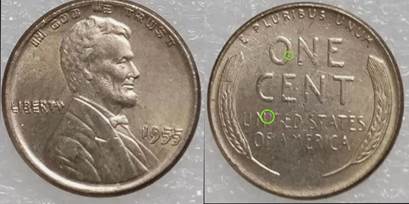
Image comparison of both coins show many repeating marks. Highlighted in green are common to all coins with this reverse and include:
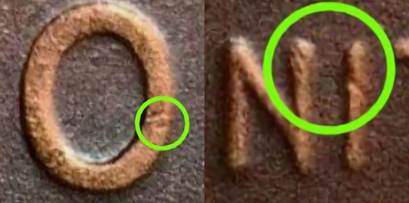
Lump at the edge of wheat stalk
Small lump inside of ONE
Highlighted in red are common but not seen on all examples.
Crack from the rim to Wheat stalk
Extending Crack through the stalk to the field
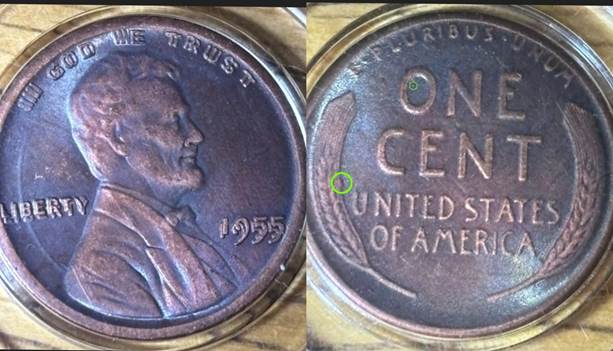
Being the Lincoln Cent series is one of the most popular to collectors and many key/semi key dates are needed to complete the set, it is of no surprise this counterfeit family is extensive. Other dates that have been seen from this family include the 1931s, 1955 “DDO”, and 1924D cents imaged below.
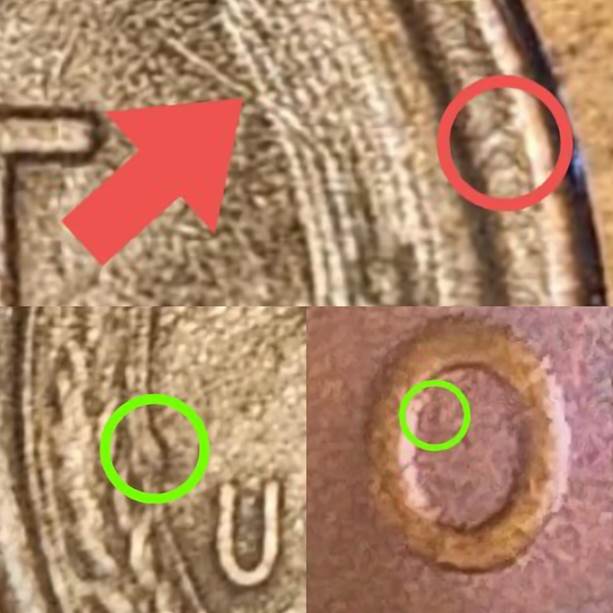
A close-up collage of identifying marks.
If anyone thought it was just key/semi key dates that are counterfeited, you would be wrong. Here is a common date 1958 exhibiting the “Lumped reverse.”
For more information, including die markers, see Michael Bugeja’s post, titled, “Identifying Fake 1909-S VDB Cents.” Now collectors have two comprehensive articles about this key date. Proxiblog strongly encourages any Lincoln cent collector to read and refer to these two articles before bidding on any raw 1909-S VDB. Also, make sure to check the certification to ensure that the holder also is not counterfeit.
Proxiblog advises newer collectors to follow these general guidelines:
If you are ready to bid hundreds of dollars on a coin, resist buying a raw one and shop for one holdered by PCGS, NGC, ANACS and CAC.
Be especially careful when purchasing raw coins from eBay and other online venues. AI bots cannot detect counterfeits, so you are on your own.
Make sure the seller takes returns and has good reviews. Also, the number of positive reviews is a good indicator. If someone has 0 sales or even fewer than 100, do not take a chance.
If you already bought the coin, weigh it and go to PCGS CoinFacts for the date and mintmark, checking your coin against weights and dimensions.
If you like posts like this, you can read more articles on counterfeit coins by Jack Riley, Jack D. Young and Michael Bugeja at this URL. Also, please subscribe so you can get our weekly newsletter and be informed whenever there is a new article or column.
Proxiblog also has more than a thousand friends and followers on Facebook Coin Groups and thousands more across YouTube and social media. To get the latest discussion and commentary, be sure to friend us by clicking here.
You can find more information about errors and varieties as well as buying and bidding on coins in Coin News Updated: The Essential Guide to Online Bidding. Please consider purchasing the work for yourself or a friend, as it underwrites this hobbyist website. Thank you.
Prompting this article is a counterfeit 1878-P Morgan Dollar previously listed in an eBay auction. The coin immediately caught my attention due to a well known counterfeit C3 reverse. Interestingly, 1878-P Morgan Dollars can feature a C3 reverse paired with a broken right fourth star–a detail that makes this particular counterfeit especially noteworthy.
In a comparison with this 1884-P example we can see the reverse is a match. The 1884 coin also shows clear signs of being cast and weighs less than 23 grams. The weight further reinforces the conclusion that is a counterfeit.
A detailed comparison of the reverses reveal repeating circulation marks:
A noticeable depression of the “N” in the Motto.
Two small circular lumps positioned above above the wreath.
A distinct indentation adjacent to the eagle’s head.
This counterfeit “Family” is extensive, encompassing nearly every date within the Morgan Dollar series.
Markers highlighted in Red indicate additional markers that are not presented on all specimens of this reverse but have been observed across several known examples.
Markers highlighted in Green denote consistent features found on every instance of this “common reverse”, serving as the most reliable identifiers.
Remarkably, while drafting this article, yet another 1878 Morgan Dollar appeared for sale on eBay, further underscoring the prevalence of this counterfeit operation.
The obverse is crudely executed, whereas the reverse presents a more convincing appearance. Though the listing features blurred and seemingly edited photographs, raising questions of intent. In this instance, the images are presented without highlighted markers to allow readers to examine these features in their unaltered form. Observant readers will recognize that this reverse is identical to that of the 1879-P example illustrated above.
Once again, these counterfeits remind me to advise newer collectors to follow these general guidelines:
If you are ready to bid hundreds of dollars on a coin, resist buying a raw one and shop for one holdered by PCGS, NGC, ANACS and CAC.
Be especially careful when purchasing raw coins from eBay and other online venues. TAI bots cannot detect counterfeits, so you are on your own.
Make sure the seller takes returns and has good reviews. Also, the number of positive reviews is a good indicator. If someone has 0 sales or even fewer than 100, do not take a chance.
Weigh the coin and go to PCGS CoinFacts for the date and mintmark, checking your coin against weights and dimensions.
If you like posts like this, you can read more articles on counterfeit coins by Jack Riley, Jack D. Young and Michael Bugeja at this URL. Also, please subscribe so you can get our weekly newsletter and be informed whenever there is a new article or column.
Proxiblog also has more than a thousand friends and followers on Facebook Coin Groups. To get the latest discussion and commentary, be sure to friend us by clicking here.
You can find more information about errors and varieties as well as buying and bidding on coins in Coin News Updated: The Essential Guide to Online Bidding. Please consider purchasing the work for yourself or a friend, as it underwrites this hobbyist website. Thank you.
The Lincoln cent series is arguably the most popular in numismatics, with many young collectors getting their start filling Whitman Folders in hopes to find the “key dates.” With such a popular series and many expensive coins to complete the set, one would expect to see many counterfeits. Many types of fake wheat cents exist, including altered dates, added mintmarks, cast coins, and plated cents. This article dives into a modern counterfeit common reverse used interchangeably on mainly key date coins that I refer to as the “IN-Line” reverse.
Images of two counterfeit 1909s VDB cents offered on eBay.
Both coins showcase a Deep N reverse (Type 2) which was used in 1909 and followed through the end of the series in 1958; however, all genuine 1909s VDB cents have a Shallow N (Type 1).
A comparison of the reverse shows common circulation marks between the two. A dent in the “O” culminating with the “IN” slash.
Interestingly this reverse was utilized with and without the “VDB” initials! This 1914-D and 1955 DDO share the “IN-Line” reverse with no remnants of the VDB initials.
This extensive family even consist of struck counterfeit common date “Off-center” errors!
Since viewing can be a challenge to the readers, I assembled close-up collage of the highlighted markers.
This has primarily been used to create counterfeit key date and semi key date coins. However, with the addition of the off-center strike 1946s, it is clear this can be found on common dates as well as counterfeit error coins.
If you are collecting key dates, especially the 1909-S VDB, be sure as well to view Michael Bugeja’s article with all the requisite die markers.
If you like posts like this, you can read more articles on buying, selling and collecting at Proxiblog.org. Also, please subscribe to get our weekly newsletter and be informed whenever there is a new article or column.
Proxiblog also has hundreds of followers on Facebook Coin Groups. To get the latest discussion and commentary, be sure to friend us by clicking here.
You can find more information about errors and varieties as well as buying and bidding on coins in Coin News Updated: The Essential Guide to Online Bidding. Please consider purchasing the work for yourself or a friend, as it underwrites this hobbyist website. Thank you.
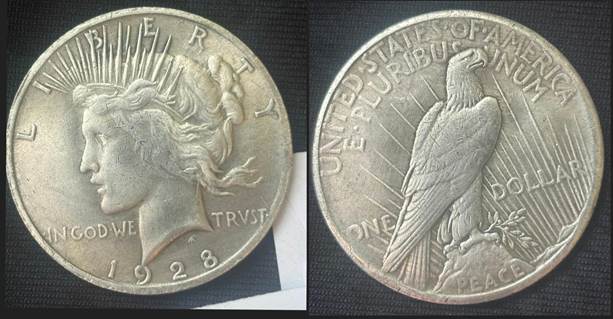
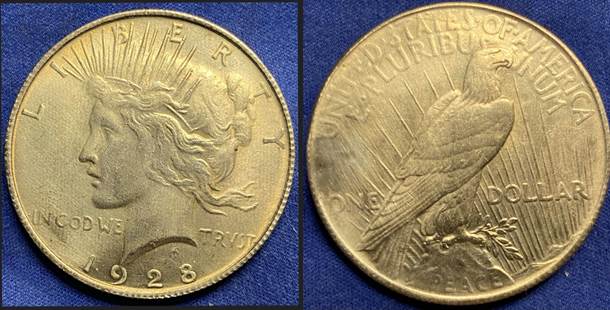
Another group of counterfeit Peace Dollars has surfaced. During my routine browsing of various Facebook groups and online marketplaces, I frequently encounter counterfeit examples of various series. In one of the larger groups, a 1928 Peace Dollar was shared with many commenters claiming this to be genuine and stating it “should be certified”. At first glance the overall appearance is that of many modern cast counterfeits. This prompted me to investigate further.
Several weeks ago, I was contacted by my colleague Dave Jordan, regarding a counterfeit 1928 Peace Dollar we had the opportunity to examine. At the time, I hadn’t documented this particular counterfeit. The recent example of another specimen, however, suggests that there are additional pieces in the market.
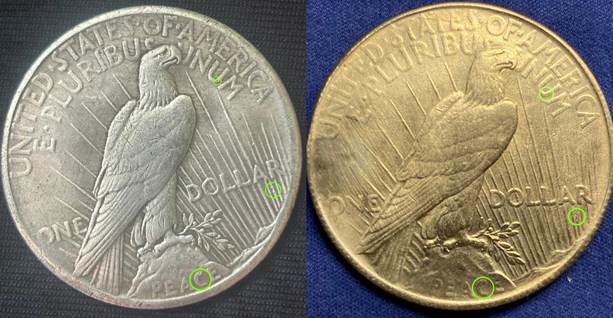
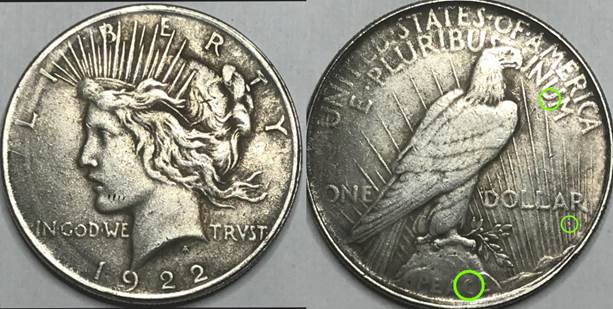
Upon comparison,it became evident that both examples originated from the same counterfeit family , which I refer to as the “Dotted Rays.” Several repeating marks are consistently present on the reverse, highlighted in green for reference :
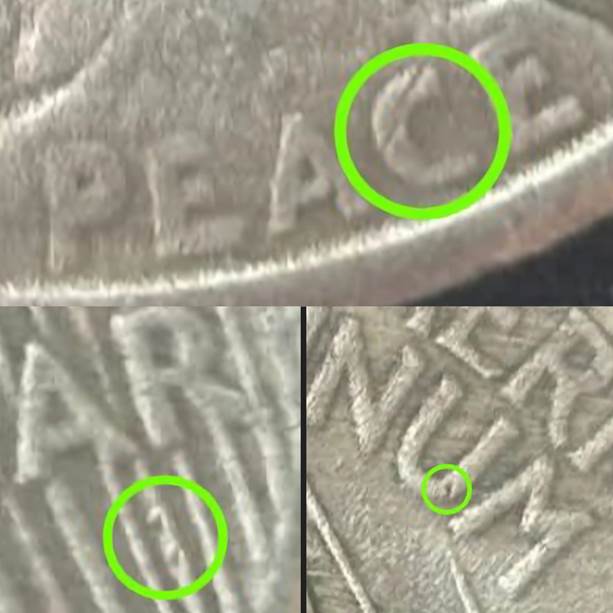
Two dent in the ray below A of Dollar
Diagonal slash through C of Peace
Depression in U of UNUM
This wouldn’t be a “family” with just one date. Following the search yielded at least 2 additional dates (1922 and 1927). Both of which share the “Dotted Rays reverse.”
I recognize that examining these markers in detail can be challenging. To assist readers, I have prepared a collage of close-up images highlighting the key diagnostics.
I share the news about these counterfeit dollars because you can lose many dollars bidding and buying them, only to find out later that you have been scammed.
In Proxiblog’s recent article about bidding online, titled “Bidding Basics,” we recommend working only with trusted sellers, especially on eBay, making sure you can return your purchases.
If you like posts like this, you can read more articles on counterfeit coins by Jack D. Young, Jack Riley and Michael Bugeja at this URL. Also, please subscribe so you can get our weekly newsletter and be informed whenever there is a new article or column.
Proxiblog also has thousands of followers on Facebook Coin Groups, YouTube and other venues. To get the latest discussion and commentary, be sure to friend us by clicking here.
You can find more information about errors and varieties as well as buying and bidding on coins in Coin News Updated: The Essential Guide to Online Bidding. Please consider purchasing the work for yourself or a friend, as it underwrites this hobbyist website. Thank you.
Morgan and Peace Dollars are among the most popular and widely collected U.S. coins. While many collectors appreciate these coins for their history and beauty, fewer take the time to explore the fascinating varieties of each series. These varieties, known as VAMs, are named after Leroy Van Allen and A. George Mallis, the researchers who carefully studied and cataloged them by their die marriage.
Learning VAMs can feel like stepping into a whole new dimension of collecting. It’s a field that rewards patience and curiosity, often taking years to master variety attribution. Thankfully, new collectors don’t have to start from scratch! Resources such as the VAMWorld website provide a wealth of information, guides, and images that make this specialized area more approachable.
VAMWorld allows users to “contribute, edit and improve” its listings, continually updated with new discoveries, delisted varieties, renumbered varieties, and other important revisions! It is the most up-to-date listing for Morgan and Peace Dollar varieties. While the site includes a dedicated tab for new collectors, this section is often overlooked. For those just beginning their journey of studying VAMs, I strongly recommend first to read the Definitionsand Attribution 101 pages as it will be needed to understand various design changes, date placements, mintmark locations, die clashing and other characteristics of variety attribution and terminology.
At present, VAMs aside, the hobby focuses on errors and varieties with newcomers, in particular, hunting ultra rarities such as 1992/1992-D Close AM or 1982-D Small Date 3.1 grams. Those types of varieties for Morgan and Peace dollars are catalogued in VAMWorld. But we go one step deeper. We not only identify that variety but also the various dies that might have created it and the popularity of those varieties within a variety.
Let’s see how Proxiblog’s Michael Bugeja uses VAMs to show all the various types of 1900-O/CC Morgans. The popularity and value of this Morgan is not only the variety, but the prominence thereof. VAMs 7 through 12 identify the difference in prominence of the overmintmark.
I often stress to newer collectors the importance of learning and understanding the reverse hub types for the Morgan Dollar series. This chart represents all of the reverse hub types used for the series in detail. It mentions only 1878 but is for the entire Morgan series from 1878-1921.
Granted, the above chart might intimidate hobbyists new to VAMs. Let’s simplify everything and show how three different VAM reverses for the 1878 8TF, replete with pickup points:
Developing a strong grasp of these distinctions is invaluable not only for attribution but also for detecting counterfeit pieces, as reverse hub diagnostics can quickly reveal inconsistencies.
In my very first article for Proxiblog, I used VAMs to discover a family of counterfeits that fooled collectors and grading services for decades. I wrote, “The ‘Micro O’ varieties have always been scarce coins to come by, and in 2005, these were deemed counterfeit by PCGS when 3 examples showed repeating circulation marks between the 1896 O VAM-4, 1900 O VAM-5, and 1902 O VAM-3.”
Navigating the VAMWorld website can feel overwhelming for newer collectors, but becomes much easier when utilizing the tools and resources provided. Each date specific page includes a set of guides.
Many collectors focus on the Top 100,Hot 50, and Hit List 40 varieties. These showcase the most popular and valuable varieties, minimizing what is known as “micro-vamming,” or listing insignificant types.
Introducing the Top 100, VAMWorld writes, “Many of these VAMs have entered the mainstream collecting of Morgan dollars; it has become unheard of to claim a complete Morgan dollar collection without including the 1882-O/S, Scarface, Hot Lips, and an 1900-O over CC example among several other varieties.”
Proxiblog emphasizes this with articles on each of those above and more. For instance, click the photo below to go to these VAM varieties that are viewed, simply, as desirable and valuable Morgans:
If you like posts like this, subscribe so you can be informed whenever there is a new article or column.
Proxiblog also has hundreds of followers on Facebook Coin Groups. To get the latest discussion and commentary, be sure to friend us by clicking here.
You can find more information about types, varieties, errors, grading, bidding and buying in Coin News Updated: The Essential Guide to Online Bidding. Please consider buying or gifting the work for a friend, as it underwrites this hobbyist blog. Thank you.
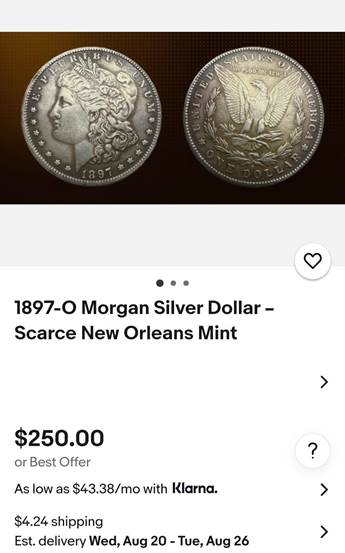
In Numismatics, authenticity generally serves as the foundation in which all other qualities–such as grade, variety, and historical importance–are evaluated. Without certainty of authenticity, a coin’s value is nullified. This article was prompted by a recent eBay listing for an 1897-O Morgan Dollar offered at $250, which upon review, was determined to be counterfeit. For ethical reasons, the seller’s identity will remain undisclosed. After being contacted, the seller acted responsibly by immediately removing the listing and clarifying that they had been unaware of the coin’s illegitimacy. Their swift response and willingness to prevent the sale of a counterfeit merits recognition.
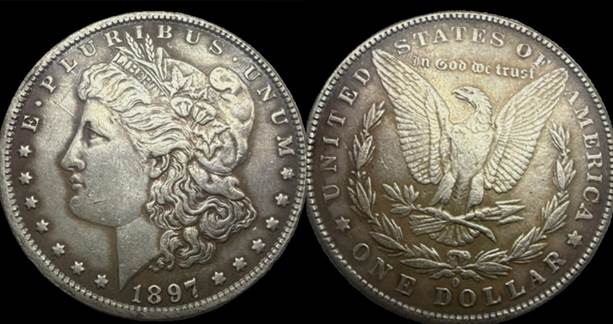
Here is a closer view of the coin in question. Immediately noticing the “Oval O” reverse which is not seen on 1897 dated coins, one can see something is wrong!
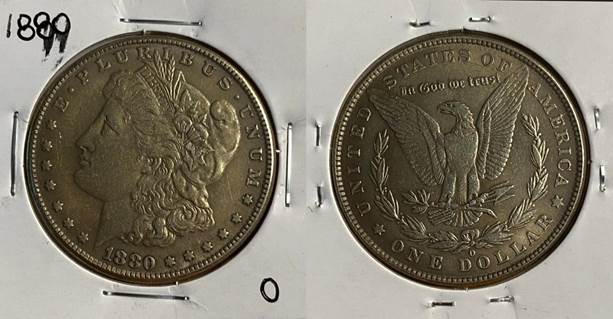
Image from an 1880-O courtesy of my friend Dave Jordan that shares a common reverse to the 1897-O listed on eBay.
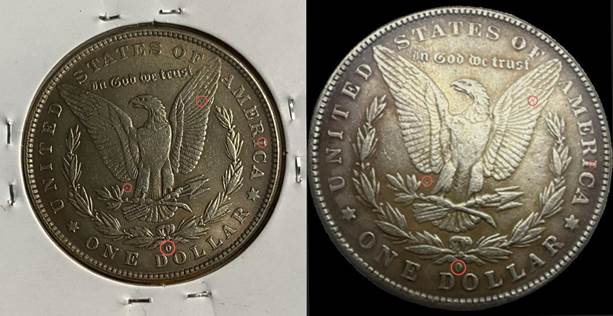
A side by side comparison shows common markers related to this “Family.” Noteworthy markers include:
Oval O set left
Indent above the 2 berries below the right wing
Depression mark in the eagles left wing (viewers right) just above the tip of the wreath
Minor depression mark of the “I” in America
It is worth mentioning this reverse has been seen on 1895-O dated coins with an additional crack through the “T” of United. These are better quality counterfeits than many you may come across.
By understanding how die markers are used and by carefully examining coins for inconsistencies, coin collectors can increase their ability to identify counterfeit coins.
If you like posts like this, please go to our counterfeit archive with reports from Jack Riley, Jack D. Young and Michael Bugeja. Also, please subscribe so you can get our weekly newsletter and be informed whenever there is a new article or column.
Proxiblog also has thousands of followers on Facebook Coin Groups, YouTube and social media. To get the latest discussion and commentary, be sure to friend us by clicking here.
You can find more information about errors and varieties as well as buying and bidding on coins in Coin News Updated: The Essential Guide to Online Bidding. Please consider purchasing the work for yourself or a friend, as it underwrites this hobbyist website. Thank you.