The 1878-S Morgan has a mintage of 9,774,000 and is valuable in higher grades, but a small detail on an otherwise even silver melt coin is a coveted variety.
Let’s define “Nock,” an uncommon word, except for archers, whose definition is a notch at either end of a bow for holding the string.
So right off the word leads us to the quiver of arrows held by the eagle on the reverse.
Morgan 1878-S “Long Nock” coin refers an extended length of the arrow shaft (the “nock”) in the eagle’s talon. This variety is a result of a design variation used on the first set of dies delivered to the San Francisco Mint.
Let’s compare a regular 1878-S reverse with a “long nock” one with this photo from PCGS CoinFacts:
The “long nock” feature extends the tip of the central arrow.
This variety has several specific variations in the VAM directory (named after the directory compiled by Leroy Van Allen and A. George Mallis):
These varieties happened because of an urgent need to produce Morgan dollars at various mints in 1878. The first 10 pairs of dies for the San Francisco Mint had the “long nock” design. When the US Mint asked engraver George T. Morgan to revise the design, reducing the relatively high relief (shortening die life), the nock was shortened and the number of tail feathers on the eagle were reduced from eight to seven.
Value for this variety is high but few ever exceed almost uncirculated levels. The top pop at PCGS is AU53.
At Very Fine 20, the coin retails for $275 and increases by about $100 each Sheldon grade higher up until AU53.
Nevertheless, you will find 1878-S Morgans everywhere–even in slabbed coins–with the owner or holdering company missing the variety. (If you submit a coin without identifying and paying for a variety, that designation will not be on the label.)
Happy hunting!
If you like posts like this, subscribe so you can be informed whenever there is a new article or column.
Proxiblog also has thousands of followers on Facebook Coin Groups, YouTube and other social media. To get the latest discussion and commentary, be sure to friend us by clicking here.
You can find more information about types, varieties, errors, grading, bidding and buying in Coin News Updated: The Essential Guide to Online Bidding. Please consider buying or gifting the work for a friend, as it underwrites this hobbyist blog. Thank you.
This video documents the various ways to identify fake Chinese holders and coins, including lack of logos on slab, pasted Gold Shield sticker, wrong fonts, wrong 1921 label, wrong reverse and so much more.
When people ask if their coin is cleaned, or question hobbyists who say their coin is cleaned, many collectors do not know exactly why. This article explains what is known as destructive cleaning.
These methods permanently alter the coin’s surface and dramatically reduce its collectible value.
Dipping: Using a chemical solution (often a dilute acid) to strip away toning or oxidation from the coin’s surface, leaving micro bubbles that are red flags.
Smoothing: Using a cloth, abrasive paste or other substance to rub the surface, leaving tiny scratches called “hairlines.”
Polishing: Using a device or tool to buff the surface of the coin so that it shines with a false luster, often blurring devices.
Whizzing: Using a high-speed rotating brush to create artificial luster, leaving unnatural proof-like sheen with telltale patterns of metal flow around the coin’s devices.
Scrubbing: A coin that contains evidence of an abrasive material like baking soda or a metal brush, often to remove verdigris or other contaminant.
Chemical Application: Soaking a coin in acidic household items like vinegar with salt or lemon juice that remove verdigris and ruin eye appeal.
Electrolysis: Using electrical current in a solution to strip away corrosion, a process often used on ancient coins or ones found by metal detecting.
All sample coins above would get a details/cleaned grade by a holdering company.
For those who want to clean coins via non-destructive methods, consider rinsing them in distilled water or soaking in acetone, mild soap or olive oil. To learn more about if and when to clean coins, see “When, If and How to Clean Coins.”
If you like posts like this, subscribe so you can be informed whenever there is a new article or column.
Proxiblog also has thousands of followers on Facebook Coin Groups and across social media. To get the latest discussion and commentary, be sure to friend us by clicking here.
You can find more information about types, varieties, errors, grading, bidding and buying in Coin News Updated: The Essential Guide to Online Bidding. Please consider buying or gifting the work for a friend, as it underwrites this hobbyist blog. Thank you.
Internet venues often give rather interesting finds. In this case, modern counterfeit Lafayette Dollars.
The Lafayette Dollar was the first U.S. commemorative silver dollar, and the first coin to feature an American citizen (Lafayette; made honorary citizen by Congress) and a U.S. President (Washington) together. Add to that its scarcity in mint condition due to low sales and melting.
So this coin is a target of counterfeiters.
The image below is from a semi-large eBay seller who has a number of legitimate coins listed; however, in the mix of these there lies a counterfeit Lafayette Dollar. If anyone wants to authenticate a Lafayette Dollar there are 5 known DuVall varieties and that can be sourced from VAMWorld; these examples do not attribute.
A comparable example below is sourced from a larger Facebook coin group. Presented as s questionable, the coin at a glance looks suspicious.
Comparing the two “coins” we can see a few repeating marks highlighted in green:
Depression in A
Small circular dot behind the eye
Depression on the top of the tail
Two sporadic field dots above the date
This third example below clearly stated “copy” and was derived from another online source known for selling counterfeit U.S. coins. Additional markers in red denote common similarities; yet these did not appear present on the eBay example. They are present on the piece shared in the large group.
Highlighted repeating marks in red:
Lines protruding from ETT
Spike from T
Apparently scratch from behind the shoulder
“Boot Spur”
If you spot a counterfeit coin on eBay, report it immediately using the “Report Item” link on the listing to eBay’s Trust & Safety team.
If you like posthttps://www.amazon.com/dp/B0D131V2QRs like this, you can read more articles on counterfeit coins by Jack D. Young, Jack Riley and Michael Bugeja at this URL. Also, please subscribe so you can be informed whenever there is a new article or column.
Proxiblog also has hundreds of followers on Facebook Coin Groups. To get the latest discussion and commentary, be sure to friend us by clicking here.
You can find more information about errors and varieties as well as buying and bidding on coins in Coin News Updated: The Essential Guide to Online Bidding. Please consider purchasing the work for yourself or a friend, as it underwrites this hobbyist website. Thank you.
View the forgotten women whose beauty metamorphosed to Lady Liberty on our coins. I bring them to life so that we remember Anna Willess Williams, teacher and philosopher, and Teresa de Francisci, model. Anna was a classic beauty (inside and out) and Teresa, a Mediterranean immigrant who became the American symbol of freedom and worldwide peace. Proxiblog will be posting again on Jan. 2, 2026.
The most counterfeited coin is the 1909-S VDB; but the 1914-D Lincoln Cent actually has a smaller surviving population. This makes the 1914-D a prime target for counterfeiters.
The 1914-D Lincoln cent, scarce in high grades, is often faked by altering dates (i.e. 1944-D) or adding mint marks.
Look for a large gap between the “9” and the second “1” in date. 1944-D cents are commonly altered to appear as 1914-D cents, but this leaves too much space between the first two digits and the last two digits.
See this example from NGC:
Weight is important. a genuine 1914-D should weigh in at 3.11 grams. Counterfeits are usually lighter or heavier based on the metal used for the fake coin.
Key die markers include a diamond-shaped or crisp “D” mint mark.
Here is what an authentic D mintmark should look like:
Here is a counterfeit mintmark:
Let’s see them together so you can tell how to identify a counterfeirt:
The genuine mintmark is crisp; the counterfeit, mushy.
Compare the position and shape of the mintmark to known genuine examples. Added “D” counterfeiters often use wrong mintmark style and position. Example:
Also look for evidence of die polishing, especially on Lincoln’s coat lapel, common for this date.
Finally, authentic 1914-D cents do not have VDB anywhere. Those initials used to appear on the reverse in some 1909 cents; but that was removed because it called too much attention to itself. No designer initials appear in 1914. The VDB was restored under the shoulder of Lincoln in 1918.
If you have any doubt about a raw 1914-D, do not purchase it because of the predominance of counterfeits. Spend your money on a slabbed example from PCGS, ANACS, CAC or NGC. If you have a raw 1914-D Cent, send it in for authentication. That will ensure a sale when you are ready to sell.
If you like posts like this, subscribe so you can be informed whenever there is a new article or column. You’ll also receive a free newsletter each week.
Proxiblog also has thousands of followers on Facebook Coin Groups and across social media. To get the latest discussion and commentary, be sure to friend us by clicking here.
You can find more information about types, varieties, errors, grading, bidding and buying in Coin News Updated: The Essential Guide to Online Bidding. Please consider buying or gifting the work for a friend, as it underwrites this hobbyist blog. Thank you.
Jefferson Nickel role hunters should be on the lookout for valuable 1968-S through 1970-S full-step rarities, often overlooked and sometimes even confused with proof strikes. True, these are ultra rarities; but looking for them sharpens the eye and several dozen or more may still be at large in bank rolls.
In 1968, the “S” mintmark for Jefferson nickels was reintroduced for circulating coinage after a hiatus from 1965 to 1967. During that time, the Mint prohibited mintmarks due to coin hoarding, pursuant to Coinage Act of 1965, meant to alleviate a coin shortage and to discourage hoarding of silver coins.
Mintmarks were restored to circulating coins in 1968. In 1971, the San Francisco Mint struck only proof nickels.
The purpose of this article is to call attention to values associated with business strikes for those critical years. Also, newer hobbyists in general should be able to distinguish the difference between mint state business strikes and proof strikes.
Let’s begin with proof strikes for these years. These largely have no value unless PR69 deep cameo.
The San Francisco mint was extraordinarily busy making business strikes: 1968-S mintage: 103,437,510; 1969-S mintage: 123,009,631; and 1970-S mintage: 214,464,814.
Because of huge quotas, dies weren’t swapped out as they normally would, meaning deterioration limited the number of full-step coins. Only those at the beginning of the manufacturing process produced those rarities.
In fact, you will not find a 1969-S nickel with full steps. f you find one, you bagged the unicorn. None are thought to exist, although this ANACS example was offered in 2009 by Heritage Auctions. A reserve of $1200 was put on the coin, but it did not sell.
There is a reason it did not sell. I question whether this even has full steps. It definitely would not crossover to PCGS or NGC:
That said, PCGS has holdered 25 full-step 1968-S and 106 full-step 1970-S. NGC has holdered 13 1968-S FS and 36 1970-S FS.
See this PCGS chart for values:
True, you might not be able to find a full-step 1968-S through 1970-S. Nevertheless, knowing the rarities of these dates and the enormous mintages of each, it still is worth checking, even if only to distinguish the business strike from the proof strike.
Concerning other denominations:
The San Francisco Mint struck business strike and proof cents from 1968-74, with the facility shifting to producing proof coinage for collectors after 1975. The San Francisco Mint also produced business strike Roosevelt dimes from 1946-55 but did not produce circulating dimes between 1968 and 1974. The facility produced quarters and half dollars from 1968 through 1974. After 1975, the California Mint produced proof coinage, with business strikes in some years for collectors.
Finally, the San Francisco Mint made Eisenhower dollars from 1971 to 1978, but did not produce copper-nickel business strikes during all of those years. It also minted business strike dollars later with the Susan B. Anthony series.
If you like posts like this, please go to our counterfeit archive with reports from Jack Riley, Jack D. Young and Michael Bugeja. Also, please subscribe so you can get our weekly newsletter and be informed whenever there is a new article or column.
Proxiblog also has hundreds of followers on Facebook Coin Groups. To get the latest discussion and commentary, be sure to friend us by clicking here.
You can find more information about errors and varieties as well as buying and bidding on coins in Coin News Updated: The Essential Guide to Online Bidding. Please consider purchasing the work for yourself or a friend, as it underwrites this hobbyist website. Thank you.
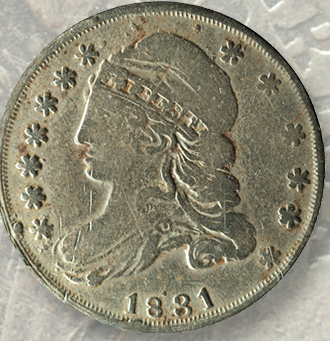
A Flowing Hair half dollar from my Great Grandfathers collection always amazed me. The tattered remains of Lady Liberty and a featherless silhouette of an eagle are some of the characteristics that endear this 230-year-old coin to me. I can’t imagine the many hands it passed through, or the type of purchases made. It makes one think “if only coins could talk.”
The Designer Robert Scot:
Robert Scot was born in 1745 in Edinburgh, Scotland, and was trained as an engraver, watchmaker and silversmith in England before coming to the United States in 1775. When Scot was about 30 years old, he immigrated to Fredericksburg, Virginia. In 1780, under Governor Thomas Jefferson, Scot moved to Richmond (the Capital of Virginia) as an engraver to the Commonwealth. Scot and his family were Free Quakers, a sect that supported the Revolution; therefore his work reflected the ideals of unity, liberty, and rebellion (which were at the core of the American Revolution). During the turbulent times of the Revolutionary War (1775-1783,) Richmond was burned and destroyed by the British. This led Scot to move to Philadelphia in 1781 where he set up a small shop. He started engraving for Robert Morris the Superintendent of the Office of Finance for the United States. His portfolio was large and impressive including engraving books, medals, seals, currency, stamps, and maps.
On November 23, 1793, Scot was commissioned by George Washington to be the Chief Engraver of the United States Mint, after the non-commissioned engraver Joseph Wright died from yellow fever that very year. Throughout the years Scot designed many coins, such as the Liberty Cap Half Cent, Draped Bust Half Cent, Draped Bust Large Cent, Matron Head Large Cent, Flowing Hair Half Dime, Draped Bust Half Dime, Draped Bust Dime, Draped Bust Quarter, Flowing Hair Half Dollar, Draped Bust Half Dollar, Flowing Hair Dollar, Draped Bust Dollar, Capped Bust to Right Quarter Eagle, Capped Bust to Right Half Eagle, and Capped Bust to Right Gold Eagle.
PCGS Coin
Flowing Hair Half Dollar Design
Congress’ 1792 Coinage Act (also known as the Mint Act) standardized American coinage. The Act provided a framework for design and production and called for the obverse image to be “Emblematic of Liberty” as well as using the word “LIBERTY” and year. The reverse was to be inscribed with “UNITED STATES OF AMERICA” and have a “Figure or Representation of an Eagle.”
Scot portrayed Liberty as a right-facing youthful female with “flowing hair” to represent freedom. The word LIBERTY appears on top of the coin, while 15 six-pointed stars around represent the number of states in the Union (eight to the left and seven to the right). The date is located at the bottom. The reverse illustrates a small eagle with spread wings perched, surrounded by laurel branches. The border displays the motto “The United States of America.” The edge is inscribed with “Fifty Cents or Half Dollar” with decorative symbols between the words. Interestingly, this was also the first time three different denominations in silver had the same design: the Dollar, Half Dollar, and Half Dime.
Mintage and Varieties
The Coinage Act of 1792 not only regulated coins but created the United States Mint in Philadelphia. The mint produced 23,464 half dollars dated 1794, and 299,680 dated 1795. The obverse was later replaced by the Draped Bust portrait of Liberty; thus, the Flowing Hair half dollar was only minted for 2 years. They weight was 13.48 grams with a 32.5 mm diameter with a thickness of 2.15mm. The composition was 89.24% silver and 10.76% copper, although many sources round up to 90% silver. In fact, it was not until 1836 (a transition year) when dollars and half dollars were 90% silver.
Most of these half dollars were coined from dies having a master bust with a single line to mark Liberty’s portrait. They were then manually struck on adjusted planchets, leading to notable differences in coins weight and thickness. This led to a variety of types with a total of 19 obverse and 22 reverse dies known to have been used in various combinations. This resulted in about 32 die marriages (pairing different obverse and reverse dies together). A few sought after easily noticeable variations include: 2 leaves under each wing; 3 leaves under each wing; combination of 3 leaves under left wing and 2 under the right; die crack varieties, broken stem, recut date, an A over E in STATES; adjustment marks in which planchets were filed to achieve the correct weight; silver plug; and Small Head.
According to NCG, there are 62 documented variations between 1794 and 1795, although there is believed to be many more. Varieties are distinguished by the Overton numbering system. Established in the early 20th century, numismatist A.W. Overton created a comprehensive catalog of die varieties. An example is my coin, a 1795 O-104, due of the recut M in America and the last curl placement on the obverse.
Enduring Denomination
While the Flowing Hair Liberty dollar is well known, especially since the anniversary and special minted rounds in 2024, the half dollar is lesser known and talked about. Only 323,144 silver Flowing Hair half dollars were minted and (unlike the dollar) went right into commercial use. Due to the irregularities in quality of strike, it is not unusual for wear to be uneven, thus high grades are scarce. It is thought that 12% of these coins survived suggesting fewer then 3,000 examples exist today. These coins are sought after by collectors, which means they are highly counterfeited. Collectors beware and use caution, as these coins are valuable and are often thousands of dollars raw (ungraded). I hope through this article to not only share my thoughts, but to educate on the first silver half dollar, a denomination that is still minted today.
EDITOR’S NOTE: A special thank you to Darren Jewru Bartz and Sources: NCG; Coinweek; alchetron.com/Robert-Scot; learnapex.com; Wikipedia; USAcoinbook.com; Numismatic News; DJR Authentication; Greysheet; Stacks Bowers; “A Guidebook of United States Coins (Red Book), PCGS, Numismatic News, Q. David Bowers, Coin Community Family,
Proxiblog’s Michael Bugeja has one of the top California Fractional Gold collections, but his highest rated coin in that category is actually a restrike: 1863 $1, minted with the original dies in 1906. His restrike, depicted above, came in at MS66, a top pop.
PCGS has only authenticated 2 of the original 1863 $1. In fact, only a handful have ever come up for auction, with this MS62 as the highest rated.
The original 1863 California fractional gold coin has slightly less gold purity than the 1906 restrike, at 88%. Here are main differences:
Feature
Original 1863 California Gold $1 (BG-1307)
Knoll 1906 Restrike (BG-1307A)
Gold Fineness
Made from native California gold, which is approximately 0.880 fine.
Struck from gold of a finer quality than the originals.
Strike Quality
Characterized by a “business strike” quality. Can exhibit signs of wear, die clash marks, or weak areas due to the small size and era of production.
Struck with fresher dies and often displays sharper details and higher quality.
Rarity and Value
A very scarce and expensive coin, with relatively few examples known to exist.
Considered common relative to the original. Values are significantly lower.
Collector Purpose
Created for commercial circulation to meet the demand for small-denomination coins in California during the Civil War.
Produced for the collector market using original or reworked dies long after the 1864 act made private coin production illegal.
Expert Identification
Identification can rely on the quality of the strike, the level of wear, and die varieties, sometimes requiring expert examination.
Attributed by experts based on specific die characteristics and the known provenance from Herman Kroll.
An original 1863 at MS62 retails for about $700 whereas the MS66 top pop restrike sells for about half of that.
Hobbyists collect California Fractional Gold because of its Americana pioneer history. However, many newer collectors confuse latter 20th century inexpensive charms and souvenirs for the latter.
Here’s a souvenir token billed as an 1852 ½ dollar California gold coin.
Every word of that description is wrong. The token was not manufactured in 1852; is not a half dollar; not a coin; not gold; and does not come from California. Many of these are manufactured in China or sold by a U.S. tourist shop. They typically are gold plated or brass, as these samples:
Unscrupulous sellers buy these replicas, take them out of the holder, and then offer or consign them individually as California fractional gold. (See “California Gold Scam.”) Authentic pioneer gold has a denomination on it, such as 1/4, 1/2 and 1 DOLLAR. The word “dollar” is sometimes abbreviated as D. or DOL.
Here’s is an example of a token vs. a real coin:
If your small coin has a bear on the reverse, it is probably brass or gold plated; you do not have pioneer gold.
If you like posts like this, subscribe so you can be informed whenever there is a new article or column.
Proxiblog also has hundreds of followers on Facebook Coin Groups. To get the latest discussion and commentary, be sure to friend us by clicking here.
You can find more information about types, varieties, errors, grading, bidding and buying in Coin News Updated: The Essential Guide to Online Bidding. Please consider buying or gifting the work for a friend, as it underwrites this hobbyist blog. Thank you.
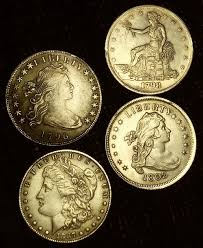
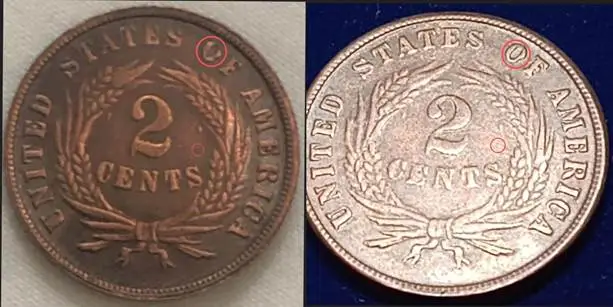
Increasingly, hobbyists are relying on artificial intelligence to identify fake coins exported by the hundreds of thousands by manufacturing facilities in China. Too often, however, AI is wrong, relying on false training data from the internet.
Machine and numismatist analyze fake coins according to different protocols. AI relies on images scraped from the internet. Its learning models rely on high-resolution images so that it can analyze subtle flaws in surface detail, texture, and edge features that are difficult to replicate.
But what if high-resolution images are not available or, in worst case scenarios, doctored via photography software?
This is why human intelligence trumps machine intelligence. Before we proceed two definitions are in order. What is a Contemporary Circulating Counterfeit and what is a Modern Forgery?
A Contemporary Circulating Counterfeit (CCC) is a coin that was illegally produced during the same period as the genuine issue and entered everyday commerce alongside authentic coins. CCCs were often made to mimic official currency closely enough to pass in trade, and they typically show signs of real circulation, regional wear patterns, and period-appropriate alloy substitutions. Many CCCs are now valued by collectors for their historical context, diagnostic quirks, and the insight they offer into economic conditions and minting practices of their time.
In contrast, a Modern Chinese Forgery refers to a deceptive replica produced in recent decades—often using CNC machining or digital dies—with the intent to defraud collectors or simulate numismatic value. These forgeries frequently match regal weight and dimensions too precisely, use non-period alloys like Fe/Ni or German Silver, and may feature fantasy legends, artificial toning, or blank or overly sharp edges. Unlike CCCs, they show no genuine circulation history and are typically absent from community catalogs like CCC–Good Ones.
I am cataloging here for Proxiblog sophisticated techniques that counterfeit detectives use in identifying fakes.
Here are the methods.
For Historical Contemporary Circulating Counterfeits
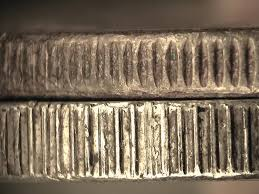
1. Edge diagnostics (third side) show hand-cut, irregular milling, or worn reeding consistent with circulation and non-regal production.
2. Weightslightly off regal specs, often 5–10% under, but consistent across known examples (families of fakes) and plausible for the era of counterfeiting.
3. Surface silvering or wash may be present on brass or copper cores, often worn through naturally with age.
4. Alloy matches period substitutions: wartime brass, nickel-silver, or low-grade steel confirmed via X-ray fluorescence (XRF), a “non-destructive analytical technique used to determine the exact elemental composition of a coin’s metal.
5. Die style mimics contemporary minting: hand-cut or worn dies with plausible irregularities and regional quirks.
6. Legends match genuine types with subtle errors: spacing, font, or punctuation off — verified against Stacks Bowers and Heritage Auctions.
7. Strike pressure and rim formation match era: weak or uneven, often with off-center or double strikes.
8. Known provenance or regional clustering: tied to specific towns, wartime zones, or trade routes; often supported by field card documentation.
9. Diagnostic die markers (e.g., die cracks, repunched dates, filled letters) shared across multiple specimens.
10. Natural toning and patina: sulfur-induced browns, thin-film interference, or oxidation consistent with age and storage.
For Modern Chinese Forgeries:
1. Bad Chinese Modern Forgery Non-CCC deceptive fantasy, often manufactured by Computer Numerical Control (CNC), computer-controlled lathes or milling machines to create the dies used to produce fake coins that are chemically aged.
2. Edge shows CNC reeding, lathe chatter, or repeating patterns, often too perfect or mechanically uniform. (Sometimes edges are blank or show no reeding at all, especially on fake silver types — a major red flag.)
3. Edge wear often absent or artificially applied, lacking the smooth abrasion of genuine circulation.
4. Weight matches regal specs too precisely, suggesting CNC replication or fantasy intent.
5. Use of iron-nickel alloys, Fe/Ni or “German Silver” common in fake “silver” types — confirmed via XRF as non-period and non-circulating.
6. Surface silvering often artificial, with flaking, bubbling, or chemical residue under magnification.
7. Die style overly sharp or digital, lacking the nuance of hand-cut or worn dies; often shows mirrored fields or laser-like precision.
8. Legends include anachronisms, fantasy elements, or mismatched fonts, often failing comparison with Stacks Bowers and Heritage Auctions.
9. Strike pressure and die alignment too perfect, lacking flaws of hand-struck CCCs; often shows full rim and centered strike.
10. Absence from CCC analyzed by community consensus, often flagged as deceptive or fantasy.
To be sure, these are red flags that veteran hobbyists use and learn from. But it is never too early for beginning and intermedia collectors to scroll through these red flags, look up terms that you do not fully understand, and continue learning how to identify counterfeits.
For beginning collectors
Here are simple techniques:
If you are ready to bid hundreds of dollars on a coin, resist buying a raw one and shop for one holdered by PCGS, NGC, ANACS and CAC.
Be especially careful when purchasing raw coins from eBay and other online venues. TAI bots cannot detect counterfeits, so you are on your own.
Make sure the seller takes returns and has good reviews. Also, the number of positive reviews is a good indicator. If someone has 0 sales or even fewer than 100, do not take a chance.
Weigh the coin and go to PCGS CoinFacts for the date and mintmark, checking your coin against weights and dimensions.
If you like posts like this, you can read more articles on counterfeit coins by Jack Riley, Jack D. Young and Michael Bugeja at this URL. Also, please subscribe so you can get our weekly newsletter and be informed whenever there is a new article or column.
Proxiblog also has hundreds of followers on Facebook Coin Groups. To get the latest discussion and commentary, be sure to friend us by clicking here.
You can find more information about errors and varieties as well as buying and bidding on coins in Coin News Updated: The Essential Guide to Online Bidding. Please consider purchasing the work for yourself or a friend, as it underwrites this hobbyist website. Thank you.