
New members of Facebook and other internet coin sites (eBay, TikTok, Etsy) are told routinely that their face value coins are worth thousands because they lack mint marks. As hobbyists know, at one time the United States only had one mint, in Philadelphia, and so no mint mark was necessary. The U.S. Mint then added other production facilities around the country, so they included mint marks like CC (Carson City), S (San Francisco), D (Denver) and so on.
In 1977, the U.S. Mint in Philadelphia produced 4,469,930,000 cents. All of them lack a mint mark. In fact, if a P mint mark ever was found on one–it will never happen!–that would truly be a rarity of all rarities.
As Coin Week notes, “Modern Proof coins that were struck at the San Francisco Mint, as most Proof coinage has been since 1968, normally bear an “S” mint mark. A small number of these coins have surfaced over the years that lack the mint mark, and they are among the greatest rarities of modern American coins – with some of them even being unique.”
A 1977 proof cent without an “S” mint mark purportedly was found in a cash register that year. Presumably, it was a test coin that someone escaped the mint.
Now take a look at how click-baiters on social media hype a common (in this case, zinc-rotted) face value cent as the illusive 1977 test proof coin without a mint mark.
There are other examples flooding coin sites. This is an almost uncirculated 1977 face-value business strike erroneously labeled rare and selling for $600 on Etsy:

There are dozens of face value cents s on eBay right now are going for hundreds and thousands of dollars. Here’s just one:

On the left is an uncirculated business strike 1977 cent, selling for $1.50 on Apmex. On the right is a proof cent selling for $4.95 on the same site. Note the different surfaces and stronger double strike on the proof cent, bestowing a special high-gloss luster.

Now imagine that the “S” was missing on the proof cent. That would be the fabled experimental coin that somehow escaped the mint.
And yes, the “S” mint mark is missing on proof coins of other years.
A 1968 proof set sells for less than $20. However, about a dozen 1968 proof sets escaped the Mint without an S mint mark. They are worth thousands. Here’s an example of such a proof coin:
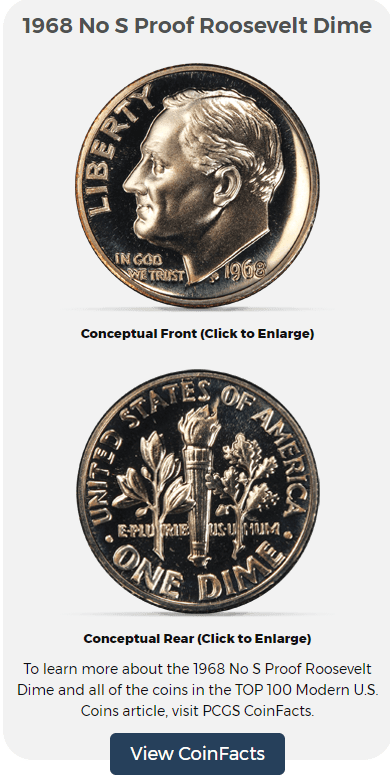
Another missing mint mark occurred with the 1975 No S dimes, only a few known. Other coins missing S mint marks are 1970 No S dimes, 1971 No S nickels, 1976 No S Ike and 1990 No S Lincoln cent.
So let’s summarize:
You likely have handled hundreds if not thousands of 1977 business strike cents. You may have a 1977-S proof set. Odds are almost 0% that you have a 1977 proof cent without an S mint mark.
If you like posts like this, subscribe so you can be informed whenever there is a new article or column.
Proxiblog also has thousands of followers on Facebook Coin Groups, YouTube and social media. To get the latest discussion and commentary, be sure to friend us by clicking here.
You can find more information about types, varieties, errors, grading, bidding and buying in Coin News Updated: The Essential Guide to Online Bidding. Please consider buying or gifting the work for a friend, as it underwrites this hobbyist blog. Thank you.


