Debunking the 1977 “missing mint mark” cent


New members of Facebook and other internet coin sites (eBay, TikTok, Etsy) are told routinely that their face value coins are worth thousands because they lack mint marks. As hobbyists know, at one time the United States only had one mint, in Philadelphia, and so no mint mark was necessary. The U.S. Mint then added other production facilities around the country, so they included mint marks like CC (Carson City), S (San Francisco), D (Denver) and so on.

In 1977, the U.S. Mint in Philadelphia produced 4,469,930,000 cents. All of them lack a mint mark. In fact, if a P mint mark ever was found on one–it will never happen!–that would truly be a rarity of all rarities.

As Coin Week notes, “Modern Proof coins that were struck at the San Francisco Mint, as most Proof coinage has been since 1968, normally bear an “S” mint mark. A small number of these coins have surfaced over the years that lack the mint mark, and they are among the greatest rarities of modern American coins – with some of them even being unique.”

A 1977 proof cent without an “S” mint mark purportedly was found in a cash register that year. Presumably, it was a test coin that someone escaped the mint.

Now take a look at how click-baiters on social media hype a common (in this case, zinc-rotted) face value cent as the illusive 1977 test proof coin without a mint mark.


There are other examples flooding coin sites. This is an almost uncirculated 1977 face-value business strike erroneously labeled rare and selling for $600 on Etsy:


There are dozens of face value cents s on eBay right now are going for hundreds and thousands of dollars. Here’s just one:


On the left is an uncirculated business strike 1977 cent, selling for $1.50 on Apmex. On the right is a proof cent selling for $4.95 on the same site. Note the different surfaces and stronger double strike on the proof cent, bestowing a special high-gloss luster.

Now imagine that the “S” was missing on the proof cent. That would be the fabled experimental coin that somehow escaped the mint.

And yes, the “S” mint mark is missing on proof coins of other years.

A 1968 proof set sells for less than $20. However, about a dozen 1968 proof sets escaped the Mint without an S mint mark. They are worth thousands. Here’s an example of such a proof coin:


Another missing mint mark occurred with the 1975 No S dimes, only a few known. Other coins missing S mint marks are 1970 No S dimes, 1971 No S nickels, 1976 No S Ike and 1990 No S Lincoln cent.

So let’s summarize:

You likely have handled hundreds if not thousands of 1977 business strike cents. You may have a 1977-S proof set. Odds are almost 0% that you have a 1977 proof cent without an S mint mark.

If you like posts like this, subscribe so you can be informed whenever there is a new article or column.

Proxiblog also has thousands of followers on Facebook Coin Groups, YouTube and social media. To get the latest discussion and commentary, be sure to friend us by clicking here.

You can find more information about types, varieties, errors, grading, bidding and buying in Coin News Updated: The Essential Guide to Online Bidding. Please consider buying or gifting the work for a friend, as it underwrites this hobbyist blog. Thank you.

Missing v. Philadelphia Mint Marks


Missing mint marks on US coins occur on a handful of proof coins and one business strike dime. Billions of business strike coins with no mint marks were produced in Philadelphia, as at one time, it was the only manufacturing facility. Later, other facilities were added across the country, thereby requiring a mint mark.

The Philadelphia Mint did not use a mint mark on coins until 1980, with the exception of the 1979 Susan B. Anthony dollar, 1942-45 35% silver Jefferson war nickels, and the 2017 Lincoln 225th anniversary cent.

Social media click-baiters have confused the terms “missing” and “no mint mark.” Let’s correct the record with this article, starting with this chart, so you can see why these are ultra rarities unlikely to be found in pocket change or rolls.


Let’s explore these individually.

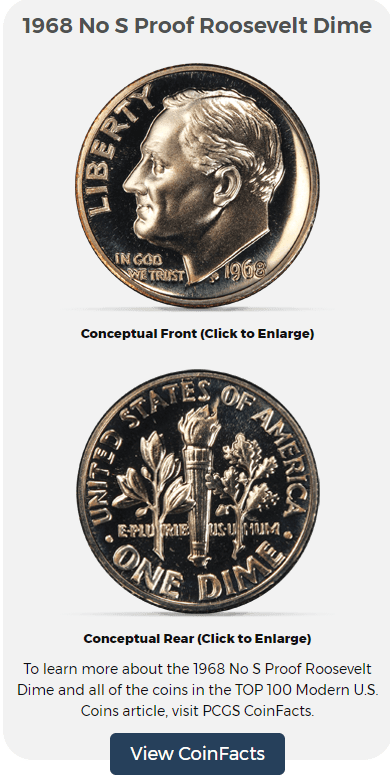
1968 No S Proof Dime

A 1968 proof set sells for less than $20. However, about a dozen 1968 proof sets escaped the Mint without an S mint mark. They are worth thousands. Here’s an example of such a proof coin.


1990 No S Lincoln Cent

Fewer than 200 examples:


1970 No S Roosevelt Proof Dime

Fewer than a dozen:


1975 No S Roosevelt Proof Dime

Only 2 known examples:


1983 No S Roosevelt Proof Dime

Several hundreds exist:


1971 No S Jefferson Proof Nickel

1655 believed minted and released:


1976 No S Eisenhower Proof Dollar

Only 1 known to exist. To read about this coin, go to CoinFacts: https://www.pcgs.com/top100/coin4


The only business strike to leave the mint is the 1982 No P mint mark.

1982 No P Mint Mark

8,000-10,000 released by the Mint:


Given the billions of coins that have been minted since the late 18th century, as well as the billions still in circulation worth face value, the odds of anyone finding these coins in pocket change are extremely low.

Misleading social media posts and scam coin sites, especially on Facebook, TikTok and YouTube, lead people to believe that any coin without a mint mark is valuable–worth tens of thousands of dollars. Here’s an example:


So let’s put the issue of missing v. Philadelphia mint marks into perspective. You have close to zero chance of finding a proof S coin with missing mint mark in pocket change and a near 100% chance of finding a Philadelphia minted coin every time you make a cash transaction.

We hope this post clarifies the situation.

Below is more information from Heritage Auctions about mint marks:

  • C: Charlotte (Gold only, 1838-1861)
  • CC: Carson City (1870-1893)
  • D: Dahlonega, Georgia (Gold only, 1838-1861)
  • D: Denver (1906 to date; easily distinguishable from Dahlonega because of the different timeframes in which the mints operated)
  • O: New Orleans (1838-1909)
  • P: Philadelphia (Silver “Nickels” 1942-45; Dollar coins 1979 to date; other coins except cents 1980 to date. Although the Philadelphia mint has been operating continuously since 1793, most Philadelphia coins do not have a mintmark)
  • S: San Francisco (1854 to date. Now mints collector coins only. The last circulating coin to bear an ‘S’ mintmark was the 1980-S SBA Dollar)
  • W: West Point (1983 to date; collector coins only)

If you like posts like this, subscribe so you can be informed whenever there is a new article or column.

Proxiblog also has thousands of followers on Facebook Coin Groups and other social media. To get the latest discussion and commentary, be sure to friend us by clicking here.

You can find more information about types, varieties, errors, grading, bidding and buying in Coin News Updated: The Essential Guide to Online Bidding. Please consider buying or gifting the work for a friend, as it underwrites this hobbyist blog. Thank you.