Clickbait social media sites have tricked new coin collectors into believing they can find ultra rarities in pocket change and bank rolls. What are the odds?
We’ll calculate those odds later. But here’s the list of what you in all likelihood will never find:
- 1974-D Aluminum Cent
- 1943-D Copper Cent
- 1944-S Steel Cent
- 1982-D Small Date 3.1 grams
- 1943-S Copper Cent
- 1944-D Steel Cent
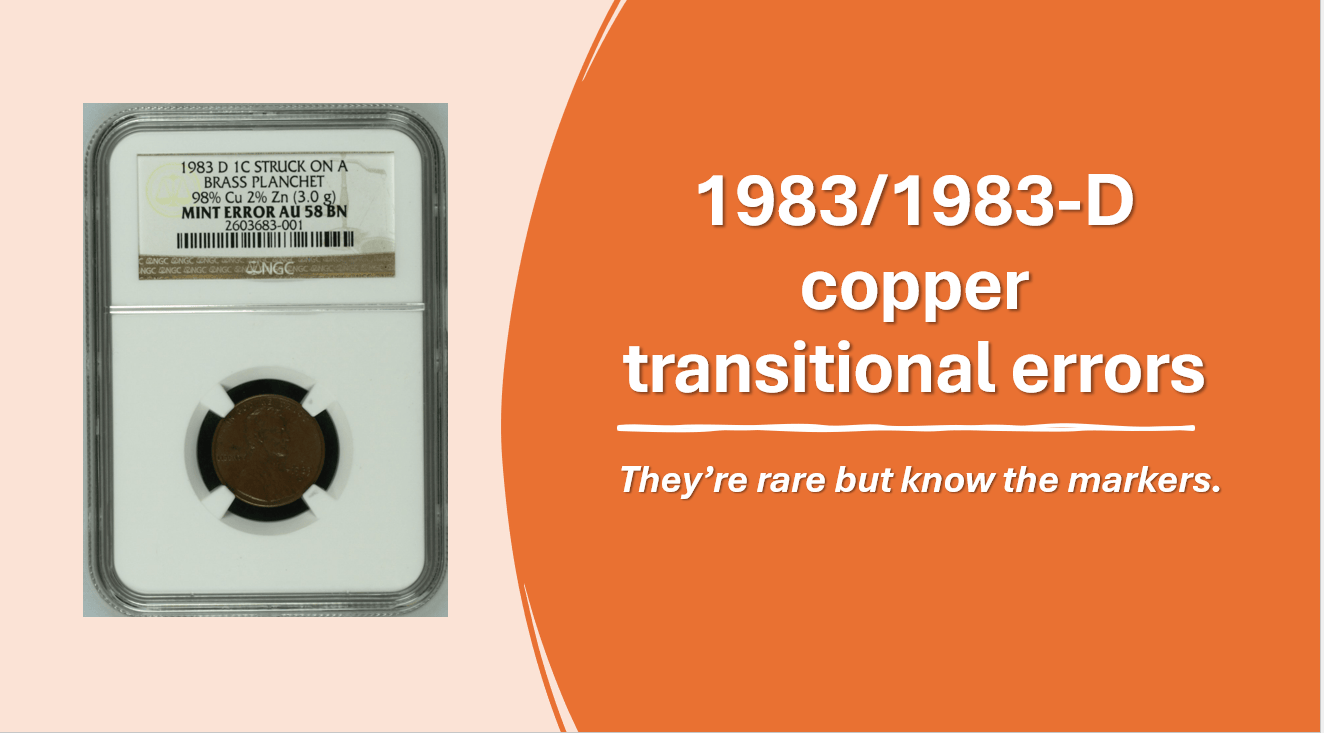
- 1983/83-D Copper Cent
- 2000 Sacagawea Mule
- 1944 Steel Cent
- 1943 Copper Cent
- 1969-S DDO Cent
- 1971-D DDO Cent
Social media scammers also proclaim “no mintmark” coins are rarities. No mintmark means minted in Philadelphia; missing mintmark is the rarity. Again, later in the article, we will show you just how many of these rarities are believed minted:
- 1968 No S Proof Dime
- 1990 No S Lincoln Cent
- 1970 No S Roosevelt Proof Dime
- 1975 No S Roosevelt Proof Dime
- 1983 No S Roosevelt Proof Dime
- 1971 No S Jefferson Proof Nickel
- 1976 No S Eisenhower Proof Dollar
- 1982 No P Mintmark
But not to despair! There are hundreds of findable rarities in rolls and pocket change. They won’t make you rich, but will make you a coin collector–a true hobbyist–who knows how to spend time wisely.
Clickbait Social Media
Scammers on Facebook and YouTube foster the belief you can get rich and retire with pocket change.
Here’s a sample YouTube video:
There are only 5 known 1943-S Copper Cents. People have been checking their change and bank rolls for 70 years. To calculate odds of your finding one, factor this: some 125 million Americans consider themselves coin collectors to some degree. Twenty percent of Millennials, or 14.5 million, have taken a keen interest in numismatics.
New collectors have purchased coin microscopes and visit TikTok, Google, YouTube, eBay, Facebook and other social media venues, believing they can strike it rich by checking their change at the grocery store or making several trips to the bank for rolls.
Now consider the past 50-70 years of Americans collecting coins and looking for ultra rarities like 1943 copper cents or 1944 steel ones. What do you think the odds are of your finding one of them?
Now factor the hundreds of thousands of fake ultra rarities exported to the US by China. These often find themselves in rolls and auctions. Etsy, an American company flooded with Chinese sellers, and Temu, a Chinese company, also have saturated the coin market place with replicas. See this article for examples.
AI Calculates Odds
In addition to being a numismatist, I am a distinguished professor (actual title) emeritus at an institution of science and technology. My research specialty is artificial intelligence. I fed data into several sites and databases to calculate the odds of your finding one of these treasures.
In the table below, you will see those top 12 rarest coins and their values along with the odds of your finding one in pocket change or bank rolls.
Brace yourself:

Social media is undermining the hobby along with Chinese counterfeiters who count on your not knowing die markers for rarities. If you don’t, you can spend thousands on replicas.
Some examples:
Just consider the 1943-S restrike copper cent offerings on Etsy:

eBay scammers buy these restrikes and then list them as ultra rarities. Here’s an example:

You also can find “missing mintmark” rarities in online auctions
Missing Mintmarks
The Philadelphia Mint did not use a mint mark on coins until 1980, with the exception of the 1979 Susan B. Anthony dollar, 1942-45 35% silver Jefferson war nickels, and the 2017 Lincoln 225th anniversary cent.
Here’s another table about how many missing mint mark coins are believed to have been released into circulation.

Here are tactics of counterfeiters and scammers:
- Altering Normal Coins: Forgers might take a regular dime and try to remove the mintmark.
- Tooling: Look for signs of filing or polishing where the mintmark should be.
- Fake “No-S” Proofs: A common tactic is to take a regular business strike (like a 1970-S) and try to remove the ‘S’ to pass it off as the rare proof version.
If you would like to learn more about the above missing mint mark coins, click here for a full article.
Findable Rarities
There are hundreds of varieties and error coins that hobbyists still can find in pocket change in bank rolls and that are holdered by PCGS, NGC and ANACS. For a comprehensive list, click here.
Coin collecting is in part about value and investment. The difference between now and past decades is where new hobbyists are getting misinformation. In the past, most numismatists embraced the hobby because of the history, art, culture and metallurgy of coins, medals and paper money.
That is why Proxiblog recommends these three articles for new hobbyists:
HOW TO COLLECT COINS *** HOW TO GRADE COINS *** HOW TO SELL COINS
If you like posts like this, subscribe so you can be informed whenever there is a new article or column.
Proxiblog also has thousands of followers on Facebook Coin Groups, YouTube and social media. To get the latest discussion and commentary, be sure to friend us by clicking here.
You can find more information about types, varieties, errors, grading, bidding and buying in Coin News Updated: The Essential Guide to Online Bidding. Please consider buying or gifting the work for a friend, as it underwrites this hobbyist blog. Thank you.