It all began with tail feathers. In 1878, the Morgan Dollar replaced the Trade Dollar with the initial die showing 8 tail feathers on the reverse eagle. Shortly after production began, the Mint altered the tail feathers, superimposing a 7 TF version over the 8 TF. You can believe or dismiss the stories, but the change may have been made because someone pointed out that eagles have one tail feather longer than the other. Dies were altered again to show 7 tail feathers.
Here is a depiction of all three types, compliments PCGS CoinFacts:
Turns out that eagles have 12 tail feathers, not 7 or 8. (Curiously, the 7/8 TF has 12 feathers if you count the doubling.)
The 1878 7/8 variety has two types, strong and weak, depending on the prominence of the doubling. Here’s an illustration:
After everyone agreed to the 7 tail feathers on the reverse, changes then were suggested for the breast of the eagle. One had the 1878 design and the latter, the design of the 1879 reverse. The 1878 has a flat breast; the 1879, a rounded one.
See this PCGS designation:
Now let’s view all of them in one nifty panel to help identification (right click to expand):
You can read a comprehensive article about the number of strikes per variety on PCGS CoinFacts.
As for value, here are current retail/auction prices for various grades, again from CoinFacts:
Values
VARIETY
XF40
AU55
MS63
MS65
1978 8TF
$140
$210
$525
$2,700
8/7 Strong
$100
$175
$525
$3,500
8/7 Weak
$100
$140
$250
$950
1878 Rev. 78
$85
$125
$225
$800
1878 Rev. 79
$72
$150
$450
$2,000
Be especially careful when bidding on or buying raw coins of these varieties as sellers often misidentify these types.
Here’s a perfect example, an 1878-S (not 1878 Philadelphia) with no doubling on the tail feathers listed as 1878 7/8 TF Strong:
If you like posts like this, please subscribe so you can be informed whenever there is a new article or column.
Proxiblog also has thousands of followers on Facebook Coin Groups, YouTube and social media. To get the latest discussion and commentary, be sure to friend us by clicking here.
You can find more information about errors and varieties as well as buying and bidding on coins in Coin News Updated: The Essential Guide to Online Bidding. Please consider purchasing the work for yourself or a friend, as it underwrites this hobbyist website. Thank you.
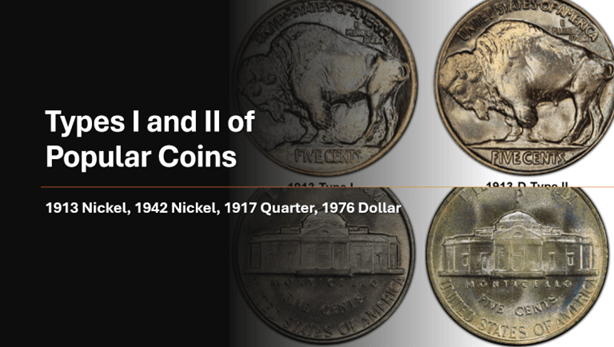
On occasion, the U.S. Mint halts production and redesigns a coin for a variety of reasons, from die flaws to artistic opinion. Hobbyists often collect all types of a given series, especially in popular denominations. They also know which type is more valuable.
We’ll do that here.
1913 Types I & II Buffalo Nickel
A few months after its release, the Mint noticed that the reverse denomination “FIVE CENTS” was wearing down too to quickly. The mound gave it no protection.
Later in the year the Mint changed the design and created a recess below the buffalo, thereby extending the life of the denomination.
As for value, 1913 Type I at MS63 retails for about $110; 1913-D, $200; 1913-S, $350. Type II values are greater, again at MS63: 1913, $150; 1913-D, $450; 1913-S, $1,575.
The challenge for hobbyists is assembling a mint state set of all six mints.
1942 Types I and II, Jefferson Nickel
The reason for two types of 1942 nickels had nothing to do with the design; it had to do with the metal. The Mint produced Type 1 with a regular nickel composition, and Type 2, considered a “wartime” nickel, with a silver alloy to conserve nickel for the war effort. To distinguish Type I from Type II, the Mint added a “P” mintmark on the reverse.
Most hobbyists are fond of Type II because of the silver; but retail values at MS65 for both coins are about $50.
1917 Types I & II Standing Liberty Quarter
The 1917 Standing Liberty Quarter design featured Lady Liberty with a bare breast on the obverse. Some say the public thought the display was indecent. So the coin was redesigned, covering up the naked breast with chain mail.
The Mint also changed the reverse, moving three stars from the rim to below the eagle.
As for value, the 1917 Type I in MS63 retails for $475; 1917-D, $625; and 1917-S, $650. Type II values at MS 63 are $360, 1917; $575, 1917-D; and $600, 1917-S.
1976 Eisenhower Dollar, Types I and II
The 1976 dollar is not the only year of different types in the series. You can read about 1972, Types I, II and III, by clicking here.
The Bicentennial Dollar had a one-year reverse design, featuring the Liberty Bell in front of the moon. Later in the year the Mint decided to change the font from a thicker lettering to a thinner one.
Because of weaker strikes, Type 1 is considered the more valuable coin, meaning any high mint state example is scarce. Values for Type I, P and D, range from $100-$200; Type II, P and D, from $50-$100.
If you like posts like this, please subscribe so you can be informed whenever there is a new article or column.
Proxiblog also has thousands of followers on Facebook Coin Groups, YouTube and social media. To get the latest discussion and commentary, be sure to friend us by clicking here.
You can find more information about errors and varieties as well as buying and bidding on coins in Coin News Updated: The Essential Guide to Online Bidding. Please consider purchasing the work for yourself or a friend, as it underwrites this hobbyist website. Thank you.
If you collect Buffalo nickels and are searching for the series’ two doubled dies, be advised that you probably won’t find them in rolls or pocket change, although it still is possible.
If you find one, you will have a valuable coin.
The 1916 DDO retails for thousands, even in Good 6, and astronomically more in Fine 12 and above. Only about 200 are thought to exist.
The 1935 DDR retails for about $300 in VF30 and rises into the thousands in AU and low mint state condition. Only about 300 are thought to exist.
1916 DDO
The 1916 Doubled Die Buffalo nickel is one of the hobby’s most coveted doubled die varieties. As you can see, the doubling is prominent in the date.
Never buy a raw 1916 DDO because they are mostly counterfeit or misattributed. See this eBay example that purports to be an NGC details graded coin.
The scam seller is counting on a few things here. Buyers do not know how to grade and look up certification numbers.
If you go to NGC to verify link and input the cert there, you get this coin:
Without even a closeup comparison, you can see immediately that the scam seller is using a details grade from NGC to deceive novice buyers. But let’s compare here.
Never bid on or buy a raw rarity because of the prevalence of counterfeit and misidentified coins.
1935 DDR
In many respects, the 1935 doubled die reverse is as scarce as the 1916 DDO. The price discrepancy does not involve the scarcity but the prominence of the doubling. The reverse doubling on this DDR is faint or non-recognizable in low grade examples. You will need a loupe or coin microscope to recognize the diagnostics.
See the arrows pointing to the most doubled letters in the above denomination.
Once again, never buy this coin raw or bid on an uncertified lot in eBay. The scammer below does not even realize that he is showing a 1935-S nickel with no doubling, billing it as the 1935 DDR.
That lot is not almost uncirculated but very fine. He wants $1,000 for a $15 coin.
Also, many sellers see machine doubling or worn die examples, calling them 1935 DDR. Here’s a worn coin and die example:
Note the faint machine doubling on the top of “Cents” as well as no doubling on the bottom of the “E’s,” “N” and “S” of “Cents.”
If you like posts like this, please subscribe so you can be informed whenever there is a new article or column.
Proxiblog also has thousands of followers on Facebook Coin Groups, YouTube and social media. To get the latest discussion and commentary, be sure to friend us by clicking here.
You can find more information about errors and varieties as well as buying and bidding on coins in Coin News Updated: The Essential Guide to Online Bidding. Please consider purchasing the work for yourself or a friend, as it underwrites this hobbyist website. Thank you.
When hobbyists give nicknames to coin varieties, you can count on three things: they are popular, easy to spot, and valuable.
Interestingly, two of the coveted Morgan dollar varieties are found on the obverse of 1888-O. The other two occur on reverses of the 1890-CC and 1901 dollars, respectfully. These four are also known by two other designations: DDO and DDR and VAM, which stands for “Van Allen and Mallis,” referring to a study by Leroy Van Allen and A. George Mallis of Morgan and Peace dollar die varieties.
Here are the VAM designations for the above nicknamed coins:
1888-O VAM 1B “Scarface”
1888-O VAM 4 “Hot Lips”
1890-CC VAM 4 “Tailbar”
1901 VAM 3 “Shifted Eagle”
Now let’s explore the diagnostics.
1888-O VAM 1B “Scarface”
The scar on the face of Lady Liberty was due to a die crack. Look at the E from “PLURIBUS” running across the face from the nose to the hair curls. PCGS has holdered about 75 of these, so this qualifies as a rarity, with values in the hundreds for fine through extra fine and in the thousands for almost uncirculated and low mint state. Check PCGS for latest prices.
1888-O VAM 4 “Hot Lips”
The doubling here is easy to see without a loupe and has three distinct marks: a doubling along the nose, a second pair of lips and chin. PCGS has holdered hundreds of these across all conditions. Hundreds more are out there undiscovered. Values are $100+ for F12 with thousands for low mint state samples. Check PCGS CoinFacts for latest figures.
1890-CC VAM 4 “Tailbar”
The tailbar is easily seen with the naked eye, descending from the bottom feather of the eagle to the wreath. PCGS has holdered 1,200 of these in various conditions, with hundreds of dollars for fine examples and thousands for low mint state. Check PCGS CoinFacts for updated retail prices.
1901 VAM 3 “Shifted Eagle”
The “shift” in the eagle is concerns doubling below the tail feathers. Values range from $100 in fine to thousands in almost uncirculated and above. Hundreds have been holdered across the Sheldon 1-70 scale. Check PCGS CoinFacts for latest values.
The best place to find Morgan varieties like this are in online auctions. You can go to the preferred online sellers tab of Proxiblog to access reputable sellers. Often auctioneers (and bidders) do not realize that they have a variety because they did not know how to identify them. That is why coin collecting requires continuous study and knowledge of articles like this.
If you like posts like this, subscribe so you can be informed whenever there is a new article or column.
Proxiblog also has thousands of followers on Facebook Coin Groups, YouTube and social media. To get the latest discussion and commentary, be sure to friend us by clicking here.
You can find more information about types, varieties, errors, grading, bidding and buying in Coin News Updated: The Essential Guide to Online Bidding. Please consider buying or gifting the work for a friend, as it underwrites this hobbyist blog. Thank you.
Within six years, the U.S. Mints at Philadelphia, Denver and San Francisco produced four doubled dies: 1937 DDO, 1942-D DDO, 1943 DDO and 1943-S DDO.
This article not only shares key diagnostics so that you can identify examples from rolls or online offerings. It warns against raw coins on eBay that claim to be these doubled dies and sell lots without any doubling or with machine doubling.
1937 DDO
The 1937 DDO is scarce but still discoverable in rolls and bank bags, usually in lower mint states. Look for doubling you can see with a loupe or naked eye on the motto, “In God We Trust.” You also can check the date with doubling there on the “1” and “9.” You might not see that if the coin is worn.
Retail values are typically less than $300 in fine and very fine condition condition. In extra fine, the price jumps into the $500s. PCGS has holdered about 60 of these.
If buying raw and online, be sure to compare the diagnostics because this quarter also was struck with worn dies leaving slight machine doubling on the date, as in this example, not a 1937 DDO.
1942-D DDO
The doubling is easily seen with or without a loupe in the legend and in the “R” of the motto.
Values for the 1942-D DDO typically are less than $500 in fine and extra fine. In almost uncirculated condition, price rises to $1,000 or higher.
Once more, you will see plenty of misidentified 1942-D quarters on eBay and elsewhere. That’s why it is essential to study the diagnostics and then compare. Here’s an example that lacks doubling in the legend and “R” in the motto:
1943 DDO
The 1943 DDO is the scarcest of the four Washington doubled die quarters. You will need a loupe or even a coin microscope to see the doubling on “In God We Trust” and on the “L” of “Liberty.”
PCGS has only holdered fewer than 60 of these, dramatically increasing value, even in lower grades. In extra fine, the coin retails between $600-$1000. In AU 58, in $5,000 or more.
Again, be careful if you plan to bid on or buy a raw 1943 designated as DDO when it isn’t. Here’s an example for $995. Never spend that money unless the coin was verified and holdered by PCGS, NGC, CAC or ANACS.
1943-S DDO
The 1943-S DDO is easily identified with hub doubling in the legend and especially in the motto, as indicated below. Better still, hundreds have been found in rolls and even in pocket change.
Values are more affordable than other Washington quarter doubled dies selling for about $300 in almost uncirculated and in the high hundreds to a $1,000 in lower mint states.
Once again, be careful bidding on or buying raw coins that purport to be doubled dies, especially worn ones like that below, which lacks key diagnostics.
If you like posts like this, please subscribe be informed whenever there is a new article or column.
Proxiblog also has thousands of followers on Facebook Coin Groups, YouTube and social media. To get the latest discussion and commentaries, click here.
You can find more information about errors and varieties as well as buying and bidding on coins in Coin News Updated: The Essential Guide to Online Bidding. Please consider purchasing the work for yourself or a friend, as it underwrites this hobbyist website. Thank you.
If you are searching for errors and varieties, you need to know the process used at the U.S. Mint. Otherwise, you will think damaged coins are valuable errors.
Before we describe the minting process, we need to make an analogy. Most people know how newspapers are printed. So let’s start there.
Printing Process
Newsroom editors design the layout for each page, including photos and illustrations. Using a laser, a press employee creates an aluminum plate, attached to a drum. Plates are coated with ink, and the drum spins, transferring ink to rubber blanket. Paper is fed through those blankets to print each page.
If the ink blurs a page, or if there is insufficient ink, the press run has to be stopped because that error will appear in every newspaper.
This newspaper was damaged by rain and fire. It did not leave the press room like this.
Likewise, this coin was damaged by fire. It didn’t leave the U.S. Mint like that.
A damaged coin is not a mint error or variety.
The Minting Process
A coin’s design is created by artists. The Citizens Coinage Advisory Committee and the Commission of Fine Arts review designs and select one for manufacturing.
The chosen design is transferred to a master die made from hardened steel to preserve the coin for future reference. That master die creates working dies used to strike the coins.
The Mint purchases metal coils for each denomination. Those are straightened so that the blanking press can make planchets.
Blanks are heated to soften and prepare them for striking. That process includes a striking hammer that pounds the blank between obverse and reverse of a working die.
Blanks are squeezed by a machine called an upsetting mill to form a rim.
A quality control operator inspects the first run of a particular coin to ensure that no mistakes are made.
Mintmarks used to be hand-punched directly into the working die. Engravers manually struck a steel punch bearing the mintmark onto the die.
This resulted in varied positions and sometimes faint or shadowed impressions, known as repunched mint marks (RPMs), because a technician might not have struck the punch perfectly straight or the impression was too weak, requiring a second attempt.
Here is a nifty list so that you know how to describe the RPMs:
After 1989, the mintmark was added to the master hub, leading to consistent, identical mintmarks on all working dies from that point forward.
What This Means
Think again about a newspaper page with an error like blurred or smeared ink. Maybe one photograph with the wrong caption or misspelled name. Those errors will appear on each page unless the press operator stops the run and fixes the flaw.
This is the same process when minting coins. In other words, a particular flaw will exist on all coins made by the damaged working die.
So if you think your coin has a “unique” flaw, it is likely not an error or variety. The U.S. Mint does not make coins one planchet at a time. In fact, each die may make up to a million coins before being exchanged for a new working die.
Changing working dies means extra work. Sometimes Mint employees will polish a die so that it can continue striking. This may result in die deterioration responsible for filled mint marks, struck through grease, and “L” in “Liberty, for instance, close to the rim of a cent.
Sometimes quality control falters. For instance, some 40,000 double die 1955 cents were mistakenly released to the public. There was a reason, too. In 1955, the Philadelphia Mint was working overtime to meet the demand for new cents, primarily because of a one-cent tax on cigarettes. In the round-the-clock mayhem, the hub doubling was missed and those errors were mixed with other non-error cents.
If you understand the minting process, you won’t be led astray by clickbait social media coin videos and hyped values of error coins and varieties.
Proxiblog, operated by Michael Bugeja, a former writer for Coin World and past member of the U.S. Mint’s Citizens Coinage Advisory Committee, has seen production at the Philadelphia Mint and branch mints. He has assembled two valuable directories: one is an illustrated coin glossary that contains terms used in the minting process, and one that lists all the errors and varieties of popular denominations recognized by the U.S. Mint as well as top holdering companies.
If you like posts like this, please subscribe so you can be informed whenever there is a new article or column.
Proxiblog also has thousands of followers on Facebook Coin Groups, YouTube and social media. To get the latest discussion and commentaries, click here.
You can find more information about errors and varieties as well as buying and bidding on coins in Coin News Updated: The Essential Guide to Online Bidding. Please consider purchasing the work for yourself or a friend, as it underwrites this hobbyist website. Thank you.
If you are going to collect error coins, looking in pocket change, be more strategic and find these 3 valuable ones you can find in circulation and see with the naked eye rather than a microscope.
If you like posts like this, please subscribe so you can be informed whenever there is a new article or column.
Proxiblog also has thousands of followers on Facebook, YouTube and other venues. To get the latest discussion and commentaries, click here.
You can find more information about errors and varieties as well as buying and bidding on coins in Coin News Updated: The Essential Guide to Online Bidding. Please consider purchasing the work for yourself or a friend, as it underwrites this hobbyist website. Thank you.
If you like posts like this, please subscribe so you can be informed whenever there is a new article or column.
Proxiblog also has thousands of followers on Facebook Coin Groups, YouTube and social media. To get the latest discussion and commentaries, click here.
You can find more information about errors and varieties as well as buying and bidding on coins in Coin News Updated: The Essential Guide to Online Bidding. Please consider purchasing the work for yourself or a friend, as it underwrites this hobbyist website. Thank you.
Clickbait social media sites have tricked new coin collectors into believing they can find ultra rarities in pocket change and bank rolls. What are the odds?
We’ll calculate those odds later. But here’s the list of what you in all likelihood will never find:
1974-D Aluminum Cent
1943-D Copper Cent
1944-S Steel Cent
1982-D Small Date 3.1 grams
1943-S Copper Cent
1944-D Steel Cent
1983/83-D Copper Cent
2000 Sacagawea Mule
1944 Steel Cent
1943 Copper Cent
1969-S DDO Cent
1971-D DDO Cent
Social media scammers also proclaim “no mintmark” coins are rarities. No mintmark means minted in Philadelphia; missing mintmark is the rarity. Again, later in the article, we will show you just how many of these rarities are believed minted:
1968 No S Proof Dime
1990 No S Lincoln Cent
1970 No S Roosevelt Proof Dime
1975 No S Roosevelt Proof Dime
1983 No S Roosevelt Proof Dime
1971 No S Jefferson Proof Nickel
1976 No S Eisenhower Proof Dollar
1982 No P Mintmark
But not to despair! There are hundreds of findable rarities in rolls and pocket change. They won’t make you rich, but will make you a coin collector–a true hobbyist–who knows how to spend time wisely.
Clickbait Social Media
Scammers on Facebook and YouTube foster the belief you can get rich and retire with pocket change.
Here’s a sample YouTube video:
There are only 5 known 1943-S Copper Cents. People have been checking their change and bank rolls for 70 years. To calculate odds of your finding one, factor this: some 125 million Americans consider themselves coin collectors to some degree. Twenty percent of Millennials, or 14.5 million, have taken a keen interest in numismatics.
New collectors have purchased coin microscopes and visit TikTok, Google, YouTube, eBay, Facebook and other social media venues, believing they can strike it rich by checking their change at the grocery store or making several trips to the bank for rolls.
Now consider the past 50-70 years of Americans collecting coins and looking for ultra rarities like 1943 copper cents or 1944 steel ones. What do you think the odds are of your finding one of them?
Now factor the hundreds of thousands of fake ultra rarities exported to the US by China. These often find themselves in rolls and auctions. Etsy, an American company flooded with Chinese sellers, and Temu, a Chinese company, also have saturated the coin market place with replicas. See this article for examples.
AI Calculates Odds
In addition to being a numismatist, I am a distinguished professor (actual title) emeritus at an institution of science and technology. My research specialty is artificial intelligence. I fed data into several sites and databases to calculate the odds of your finding one of these treasures.
In the table below, you will see those top 12 rarest coins and their values along with the odds of your finding one in pocket change or bank rolls.
Brace yourself:
Social media is undermining the hobby along with Chinese counterfeiters who count on your not knowing die markers for rarities. If you don’t, you can spend thousands on replicas.
Some examples:
Just consider the 1943-S restrike copper cent offerings on Etsy:
eBay scammers buy these restrikes and then list them as ultra rarities. Here’s an example:
You also can find “missing mintmark” rarities in online auctions
Missing Mintmarks
The Philadelphia Mint did not use a mint mark on coins until 1980, with the exception of the 1979 Susan B. Anthony dollar, 1942-45 35% silver Jefferson war nickels, and the 2017 Lincoln 225th anniversary cent.
Here’s another table about how many missing mint mark coins are believed to have been released into circulation.
Here are tactics of counterfeiters and scammers:
Altering Normal Coins: Forgers might take a regular dime and try to remove the mintmark.
Tooling: Look for signs of filing or polishing where the mintmark should be.
Fake “No-S” Proofs: A common tactic is to take a regular business strike (like a 1970-S) and try to remove the ‘S’ to pass it off as the rare proof version.
There are hundreds of varieties and error coins that hobbyists still can find in pocket change in bank rolls and that are holdered by PCGS, NGC and ANACS. For a comprehensive list, click here.
Coin collecting is in part about value and investment. The difference between now and past decades is where new hobbyists are getting misinformation. In the past, most numismatists embraced the hobby because of the history, art, culture and metallurgy of coins, medals and paper money.
That is why Proxiblog recommends these three articles for new hobbyists:
If you like posts like this, subscribe so you can be informed whenever there is a new article or column.
Proxiblog also has thousands of followers on Facebook Coin Groups, YouTube and social media. To get the latest discussion and commentary, be sure to friend us by clicking here.
You can find more information about types, varieties, errors, grading, bidding and buying in Coin News Updated: The Essential Guide to Online Bidding. Please consider buying or gifting the work for a friend, as it underwrites this hobbyist blog. Thank you.