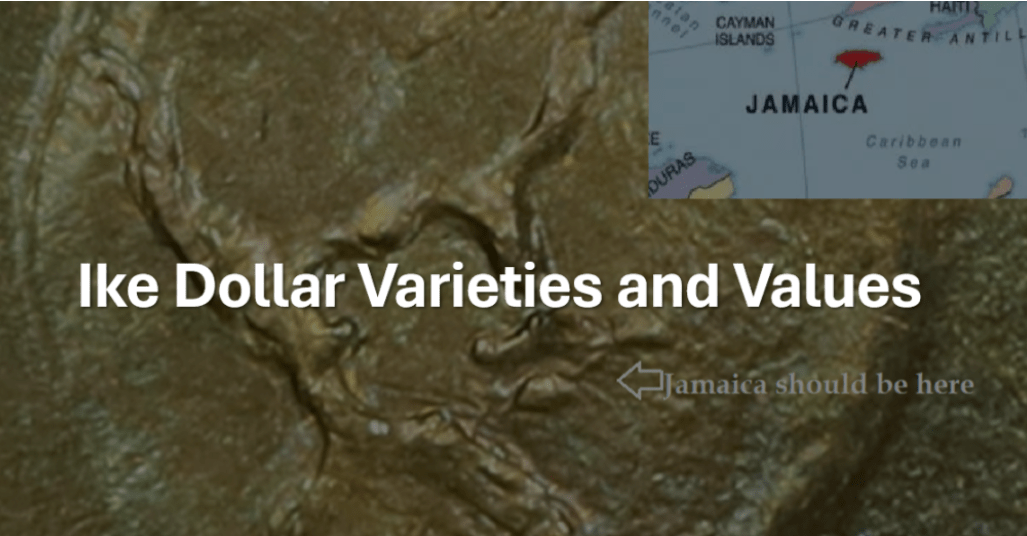
In 1972, three was the charm in designing the Eisenhower dollar, all focused on how to display four countries—Cuba, Jamaica, Haiti and the Dominican Republic—off shore south of Florida on the tiny rounded world device featured on the reverse.
Here is a visual depiction of Types 1, 2 and 3, compliments PCGS CoinFacts:
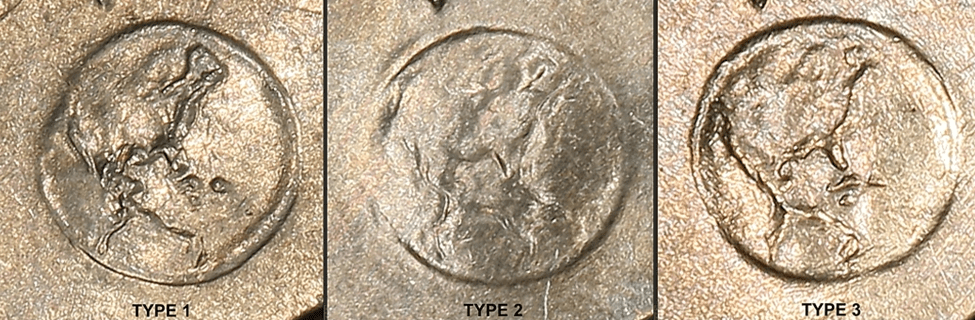
Keep in mind as we review the types that the round small design is meant to depict earth as seen from the surface of the moon.

After production began, quality control officials noticed the misplacement of Jamaica on the map. It appears south of Florida rather than southeast.
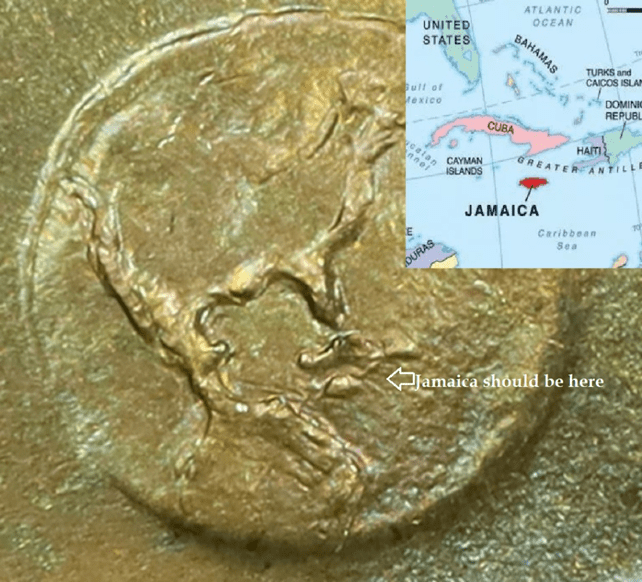
Because of poor strikes, a Type 1 in MS65 is relatively rare with a value of about $100. The price triples in MS65+. In MS66, the coin is an ultra rarity worth about $3,500. In MS66+, with only two slabbed by PCGS, the price rises to $11,500.
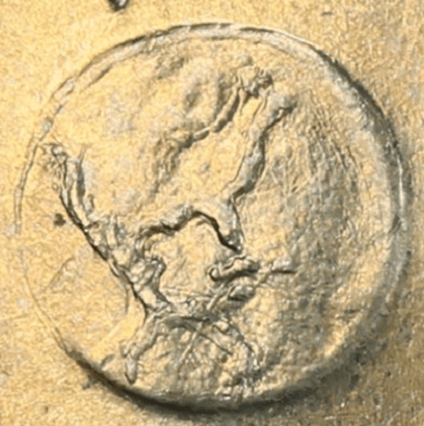
Type 2 ran into additional problem. This variety was struck from one known reverse die before production ceased. Again, it concerned the map.
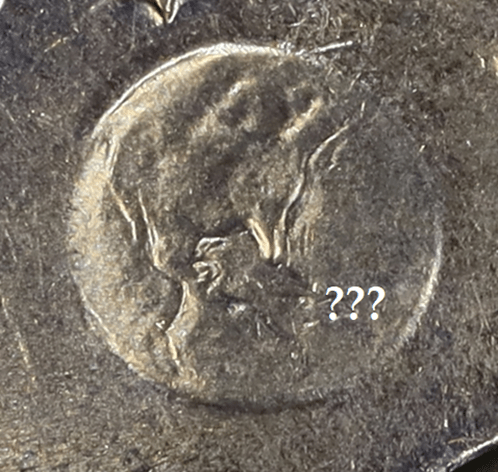
As you can see, the islands are flat and indistinguishable from each other, almost looking like a lamination error below Florida.
The US Mint estimates some 40,000 Type 2 coins were released to the public, making this the key date and most desired variety of the series. Most strikes were weak, adding to value in higher mint state. Retail prices range from $1,500 in MS65 and $2,500 in MS65+. MS66 is an ultra rarity worth $10,000. No Type 2 coin has been graded higher than MS66+, with only two reported by PCGS.
The Mint finally got it right with Type 3, as far as strike was concerned, with Jamaica still a tad off kilter but at least distinguishable.
Type 3 values are a bit lower than Type 1 values with MS65 selling for less than $100 and MS65+ for about $250. In MS66, the price rises to $1,375. In MS66+, the few coins at that level go for about $6,000.
We get two more varieties of the Eisenhower dollar in Bicentennial issues. These coins carry the date 1976 but were struck in 1975.
PCGS CoinFacts shows the difference in design:
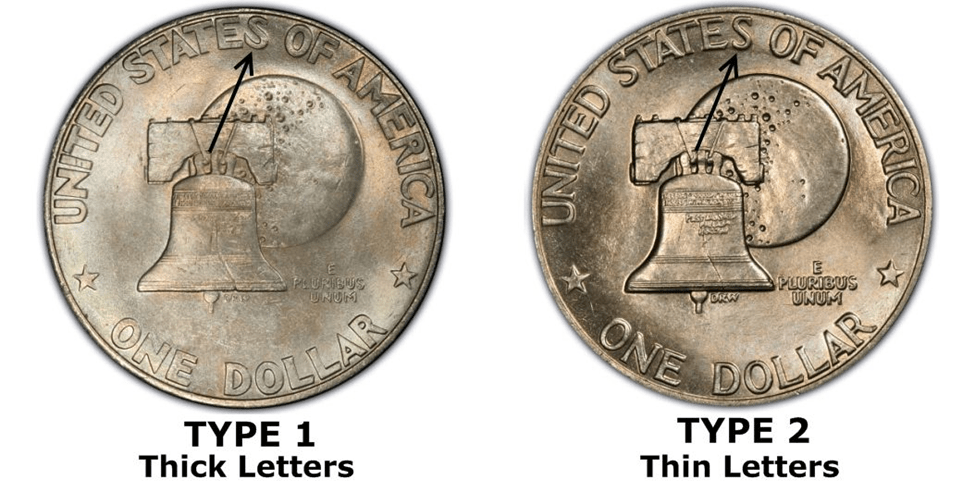
The thick lettering seems out of place. It was almost as if the Mint adopted a “design as you go” production that year. The font used for Type 2 is thinner and sharper. Both designs also appear on the 1976-D Bicentennial issues.
Hobbyists search for the Type 1 from the Philadelphia mint as only 4,019,000 were struck. In gem MS65, these retail for $120. Values rise to $600 at MS65+; $1,900, MS66; and $7,250, MS66+.
Values for Type 2, Philadelphia, with a mintage of 113,318,000, are less than $100 for MS65-66. This coin at MS66+ retails for $1,150 and at MS67, $2,600.
Mintages rise again with Denver Bicentennial Ikes. The Mint produced 21,048,710 of Type I, with values less than $200 in MS65-66. Only at MS66+ do prices rise to $900, with $9,500 at MS67.
The Denver facility produced 82,179,564 Type II dollars. Values are less than $100 for MS65-66; $435, MS66+; and $2,750, MS67.
Despite design issues, the Eisenhower dollar is a nifty challenge for beginning hobbyists. All issues and types are readily available, although often in lower mint states. Also, 1971-S through 1974-S and 1976-S are available in 40% silver.If you like posts like this, please subscribe so you can get our weekly newsletter and be informed whenever there is a new article or column.
If you like posts like this, please use the subscribe so you can be informed whenever there is a new article or column.
Proxiblog also has thousands of followers on Facebook Coin Groups, YouTube and social media. To get the latest discussion and commentaries, click here.
You can find more information about errors and varieties as well as buying and bidding on coins in Coin News Updated: The Essential Guide to Online Bidding. Please consider purchasing the work for yourself or a friend, as it underwrites this hobbyist website. Thank you.
