On occasion, the U.S. Mint halts production and redesigns a coin for a variety of reasons, from die flaws to artistic opinion. Hobbyists often collect all types of a given series, especially in popular denominations. They also know which type is more valuable.
We’ll do that here.
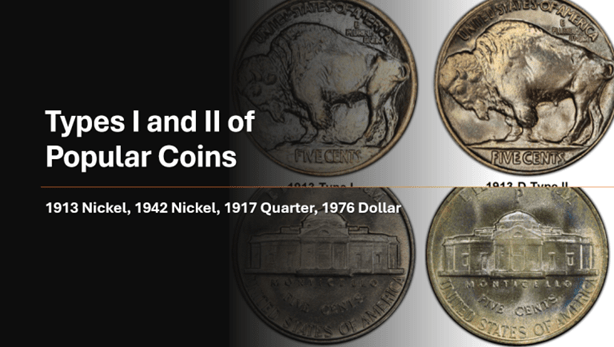
1913 Types I & II Buffalo Nickel
A few months after its release, the Mint noticed that the reverse denomination “FIVE CENTS” was wearing down too to quickly. The mound gave it no protection.

Later in the year the Mint changed the design and created a recess below the buffalo, thereby extending the life of the denomination.

As for value, 1913 Type I at MS63 retails for about $110; 1913-D, $200; 1913-S, $350. Type II values are greater, again at MS63: 1913, $150; 1913-D, $450; 1913-S, $1,575.
The challenge for hobbyists is assembling a mint state set of all six mints.
1942 Types I and II, Jefferson Nickel
The reason for two types of 1942 nickels had nothing to do with the design; it had to do with the metal. The Mint produced Type 1 with a regular nickel composition, and Type 2, considered a “wartime” nickel, with a silver alloy to conserve nickel for the war effort. To distinguish Type I from Type II, the Mint added a “P” mintmark on the reverse.

Most hobbyists are fond of Type II because of the silver; but retail values at MS65 for both coins are about $50.
1917 Types I & II Standing Liberty Quarter
The 1917 Standing Liberty Quarter design featured Lady Liberty with a bare breast on the obverse. Some say the public thought the display was indecent. So the coin was redesigned, covering up the naked breast with chain mail.

The Mint also changed the reverse, moving three stars from the rim to below the eagle.
As for value, the 1917 Type I in MS63 retails for $475; 1917-D, $625; and 1917-S, $650. Type II values at MS 63 are $360, 1917; $575, 1917-D; and $600, 1917-S.
1976 Eisenhower Dollar, Types I and II
The 1976 dollar is not the only year of different types in the series. You can read about 1972, Types I, II and III, by clicking here.
The Bicentennial Dollar had a one-year reverse design, featuring the Liberty Bell in front of the moon. Later in the year the Mint decided to change the font from a thicker lettering to a thinner one.

Because of weaker strikes, Type 1 is considered the more valuable coin, meaning any high mint state example is scarce. Values for Type I, P and D, range from $100-$200; Type II, P and D, from $50-$100.
If you like posts like this, please subscribe so you can be informed whenever there is a new article or column.
Proxiblog also has thousands of followers on Facebook Coin Groups, YouTube and social media. To get the latest discussion and commentary, be sure to friend us by clicking here.
You can find more information about errors and varieties as well as buying and bidding on coins in Coin News Updated: The Essential Guide to Online Bidding. Please consider purchasing the work for yourself or a friend, as it underwrites this hobbyist website. Thank you.
