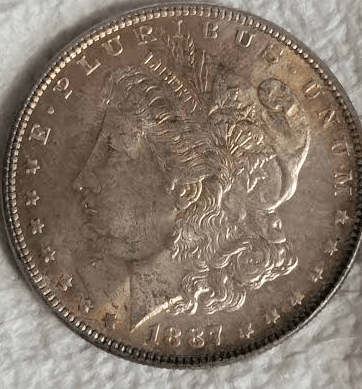
There are various patterns of toned coins ranging from rainbow to terminal. Here are the major ones. You can use these terms when selling or sharing your coins with others.
Rainbow
Rainbow colors in nature are Red, Orange, Yellow, Green, Blue, Indigo and Violet. These can be found on coins, as in this example from one of my former coins sold on GreatCollections:
Monster
This term is often misused. Coins that are true “monsters” have exceptionally vibrant, intense, and often, high-value colorful toning, frequently associated with Morgan dollars. Again, from one of my former coins:
Target (Bull’s Eye)
Concentric rings of color, often developing from the outside rim inward. This was one of my favorites and difficult to sell:
Pastel
These coins exhibit soft, light and delicate colors, as in this former coin I owned, also sold on GreatCollections:
Natural/Skin
This refers to natural, undisturbed patina that has developed over a long period. Again, a former coin:
Cabinet
Deep, attractive, often golden or brown toning that develops slowly over many years of storage in a felt-lined cabinet. This coin actually toned over decades in such a cabinet, with the coin saved after JFK’s passing.
Crescent
Toning that appears as a crescent moon shape on a portion of the coin, often caused by how it sat in a holder or album. It was difficult for me to sell this one:
Textile
A rare sought-after pattern that mimics the texture of the canvas mint bag in which the coin was stored. Again, one of my former coins:
Mottled/Splotchy
Uneven and spotty toning as in this former coin of mine:
Taped
Coins originally taped to an album that may develop unique toning where the tape once was, as in this formerly owned coin:
Corrugated Cardboard
These are extremely rare and coveted coins because they often take on the colors of the American flag. I mourned selling this one:
Tarnish Toning
Coin has ugly surface layer of silver sulfide or silver oxide, resembling tarnish on silverware. Be careful giving it a bath in acetone. You might discover flaws and cleaning.
Artificial Toning
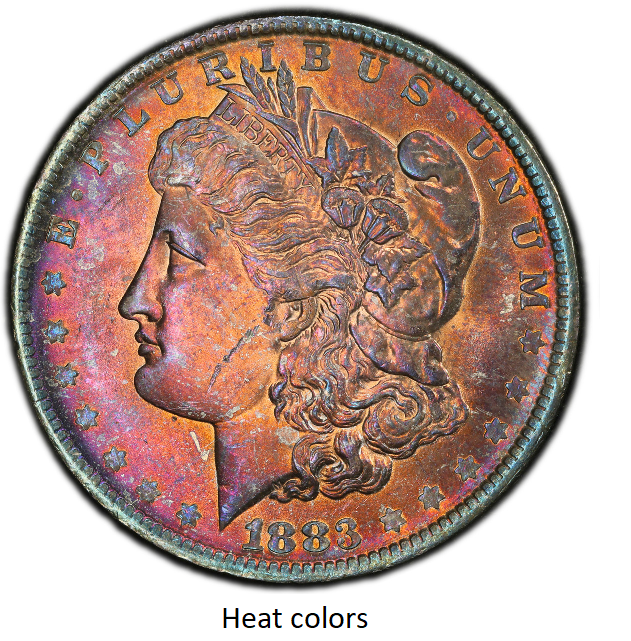
This Sulphur/egg/heated colors are an easy giveaway that someone tried to doctor a coin. Forced sulfur and egg fumes combined with aggressive heat typically produce an unscientific or “screaming” palette dominated by yellow, burnt orange, deep magenta, and dull blue.
Black/Terminal
Advanced oxidation that can hide coin details, often reducing desirability. You can find plenty of these once beautifully toned American Silver Eagles that crossed over from old green PCI holders to PCGS, with the Gold Shield interacting again with the toning until it goes terminal. You can see that with crossed over coins that had TrueView:
If you like posts like this, subscribe so you can be informed whenever there is a new article or column.
Proxiblog also has thousands of followers on Facebook Coin Groups and other social media. To get the latest discussion and commentary, be sure to friend us by clicking here.
You can find more information about types, varieties, errors, grading, bidding and buying in Coin News Updated: The Essential Guide to Online Bidding. Please consider buying or gifting the work for a friend, as it underwrites this hobbyist blog. Thank you.
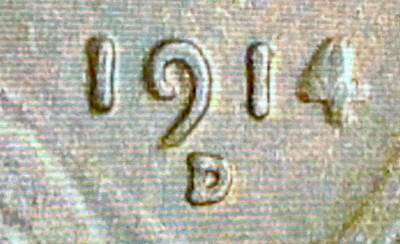
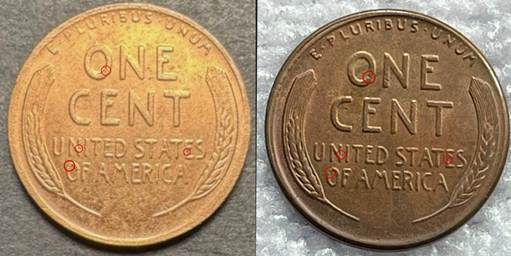
Prompting this article is a 1914-D cent that a friend shared in a large Facebook coin group. After I explained that this was not genuine, I received additional closeup images for analysis.
A closeup image of the date and mintmark shows this coin is not a genuine 1914-D. The shape and placement of the mintmark is incorrect. This, however, is not the case of an altered date or an added mintmark; the entire coin is counterfeit.
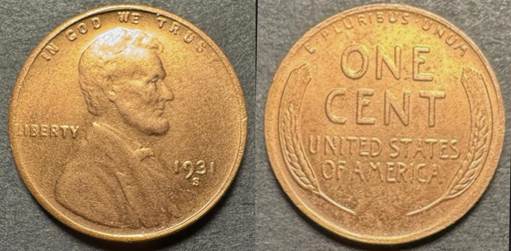
This 1931-S had surfaced on eBay within the last few months. Comparing both reverses it is clear these were produced from the same makers and related to a large “family” of counterfeits. I’m calling this family “Notched O.” More on that momentarily.
The image quality of the 1931-S is subpar, leaving blurry images, yet enough to discern the repeating marks.
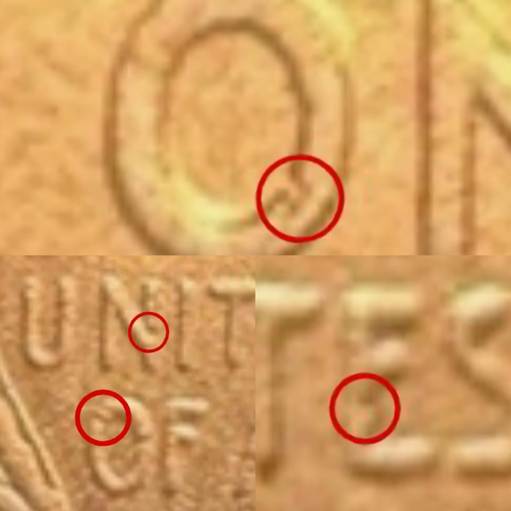
“Common marks” highlighted in Red:
Depression in O
Dent in “N” as well as the “O” in the word OF
Small indent of the “E”
At this writing I’ve only seen this on both 1914-D and 1931-S. Likely this exists on many key and semi key dates as well.
To check if your coin may belong to this “fugazi” (i.e. “fake”), look for those common marks highlighted above in red.
If you like posts like this, you can read more articles on counterfeit coins by Jack D. Young, Jack Riley and Michael Bugeja at this URL. Also, please subscribe so you can be informed whenever there is a new article or column.
Proxiblog also has thousands of followers on Facebook Coin Groups, YouTube and other venues. To get the latest discussion and commentary, be sure to friend us by clicking here.
You can find more information about errors and varieties as well as buying and bidding on coins in Coin News Updated: The Essential Guide to Online Bidding. Please consider purchasing the work for yourself or a friend, as it underwrites this hobbyist website. Thank you.
If you are in the market for fabulous toned coins, think about Tidy House and American Savings lots whose cardboard produces rainbow patinas.
But there are pitfalls, too. Unscrupulous sellers keep the toned coins and swap lesser or doctored coins.
This article showcases the type of toning you might find with original offerings.
Tidy House Dollars
“Tidy House dollars” are Morgans used in a promotional campaign by the Tidy House Products Company, a cleaning products company, in the 1960s.
The company reportedly acquired a large number of common-date Morgan silver dollars, mostly from the New Orleans (O) mint from the 1880s, from a U.S. Treasury hoard. These coins were sealed in a cardboard holder with an advertising description.
Toning is the main reason “Tidy House dollars” are collected. Coins in the cardboard develop rainbow patinas, as in this example from my collection:
I sent to PCGS and got this grade and TrueView:
But what to do with the now-empty Tidy House holder? You should save the holder after you slab your coin and then, when ready to sell it, show if as this seller did on eBay:
Don’t be fooled by Tidy House holders with coins having no patina. Those probably have been swapped out. You want to buy original ones with rainbows. Otherwise, let the lot go.
And keep in mind that Tidy House only holdered Morgans, not Peace dollars, as in this artificially toned one that I wrote about at Coin World.
In addition to Morgan dollars, Tidy House also holdered 1964 JFK Half Dollars. Those, too, usually have magnificent toning. Here’s an example from one of my Tidy House purchases:
Here’s an offering with all the paperwork and obviously swapped out coins.
American Savings Dollars
American Savings and Loan” banks, especially in Texas, also ran promotions using silver dollars, especially 1979-S Morgans, from a bank bag purchased from the Mint in the 1960s. These have exceptional toning.
I purchased this one in 2022:
Here’s how it graded:
I use the TrueView for my Proxiblog logo.
The empty holder is in my office drawer.
As with the Tidy House dollar, do not purchase any American Savings dollar that lacks toning or has ugly or doctored patina. If the coin exhibits wear, it didn’t come from the bank bag, as this coin, which is AU and has been cleaned and retoned:
If you like posts like this, subscribe so you can be informed whenever there is a new article or column.
Proxiblog also has thousands of followers on Facebook Coin Groups and other social media. To get the latest discussion and commentary, be sure to friend us by clicking here.
You can find more information about types, varieties, errors, grading, bidding and buying in Coin News Updated: The Essential Guide to Online Bidding. Please consider buying or gifting the work for a friend, as it underwrites this hobbyist blog. Thank you.
No one is exactly sure how this variety happened, but the US Mint–under pressure then to produce billions of coins–mistakenly used the reverse of a 1968-S Proof Dime for the reverse of 1969-P, 1970-P and 1970-D Roosevelt business strikes. The official variety is known as 1969 rev. of 1968, 1970 rev. of 1968 and 1970-D rev. of 1968 (FS-901).
The FS-901 refers to a catalog number identified by Bill Fivaz and J.T. Stanton, co-authors of the Cherrypickers’ Guide to Rare Die Varieties of United States Coins.
“Reverse of 1968” on these three dimes is a numismatic variety recognized by all major holdering companies. The 1968 reverse shows two distinct, well-defined, and sharp valleys in the torch flame, whereas the business strike reverse has a less defined, blurry flame.
The 1969-P FS-901 is generally considered the rarest of the three with about 15 holdered by PCGS. 1970-D FS-901 is the most common with about 30 holdered by PCGS. About 20 for the 1970 rev. of 68.
All of these varieties can be found in rolls, although they are very scarce.
While this is a rare variety by population data, PCGS values remain low, ranging from $50-100.
You can find the variety on eBay selling about the same or higher, although the coins are unholdered, as in these examples:
If you are a dime roll hunter, keep your eyes peeled for other Roosevelt dime varieties:
As you can see, there are not many varieties for Roosevelt dimes, but click the links above and go to Proxiblog for articles explaining die markers.
If you like posts like this, subscribe so you can be informed whenever there is a new article or column.
Proxiblog also has thousands of followers on Facebook Coin Groups, YouTube and other social media. To get the latest discussion and commentary, be sure to friend us by clicking here.
You can find more information about types, varieties, errors, grading, bidding and buying in Coin News Updated: The Essential Guide to Online Bidding. Please consider buying or gifting the work for a friend, as it underwrites this hobbyist blog. Thank you.
As a member of several Facebook coin groups, I see 1943 P/D/S replicas and, on occasion, die struck Chinese counterfeits. Yet many new collectors claim to have found these ultra rarities, believing they struck it rich. They have been informed by click-bait posts and videos telling viewers that these rarities will turn up in rolls and pocket change.
What turns up are replicas, altered dates, copper plated steel cents and die-struck copper counterfeits.
Approximately 40 copper-alloy cents were accidentally minted across all three U.S. Mints (Philadelphia, Denver, San Francisco) in 1943. The 1943-D is the rarest (1 known), while 1943-S (San Francisco) is exceptionally rare (fewer than 5 known). Some 20+ 1943 cents are said to exist.
Types of Fake Coins
Copper plated zinc cents cost less than $10 on Etsy and other sites. These are replicas, as in the photo below.
Chinese counterfeiters have perfected their craft making fake 1943 P/D/S “copper” cents.
Common production methods include:
Striking on Non-Magnetic Blanks: Counterfeiters use copper or bronze blanks to strike fake coins. Unlike genuine 1943 steel cents that are magnetic, these fakes will not stick to a magnet as if genuine copper.
Transfer Die Technology: Counterfeiters often use transfer dies, taking a genuine 1943 steel cent and pressing it into a heated, metal to create an exact negative image of the coin. Then they strike copper or bronze copies.
Copper Plating: Counterfeiters also take common 1943 steel pennies and coating them in a thin layer of copper. These, however, will still be magnetic.
Date Alteration: Some forgers take genuine copper pennies from 1945, 1948, or 1949 and manually rework the last digit into a “3.”
The latest threat involves advanced operations in China with minting equipment on par with the US Mint.
Simple detection methods include using
A magnet. If the coin sticks to it, it isn’t copper.
A coin scale to see if your specimen weighs 3.1 grams. (Steel cents weigh 2.7 grams.)
A lupe to view the date and to detect if it has been altered.
Here’s an example of a 1948 cent altered to look like a 1943 copper cent weighing 3.1 grams and passes the magnet test:
1943 Copper Cent
A more advanced method to detect counterfeits concerns die markers.
This person claims to have found a 1943 copper cent below. The date on genuine copper and steel cents are the same. Also, on the 1943 cent, the word “liberty” is strongly struck without die deterioration. Here is his counterfeit:
Here’s how to check using die markers:
As you can see, the “9” in the counterfeit is lower than the “9” of the steel an genuine cent.
1943-D Copper Cent
Only one 1943-D Copper Cent has been found. Again, the market is flooded with thousands of replicas and counterfeits.
A genuine 1943-D copper cent would have the exact same date position as a 1943-D steel cent. Because both coins were struck using the same dies, the alignment and shape of the digits must be identical.
This fake was posted on Facebook:
You can see that the date and mintmark differ from the sole authentic one:
The counterfeit is also affirmed when compared with the date and mintmark position of the 1943-D Steel Cent:
1943-S Copper Cent
Genuine 1943-S copper cents are very rare, with fewer than 5 known. Look for faint doubling on the date and die scratches near the motto and wheat stalks.
Another die marker on some 1943-S copper cents is a tilted “S.”
Odds of finding any of these ultra rarities are minimal. Consider the tens of thousands of replicas, altered dates, plated steel cents and die-struck counterfeits as opposed to the handful of genuine rarities that actually have been slabbed. Nevertheless, if you still believe you have one of the dozen or so lost genuine 1943 copper cents, send to PCGS, CAC, ANACS or NGC for the verdict.
If you like posts like this, subscribe so you can be informed whenever there is a new article or column.
Proxiblog also has thousands of followers on Facebook Coin Groups, YouTube and other social media. To get the latest discussion and commentary, be sure to friend us by clicking here.
You can find more information about types, varieties, errors, grading, bidding and buying in Coin News Updated: The Essential Guide to Online Bidding. Please consider buying or gifting the work for a friend, as it underwrites this hobbyist blog. Thank you.
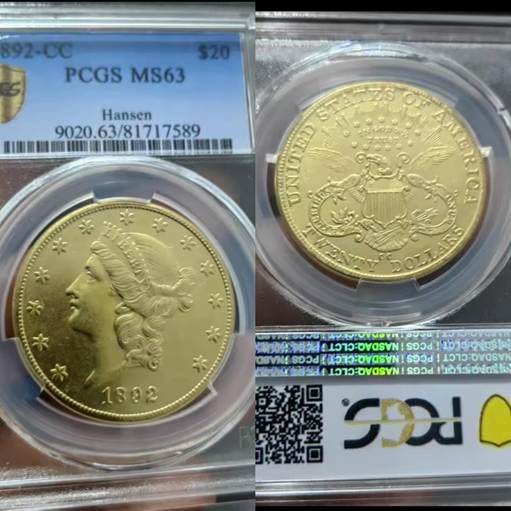
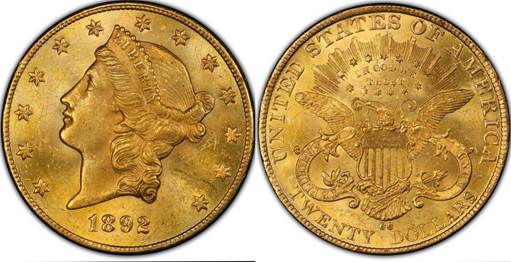
Counterfeiters aren’t numismatists. They often use incorrect design types that are impossible for a given coin and do not understand how third party grading services holder the coins they certify. This example may take the cake! A counterfeit 1892-CC $20 Gold piece in a fake PCGS holder. Not just any holder, a holder pedigreed to D.L. Hansen!
Let’s view the counterfeit example compared to the genuine one below that from Hansen’s collection.
When you compare the two, it is very clear that they are not the same coin. One can see the CC position is incorrect along with a large lump on the ribbon.
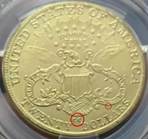
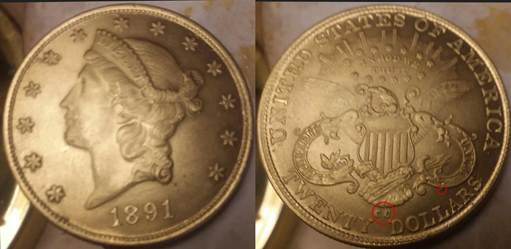
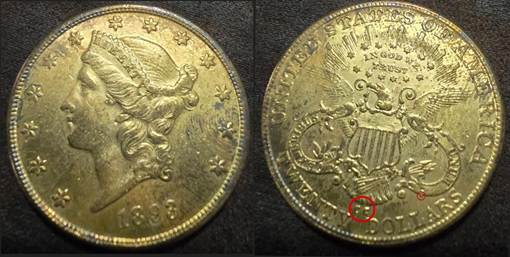
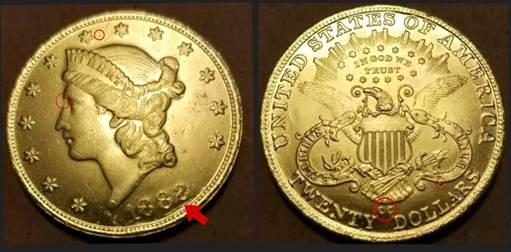
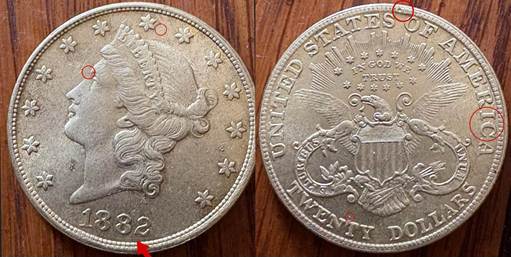
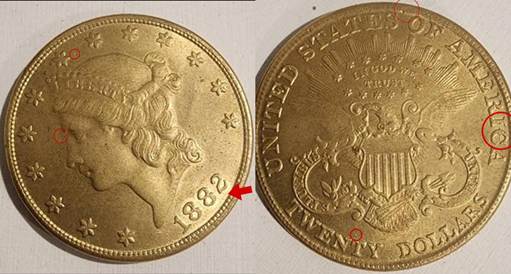
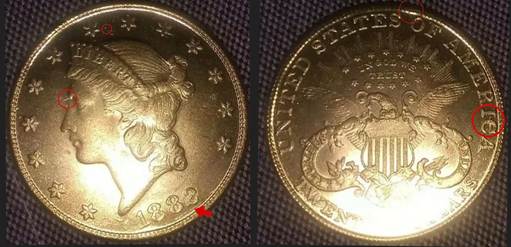
The “Family” is likely very extensive and many dates have been noted sharing this common reverse. Additional images shared below are from an 1891-CC coin as well as an 1893-CC. These were recently shared to a large Facebook group where they got mixed reviews.
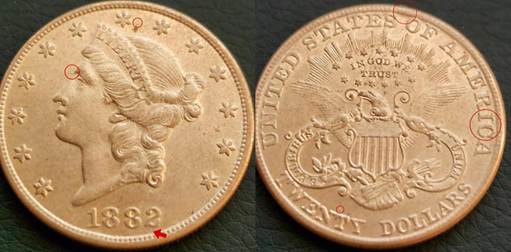
Now to the connection between the common reverses. This 1882-CC shares the “common reverse.” The obverse is very distinct as well for this date. The 1882 date was interchanged with both P and CC mint reverses. Noteworthy: the surface lump above Liberty’s head, spike protruding from the bridge of the nose, and a raised line under the date.
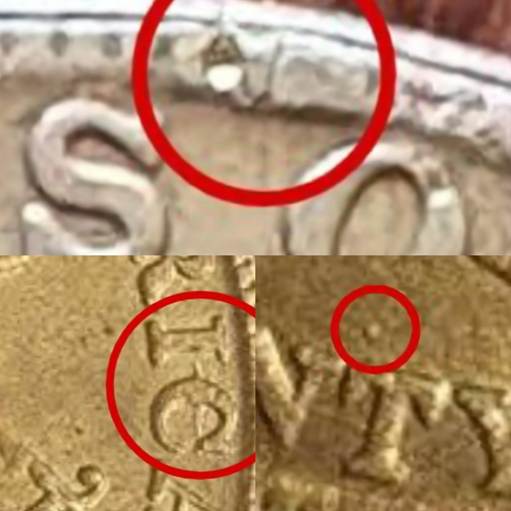
Interesting occurrence with the Philadelphia reverse is that it was later tooled to repair the denticles. The first two images show a depression along with the deformation of the denticles at approximately K12.
The next two images show the deformed denticles but no indentation within them.
“Common” P reverse
Closeup images of markers include:
Deformed Denticles with a depression, later was repaired
Spike through “C”
Small field dot above “T”
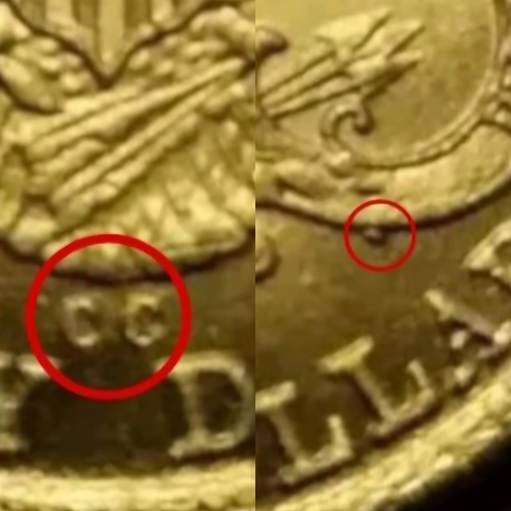
“Common” CC reverse
Closeup image of repeating marks include:
CC centered above denomination
Small chip above “DOLLARS”
If you purchase a counterfeit coin, especially one as expensive as a $20 gold one, contact the seller for a refund. If the seller refuses to accept a return for a counterfeit coin, immediately initiate a dispute with the payment platform (eBay, PayPal, or credit card company) for an “item not as described,” as counterfeit items are illegal to sell. Document the fraud with professional authentication, and if necessary, report the seller to the U.S. Secret Service or local law enforcement.
If a dispute cannot be resolved, and you report the fraud to the U.S. Secret Service, you may be required to turn the coin over to authorities. In any case, never attempt to re-sell the coin, even if you disclose that it is a counterfeit.
If you like posts like this, you can read more articles on counterfeit coins by Jack D. Young, Jack Riley, John Lorenzo and Michael Bugeja at this URL. Also, please subscribe so you can get our weekly newsletter and be informed whenever there is a new article or column.
Proxiblog also has thousands of followers on Facebook Coin Groups, YouTube and other venues. To get the latest discussion and commentary, be sure to friend us by clicking here.
You can find more information about errors and varieties as well as buying and bidding on coins in Coin News Updated: The Essential Guide to Online Bidding. Please consider purchasing the work for yourself or a friend, as it underwrites this hobbyist website. Thank you.
Many hobbyists recommend holdering coins only if they are valuable enough without considering other reasons listed here.
True, the cost to grade can be prohibitive for some collectors. Top companies charge anywhere from $25-38 per coin in addition to fees for membership, handling and mailing, with additional fees for error coins, varieties, special labels or quicker turnaround times.
If cost is not a factor, you might consider holdering a coin for reasons other than inherent value.
Authenticity
A slab provides assurance that a coin is genuine, reducing the risk of purchasing a counterfeit. China exports hundreds of thousand fake coins each year to the United States, especially ones with a Carson City mintmark. If you holder the coin with PCGS, NGC, ANACS, CAC or ICG, you will have a unique barcode or serial number, allowing collectors to verify the coin’s details. Additionally, PCGS and other companies embed security chips to guard against counterfeiting.
Storage
Slabs are sonically sealed in hard plastic, protecting coins from physical damage, such as scratches and drops, as well as environmental damage. Companies also sell containers for compact storage. What’s more, you can share your love of the hobby with family and friends, letting them hold the slabs without your worrying about the coins being improperly handled.
NGC offers some of the most advanced coin holders in a range of sizes to fit virtually every coin ever struck. The company writes, “Designed for long-term preservation and protection, the NGC holders are comprised of high-quality inert materials” with security features. “Collectors, dealers and even the Smithsonian Institution trust NGC holders to protect their most treasured rarities.”
Photography
Top holdering companies also provide photos of coins, sometimes for an additional fee. This is especially important for toned coins. For example, PCGS does a fine job enhancing the rainbow of colors that grace the patina. Photos are important if you keep your collection in a bank box or live somewhere else (i.e. a college student away from home) allowing you to see your coins when and where ever you wish.
PCGS TrueView images are perfect for toned coins like this:
Family
A “family” of coins share common design elements, denominations, mintmarks or thematic characteristics within a series. For instance, you may want to collect all five 1878 Morgan dollars or W-mintmark Quarters or perhaps an example of various errors or varieties, as in the seven 1982 cents or 1942-45 silver war nickels. In these cases, a slab’s labeling is important as you assemble the family of your choice.
Set Assemblies and Registries
A complete date and mint mark set of Morgan Silver Dollars (1878–1921) usually contains close to 100 coins. Because there are so many, some hobbyists prefer year sets. Other assemble sets of a specific mintmark, such as all the coins minted in San Francisco or Carson City. A date and mintmark set of Peace Silver Dollars (1921–1935) consists of 24 coins. Regardless of the set in question, collectors may include a lesser value coin in a holder merely to complete the set in question.
Veteran hobbyists also may participate in set registry competitions, again requiring every coin or variety in the series. One of the most popular PCGS set registries are “low-ball” ones featuring the most worn coins.
Selling
It is often easier to sell, trade, or auction a coin that is already certified, particularly online or to collectors who cannot inspect it in person. Some large auction companies such as GreatCollections or Heritage may require you to holder your coins before they will list them in their catalogs. If you holder with PCGS, NGC or CAC, your coins can be sold sight unseen because of the consistency and quality of the grading.
GreatCollections even notes certification in his banner: “Certified Coin and Paper Money Auctions.”\
Provenance
Serious hobbyists often are concerned about provenance of specific rarities. But even damaged or heavily worn coins may be family heirlooms, such as a grandfather’s “pocket piece.” A coin with deep personal history can be preserved in a “perfect” state by slabbing it, even if it is not especially valuable.
In the past, family members might have passed down coins that they wore as jewelry. This was especially popular in the 19th Century. Here’s a perfect candidate for a slabbed personal heirloom, an 1885 20th Anniversary medal commemorating Abraham Lincoln’s death.
Many collectors prefer raw coins to slabbed ones because they want to hold history. There certainly is a place for that. Just keep some of the low-ball Morgan dollars, for instance, so friends and children can feel the heft of the silver.
If you like posts like this, subscribe so you can be informed whenever there is a new article or column.
Proxiblog also has thousands of followers on Facebook Coin Groups, YouTube and other social media. To get the latest discussion and commentary, be sure to friend us by clicking here.
You can find more information about types, varieties, errors, grading, bidding and buying in Coin News Updated: The Essential Guide to Online Bidding. Please consider buying or gifting the work for a friend, as it underwrites this hobbyist blog. Thank you.
There are many ways to figure the worth of a coin. Follow this step-by-step method, answering these questions along the way:
Is it certified?
Do you know denomination, series, strike?
Do you know the mintmark?
Do you know the Sheldon Scale?
Can you identify your coin on the Sheldon Scale?
Can you spot flaws affecting value?
Are you ready to estimate value now?
Do you know how to establish silver melt?
Is it certified?
If you have a coin certified by PCGS, NGC, ANACS, CAC and ICG, simply go to their verification sites and input the certification number on the label. Here are links:
Even though these holdering companies all have certification websites that show the exact coin, grades for each are not equal. For instance, compare an 1883 MS66PL Morgan in an ICG slab with the same grade and condition for a PCGS Morgan. The ICG coin has disqualifying marks that may be a scratch and rim ding. I also do not think the ICG coin is prooflike. It may just have a good caftwheel.
In general, PCGS, NGC and CAC are top tier. ANACS a close second. ICG considerably less.
If you have a coin holdered by another company, consider the coin inside “raw” or unholdered.
Do you know denomination, series, strike?
You need to identify these features, which every coin has:
Denomination Definition: The face value of a coin, or the specific amount of money it is meant to represent. Example: Common U.S. circulating denominations include 5 cents (nickel), 10 cents (dime), and 25 cents (quarter).
Series Definition: A series is the complete set of a specific coin design, minted over a period of years, usually including all dates and mint marks. Example: Lincoln Cent Series (1909–Present): Includes every date/mint combination of the Lincoln penny.
Strike Definition: Refers to the method of manufacturing used to create the coin. Types of Strike:
Circulation Strike (Business Strike): Coins made for everyday commerce, usually produced quickly in high volumes.
Proof Strike: Coins made for collectors, typically with higher pressure, multiple hits, and polished dies to create a mirror-like field and frosted design.
Special Mint Strike (SMS) / Burnished: Specific, high-quality finishes used for special sets.
Do you know the mintmark?
These are mintmarks for US coins identifying the facility of manufacture:
P – Philadelphia, Pennsylvania: The primary U.S. Mint. Most coins from Philadelphia historically had no mint mark, but the “P” now appears on most denominations except the penny. D – Denver, Colorado: Operating since 1906, this mark is found on most modern circulating coins. S – San Francisco, California: Since 1975, primarily produces high-quality “proof” sets for collectors. W – West Point, New York: Established as a mint in 1988, it mostly produces bullion and special collector coins.
Historic U.S. Mint Marks: These letters appear on older coins from facilities that are no longer in operation. C – Charlotte, North Carolina: Produced gold coins only from 1838 to 1861. D – Dahlonega, Georgia: Also produced gold coins only from 1838 to 1861 (not to be confused with the modern Denver “D”). O – New Orleans, Louisiana: Struck gold and silver coins intermittently from 1838 to 1909. CC – Carson City, Nevada: Famous for silver dollars, operating from 1870 to 1893.
Once you know the denomination, series and strike, you can go to PCGS CoinFacts to find the location of the mintmark.
Do you know the Sheldon Scale?
The Sheldon Scale is a 70-point numerical system to determine a coin’s condition and market value, ranging from 1 (Poor) to 70 (Perfect Mint State).
There are two main types of condition: circulated and uncirculated. Numbers 1–59 (Circulated), from poor to almost uncirculated.
Intermediate grades are Poor, About Good, Good, Very Good, Fine, Very Fine, Extra Fine, About or Almost Uncirculated, Uncirculated.
Here is a nifty chart for numbers and condition.
Can you identify your coin on the Sheldon Scale?
Identifying the condition is subjective, even for veterans; but you can come close if you compare your coin to the denomination, series and strike on PCGS Photograde, which provides photographs that you can use for comparison.
Example:
You have to compare obverse and reverse, but for purposes here, we’ll just do obverse.
Underestimate when you compare your coin to one on Photograde, adjusting for personal bias. In this case, you may be tempted to think your coin is almost uncirculated. But a strict comparison puts it in the Extra Fine category, somewhere between Very Fine 35 and XF45. Let’s go with XF45
Can you identify flaws affecting value?
There are dozens of possible flaws on a coin that lower value or prevent it from being “straight graded” (a numerical score). Here are major ones:
Cleaning: Harsh abrasive cleaning or polishing that damages the surface.
Environmental Damage: Corrosion, excessive toning, or verdigris.
Physical Damage: Major scratches, rim dents, or metal movement.
Altered Surfaces: Applying substances like wax, putty, or lacquer to hide flaws.
Questionable Color: Artificial re-toning, often used to make a coin look more attractive.
Filed Rims: Rims that have been filed to smooth out dents or damage.
Any one of the above flaws will reduce the value of your coin, depending on severity. In many cases, that is 25-50% of estimated worth.
Are you ready to estimate value now?
You know the denomination, series, strike and mintmark. You know the Sheldon Scale and have estimated the grade using PCGS Photograde. You eliminated possible flaws and think your coin can be straight graded.
Let’s continue with the 1900 Morgan Dollar at XF40:
Go to PCGS CoinFacts for retail and auction values for such a coin.
The retail value here is $85 (due at the time in part to the high price of silver). But only 20 have been slabbed at that grade, meaning it probably wasn’t worth the cost of grading. That is confirmed because there are no recent auction sales listed at that low grade.
Your coin is silver melt.
Do you know how to establish silver melt?
Here is the formula:
Multiply the item’s total weight (in troy ounces) by its purity percentage, then multiply that result by the current spot price of silver.
Again, let’s use that 1900 Morgan Dollar.
Morgan dollars (1878–1904, 1921) contain 90% silver and 10% copper, with a total weight of 26.73 grams, resulting in 0.77344 troy ounces of pure silver per coin.
The current market value for one troy ounce of silver, which changes frequently, happens to be $109 (during a spike in that precious metal). Thus, the silver melt value of your Morgan is 0.77344 times $109 = $84.30.
Keep in mind that coin dealers usually only buy 10-15% under silver melt. So you’re looking at about $71, depending on your buyer.
If you like posts like this, subscribe so you can be informed whenever there is a new article or column.
Proxiblog also has thousands of followers on Facebook Coin Groups, YouTube and other social media. To get the latest discussion and commentary, be sure to friend us by clicking here.
You can find more information about types, varieties, errors, grading, bidding and buying in Coin News Updated: The Essential Guide to Online Bidding. Please consider buying or gifting the work for a friend, as it underwrites this hobbyist blog. Thank you.
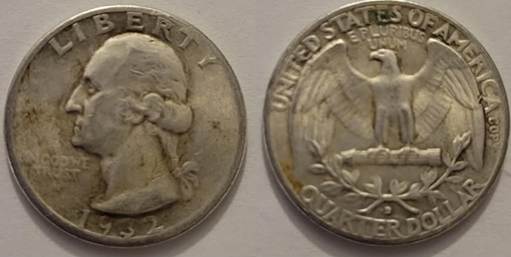
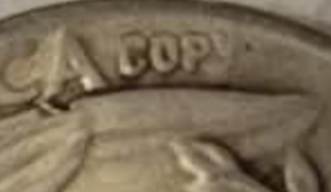
This article stems from a “copy” stamped key date 1932-D Washington Quarter. This abides by the Hobby Protection Act and isn’t to deceive anyone. As we know, counterfeiters don’t abide by the law!
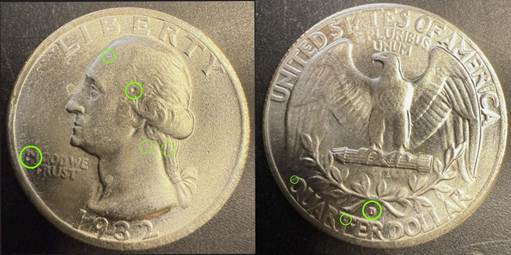
The next example was sent to me by a friend. Highlighted obverse markers match the previous “copy.”
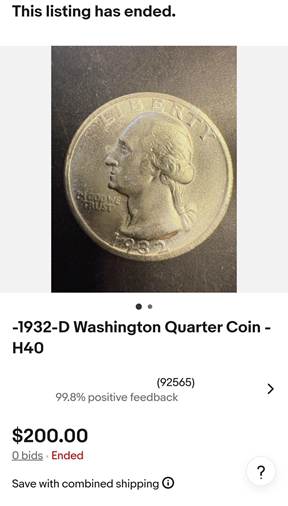
An example surfaced on eBay from a rather large seller. After a brief discussion with them showing this to be a counterfeit they removed the listing. The obverse shares a couple repeating marks, but we see additional ones to be used in the future. The reverse is a match to the example shared to be by a fellow collector.
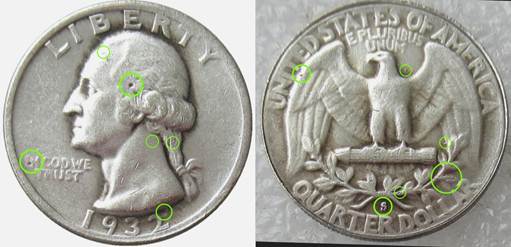
Another internet venue provides us images of a 1932-S that shares this “common obverse.” Highlighted in green are repeating marks for this reverse.
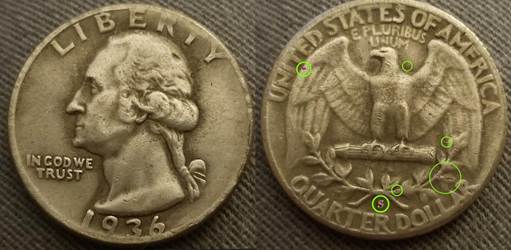
It isn’t only key date coins that counterfeiters target! This 1936-S shares the same reverse as the aforementioned 1932s.
Keep in mint that shopping venues Temu and Etsy sell thousands of replicas, some die struck, further eroding the hobby market.
It is also important to learn die markers for the 1932-D and S key dates. Click here for that.
f you like posts like this, you can read more articles on counterfeit coins by Jack D. Young, Jack Riley and Michael Bugeja at this URL. Also, please subscribe so you can be informed whenever there is a new article or column.
Proxiblog also has thousands of followers on Facebook Coin Groups, YouTube and other venues. To get the latest discussion and commentary, be sure to friend us by clicking here.
You can find more information about errors and varieties as well as buying and bidding on coins in Coin News Updated: The Essential Guide to Online Bidding. Please consider purchasing the work for yourself or a friend, as it underwrites this hobbyist website. Thank you.
The 1956 Franklin Half Dollar was struck with two different reverse designs, Type I and Type II, concerning the small eagle on the reverse. Type I features four distinct feathers to the left of the perch, while the Type II shows only three visible feathers. Both types were minted, with Type I used for both circulation strikes and proofs, and Type II primarily used on proofs.
The reason for this post is the value of Type I proofs. This design was exclusively for business strikes. That makes proofs with this design valuable. For instance, in mint state PR64, type I retails for $210 while Type II goes for $44.
As you can see, identifying Type I will bring huge value that only increases with if cameo or deep cameo. At gem PR65, Type I cameo retails for $225 and deep cameo, $975; compare to Type II, cameo PR65, $67, and Type II, deep cameo, $165.
Here’s how to tell, compliments PCGS CoinFacts:
You can count those feathers as die markers. But an easier way is to note how Type I has a poor strike, not showing the complete feathers:
That’s where to look.
The best way to find Type I is via proof sets, which typically go for $50:
You will need magnification on sets like the one above to see if the offering is Type I or II.
You can find Type I on eBay because the seller doesn’t know what he has:
If you use a photo app to expand the photo, you’ll see this is Type I:
If you like posts like this, subscribe so you can be informed whenever there is a new article or column.
Proxiblog also has thousands of followers on Facebook Coin Groups, YouTube and other social media. To get the latest discussion and commentary, be sure to friend us by clicking here.
You can find more information about types, varieties, errors, grading, bidding and buying in Coin News Updated: The Essential Guide to Online Bidding. Please consider buying or gifting the work for a friend, as it underwrites this hobbyist blog. Thank you.