“NOT PCGS” Draped Bust $


By Jack D. Young

During a normal internet dumpster dive for counterfeits I spotted this listing on AliExpress–an obvious “Red Book Counterfeit”–due to the off-center bust design only used on a 1795 dated variety.

A “Red Book Counterfeit” refers to a fake coin that resembles a genuine U.S. coin as illustrated in the reference guide, “A Guide Book of United States Coins.” The Red Book serves as a comprehensive, annually updated price guide that provides detailed information on genuine U.S. coins. But counterfeiters, especially in China, use the volume as a design guide in manufacturing fakes.

As you might expect, AliExpress is owned by the Chinese company Alibaba Group, a multinational technology company that focuses on e-commerce, retail, internet, and technology (seemingly without a care about counterfeit coins).

Here is the AliExpress fake:

Past Ali listed 1796 PCGS draped bust dollar

Checking the PCGS cert number pulled this info up from their website:

PCGS on-line info for the labeled cert #

Not even close to the genuine one!

Comparison images to the genuine PCGS example for the cert #

So, considering a purchase I decided to message a question to the seller, “Lucy Coins Store,” which has been on Ali for several years. I was the first to report that this seller houses counterfeits in fake PCGS slabs!

And I sent the following note and received the following answer:


And another side note: I have purchased “coins” from the other sellers listed there and received refunds due to their being “not as described” and reported counterfeits.

I decided to purchase it and see what I would receive; and the fake did in fact look like the listed example.

Counterfeit received

Once in-hand, I started the return/ refund process through Ali; having talked with customer service there before they feign no tolerance for selling counterfeits on their venue. I was almost instantly informed my request was denied! So, I submitted another request:


A solution of “no refund” again. They called it “a new proposal.” So, I uploaded more in as much as they noted that I “rejected the solution of AliExpress”; well, yeah. …


And another rejection and so-called “solution”:


Actually, they do have a repeal process which I initiated and sent additional info:

In addition to the 2 side-by-side comparison images I sent this one trying to explain the issue!

Combination image of why this one is wrong!

And again, I was rejected; they did allow me to appeal again.

Appealed through their process

And rejected…


Best I can tell, they really didn’t care the coin is a counterfeit but that it was properly imaged in the listing.

Next step, take it to PayPal! There you can select that you received a counterfeit item and I sent all of the documents I had generated for the Ali report. Unfortunately, I received a pretty quick response that I hadn’t made my case adequately and had 3 days to add information or they would side with the seller.

So, I added some information about counterfeits, including how this bust design was only used for 1795 AND an image I had reported it through the Anti-Counterfeit Education Foundation.


And from there I waited, wondering if I would even get another response. And then:


And so, it ends with this one; it is interesting that when you click on the old sales link you get this, a similar but different counterfeit. But I am not willing to test me luck this time😎!


Latest Ali listing at same seller/ listing location as mine.

I realize that identifying this counterfeit took years of skill compounded by dogged persistence. Some collectors might not know how to identify fakes with die markers. But as Proxiblog’s Michael Bugeja often notes, the Chinese just can’t get the font right (nor understand how and when to use a hyphen [as in “off-center”].)


If you like posts like this, you can read more articles on counterfeit coins by Jack D. Young, Jack Riley and Michael Bugeja at this URL. Also, please subscribe so you can get our weekly newsletter and be informed whenever there is a new article or column.

Proxiblog also has thousands of followers on Facebook Coin Groups, YouTube and social media. To get the latest discussion and commentary, be sure to friend us by clicking here.

Advertisement

You can find more information about errors and varieties as well as buying and bidding on coins in Coin News Updated: The Essential Guide to Online Bidding. Please consider purchasing the work for yourself or a friend, as it underwrites this hobbyist website. Thank you.

How to Sell Coins in 7 Steps

You may have inherited a coin collection or decided to sell some or all of your coins. It is essential to know how to sell your coins; otherwise, you could be low-balled or scammed. Follow these 7 steps, and you reduce the odds of being taken advantage of. And be sure to visit Proxiblog.org, one of the top coin sites on the internet. Subscribe and get our free weekly newsletter.


Walking Liberty Varieties and Doubled Die


There are four varieties and one popular error in the Walking Liberty Half Dollar series with different mintmark placements for the 1917 Denver and San Francisco coins and one 1946 doubled die reverse.

We’ll begin with the mintmark placements. The 1917 Philadelphia half, of course, had no mintmark. But initially, the halves from the Denver and San Francisco mints had the same placements as 1916 D and S. Production began in January. In February, Mint Director F. J. H. von Engelken thought the mintmark under the motto looked like a die defect; so he ordered the mintmark moved to the reverse, thus creating four varieties.

Here is a visual of the four half dollars:


Because production was halted, we know the mintage of each variety: 1917-D Obverse, 765,400; 1917-D Reverse, 1,940,000; 1917-S Obverse, 952,000; and 1917-S Reverse, 5,554,000. Any of the four in uncirculated condition retails in the thousands. Typically, if you’re a bank roll hunter, you will find worn examples. Values for VF30 are 1917-D Obverse, $250; 1917-D Reverse, $285; 1917-S Obverse, $650; and 1917-S Reverse, $150.

The reverse mintmark remained on Walking Liberty Halves coins through 1947, the last year in the series.

A year earlier, the Mint at Philadelphia, a die contained doubled letters on the reverse. PCGS estimates some 3,000 were released into circulation. Here is an illustration:


The doubling here is easy to spot on the “L,” “U” and “R.” An example in Good 4 is worth $50, rising to $110 in VF30 and in the hundreds and thousands in almost uncirculated and mint state.

The popularity of these varieties and doubled die is based on their often turning up in worn condition in bank rolls. Happy Hunting!

If you like posts like this, please subscribe so you can get our weekly newsletter and be informed whenever there is a new article or column.

Proxiblog also has thousands of followers on Facebook Coin Groups, YouTube and social media. To get the latest discussion and commentaries, click here.

You can find more information about errors and varieties as well as buying and bidding on coins in Coin News Updated: The Essential Guide to Online Bidding. Please consider purchasing the work for yourself or a friend, as it underwrites this hobbyist website. Thank you.

Micro Morgan Dollars


Micro mintmarks are valuable and relatively easy to identify if you know how to compare them with their regular counterparts. In this post we will describe two desired ones in the Morgan Dollar series along with counterfeits that hobbyists may not immediately detect.

1899-O Micro O

The 1899-O Micro O’s mintmark is noticeably smaller than regular size mintmarks normally seen on Morgan dollars. Its size would fit well on a Quarter Dollar. Here is a comparison from PCGS CoinFacts:


The normal mintmark is oval shaped and the micro, circle shaped. The micro mintmark is closer to the ribbon of the laurel wreath and farther from the “D” and “O” of “Dollar.” The 1899-O Micro O is not rare, as thousands were released into circulation; however, because of the popularity of the Morgan series, is coveted and also included in registry sets.

If you are interested in VAM designations, which many collectors are, you can find this micro mintmark under several varieties, with popular ones being 4,5,6 and 31. (VAM stands for Van Allen-Mallis, the surnames of the two numismatists, who cataloged die varieties of Morgan and Peace silver dollars.)

Values of the 1899-O Micro O are in the thousands for mint state examples. Almost uncirculated examples retail in the high hundreds. But worn examples, which often are found in auctions and estate sales, sell for a few hundred dollars or less, depending on condition.

1903-S Micro S

The 1903-S Micro S Silver Dollar also has a noticeably tiny mintmark, again, what might be used on a Quarter Dollar. Speculation is the engraver at the Mint used the wrong punch and didn’t realize the error.

Again, the variety is easy to identify as the mintmark (similar font) is roughly about half size of a normal mintmark.


As with the 1899-O Micro O, this variety is relatively plentiful with hundreds slabbed by top third-party grading companies. The VAM 2 variety is especially desired.

Values, even in worn condition, are much higher than the 1899-O Micro O. The 1899-O had a mintage of 12,290,000; the 1903-S, 1,241,000. As such, even at G4, the retail for the 1903-S variety is about $100. Values rise substantially thereafter reaching a $1,000 at VF35 and soaring into tens of thousands in AU58 and higher.

Counterfeit Micro Mintmarks

Micro mintmarks 1896-O, 1900-O and 1902-O are not modern but counterfeited during the time that Morgan dollars were still being minted, making them difficult to detect for the novice collector.

PCGS has a brilliant article about these, which you can access by clicking here. Here is an illustration from that article, compliments PCGS:

PCGS notes that these contain identical linear marks, or lumps, created during the transfer process. A genuine coin would be used to create a working die, leaving lumps and other telltale signs.

Perhaps the most famous counterfeit micro O is the 1901-O Micro O, which many hobbyists actually collect. Like the 1896-O, 1900-O, and 1902-O varieties, these are high-quality fakes. PCGS states, “These fakes are notable for their deceptive similarity to genuine coins, being made of good silver and exhibiting sharp details, especially in higher-grade examples.”

If you like posts like this, please subscribe so you can get our weekly newsletter and be informed whenever there is a new article or column.

Proxiblog also has thousdans of followers on Facebook Coin Groups, YouTube and social media. To get the latest discussion and commentaries, click here.

You can find more information about errors and varieties as well as buying and bidding on coins in Coin News Updated: The Essential Guide to Online Bidding. Please consider purchasing the work for yourself or a friend, as it underwrites this hobbyist website. Thank you.

Family of Fake Indian Cents


By Jack D. Young

A recent counterfeit Indian Head Cent listed on eBay from a larger seller sparked my interest–to the extent that I decided to investigate it, especially since the coin was shared to several Facebook groups.

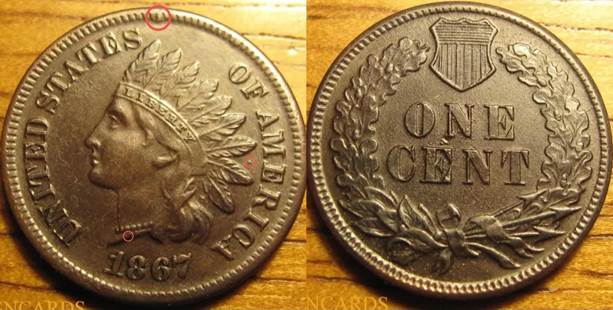
I discovered a rather large “Family” sharing a common obverse. A “Family” is code for counterfeits with common markers among various dates. Most notably, I viewed the deformed denticles at 12 o’clock on the obverse and a raised lump left of “M-E.” The 1867 pictured below is from that larger seller.


The above example also shared a depression in the neck. I recalled seeing this in an NGC article published about 2013 or thereabouts. That article didn’t include these “common marks” rather more of a description of the surfaces.


After browsing online for sometime it was clear this was a very large “Family” and not limited to a few dates. Most examples were either key or semi-key dates but it would be expected this could be seen on common date Indian Cents.

This listing includes the Key date 1877! Along with another 1908s and two semi-key dates including 1866 and 1870. All images highlight the lump on the field between the feathers as well as the deformed denticles.


Some pieces aren’t as deceptive as others but many of these were already in collections! Stay diligent when looking for new coins to add to your collection and research extensively.

If you like posts like this, you can read more articles on counterfeit coins by Jack D. Young, Jack Riley and Michael Bugeja at this URL. Also, please subscribe so you can get our weekly newsletter and be informed whenever there is a new article or column.

Proxiblog also has thousands of followers on Facebook Coin Groups, YouTube and social media. To get the latest discussion and commentaries, click here.

You can find more information about errors and varieties as well as buying and bidding on coins in Coin News Updated: The Essential Guide to Online Bidding. Please consider purchasing the work for yourself or a friend, as it underwrites this hobbyist website. Thank you.

Etsy’s Ripoff Replicas


Etsy, a major seller of coins, has house rules that prohibit fakes, and yet is one of the major distributors of counterfeits and replicas. That, in itself, is not the problem. Scam sellers on Facebook coin sites and online auctions purchase these replicas and then try to pass them off as authentic, hoping to bait new hobbyists who do not know any better.

Here’s an example:


Proxiblog catalogued keydate replicas and is sharing them here. Bookmark the URL and share this post whenever you see someone trying to pass off these items as genuine.


Proxiblog identifies these replicas every day across Facebook coin groups–to the extent that he regularly warns against sellers and scammers who claim these are genuine. Here’s a screenshot of a recent example:


If you like posts like this, you can read more articles on counterfeit coins by Jack Riley, Jack D. Young and Michael Bugeja at this URL. Also, please subscribe so you can get our weekly newsletter and be informed whenever there is a new article or column.

Proxiblog also has hundreds of followers on Facebook Coin Groups. To get the latest discussion and commentary, be sure to friend us by clicking here.

You can find more information about errors and varieties as well as buying and bidding on coins in Coin News Updated: The Essential Guide to Online Bidding. Please consider purchasing the work for yourself or a friend, as it underwrites this hobbyist website. Thank you.

Several Suspicious 1804 “Large Cents”


By Jack D. Young

Before discussing those suspicious cents, a quick definition of an electrotype–a copy of a coin formed by depositing metal onto a mold using electricity. Electrotypes are not considered genuine coins, but rather reproductions. When offered in auctions, they are fake coins.

Here is an example as an acknowledged electrotype sold in a Goldberg 2006 auction:

Images courtesy Goldberg Auctioneers

In the time span from this auction until August 2017, there was another acknowledged example reportedly sold in two different eBay auctions in 2016:


On Aug 2, 2017 another example with many of the matching obverse marks sold on eBay as an electrotype:

eBay Aug 2, 2017 Listed Electrotype Example

During the same time frame as this listing another one was running with matching marks but listed as genuine:

eBay Aug 2017 Listed Genuine Example

 eBay Aug 2, 2017 Listed Electrotype Example      eBay Aug 2017 Listed Genuine Example

Comparison of the latest eBay example listed as genuine to the documented electrotype example from the Goldberg’s 2006 auction shows the same “circulation” marks:

    eBay Aug 2017 Listed Genuine Example             Goldberg 2006 Auction Example- Electrotype

Comparison of the reverse images between these two yields similar results:


Both examples show the same marks and what appear as casting “bubble”/ defects on the surface, “casting” serious doubt that listed example is a genuine 1804 large cent. I sent the seller a number of messages, but I was too late to have him stop the auction.

eBay messages with the author

At the same time another early copper collector (unidentified) was also asking questions:


The weight listed as “11.7 grams” is a red flag as the standard was 10.89! Electrotypes regularly weigh more than a genuine example as a result of the base metal used. So it sold:

Sold as genuine on eBay 2017

The main difference between this and the Goldberg example is this one sold for a whole lot more. And an edge view would have given it away; an in-hand inspection would have been interesting to see if it was oriented correctly to a genuine 1804 large cent.

A genuine example has the reverse rotated as noted in the lot description of the “finest known” example in a past Stack’s Bowers auction:

“This die state is traditionally known as ‘Sheldon-266c,’ with substantial cuds over RTY of LIBERTY and MERIC of AMERICA, the last of the three main die states. Clash marks are seen at Liberty’s profile and throat, as well as under her hair bow. Breen describes this state as his state IV. Genuine specimens show the distinctive die rotation typical of this variety, with the reverse aligned roughly 45 degrees counterclockwise of proper coin turn.”

The Stack’s example showing the rotation of all genuine examples (and the die breaks of the late state):

1804 S-266 Cent from the Pogue Collection. Image courtesy Stack’s Bowers.

So, now the twist! I had the opportunity to purchase an example at auction this month. That one showed a provenance back to 1987 with a couple of giants in early copper previously owning it.


Reviewing the images, I confirmed it matched the others with the many common “sister marks” and it became a “must have,” not just for my collection but for the research and history of this one.

So, I won the auction and having it in-hand allowed for more observations to document these!

Author’s example and some of the eye-catching common marks!

I had the opportunity to weigh my example; it weighed 12.10 grams versus the mint standard of 10.89 grams.

I also was able to take good images of the edge and evaluate the die rotation of this “copy” versus a genuine one as images earlier with the genuine example:

Proper Die Rotation for this electrotype

Electrotype Edge of this one

And the final “twist”–back to the example sold as genuine in 2017; I decided to ask the seller about it now. He apparently mistook me for the buyer and sent this response.

Well, maybe justice, as they say Karma is a “b**ch.”


If you like posts like this, please subscribe so you can get our weekly newsletter and be informed whenever there is a new article or column.

Proxiblog also has hundreds of followers on Facebook Coin Groups. To get the latest discussion and commentaries, click here.

You can find more information about errors and varieties as well as buying and bidding on coins in Coin News Updated: The Essential Guide to Online Bidding. Please consider purchasing the work for yourself or a friend, as it underwrites this hobbyist website. Thank you.

Fake Family of Type A Reverse Peace Dollars


By Jack Riley

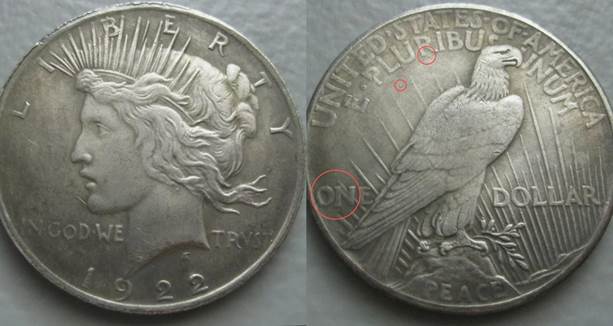
Today we discuss an extensive family of Type A fake reverse Peace Dollars, otherwise known as the 1921 High Relief reverse. We will investigate minor differences in the Type A and B (“Low Relief”) reverses whose diagnostics are key in identifying counterfeits.

First, some background: About 35,401 business strike High Relief 1922 Peace dollars were produced. All but one were melted. Also, 10-20 High Relief proof 1922 coins were made. These are not included in our discussion. Type B reverses appear on Peace dollars dated 1922-28 and 1934-35.

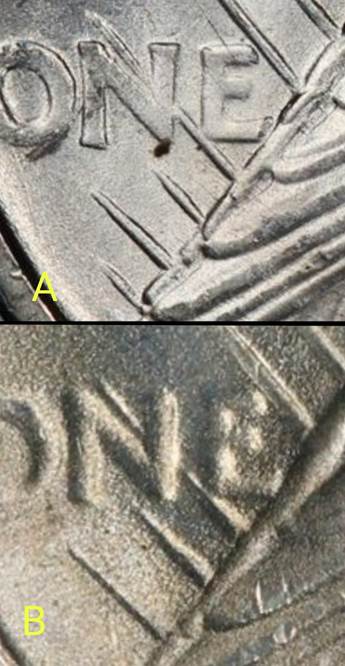
On the 1921 Type A reverse there are 4 rays below “ONE” and on the Type B reverse there are three. Secondly the shape of the leaf cluster is dramatically different. There are other subtle changes but we will use these two as the quick identifiers.


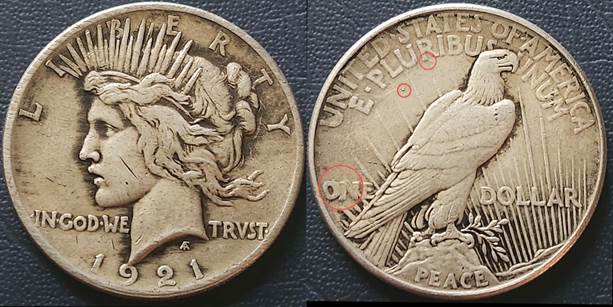
Now onto the “Fake Family”! This is an extensive group of counterfeits spanning various dates with improbable die pairings. The first image is the author’s example with highlighted markers in red. View the strong spread of one, small circular and raised lump between the rays below “L,” and a raised flaw below R. There are additional small depressions in many letters but minute.


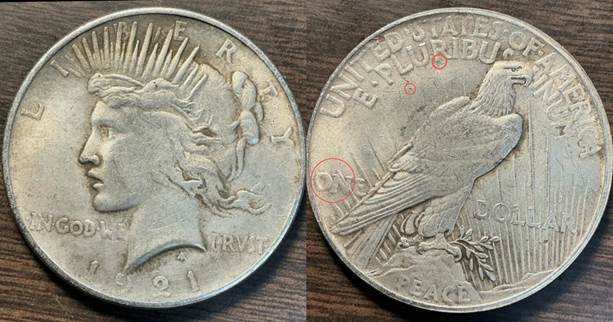
The next set of images are dated “1921” and from various online sources.


The next image was offered on Ebay by a seller who genuinely wasn’t aware the coin was counterfeit. The listing received a number of bids! I messaged the seller and had a brief discussion and they removed it. Owner stated it had been in the family’s collection since the late 1990’s.


On to our “1921” dated pieces. This is an image from fellow counterfeit researcher Jack Young.


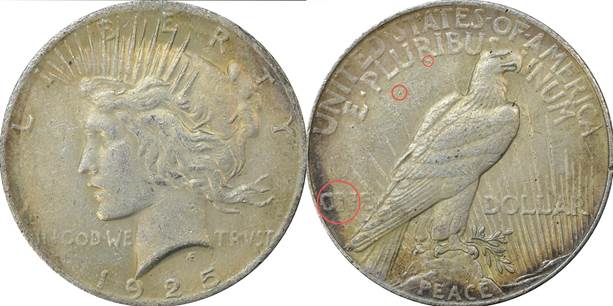
Various dates have been seen mismatched with this common reverse.


Behold one of the more fascinating pieces below. A fellow collector friend Winston Zack shared his 1925 showcasing the common counterfeit reverse and the catch? This piece scanned as 63.5% copper, 28.3% zinc, 7% nickel, 1.2% silver, and traces of iron!


Finally to round out this article, we present two matching counterfeit 1921 Peace Dollar in fake PCGS holders! One which was offered for sale through a Facebook group.


So once again a few of these bypassed numerous collectors who already purchased them or were in the process of doing that. Proxiblog hopes this information gets disseminated so no one purchases any of these counterfeit Peace Dollars!

If you like posts like this, you can read more articles on counterfeit coins by Jack Riley, Jack D. Young and Michael Bugeja at this URL. Also, please subscribe so you can get our weekly newsletter and be informed whenever there is a new article or column.

Proxiblog also has hundreds of followers on Facebook Coin Groups. To get the latest discussion and commentary, be sure to friend us by clicking here.

You can find more information about errors and varieties as well as buying and bidding on coins in Coin News Updated: The Essential Guide to Online Bidding. Please consider purchasing the work for yourself or a friend, as it underwrites this hobbyist website. Thank you.

Roll Hunter Alert: VDB-V Cent


Roll hunters have been finding thousands of a 2023 Lincoln Shield Cent variety featuring a second “V” after the designer initials “V.D.B.,” for Victor David Brenner. 

Top holdering companies PCGS, NGC and ANACS are slabbing this variety. Here’s how it looks:


You can find this error in pocket change, too, providing the coin is almost uncirculated or higher. The extra “V” would be hard to detect in worn coins. You also may need a loupe or magnification to affirm the find.

The Mint isn’t sure how this error happened but suspect it did during the die preparation stage.

Dies are heated to 1,800°F, doused in water and then heated again to make the steel more durable. The die is cleaned and examined under magnification to detect flaws; then it is buffed for a smooth strike.

Experts surmise the extra “V” happened at this stage. A mischievous could have punched the extra “V” into the die or a glitch occurred in the software controlling the die design.

In 2023, Coin World did an exclusive on the VDB-V cent, estimating how many made it into circulation. Paul Gilkes wrote, “Lincoln cent dies are capable of producing in excess of 1 million coins per die pair.” That means you have a great chance of finding one.

Coin World also reported that ANACS has certified 94 examples: NGC, 84 examples; and PCGS, 67. Examples have been graded as high as MS68.

Typically, however, holdered examples will be in the MS64-66 range, like the one below.


Finding the extra V is part of the fun. Prices have been trending downward in the past 1 1/2 years. The early finds were selling for $375-500. But now you can purchase excellent raw examples for under $25.

Because so many were minted, people have found rolls containing 50 of the error. eBay has several sellers offering the variety at basement prices.


If you like posts like this, please subscribe so you can get our weekly newsletter and be informed whenever there is a new article or column.

Proxiblog also has hundreds of followers on Facebook Coin Groups. To get the latest discussion and commentaries, click here.

You can find more information about errors and varieties as well as buying and bidding on coins in Coin News Updated: The Essential Guide to Online Bidding. Please consider purchasing the work for yourself or a friend, as it underwrites this hobbyist website. Thank you.