A woody–woodgrain marks on a coin–is caused by an improper alloy mix whereas similar marks are caused by dirty rollers at the Mint. Woodies are collectible. Roller marks are not.
A woody has irregular, streaky, wood-like toning, usually red brown often mixed with lighter brass-like colors. The lines are uneven, splotchy and on both sides of the coin. They often appear on older Wheat and Indian Head Cents.
Roller marks are easy to identify. They are straight and parallel. They usually appear on both sides of a coin, especially ones minted between 1978-1984.
Here is a handy chart:
Feature
Woody (Improper Alloy)
Roller Marks (Damage)
Appearance
Irregular, splotchy, wood grain texture
Straight, uniform, parallel lines
Color
Varies (Red/Brown/Brass)
Same as the rest of the coin
Depth
Surface toning, usually flush with metal
Shallow, incuse lines (cut into the metal)
Texture
Usually smooth
Scratched, feels textured
Consistency
Random streaking
Uniform, consistent width
Woodies are collectible but values depend on the condition and mintage/rarity of the coin. Most Wheat cents sell for $5-50; Indian cents, $10-75. Uncirculated ones can command high prices–basically, what one is willing to pay. Example:
If you are bidding on or buying a coin, make sure you can tell the difference. Roller mark coins are often mislabeled as woodies. Examples:
If you like posts like this, subscribe so you can be informed whenever there is a new article or column.
Proxiblog also has thousands of followers on Facebook Coin Groups, YouTube and other social media. To get the latest discussion and commentary, be sure to friend us by clicking here.
You can find more information about types, varieties, errors, grading, bidding and buying in Coin News Updated: The Essential Guide to Online Bidding. Please consider buying or gifting the work for a friend, as it underwrites this hobbyist blog. Thank you.
There are all manner of scams by people looking to cash in on collectors who do not know markers for ultra rarities. And when it comes to the 1982-D Small Date Bronze transitional error, there is a desperation by newbies educated by clickbait social media that the third example is out there in pocket change.
Sellers take advantage of such ignorance.
If you are interested in an article about the various types of 1982 cents, including all markers for the transitional error, click here.
But let’s cut to the chase with basic knowledge.
Only two 1982-D Small Date 3.1 grams have been found.
Here’s how they look close up.
Here are markers for the small date.
DO NOT bid or buy any coin that is placed on a scale reading 3.1. You’ll be buying a zinc small date, of little or no value. Or a coin on tinkered scale.
You will see several examples on eBay of sellers showing a regular 1982-D large date bronze cent in a PCGS holder. Sellers think if they claim a regular strike is the small date, you’ll believe it, only because it is holdered by PCGS and you don’t know the markers.
Here’s an example:
Here’s how to decipher.
There are two numbers below the condition. In this case below, 146021.58, means two things: 146021 goes to the CoinFacts designation and the 58, the condition, AU58. In the image below, you can see that the 146021 goes to the regular large date strike.
Here’s another example with the seller claiming this large date is a small date. Again, the 146021 gives it away.
The seller of the above coin did not take kindly to my message that this is a scam.
He doesn’t like his time being wasted. He just wants to waste your money.
Ultra rarities are not found in pocket change; when one is, that becomes a national news story. If you think you found one, do not post it on social media and claim authenticity. If you are so sure, send it to PCGS, NGC, ANACS or CAC. And if you want to buy an ultra rarity, make sure you know how to read the holder company label.
If you like posts like this, subscribe so you can be informed whenever there is a new article or column.
Proxiblog also has thousands of followers on Facebook Coin Groups, YouTube and other social media. To get the latest discussion and commentary, be sure to friend us by clicking here.
You can find more information about types, varieties, errors, grading, bidding and buying in Coin News Updated: The Essential Guide to Online Bidding. Please consider buying or gifting the work for a friend, as it underwrites this hobbyist blog. Thank you.
Several friends notified me of an obvious scam on eBay recently involving a PCGS certified 1882-CC image used by multiple sellers (showing the same origin location) listed for sale at a bargain price.
Past auction listing- I added seller’s reverse image to this
I have written previous articles on these “bait and switch” tactics by MANY eBay sellers using genuine coin images (to help fool artificial intelligence, which needs little help to do currently) to sell counterfeit coins. I have actually purchased a couple in the past just to see what a buyer would get and reported them and received my purchase price back.
So, a couple of bad signs with this listing:
Image of a genuine PCGGS certed example; PCGS shows a value of $450.00.
Listed price $39.99 with 2 sold and more than 10 available.
And the seller’s feedback notes:
Well, at least they show eBay “Verified purchases”!
And while I was reviewing this one 5 other listings with the same stock images but different sellers popped up; I started saving images and organizing my files:
From this I put a note together and sent a message to eBay alerting them about this scam and reported the subject listing.
Note to eBay
I reported them all through the feeble AI reporting process with all coming back as no policy violations including the subject example.
And so I decided to buy this one and see what I would receive.
And I received a typical CN counterfeit CC Morgan with the slashed eagle reverse!
I emailed the seller with no response; looks like he packed up his “shop,” and nothing now listed.
And going back to check the listing and follow-up I find eBay now removed the listing! It did allow me to request a return and leave appropriate feedback for the seller.
Now 3 negative feedbacks for the counterfeit bait and switch!
So we’ll see where this goes from here, as eBay stated they will step in if requested May 1. Pretty sure I won’t hear back from the seller by then.
And he apparently sold MANY of these through several different seller IDs right under eBay’s nose.
And continued reviewing turned up the genuine example and seller the scammers used for their listings:
So, come on eBay! You can do better than this.
We can do better, too, as hobbyists by learning how to identify fakes.
If you like posts like this, please go to our counterfeit archive with reports from Jack Riley, Jack D. Young, John Lorenzo and Michael Bugeja. Also, please subscribe so you can be informed whenever there is a new article or column.
Proxiblog also has thousands of followers on Facebook Coin Groups, YouTube and social media. To get the latest discussion and commentary, be sure to friend us by clicking here.
You can find more information about errors and varieties as well as buying and bidding on coins in Coin News Updated: The Essential Guide to Online Bidding. Please consider purchasing the work for yourself or a friend, as it underwrites this hobbyist website. Thank you.
That same seller also sold 2 mixed rolls of small cents faced with an apparent 1857 Flying Eagle cent to a Face Book friend; it turned out the FE is a known counterfeit, and the new owner posted them and the link to my Coin Week article about them!
The OP noted the counterfeit “tells” for this style counterfeit on his example (circled in red) referencing the Coin Week article attributions.
Bottom image of the OP’s FB post on the subject
Image from the referenced Coin Week article showing other examples with the matching marks:
While reviewing the article for images (I often go back to my own published article for reference while researcher subject “coins”!) I noticed the OP had posted a comment which I responded to.
So, purchased in 2023 and now aware as a result of the article! Ironically the article was published in 2023 as well…
Comments from the subject Coin Week article
2023 and the seller is still “at large” ! I immediately found another listing from him for a similar roll, documented his images and then worked to “win” the auction.
Recent identical eBay roll listing- I won!
So all I had to do was wait for this to be delivered. I was already planning how to document what it is once in-hand, taking images as I worked to uncover the detail I thought would match my friends, but that turned to be too easy a thought…
I was initially pretty confident I would see the “Bad T” in UNITED, but that documented attribution point wasn’t there!
Image from my microscope of my FE in the roll
OK, so what, did the seller actually slip a genuine example in the roll? My plan was failing so I just carefully unwrapped the whole roll and then imaged the contents:
And the FE? 1st thing of note is he is using repeated stock images; mine was positioned differently relative to the roll:
Listing image of the roll on the left, received on the right- date not apparent
And once removed from the roll I immediately recognized it after digging through my article:
Coin received is actually the 2nd counterfeit documented in the article, as noted:
Additional article images
So, now again confident he slipped a counterfeit into the roll I decided to send him a message. My previous attempts on the 1893-O Morgan failed because he doesn’t accept messages but apparently does when a current purchased item is linked.
Yeah, right. … But he did immediately refund my purchase price without involving eBay- a surprise for sure given all of his past responses to negative feedback given.
And he then listed another one, but I found I am now banned by him for any future listings.
Keeping it real, Jack.
If you like posts like this, please subscribe so you can be informed whenever there is a new article or column.
Proxiblog also has thousands of followers on Facebook Coin Groups, YouTube and social media. To get the latest discussion and commentaries, click here.
You can find more information about errors and varieties as well as buying and bidding on coins in Coin News Updated: The Essential Guide to Online Bidding. Please consider purchasing the work for yourself or a friend, as it underwrites this hobbyist website. Thank you.
When looking through my great grandfather’s coin collection I discovered several medals. For those who are not familiar with me or my previous articles, my great grandfather was a bartender in Brooklyn, NY, around 1900. At that time, Ellis Island was admitting people from all over the world, and thus, he took payment of different currencies. I’m sure he also traded and perhaps purchased items that led to a vast collection containing hundreds of coins and medals which hold stories of the past.
First, let’s address what is a medal. We know from winning a contest in school or watching the Olympics that medals can show achievement. We understand today that a gold medal is the most important, then silver and bronze (due to metal value). We know medals have been made throughout history as recognition, often depicting a person or event and can be minted for one person or for the masses. We see this today in the US mint where medals are sold to commemorate the 250th Anniversary of the United States of America.
Medals belong to the genre Exonumia, with medals serving as a major category of this classification. Medals fall into these subcategories: military medals, commemorative medals, souvenir medallions, and, at times, challenge coins.
They can also be contemporary and express social concerns. One of the top medal artists is sculptor Heidi Wastweet who also has served in the Citizens Coinage Advisory Committee of the U.S. Mint. Here is one of her popular medals, “Abbreviated Liberty,” about the power of free speech and the muzzling thereof. Proxiblog publisher Michael Bugeja has the 1st of 40 strikes.
But what about historic medals? Why are they so special? First, expert engravers were needed to work by hand, and perfection was necessary. Second, as Betts notes “medals are original documents in metal.” They are story tellers and tangible connections to the past. They are art, but unlike a historic painting or sculpture in its original form, medals can be reproduced, although die deterioration (having been struck several times) will cause the quality of later medals to diminish. Some medals were only struck once, or a few times, so let’s talk about mine.
I came across this large 67mm, well struck bronze medal that captivated me with its beautiful details and size. After finding out (through the internet) that this was from the Netherlands, I found information was scarce. That is until I found a picture of my medal in gold on the website of Massachusetts Historical Society located in Boston. The website states “This gold medal was presented by the States-General of the United Provinces of Holland to John Adams upon his departure as minister on 6 March 1788. Adams was the first envoy to Holland from the United States. This medal is believed to be the only known 18th century diplomatic medal presented to a United States minister.”
As I examined the pictures, I could see the same engravers mark on my medal.
John Adams’ Gold Medal
Collection of The Massachusetts Historical Society
I eagerly contacted the Historical Society by phone and explained what I had. To my surprise, Susanna from MHS Library Reader Services, said they were interested in the history of mine, as they were identical apart from the metal. I was asked to send an email the details of my medal with pictures. I was delighted to get a response within a week from the Curator of Art & Artifacts, Anne, with information on the engraver and manufacturer, as well as other interesting articles and John Quincy Adams journal entries.
Details and Engraver
The medal’s engraver, Nicolaas van Swinderen, was born in November 1705 in The Hague. His work began in 1720 as a prominent engraver and medalist. He lived on The Lutherse Burgwal (Lutheran Canal/Street) in The Hague, specializing in engraving and cutting dies. His works were often struck in the workshops of other medalists.
Over one hundred of his medals are on display in the Rijksmusum, the Teylers museum, and in the Metropolitan Museum of Art. Although there are several medals like mine (and Adams), I could not find another identical. It is unknown when and who this medal was originally made for, however, you will see that his medal dies remained active even after his death in 1760. The Commemorative Medal given to John Adams was struck using dies from van Swinderen in 1788 by Willen de Koning, a manufacturing jeweler, as Swinderen had passed away 28 years earlier.
Details:
Size: 67 mm
The obverse shows the arms and supporters of the United Provinces (lion wild with sword in shield, surmounted by crown) with the motto, “CONCORDIA RES PARVÆ CRESCUNT”. This translates: “By concord small things increase” and signed “N VS” above PARVÆ.
The reverse depicts the arms of the House of Orange-Nassau, surrounded by seven provinces, entwined with leaves and orange fruit. The motto, “DISCORDIA MAXIMÆ DILABUNTUR” translates to “By discord great things are destroyed”.
Edge: Plain, raised with integral suspension loop. Assay stamp on loop (Betts)
John Adams
(americanacorner.com)
John Adams retired from 2nd Continental Congress in November 1777 and soon went overseas. After spending time in Britain and France, Adams sought American Diplomacy in the Netherlands to secure recognition of American independence. Adams also had the job of obtaining a loan which would provide much needed assistance to the financially strapped colonies and help establish credit for the young nation.
During the 1700’s the Dutch Republic had internal political stress, but it maintained peace. The Stadholder (Dutch: Hoog-Mogenden) referred to the States-General of the United Netherlands. The Princes of Orange held this office and were referred to as “their Mighty Mightiness”. The Hague served as administrative seat of government for the Dutch Republic. Until 1810, when Amsterdam officially became capital. (Britanica)
On October 8, 1782, Adams and Dutch representatives successfully concluded the Dutch American Treaty of Amity and Commerce, primarily dealing with trade, shipping, and other commercial ventures. Adams had also made a successful application for a three-million-guilder (Dutch currency) loan. This would help fund the American Revolution.
In 1787 Adams requested to close his commission and return to America. The president of the assembly (De Wassenaar Caywyke) brought this to their High Mightiness (William V) who granted this resolution. The following is an excerpt from an account regarding the medal:
Whereupon, it having been considered, it seemed good, and was hereby ordered, that leave be taken of the said Mr. Adams, at the same time declaring that his person and conduct have been agreeable to their High Mightiness, and that the usual present of a chain and medal of gold, of the value of thirteen hundred florins, be transmitted to him; the jeweler de Koning having it in charge to prepare the same forthwith.
Passing Down Adams Medal – John Quincy Adams Diary Entries
John Quincy Adams, the son of John Adams, had quite an extensive collection of diaries. The following are excerpts regarding John Adams passing his medal down to his grandson:
27 Sept. 1819: [My father (President John Adams) called me and my son John, who was going away, into his bedchamber,] and gave him a gold medal and chain, which at the close of his Mission to the Netherlands was presented to him by the then existing States-General. My father told my son John, and directed me to remember and witness that he gave him this, rather than his gold-watch, which was a trinket, for the sake of his name; because it was John Adams; and that it should be disposed of for his benefit according to my directions.
Oct. 1819: I told John what I proposed to do with the medal and chain given him by his grandfather. Which is to keep the medal as a memorial of the giver, and to send the chain to the Mint, and have its proceeds vested in Stocks yielding interest, till he shall come of age: with this arrangement, John said he should be satisfied.
In Conclusion
Historical coins, tokens, and medals are fascinating in the history they hold and stories they tell. Although I will never know for whom my bronze medal was struck or where it came from, it led me down a path to history. I certainty did not expect that my research would lead to John Adams and his family, who had a tremendous impact on Early America. I found working with The Massachusetts Historical Society to be a wonderful experience. I will continue to dig further into this medal because I would love to know the origin.
References
“#7 Johnny Goes Dutch.” Hollandsociety.org, 2024, hollandsociety.org/2024/01/7-johnny-goes-dutch/.
“Adams Papers Digital Edition – Massachusetts Historical Society.” Masshist.org, www.masshist.org/publications/adamspapers/index.php/volume/PJA16/pageid/PJA16p265.
Betts, Charles Wyllys. American Colonial History Illustrated by Contemporary Medals. New York: Scott Stamp and Coin, 1894, pp. 275–276.
C.F.A.; Ed. The Works of John Adams. Vol. VIII, Boston, Mass, Little Brown and Co., 1853, pp. 482–483.
The “dropped star” error–technical name, “Struck-Through Dropped Filling”–is easy to detect because a star-shaped device appears in the wrong place. The error, authenticated by PCGS, exists in a 2024-D Kennedy Half Dollar.
Some believe the PCGS example is a “one of one” find, meaning, there may be no other similar error in the series. Or there just be one or more in different places. Here’s why.
The dropped star happens when grease or metal shavings fill the device. The striking continues and eventually releases the plug (also called “mint goop”) so it is struck on a subsequent planchet.
Think of the process as clogging and compacting on one planchet, dislodging and then being struck on a new planchet.
In this Kennedy half case, the star was ejected and appears on his profile. That’s interesting! The star in question was on the reverse and the plug stamped the star on the obverse of another planchet!
Here is a close-up photographed by Jeffrey Flynt who wrote about the find for PCGS.
Flynt has an optimistic outlook for error finders. He writes, “My journey from a routine coin roll hunt to a PCGS-certified ‘Dropped Star Obverse’ discovery coin has been an incredible experience. It highlights that even in the age of modern coinage, exciting and significant finds are still possible if you look closely.”
Keep in mind that the dropped star can also be a dropped number or letter as happened on other coins. For instance, a 2007-D Idaho quarter had an extra incuse “R” between the “R” and “T” in “LIBERTY.” Ken Potter, one of our top numismatists, wrote about this for Numismatic News.
He states, “Up until a few years ago the Dropped Letter error type was rarely encountered but with the Mint’s schedule for striking coins tighter than ever, it appears that routine die cleaning rarely occurs anymore.”
Here’s an example of a 1960-D dropped letter authenticated by PCGS:
Here’s a dropped “D” on a 1976-D Bicentennial Quarter.
Error and variety hunters have patience. They may look for anomalies on thousands of coins before finding an dropped device, number or letter. Unfortunately, there are fake added mintmarks and devices just as there are counterfeit and replica examples. Also, there is PAREIDOLIA, the tendency to perceive images in visual patterns, often leading to misidentification of coin errors.
For instance, “Daniel from CoinHELPu” questions whether PCGS made a mistake labeling this a dropped star. He believes the mark just may look like a star.
Proxiblog will keep monitoring this error, publishing new authenticated finds.
If you like posts like this, please subscribe so you can get our weekly newsletter and be informed whenever there is a new article or column.
Proxiblog also has thousands of followers on Facebook Coin Groups, YouTube and social media. To get the latest discussion and commentaries, click here.
You can find more information about errors and varieties as well as buying and bidding on coins in Coin News Updated: The Essential Guide to Online Bidding. Please consider purchasing the work for yourself or a friend, as it underwrites this hobbyist website. Thank you.
Key date coins are commonly counterfeited and should be viewed with scrutiny. This subject example of a 1916-D Mercury Dime surfaced and what many would call a “one glance” counterfeit.
The mintmark punch for the 1916-D is easily recognizable, along with 4 mintmark positions for genuine coins. This clearly isn’t a genuine mintmark and as one can tell by the surface quality the coin itself is a counterfeit.
This is one seen routinely through various Facebook groups, you would be hard pressed not to see one of these shared weekly. It isn’t just the key dates targeted (although that is the primary targets). Image comparison of a 1916-D, 1921-D, and 1939-D pictured below. A common reverse with a “bad” mintmark and small surface lump to the right of E.
Common markers in Red:
Surface lump to the right of E of ONE
Deformed mintmark shape and placement
Markers In Green indicate features not present on all examples. In this case two cracks running though U in “UNITED” and the A in “STATES”.
If you would like to know more about 1916-D markers, click here.
If you like posts like this, please go to our counterfeit archive with reports from Jack Riley, Jack D. Young, John Lorenzo and Michael Bugeja. Also, please subscribe so you be informed whenever there is a new article or column.
Proxiblog also has thousands of followers on Facebook Coin Groups, YouTube and social media. To get the latest discussion and commentary, be sure to friend us by clicking here.
You can find more information about errors and varieties as well as buying and bidding on coins in Coin News Updated: The Essential Guide to Online Bidding. Please consider purchasing the work for yourself or a friend, as it underwrites this hobbyist website. Thank you.
Double denomination coins are genuine errors struck on a previously struck planchet of a different denomination (e.g., a cent on a dime). Double struck coins are struck twice with the same dies, often overlapping.
Let’s investigate these genuine error coins and distinguish them from post mint damage (vise and glue coins).
Double Denomination
A double denomination error happens when a previously struck coin, often a smaller denomination like a dime, is fed into a press for a larger denomination like a cent. Because there are two denominations, struck over each other, the error is known by this name. Typically, this happens when struck coin bounces or falls into the wrong hopper or is jammed in the machine, coming loose during striking of another coin.
Technically, this is a machine error. But unlike machine doubling, double denomination coins are rare and highly sought after. The strike also usually ends up misaligned on the planchet.
The most frequent holdered examples include the so-called “11-cent coin”–a cent on a dime. Often a Roosevelt dime is struck with a Lincoln cent. One way to tell is identifying the reeded edge from the dime. Replicas and fakes often do not include this identifying aspect.
Other denominations include a 15c Coin, or Jefferson Nickel on a Cent; 35c Coin, or Quarter on a Dime; and a $1.05 Coin Sacagawea Dollar on a Nickel.
Also, the dates of these double struck coins do not have to match. Two different dates usually occur with machine-jammed coins that come loose during striking of another, as in this example:
Double Struck
This error happens when a struck coin did not eject from the coining chamber and gets struck again, or several times. The result is an overlapping and distorted design with one strike flattening the other. Some double-struck coins have a date; others, as in the above example, do not.
There are different types of double struck coins. The most common is a coin struck correctly that doesn’t eject with the second strike off center. Another type happens with a second image struck over the first. Less common are multiple strikes,
You can see the various examples on the PCGS website. Here’s a double struck off center cent from that site:
The most common double strikes include Lincoln Cents (1959-2008) and clad Jefferson Nickels, Roosevelt Dimes and Modern Washington Quarters.
Vise and Glue Coins
A “vise job” is evidence of post mint damage. It is not an error. Someone squeezed one coin atop another using a vise, hammer or pliers so that it resembles a double struck or denomination coin.
You can spot a vise job when letters or the date appeal backward or the design is sunken into one rather than raised as would be a genuine error.
Note the backward spelling of “America” on this coin:
You can also do similarly with glue. These often appear like double strikes with a ghost image seemingly stuck to a regular strike. Upon inspection, you should see a foreign raised substance. A person uses glue to get an imprint of one coin and then layers it on another. If the raised area looks shiny, you probably have a glue coin.
As the glue dries, however, it may turn darker rather than transparent, looking like metal as below:
If in the market to purchase a double denomination or double struck coin, and are unsure how to identify replicas and forgeries, make sure that it is in a reputable holder. Keep in mind that China has been exporting these fakes. Here’s some examples from Etsy, all selling for under $30.
If you are interested in the various coin conditions like double denomination and double struck, be sure to visit our illustrated coin glossary, the largest on the web, with close to 300 entries.
If you like posts like this, subscribe so you can be informed whenever there is a new article or column.
Proxiblog also has thousands of followers on Facebook Coin Groups, YouTube and other social media. To get the latest discussion and commentary, be sure to friend us by clicking here.
You can find more information about types, varieties, errors, grading, bidding and buying in Coin News Updated: The Essential Guide to Online Bidding. Please consider buying or gifting the work for a friend, as it underwrites this hobbyist blog. Thank you.
As most collectors know, Chinese counterfeits have flooded the market. Often many buyers are “burned” on key date and semi key date coins of many series. We have stressed that nothing is safe and that includes Eisenhower Dollars! These are readily available at banks for face value and yet here we have counterfeits.
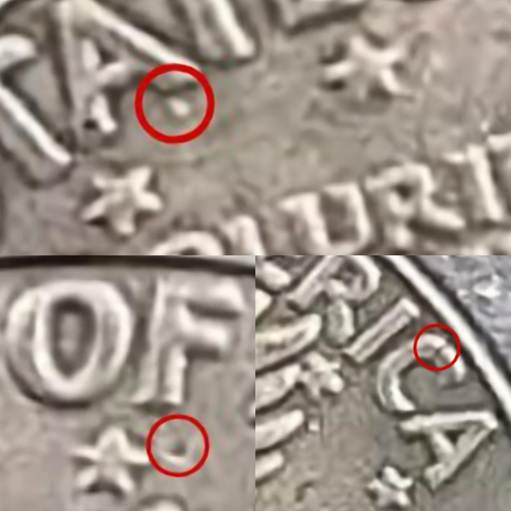
Diving straight into repeating markers of these two “coins,” a 1971-P and 1977-P show commonalities between the two. Both share matching obverses and reverses indicated in Red.
Obverse markers:
Diagonal depression of L
Depression in front of the eye
Reverse markers:
Raised lump below A1
Indent below OF
Line through C
China produces counterfeits of common coins like the Eisenhower dollar if a small profit can be made. These scammers may not be expert numismatists; but they are professional marketers who know about profit margins. Their profits expand with bulk production, flooding eBay and Facebook with fakes. China knows the coin collectors will just assume that low-value common coins like Ike dollars are genuine.
They are polluting the hobby.
If you suspect that one of your coins might be fake, see “Detecting Counterfeits” for methods.
If you like posts like this, you can read more articles on counterfeit coins by Jack D. Young, Jack Riley and Michael Bugeja at this URL. Also, please subscribe so you can get our weekly newsletter and be informed whenever there is a new article or column.
Proxiblog also has thousands of followers on Facebook Coin Groups, YouTube and other venues. To get the latest discussion and commentary, be sure to friend us by clicking here.
You can find more information about errors and varieties as well as buying and bidding on coins in Coin News Updated: The Essential Guide to Online Bidding. Please consider purchasing the work for yourself or a friend, as it underwrites this hobbyist website. Thank you.
If you want a quick refresher of the major types of doubling–hub, machine and die deterioration–view this video. It will help you identify those types with audio explanations by Michael Bugeja.
Click here for an article on the 5 types of doubling.
Also, Proxiblog has assembled some 50 videos on this site and YouTube. Click the photo below to see them.
If you like posts like this, subscribe so you can be informed whenever there is a new article or column.
Proxiblog also has thousands of followers on Facebook Coin Groups, YouTube and other social media. To get the latest discussion and commentary, be sure to friend us by clicking here.
You can find more information about types, varieties, errors, grading, bidding and buying in Coin News Updated: The Essential Guide to Online Bidding. Please consider buying or gifting the work for a friend, as it underwrites this hobbyist blog. Thank you.