I enjoy browsing through various Facebook coin groups and seeing what collectors have acquired and enjoy. While scrolling through a rather large group I came across a post where a fellow collector had completed his Lincoln Wheat Cent collection. A major milestone for any collector! In the mix was a 1909s Cent, about which I commented, and later had a private message conversation explaining that this was a counterfeit and showed proof.
He stated it was bought on eBay from a non-reputable seller in a “shotgun roll.” These are rolls of wheat cents hand assembled with generally a nicer condition coin or key date on the ends. This fell within the 30-day return policy so the collector should get his money back after returning the coins to the seller.
Another online venue offered this counterfeit 1909s. Both coins share a common reverse that has been known for awhile.
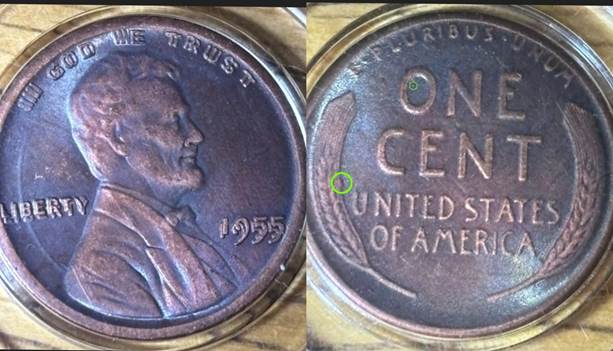
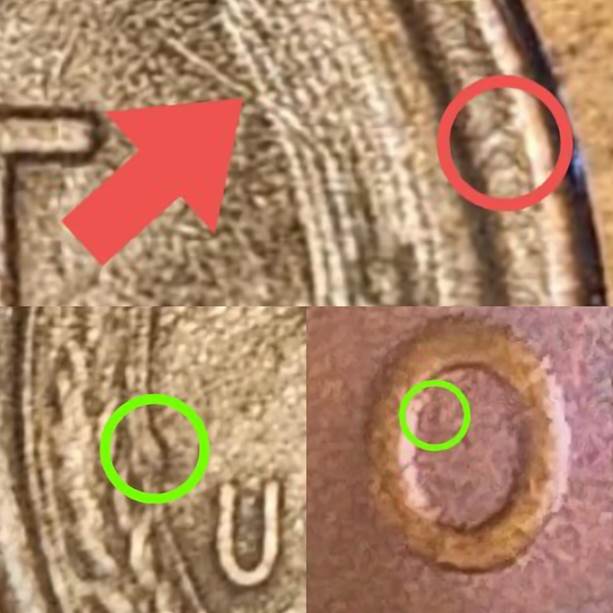
Image comparison of both coins show many repeating marks. Highlighted in green are common to all coins with this reverse and include:
Lump at the edge of wheat stalk
Small lump inside of ONE
Highlighted in red are common but not seen on all examples.
Crack from the rim to Wheat stalk
Extending Crack through the stalk to the field
Being the Lincoln Cent series is one of the most popular to collectors and many key/semi key dates are needed to complete the set, it is of no surprise this counterfeit family is extensive. Other dates that have been seen from this family include the 1931s, 1955 “DDO”, and 1924D cents imaged below.
A close-up collage of identifying marks.
If anyone thought it was just key/semi key dates that are counterfeited, you would be wrong. Here is a common date 1958 exhibiting the “Lumped reverse.”
For more information, including die markers, see Michael Bugeja’s post, titled, “Identifying Fake 1909-S VDB Cents.” Now collectors have two comprehensive articles about this key date. Proxiblog strongly encourages any Lincoln cent collector to read and refer to these two articles before bidding on any raw 1909-S VDB. Also, make sure to check the certification to ensure that the holder also is not counterfeit.
Proxiblog advises newer collectors to follow these general guidelines:
If you are ready to bid hundreds of dollars on a coin, resist buying a raw one and shop for one holdered by PCGS, NGC, ANACS and CAC.
Be especially careful when purchasing raw coins from eBay and other online venues. AI bots cannot detect counterfeits, so you are on your own.
Make sure the seller takes returns and has good reviews. Also, the number of positive reviews is a good indicator. If someone has 0 sales or even fewer than 100, do not take a chance.
If you already bought the coin, weigh it and go to PCGS CoinFacts for the date and mintmark, checking your coin against weights and dimensions.
If you like posts like this, you can read more articles on counterfeit coins by Jack Riley, Jack D. Young and Michael Bugeja at this URL. Also, please subscribe so you can get our weekly newsletter and be informed whenever there is a new article or column.
Proxiblog also has more than a thousand friends and followers on Facebook Coin Groups and thousands more across YouTube and social media. To get the latest discussion and commentary, be sure to friend us by clicking here.
You can find more information about errors and varieties as well as buying and bidding on coins in Coin News Updated: The Essential Guide to Online Bidding. Please consider purchasing the work for yourself or a friend, as it underwrites this hobbyist website. Thank you.
PCGS, NGC, ANACS, CAC, ICGS have certification web sites. You’ll gain knowledge about everything from counterfeit detection to retail, wholesale and auction values.
New collectors and others who have inherited coins typically ask Facebook coin group members what their holdered coins are worth. There is no need to do this. In fact, the question alone indicates that you do not know what you have, opening you up to low-ball offers and scam buyers.
This Facebook member posts photos of PCGS-graded coins and wonders what they are worth.
All he had to do was go to the PCGS certification site for the information. Just input the numbers and you get all the facts.
Did you catch what happened here? If so, you are beginning to understand why checking certs of ANY slabbed coin is worthwhile.
His coin is counterfeit. The label is the giveaway: “Morgan.” The Chinese forgot that the only time PCGS states the dollar is a Morgan is on labels for 1921 coins because the Peace Dollar was introduced in that year!
The person’s coins are counterfeit.
Here is another person asking about worth for this NGC coin:
NGC is not nearly as reliable with updating current value as PCGS. Note that this cert states “Price Guide Not Available.” NGC has been negligent with this for years, one of the reasons I prefer PCGS and CoinFacts. But you can still check the retail price by hitting the “Research this coin” tab.
Here are lookup sites for ANACS, CAC and ICG. Follow the same procedure.
If you want an estimate about what a coin dealer might pay you, you can access that information on the Greysheet wholesale website, requiring a subscription.
A better option to ascertain what a dealer might pay you, once again, is PCGS CoinFacts, an indispensable directory.
Let’s look up the retail and latest auction values (better than wholesale values because these states what people will pay) for that 1880-S MS64 Morgan mentioned earlier.
You get all the data for this coin, including mintages, which also play a role in value. But lower on the page you get population date and more specific details.
Better still, you can click the link for each auction. The first link, most recent sale 08/25, states someone paid a retail price in a Stacks Bowers auction. Why? Hit the link, and you get this superb coin, again with tons of data.
The ability to know retail and wholesale/auction values is a mandatory skill if you collect coins. Many just opt to go to a coin dealer who probably will use Greysheet wholesale and then deduct even more, especially if he owns a brick-and-mortar shop (he has to pay expenses, don’t you know).
Here is a typical advertisement promising to appraise coins and showing ones whose values are readily available online.
Wouldn’t it make sense, if this were your collection, to know what the retail and wholesale/auction values are before allowing someone else to tell you?
As you can see, checking certs guards against fakes and informs you in detail about your coin. Over time, you will learn not only the values but also all those data, helping you become the numismatist you were meant to be!
If you like posts like this, subscribe so you can be informed whenever there is a new article or column.
Proxiblog also has thousands of followers on Facebook Coin Groups, YouTube and social media. To get the latest discussion and commentary, be sure to friend us by clicking here.
You can find more information about types, varieties, errors, grading, bidding and buying in Coin News Updated: The Essential Guide to Online Bidding. Please consider buying or gifting the work for a friend, as it underwrites this hobbyist blog. Thank you.
NOTE: Proxiblog introduces as contributor Jack Riley, VAM enthusiast and counterfeit researcher. VAM stands for Van Allen and Mallis, authors of a study of die varieties for Morgan and Peace dollar coins.
By Jack Riley
There exists a family of counterfeits that fooled collectors and grading services for decades. The “Micro O” varieties have always been scarce coins to come by, and in 2005, these were deemed counterfeit by PCGS when 3 examples showed repeating circulation marks between the 1896 O VAM-4, 1900 O VAM-5, and 1902 O VAM-3.
Pictured below shows the repeating marks found on the three dates, indicative of transfer die counterfeits.
Images courtesy of PCGS
Along with the announcement that these varieties were counterfeit, PCGS offered “buy backs” for coins it had authenticated. Some 95 examples were certified among the three dates. PCGS no longer will authenticate 1896-O, 1900-O, and 1902-O with micro mintmarks.
“Grading and variety experts at PCGS have recently uncovered undeniable evidence that three of the so-called Micro O’ Morgan varieties, the 1896-O, 1900-O, and 1902-O, are actually contemporary counterfeits, most probably struck outside the US Mint sometime in the early 20th century. This is a significant discovery and one that will certainly have an impact on Morgan dollar variety collectors.”
This begs the question of how many such fakes exist today in PCGS holders? Prior to 2005 the market exceeded $1,000 per coin in many cases and up to $5,000 in higher grades. Assuming PCGS paid fair market value then surely most of these were sold back!
This 1902 O VAM-3 sold at Heritage Auctions on November 19th, 2002 and realized a price of $192.
Two years later the price for these coins exploded with a VF20 example selling for $2,070 on November 4th, 2004.
Images courtesy of Heritage Auctions
Later another 1902 O VAM-3 in VF30 for $5,100 in a Superior Galleries auction. That was auction lot#871 in January of 2005. (No photos of this coin.)
These coins still exist in ANACS holders with most available ones in Gen5 and Gen6 slabs. I had purchased this 1900 O VAM-5 VG Details example in August of 2024 for $150. This coin resides in a Gen6 ANACS holder that was used from 1999-2005. During the same time my friend and fellow counterfeit researcher Jack Young acquired one as well. Both of which have consecutive certification numbers pictured below. My example (top) and Jack Young’s example (bottom).
Recently an 1896 O VAM-4 appeared in a Great Collections auction in a Gen5 ANACS holder. After buyers fees this coin landed at $200. I was fortunate to acquire this example.
At the same time of this listing was also another 1900 O VAM-5 that sold the same night as the 1896. I happened to be the underbidder and the coin sold for $140 prior to fees. Later that night I received a message that a friend and fellow collector had won and the coin found a good home! This coin also resides in a Gen5 holder which was used between 1996-1999 to put a time-frame to when this coin was certified.
I hope to see these coins grow in popularity! The exact story is unclear as to who made these or when although a few theories are posed. A likely theory was disgruntled mint employees after the New Orleans Mint closed in 1909. These coins circulated indicating they were struck in a time when the price of silver was still well below the face value of the coin.
Since the discovery of these “Micro O” counterfeits, 32 die varieties have been linked to this massive operation. Two other Micro O varieties exist (1901 O VAM-42 and 1902 O VAM-96). Those were omitted from this article due to having a different reverse than the three discussed. Many of the varieties associated with this “family” are readily available and can be cherrypicked for the price of an average Morgan Dollar.
These contemporary counterfeits will pass virtually every test including measurement, weight, and Sigma Metalytics examination since these scan closer to sterling silver. The “mix matched” dies make telling many varieties easy to spot at a glance by using incorrect reverse hub types for the years.
If you like posts like this, please subscribe so you can get our weekly newsletter and be informed whenever there is a new article or column.
Proxiblog also has hundreds of followers on Facebook Coin Groups. To get the latest discussion and commentaries, click here.
You can find more information about errors and varieties as well as buying and bidding on coins in Coin News Updated: The Essential Guide to Online Bidding. Please consider purchasing the work for yourself or a friend, as it underwrites this hobbyist website. Thank you.
Inspire love of the hobby in your children, nieces, nephews, grandchildren and friends by gifting them one or more of iconic designs by the U.S. Mint, all for under $150.
With Christmas, Hanukah and the New Year nearly upon us, you may need to do last-minute shopping at a nearby coin shop or via the internet with trusted sellers on eBay or numismatic companies like APMEX. And don’t forget the U.S. Mint.
We’ll start with the Red Book, a must-have publication for any new hobbyist. Experienced collectors can use A Guide Book of United States Coins to research these gifts below so that you can share their numismatic stories and histories.
You can get this reference book for under $25 from eBay, Wal-Mart or Whitman Publishers.
Also, don’t forget the Mint by considering its holiday gift giving products. Many such products will cost more than $150. But others for less that amount may make nifty gifts, including Christmas ornaments, which sell for $35.
Now let’s consider some of the Mint’s most popular coins.
1909 VBD Cent
Experienced collectors can include a note explaining why this coin is a must-have in any collection. The “VDB” initials stand for the coin’s designer, Victor David Brenner. But government officials were concerned that they were placed in too-prominent a position and gave Brenner too much notoriety. You can snare one at APMEX for $99 in uncirculated red condition.
There is more history associated with the Lincoln cent. Research and share it and why 1909 was the first year of this coinage.
1864 Large Motto Two Cent
You can find several examples graded by PCGS, NGC and ANACS for under $150. When you search for this on eBay, choose the low price filter and include the grading company initials with “1864 Two Cent Large Motto.”
In your gift card, research and then tell the story of the motto “In God We Trust,” which first appeared on this coin, which indirectly conveyed that the Union would win the Civil War. But there is much more to this legacy. In 1956, Congress declared it the official motto of the United States.
Cite the various mottos of America beginning with the Fugio cent and what they mean about our country.
Buffalo Nickel Types I and II
You can find these two types for under $50 at APMEX. Hobbyists buying these as gifts should refresh their numismatic knowledge by researching the three Indian chiefs that formed a composite of the obverse. Even more fun would be telling the tale of Black Diamond, the model buffalo at the Central Park Zoo at the time.
The Buffalo nickel, designed by James Earle Fraser, was part of the U.S. Mint’s effort to make coinage more appealing and symbolic.
Also relate why there are two types. Hint: The raised mound on Type I caused the denomination to wear off prematurely. This introduces new hobbyists to varieties.
Mercury Dime Roll
The Mercury Dime, another coin by Adolph A. Weinman, showcases Lady Liberty with a winged Phrygian cap, making her resemble the Roman god Mercury. Research that ancient deity.
You can get a roll of these from APMEX for under $150.
If you give this as a gift, be sure to explain the value of silver and how you can use the Red Book to find values for each year in the roll, explaining mint marks and other features of this iconic dime. It introduces new collectors into roll hunting.
1917 Standing Liberty Dollar, Type I and II
This coin must be age appropriate because Type I features a partly naked Lady Liberty. I leave it to you to explain why the original bare-breasted design was considered too controversial at the time, resulting in her wearing chain mail in Type II.
Nevertheless, the devices, shield and portrait of Lady Liberty by Hermon A. MacNeil are among the most elegant designs. Research how MacNeil beat famous designers like Adolph A. Weinman in a U.S. Mint competition. That was quite a coinage feat!
Walking Liberty Half Dollar
You can purchase the 1945 date in uncirculated condition from APMEX for under $50. You can also find “Buy It Now” BU examples on eBay graded by PCGS, NGC or ANACS for under $100.
In your gift card, research and describe the symbolism of one of the Mint’s most beautiful designs, featuring Lady Liberty marching with conviction toward a new dawn for the American republic.
Morgan Dollar (1878-1904, 1921)
You can purchase an uncirculated common date Morgan for under $50 at APMEX. When you give the Morgan as a gift, make sure it is not holdered. You will want your recipient to feel the heft of this 90% 26.73 gram silver coin.
You can also research the person on whom Lady Liberty is based, Anna Willess Williams, a Philadelphia school teacher and philosopher. She agreed to be a model for designer George T. Morgan only if her name was kept out of the newspapers. As you might anticipate, it wasn’t.
MEMORABLE MOMENTS
A holiday coin gift has two dates: the one on the denomination and the holiday year in which it was given, inspiring memories as you share your research and instill the love of numismatics in your relatives and friends.
No matter how you look at it, selling coins evokes feelings. Perhaps you are ending your interest in the hobby and will have to find other ways to spend your free time. Perhaps you inherited a collection and now must dispose of it for heirs. Or maybe because you just need the money.
Experienced hobbyists know the basics of how to sell coins. But newer or “never” hobbyists may have a difficult time because the process requires a modicum of numismatic knowledge, which this article provides. And, of course, money is at stake in the form of precious metals and intrinsic values.
Here are seven steps that I have used in selling my coins. They worked for me. You may experience different results.
Step 1: Read the Red Book and consult the Blue Book
The Red Book, otherwise known asA Guide Book of United States Coins, is required reading. You have to know what you actually have. Google, eBay, Etsy, YouTube and other online listings are unreliable and often erroneous.
The Red Book shares retail values and the Blue Book, wholesale, or what a coin dealer is apt to pay you–important later.
The Red Book has updated pricing and auction data with detailed expert commentary and photos–more than 2000 images, 7,600 listings and 32,500 coin values. You’ll learn about each denomination, type, mint error and varieties as well as read articles about investing, grading and holdering coins, and detecting counterfeits.
Click here or the photo below and scroll down to “HOW TO USE THE RED BOOK” to view a Proxiblog video on the book’s utility.
Step 2: Separate coins according to denomination
To view the various denominations, again consult your Red Book or PCGS CoinFacts, a free encyclopedia of U.S. Coins.
You will find at PCGS CoinFacts detailed photos and retail/auction values of coins from half cents to gold issues as well as commemorative coins, bullion, territorial issues and patterns.
But the utility now is using the Red Book or CoinFacts to separate your coins into categories.
Step 3: Divide collection again by precious metals
These will mostly be silver and gold coins but also platinum, palladium and rhodium.
Familiarize yourself with spot price values. A fine resource is provided by the coin company APMEX, which gives updated values of all precious metals. Click the photos belowfor gold and silver values to view what your coins are worth apart from collector premium.
Step 4: Create an inventory of your collection
Create your inventory by denomination. You can do this manually via pencil and paper but eventually you want to have this in digital format. You can use Word for this. It’s a hassle, but you also should photograph obverse and reverse of each coin and include that in your inventory. You can do this with any mobile phone with a decent camera. Photos also will help your appraiser later in the process.
You also have to remember what you paid for your coins. Note that in your inventory, along with the date of sale, if you can remember it. Bookkeeping is important, as you will learn in Step 7.
Once you have a draft of what you own, consider downloading an application for a formal inventory of your coins.
There are many low-cost and free coin collection applications. Coin Week has recommended the low-cost Coin Book Pro.
You will immediately have a sense of relief once you have completed your inventory. That sense comes from due diligence.
Step 5: Learn grading basics
Start with the Sheldon scale
The Sheldon Grading Scale describes the condition of a coin without damage or other flaws, earning a number between 1 (lowest) and 70 (highest). The scale is used by PCGS, NGC, ANACS and other grading companies. The grade is an indication of value.
Know key dates of the series
Here is a nifty chart that many coin shops use on their sites. It’s not comprehensive and doesn’t include what we call “condition rarities,” or coins that are common in lower grades on the Sheldon scale but rare in about uncirculated or uncirculated condition. But it will give you an idea about dates and rarities.
Do not use digital applications to identify your coin and grade it. Programs like CoinSnap powered by AI are notoriously inaccurate. Instead, train your eye by comparing your coin to the denomination and condition as found on PhotoGrade. You may have a tendency to overgrade and overlook flaws. That’s okay. You’re not expected to be an expert grader. But a little knowledge goes a long way.
You can find a list of numismatic terms on the Proxiblog site. Click here.
Step 6: Get an appraisal
Before you sell your coins, you need to have an expert give you a fair evaluation of their worth. The best way is to contact a friend, colleague or acquaintance who knows coins. There is trust there. Keep in mind it is not enough merely to send to your appraiser the denomination, date and mint mark of your coins. Condition is everything. If your hobbyist friend lives out of town and cannot eyeball your collection, you will have to send photos of obverse and reverse of each coin or set.
You can also go to a nearby coin shop. Make sure the owner is a PNG member as they are committed to honesty and professionalism. You can find a directory here.
There also are online appraisal sites. One of the most popular is Coinappraiser.com. Visit the site. It also has useful articles about selling, auctioning and grading coins.
Step 6: Sell or consign
The coin buying world is full of scammers. DO NOT sell on social media like Facebook, Etsy or YouTube or accept payment via Venmo or other non-traceable monetary venues. You will want payment by money order, bank wire or cash (if local).
If you have valuable coins, the best place to sell them is at Heritage and GreatCollections. The problem here is that major auction houses only accept coins holdered by PCGS, NGC, ANACS, ICG and CAC. It is beyond this article to explain the cost and procedures of getting coin graded. GreatCollections has a form to submit raw coins for you at discount prices. In other words, you won’t have to pay extra for grading and also can avoid membership, handling and postal fees.
You can consign your raw and holdered coins to an online auctioneer. This requires you to (a) contact the auction house, (b) ask if they will consign your coins and (c) request a contract and terms of service (usually a 10-20% selling fee).
You can find menu tabs of online sellers at Proxiblog’s home page. We are not endorsing these auctions as places to sell coins. Suffice to say that we have either bought or consigned coins to a few of these and find them reputable. Your experience may differ.
Step 7: Accept Reality
Unless you are a skilled hobbyist, chances are you bought or purchased coins with flaws or have dozens or even hundreds of raw coins that have little value, despite what the Blue and Red books state. Sellers have to earn a profit, too, and may not want to photograph, list and pay fees for your coins on their sites unless they are fairly confident that they will sell.
Even coin shops, loaded with junk coins and low value mint sets, typically will only be looking at the precious metal or rarity of your coins. You can sell part of your collection or hold out for a price for everything, even coins of little value or ones holdered by bottom-tier companies that exaggerate condition.
In other words, anticipate low-ball offers and seller’s remorse.
Sometimes it is worth taking a loss and focusing on what you can get for inexpensive coins or sets, just to dispense with them. A typical coin dealer will usually pay about 70-75% of current market value.
Now for the ultimate reality check: taxes. Refer back to your inventory. You will need to know what you paid and what you received for your coins. You should have these data in your inventory.
The Internal Revenue Service classifies gold and silver as collectibles. Capital gains are taxed at a maximum rate of 28% of any profit. Go to this IRS site for more information.
If you like posts like this, subscribe so you can be informed whenever there is a new article or column.
Proxiblog also has hundreds of followers on Facebook Coin Groups. To get the latest discussion and commentary, be sure to friend us by clicking here.
You can find more information about types, varieties, errors, grading, bidding and buying in Coin News Updated: The Essential Guide to Online Bidding. Please consider buying or gifting the work for a friend, as it underwrites this hobbyist blog. Thank you.
Although coins from several years may appear dark from improper annealing or alloy mix, so-called “Black Beauty” nickels were minted in Philadelphia in 1958 and 1959, containing trace amounts of cobalt and silicon during the refining process resulting in their fetching appearance.
Other “gunmetal” nickels might look similar due to overheated annealing, patina gone terminal, and metal-detected corroded coins. But these should not bear the nomenclature of “Black Beauty.” Here’s a panel of 1958 and 59 black beauties alongside an improperly annealed 1963 nickel.
If you find a 1958/59 “Black Beauty,” and wish to grade the coin, it should be uncirculated; otherwise, the cost of grading is prohibitive as these are not valuable errors. Typically, they go for under $50, although unscrupulous sellers like this one use the name “Black Beauty” for tarnished verdigrised coins, asking ridiculous prices (always check “sold” on eBay).
Also keep in mind that if you wish to have “Black Beauty” on the graded label, you should submit to ANACS.
Otherwise you will get an “improperly annealed planchet” label from PCGS or NGC:
Sometimes the improper alloy mix results in only partially black coins, as in this attractive 1959 example:
While many hobbyists search for 1958/59 “Black Beauties,” improperly annealed coins can be beautiful in their own right. Here’s a lovely Shenandoah quarter:
I call these “Bay Pony” coins after brown horses with black manes and tails.
Finally, for the literati reading this post, the name “Black Beauty” comes from an animal autobiographical novel concerning a thoroughbred who tells of owners who mistreated and ultimately loved him.
If you like posts like this, please subscribe so you can get our weekly newsletter and be informed whenever there is a new article or column.
Proxiblog also has hundreds of followers on Facebook Coin Groups. To get the latest discussion and commentaries, click here.
You can find more information about errors and varieties as well as buying and bidding on coins in Coin News Updated: The Essential Guide to Online Bidding. Please consider purchasing the work for yourself or a friend, as it underwrites this hobbyist website. Thank you.
Grading is expensive. If you don’t know how to grade coins, buying coins top-tier will be your best bet. If you want to send you coins to a company, though, you had better know the various companies and which ones to avoid.
Each holdering company has its own rules, but two stand out with their grades so consistent that they were considered sight-unseen buys in the pre-internet era. Those are PCGS and NGC.
TOP TIER
My favorite for U.S. coins is PCGS because of its spectacular TrueView photos and set registries. Here’s one from a coin in my bank box, an MS68 1990 American Silver Eagle that looks like a flag, primarily because it was stored in corrugated cardboard.
NGC grades as consistently as PCGS. I use it for ancients. There is no better grading service for that. This, too, is in my bank box. (Never keep valuable coins in your house, even if you have a safe.)
Both PCGS and NGC have shortcomings, but I always recommend the two if you are considering grading. Click here for PCGS. Click here for NGC.
CAC (see photo below) is as consistent or even more so than NGC and PCGS. But it’s new to the grading game as it initially was founded as a fourth-party grading company, in essence, affirming (or not) grades of PCGS and NGC. One drawback concerns those assembling a set of PCGS or NGC to compete in registry sets. CAC is not there yet but will be in time.
SECOND TIER
Second-tier reliable grading companies include ANACS and ICG. ANACS coins in my view are close to PCGS/NGC in grading. ICG, less reliable.
Older ANACS holders sometimes are rigorously graded, as in this one:
Here is an 1878-S MS64 by ICG (I say MS63 at PCGS):
THIRD TIER
A few other holdering companies are hit-and-miss with a tendency to overstate grades and to overlook flaws. Nevertheless, they are somewhat reliable. I place them in a third tier. Those are old green and yellow PCI holders and SEGS and Numistrust holders. See below. I always look at these coins at auction and rely on my grading ability to affirm their grades. Personally, I like SEGS the best but have spotted common flaws on some of its coins, including pin scratches. So again I inspect rigorously.
BOTTOM TIER
These are some holdering companies I skip right over, not wasting time, because the grades are usually inflated and flaws, overlooked: SCG, National Numismatic Certification, newer PCI, PGA.
Here are examples:
JUST MY OPINION
Keep in mind that this post is based on my opinion and experience. You may think differently, experience different results, and even prefer lower tiers to PCGS and NGC.
But here is a warning if you are buying coins housed in these lower holders: Do not look up the year/date/mint mark on the PCGS or NGC values sites. All grading companies use the Sheldon 70 scale, but different grading standards mean different values. Read this post about that.
If you like posts like this, subscribe so you can be informed whenever there is a new article or column.
Proxiblog also has hundreds of followers on Facebook Coin Groups. To get the latest discussion and commentary, be sure to friend us by clicking here.
You can find more information about types, varieties, errors, grading, bidding and buying in Coin News Updated: The Essential Guide to Online Bidding. Please consider buying or gifting the work for a friend, as it underwrites this hobbyist blog. Thank you.
Coin collecting is a complicated business requiring knowledge of key dates and condition rarities for each denomination in addition to history, art and metallurgy. Selling coins is even more complicated if you do not know what you are doing.
This post does not cover errors and varieties. Even though YouTube, Facebook and TikTok and other sites promise thousands of dollars for error coins and varieties, identifying these takes special skills, which you may not have and is beyond the scope of this article. Often what you think is a error is really only damage. Read this post to understand why.
Below are some selling basics. Results will vary. There are just too many variables that affect value. But below are some benchmarks for you to consider, which may help you avoid buyers low-balling your collection.
Contact a PNG dealer
The easiest way to get an appraisal is to take your wares to a reputable coin shop. Before going there, however, check to see if the dealer is a member of the Professional Numismatists Guild whose motto is Knowledge, Integrity, Responsibility. You can search if your dealer is a member by clicking here.
Become familiar with the hobby
In the short term, a good way is to follow coin sites like this one. There are many on internet.
And you should purchase the numismatic bible, A Guide Book of United States Coins, also known as Red Book. Get the 2025 edition: “Updated pricing and auction records, new research, new photographs, the latest U.S. Mint data, and more! 472 pages, 2,000+ images, with more than 7,600 listings and 32,500+ coin prices.”
Become familiar with the Sheldon scale
The Sheldon Grading Scale describes the condition of a coin without damage or other flaws, earning a number between 1 (lowest) and 70 (highest). The scale is used by PCGS, NGC, ANACS and other grading companies. The grade is an indication of value.
Know key dates of the series
Here is a nifty chart that many coin shops use on their sites. It’s not comprehensive and doesn’t include what we call “condition rarities,” or coins that are common in lower grades on the Sheldon scale but rare in about uncirculated or uncirculated condition. But it will give you an idea about dates and rarities.
Familiarize yourself with common flaws
DO NOT CLEAN YOUR COINS. People without numismatic experience believe cleaning coins enhances value. It doesn’t. It typically decreases value by a significant amount.
Often the coins you inherit will be damaged in some way, polished, dipped, cleaned, whizzed and so forth. Check this Proxibid article that describes typical flaws that will greatly lower the value of your coins. Here is a doctored coin with a chemical patina:
Estimate the grade
To get an idea about grading, compare your coin with the same one on the useful free site, PCGS Photograde Online.
Check for dimensions and value
Assuming your eye makes a reasonable comparison–keep in mind that grading accurately takes time, focus and effort–then check estimated values on PCGS CoinFacts or another such site. You will get important measurements and weights, essential in making sure you do not have a counterfeit coin.
Submit to a grading company
If you think you have a rarity or condition rarity, you might consider a grading company to assign a retail value of your coins. Often, this is unnecessary, especially if you do not know how to grade. It is expensive to grade a coin with PCGS, NGC and ANACS, reputable companies. Be ware of bottom-tier grading companies that over-grade and overlook flaws.
Each holdering company has specific rules for submission. Read them.
Consign your coins
Consider contacting reputable HiBid auctioneers or eBay sellers that often take consignments. Click those links in the previous sentence to see some of Proxiblog’s favorite sites.
DO NOT SEND THE COINS to these sellers without contacting them first. Also investigate those sites to see if you might like your coins sold there. Email the site owners, describe your collection, and ask if they take assignments. Be sure to inquire about consignment fees and request a sample of the consignment contract. Read it carefully to see if you approve of the terms.
Finally, keep in mind that hammer prices and your cut may be below any retail price of the same coin, date, condition and mintmark. But auctions are a true test about value–what someone actually is willing to pay.
If you like posts like this, subscribe so you can be informed whenever there is a new article or column.
Proxiblog also has hundreds of followers on Facebook Coin Groups. To get the latest discussion and commentary, be sure to friend us by clicking here.
You can find more information about types, varieties, errors, grading, bidding and buying in Coin News Updated: The Essential Guide to Online Bidding. Please consider buying or gifting the work for a friend, as it underwrites this hobbyist blog. Thank you.