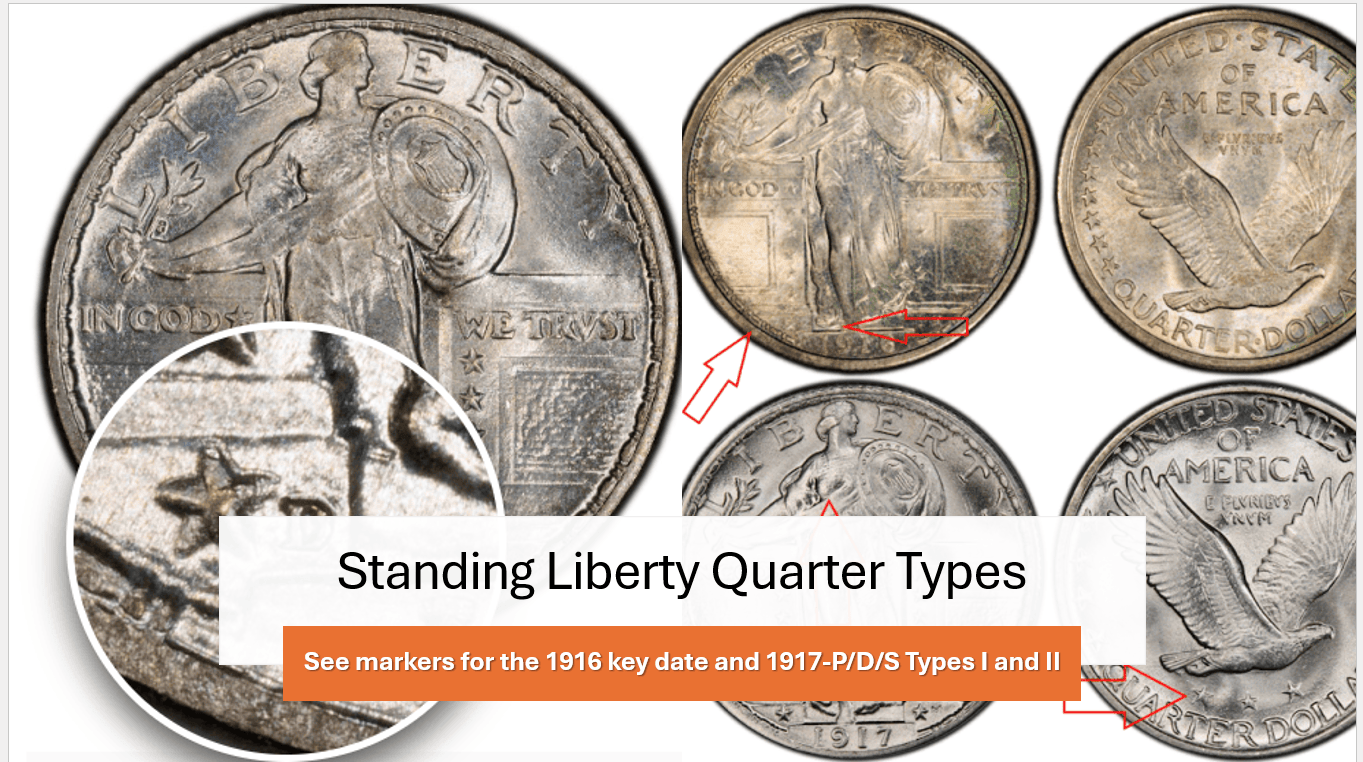
The first two years of the Standing Liberty Quarter resulted in seven varieties: 1916 key date and 1917-P/D/S Types I and II. This article defines markers and designs so you can distinguish differences among these coins.
The 1916 Quarter with a mintage of a mere 52,000 only used one obverse and one reverse die. So these are easy to distinguish from the many replicas and counterfeits out there.
Every coin should have the same placement and design of its devices.
Soon after minting this beautiful quarter, the US Mint realized that the date was positioned on a raised pedestal. That meant it could wear away completely with years in circulation.
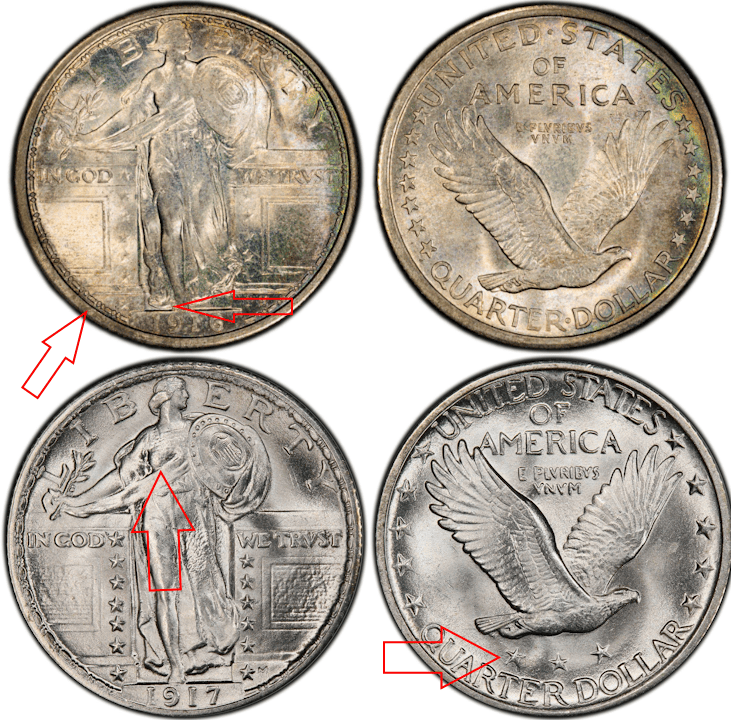
You can identify the key date by these major markers:
- The Gown: Drapery of the dress clings to Lady Liberty’s right foot down to the pedestal. On a 1917 quarter, the gown drapery is away from the foot and curled.
- The Shield and Border: The dots framing the coin’s outer rim resemble diamonds on the 1916, rather than the dashes on the 1917.
- No Mint Mark: The entire mintage of the 1916 was struck at the Philly mint.
- Type I Reverse: The 1916 quarter uses the Type 1 Reverse. There are no stars underneath the eagle. There are 7 stars on the left and 6 on the right. Type II has three stars under the eagle.
- Right Breast Exposed: This differs from other reverses with Lady Liberty in chainmail.
Let’s illustrate that with a 1917 Type II design.
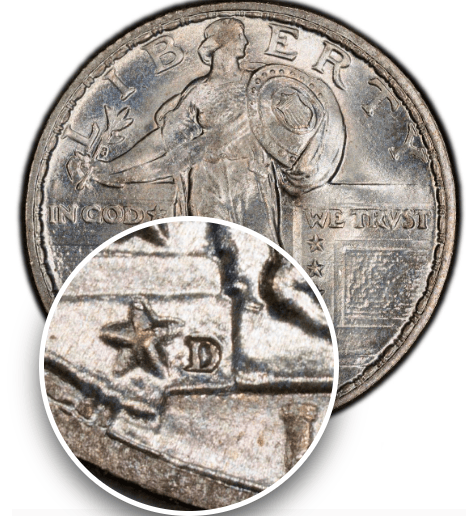
One other marker is important in Type II designs, and that is placement of the mintmark. Here is a 1917-D as example:
This brings us to why Type II was designed. Numismatists debate why Lady Liberty’s exposed breast was covered with chainmail armor in Type II designs. Some thought the exposed breast was lewd. The coin was designed by Hermon Atkins MacNeil. It drew some criticism in the media. But also World War I also might have inspired the armor. What happens, though, is that you can tell the difference.
This brings us to Type I and II of 1917 P/D/S/ designs.
Mintages were roughly equal with Type I and II P/D/S quarters. Type II mintages were greater than Type I in 1917:
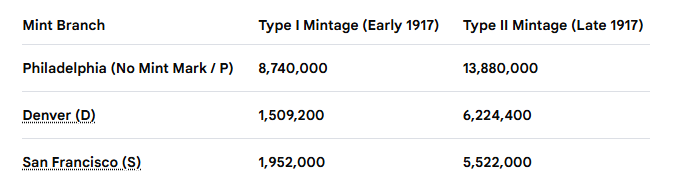
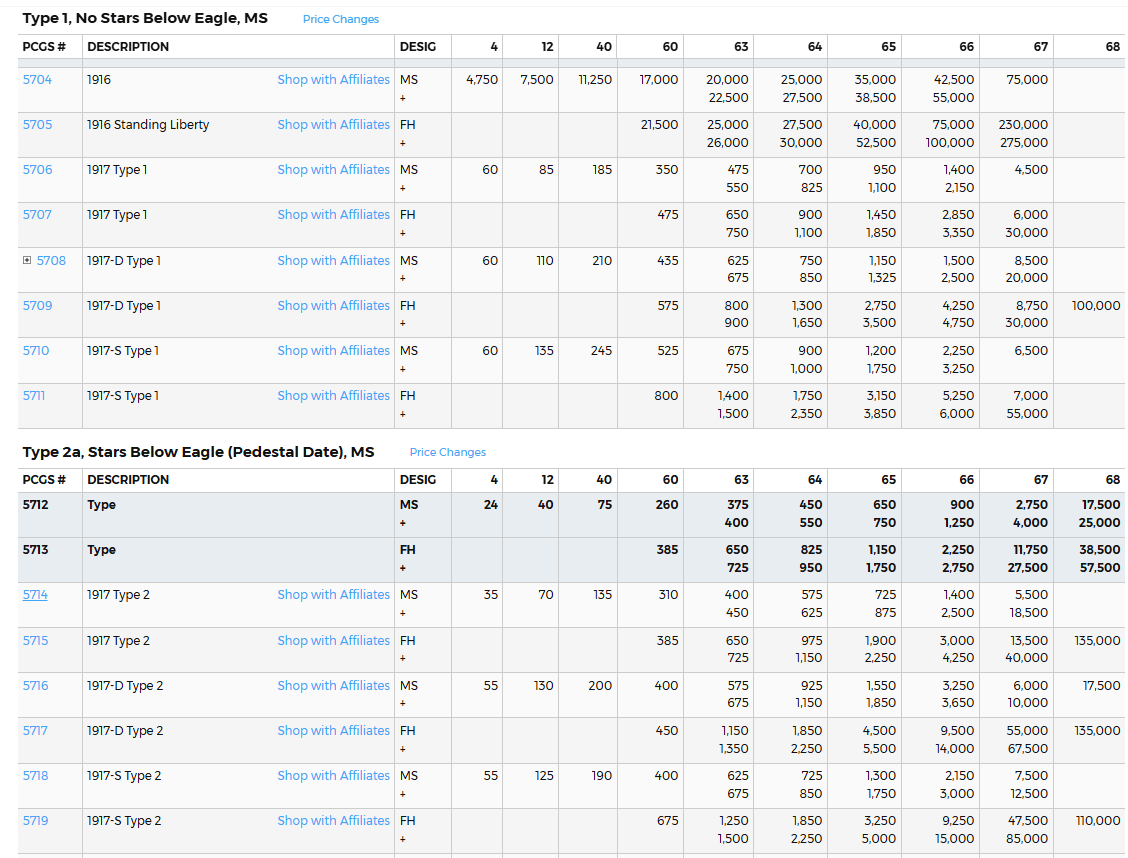
As such, values are marginally higher in Type I examples, especially since these are coveted because of the Type I design. Here are complete values compliments PCGS CoinFacts.
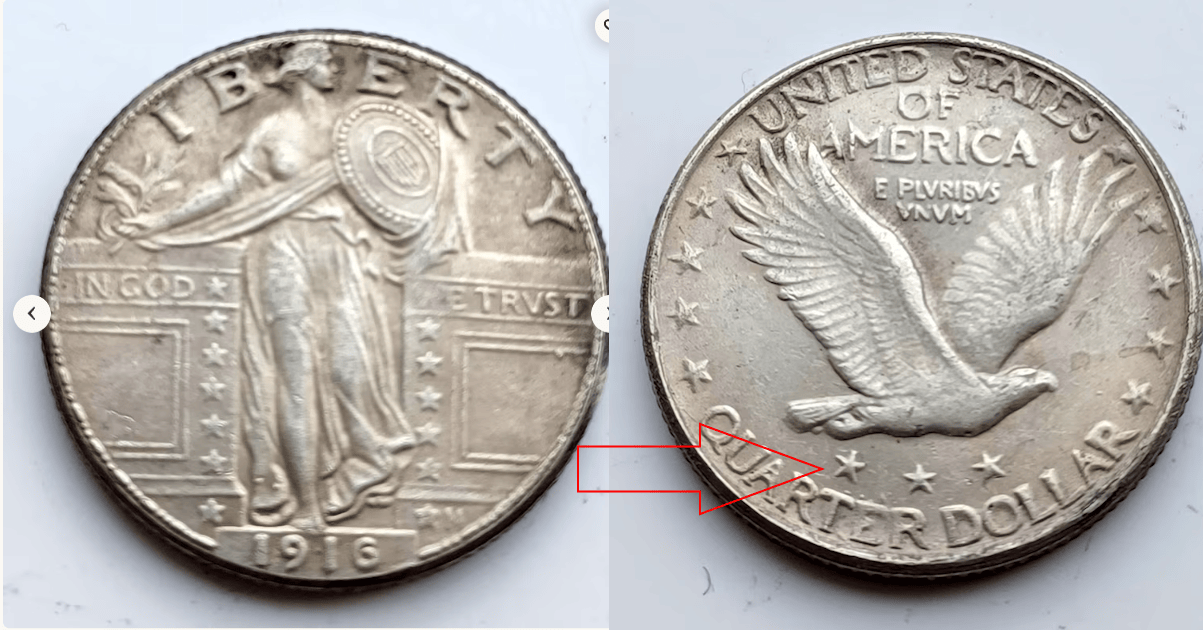
It is especially important to note the design differences because Chinese has flooded the market with fakes. Here’s an example, a purported 1916 with a Type II reverse:
If you like articles like these, please friend us on Facebook and subscribe to Proxiblog.
Proxiblog also has thousands of followers on Facebook Coin Groups, YouTube and social media. To get the latest discussion and commentaries, click here.
You can find more information about errors and varieties as well as buying and bidding on coins in Coin News Updated: The Essential Guide to Online Bidding. Please consider purchasing the work for yourself or a friend, as it underwrites this hobbyist website. Thank you.
