Some of the most beautiful toned coins have come out of double mint sets. Many new hobbyists may not be familiar with them. So let’s do that now along with their mintages.
These Uncirculated Mint Sets were made from 1947 through 1958 (no sets in 1950). Each set included two examples of every circulating coin denomination from each operating U.S. mint (Philadelphia, Denver, and San Francisco), housed in cardboard and paper holders–which cause the toning.
Annual Mintages (1947–1958):
- 1947: 5,000
- 1948: 6,000
- 1949: 5,000
- 1950: Not issued
- 1951: 8,654
- 1952: 11,499
- 1953: 15,538
- 1954: 25,599
- 1955: 49,656
- 1956: 45,475
- 1957: 32,324
- 1958: 50,314
Mintage is important because if you find stellar coins in older sets they will be valuable today. However, because of the beautiful toning, many collectors have swapped out those colorful gems and replaced them with lesser coins.
That is the focus of this article.
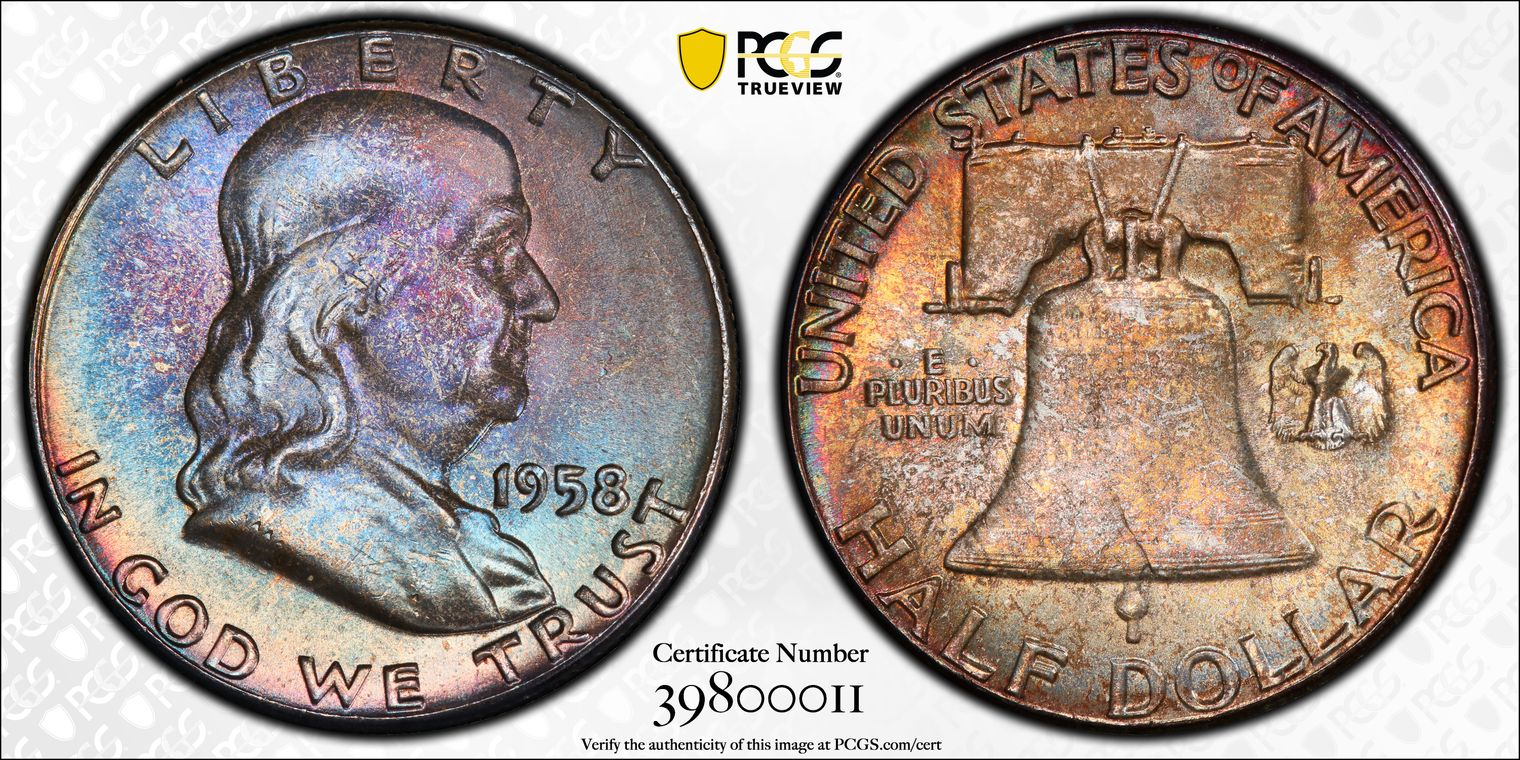
Here’s an example of a toned mint set coin so you have a sense of the beauty.
Sometimes people remove the toned coins and leave blank spaces, but sell the sets as if original. This 1956 “original” double mint set features 22 coins, rather than 18. Moreover, it is in the wrong packaging.

This is how it should look:

Sometimes the seller offers a partial rather than complete set, as in the example below:


The seller is being accurate that this is not a complete 1952 double mint set. He doesn’t say how many coins are included. He repeats the “P” in the headline and description. But he shows two photos of the same 10-coin partial set, perhaps indicating a 20-coin partial set, and novice bidders might know make the connection that the “D” (Denver) and “S” (San Francisco) sets are missing.
I seldom bid on partial sets because that indicates to me that the best coins are missing, submitted for holdering or broken up and sold individually.
These sets continue to be highly desired because of the resultant toning from the cardboard and paper packaging. Here’s a rainbow example from one of my 1952 double mint sets, a beautiful MS66 “S” mint showcasing the vibrant rainbow hues:

The difficulty in identifying partial and complete sets concerns how some sets feature 18 coins (1956), and others 22 coins (1955), 28 coins (1947-49) and 30 coins (1951-1954, 1957-58).
Each year has a distinct cardboard and paper holder. It’s important to identify these because unethical sellers sometimes assemble fake double mint sets and put them in the wrong packaging.
This set is suspicious because it lacks the pink paper that covers the cardboard holder. Also, the coins clearly have been swapped out and are not toned, despite what the seller states:

The 1957 mint set features pink paper flaps that tone coins so richly. While the majority of mint sets utilized plain or green paper backing to protect the coins, the 1957 set famously departed from this norm. Here’s an example of the holder–again with some of the coins (perhaps not the cents) seemingly swapped out.
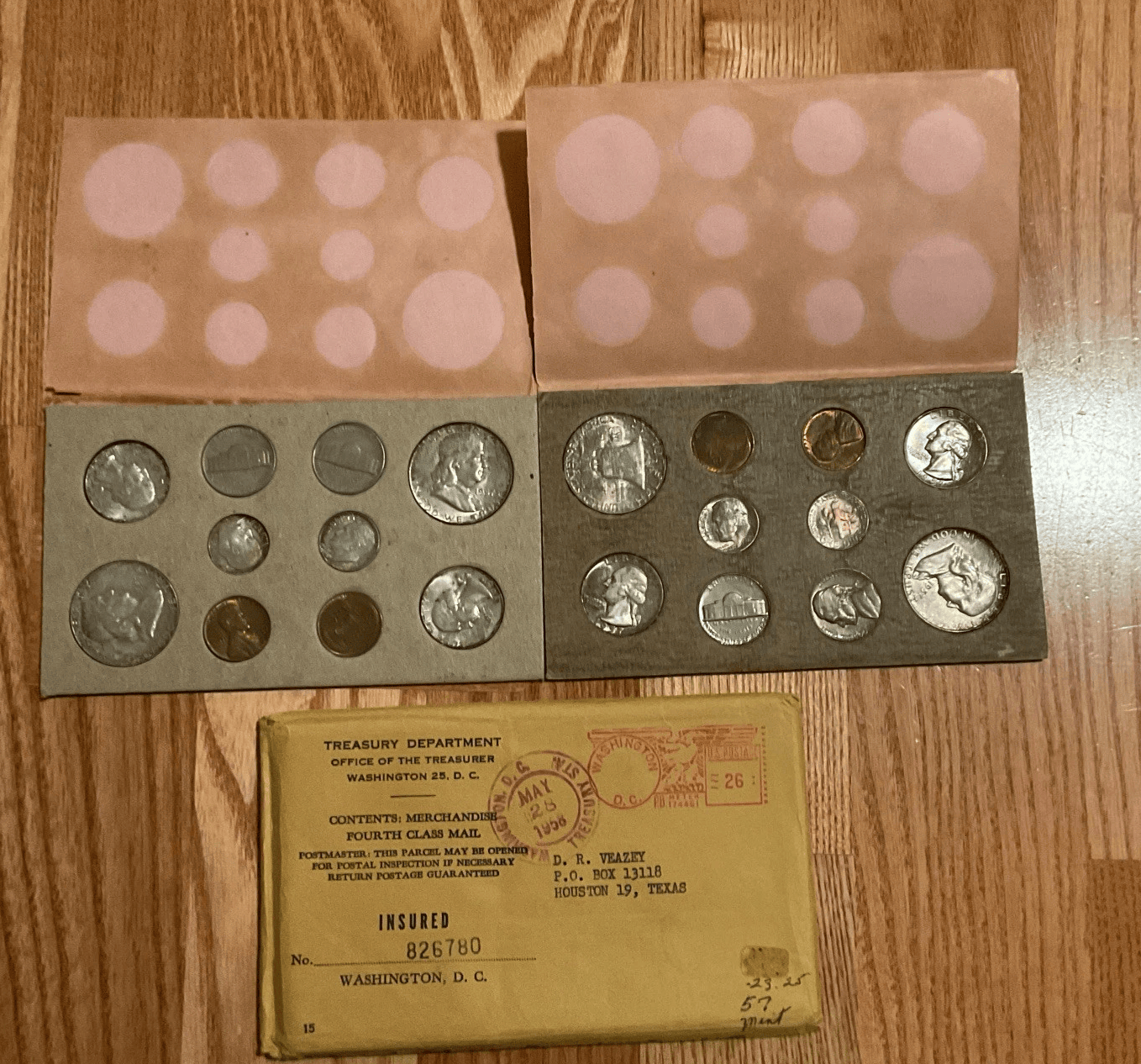
You don’t have to memorize the specific years and packaging. You can go to a reputable seller, like APMEX, and view the original packaging. Then compare with the lot being offered at auction.
If you like posts like this, subscribe so you can be informed whenever there is a new article or column.
Proxiblog also has thousands of followers on Facebook Coin Groups and across social media. To get the latest discussion and commentary, be sure to friend us by clicking here.
You can find more information about types, varieties, errors, grading, bidding and buying in Coin News Updated: The Essential Guide to Online Bidding. Please consider buying or gifting the work for a friend, as it underwrites this hobbyist blog. Thank you.
