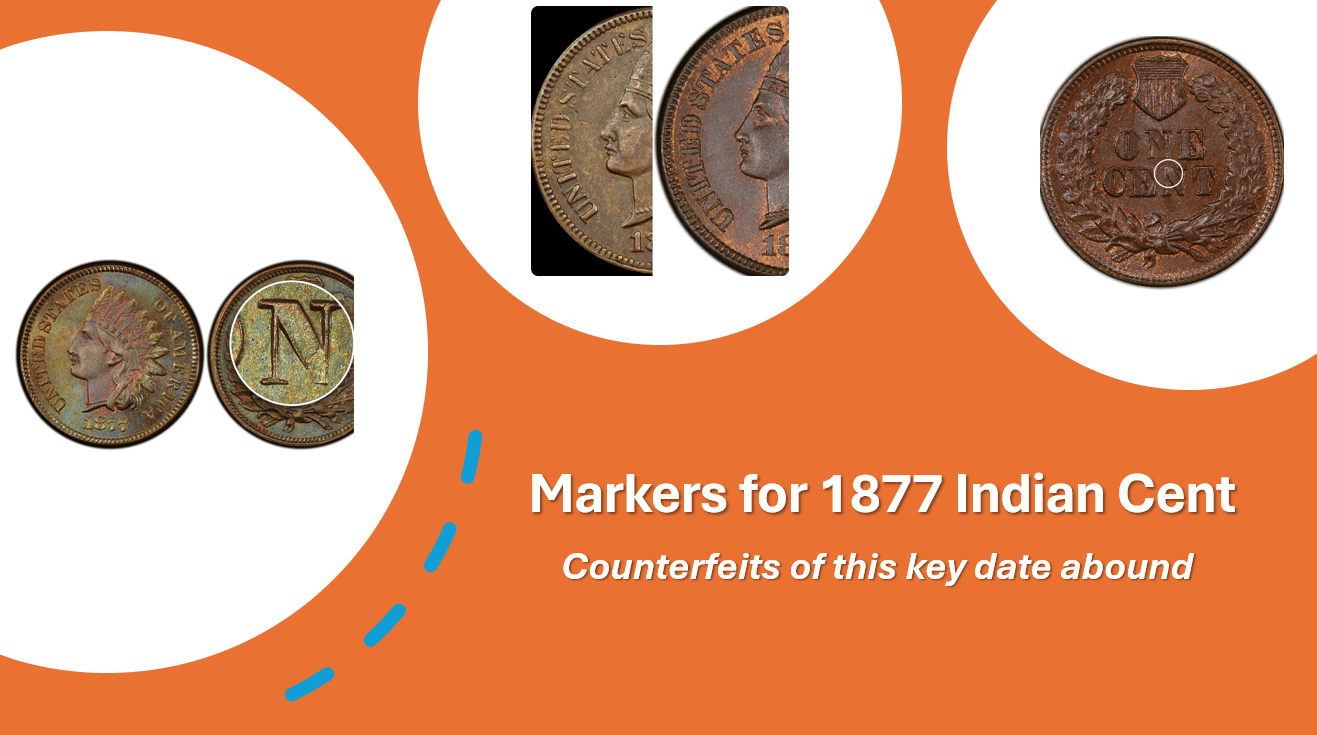
One of the most counterfeited coins is the key date 1877 Indian Cent. It has a low mintage of 852,500. Genuine examples cost hundreds and thousands of dollars. A Good-4 example retails for $650. Extra fine ones go for $3,000 and MS63 Brown, $7,000.
Those values alone make it necessary to know markers so you do not end up with a fake, altered or replica coin.
On all genuine circulation strikes, a single reverse working die was used. So these markers are vital and uniform.
The “N” in ONE slowly grows weaker and shallow as it proceeds to the bottom right corner.
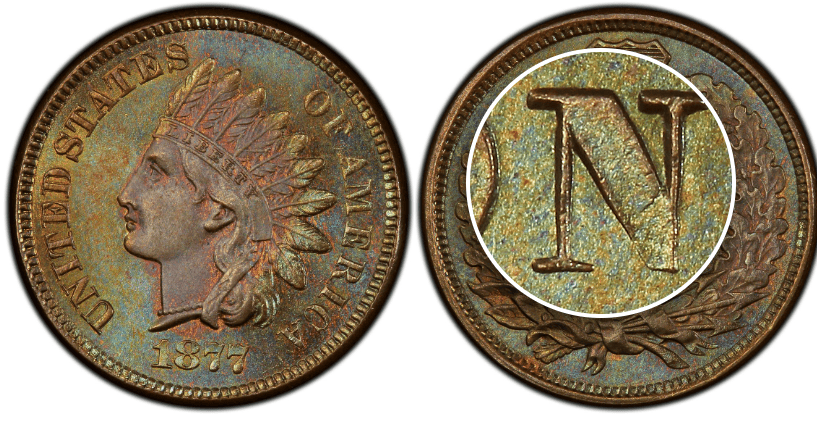
The top left corner of the “N” in CENT also is weakly struck and shallow when you compare it to other letters.
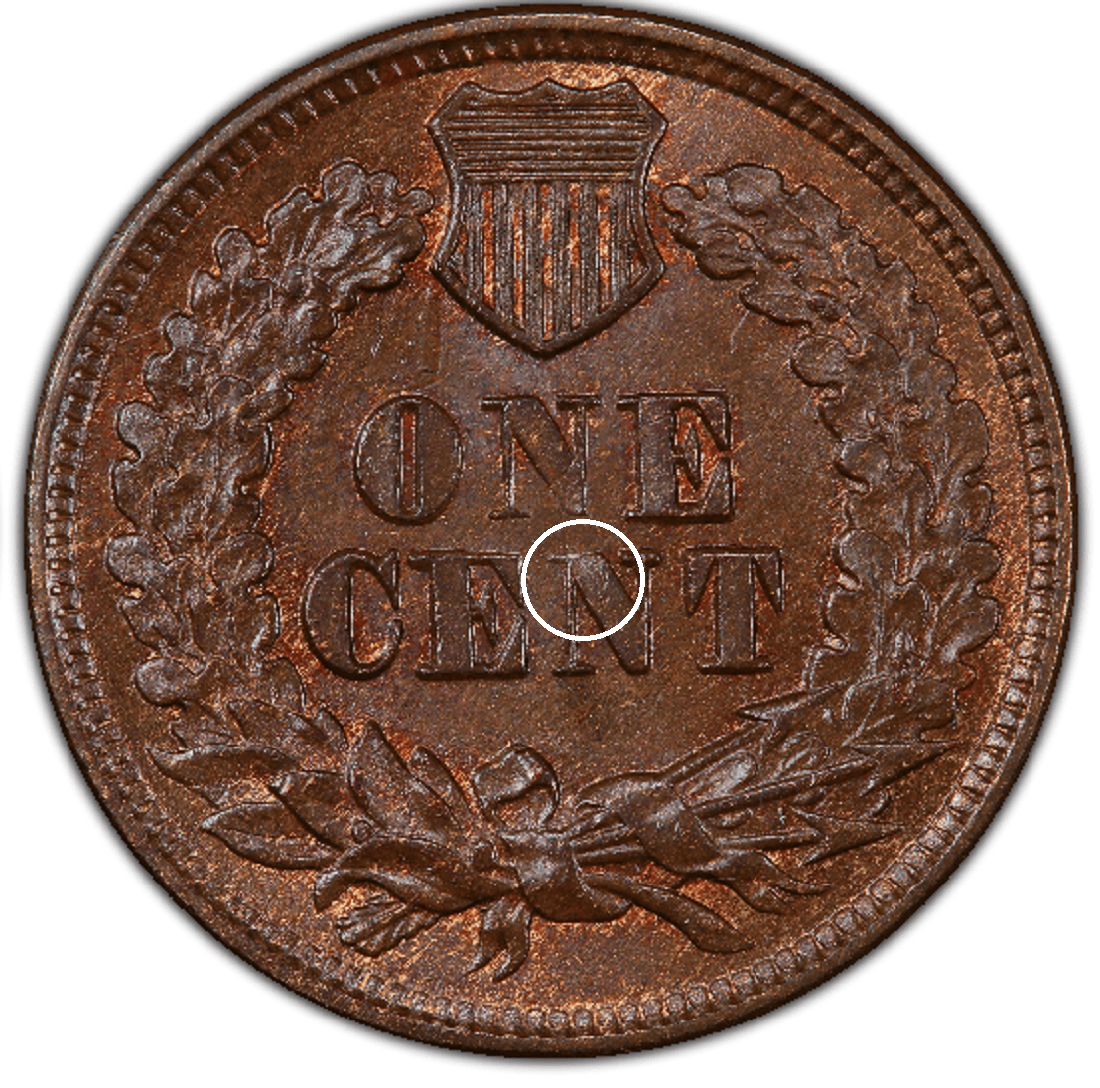
If these “N”s are sharply struck on the reverse, you’re looking at a counterfeit coin.
There are also obverse markers, beginning with the so-called “Slanted 77” in the date. Draw an imaginary horizontal line across the date, and the second “7” should be slightly lower than the first.
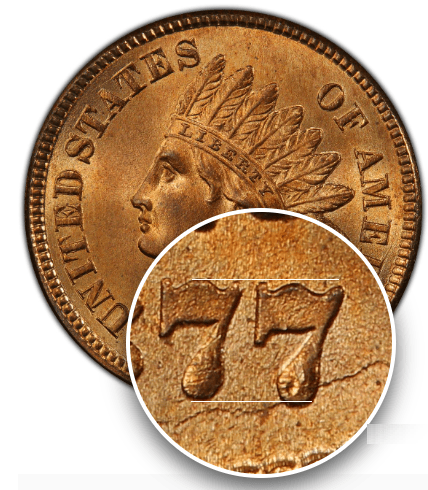
If the “7”s are parallel and equal in orientation, you have a fake coin.
You also should check the second “7” for evidence of tooling, changing the last digit of the less valuable 1871, 1874 or 1879 so it appears like a “7.”
You can also do the balance test to see if your coin is a counterfeit. Genuine Indian Head cents have beleved edges and as such cannot stand balanced on its edge. Chinese fakes have flat squared edges. You can balance these.
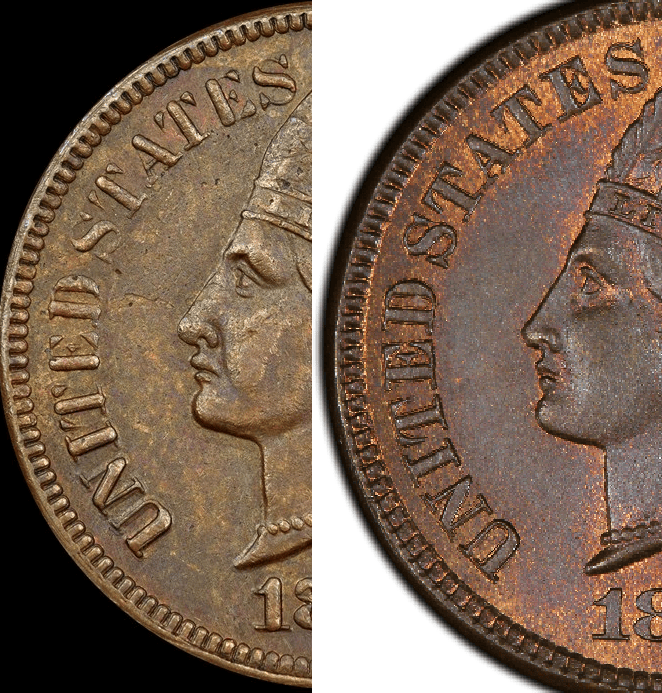
Also many examples of contemporary counterfeits have a mushy or weakly struck “United States of America.” On genuine coins, this should be legible and crisp. In the image below, the left example is the counterfeit.
Keep in mind that Etsy and Temu sell replicas. Example:
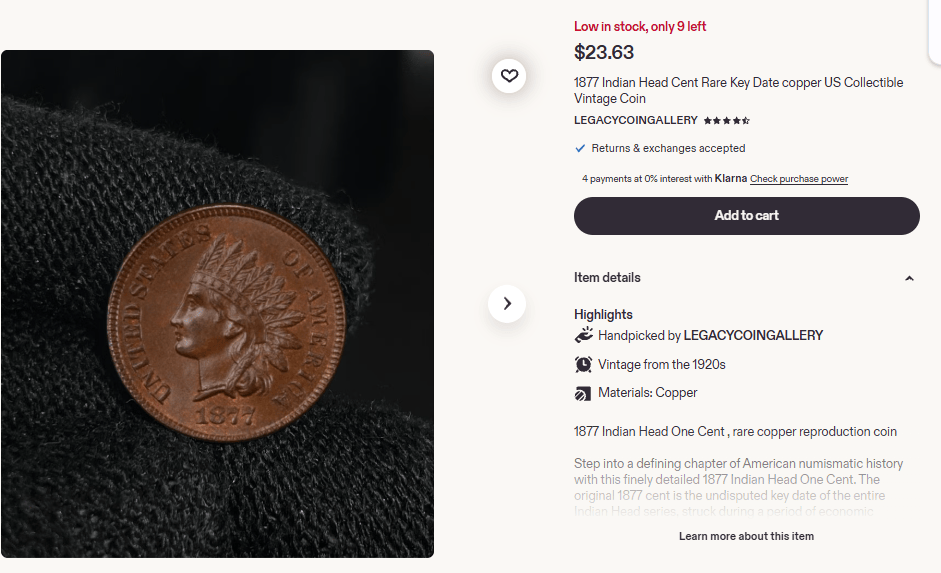
These replicas have many of the same markers as authentic coins and often appear on eBay as authentic.
As a rule, be especially wary of spending hundreds or thousands of dollars on raw 1877 cents if you do not know the markers or have doubts about them. Best to wait for your treasured key date graded by a top holdering company and sold on a legitimate site or shop.
If you like posts like this, subscribe so you can be informed whenever there is a new article or column.
Proxiblog also has thousands of followers on Facebook Coin Groups, YouTube and social media. To get the latest discussion and commentary, be sure to friend us by clicking here.
You can find more information about types, varieties, errors, grading, bidding and buying in Coin News Updated: The Essential Guide to Online Bidding. Please consider buying or gifting the work for a friend, as it underwrites this hobbyist blog. Thank you.
