Coin designations raise value


In addition to mintage, mint marks and condition, expert hobbyists not only know the various coin designations but also study each series to see which ones increase values–some by hundreds and even thousands of dollars.

Take a moment out of roll and error hunting and learn these.

Know the Designations and Abbreviations

Here are PCGS designations and abbreviations (other holdering companies may have different abbreviations):

CENT: RED (R), RED BROWN (RB), BROWN (B)

Colors describing the brilliance or patina on cents, not only Lincoln cents but the denomination. Values for “red” brilliant uncirculated cents command the highest retail prices.


JEFFERSON NICKEL: FULL STEPS (FS)

Showing a strong strike for coins grading MS60 or higher, with at least five unbroken steps visible on the reverse Monticello building.


MERCURY DIME: FULL BANDS (FB)

Showing the middle bands of the fasces are clearly separated with no breaks, scratches or marks in coins grading at least MS60.


ROOSEVELT DIME: FULL BANDS (FB)

Showing the lower and upper bands of the torch are clearly separated with no breaks, scratches or marks in coins grading at least MS60.


STANDING LIBERTY QUARTER: FULL HEAD (FH)

Showing three leaves on the head, ear hole must be present, and hairline distinct.


FRANKLIN HALF: FULL BELL LINES (FBL)

Showing the full, uninterrupted lines on the lower ones of the bell device for coins grading at least MS60.


CAMEO/DEEP CAMEO

A glossy or matte surface on devices, appearing frosty on both sides of the coin, distinguishing them from the fields. The degree of frostiness establishes the designation. If one side is deep cameo and another side, only cameo (depicted below), them the designation is cameo, as both sides must contain the requisite frostiness.


DEEP MIRROR PROOFLIKE (DMPL)/PROOFLIKE (PL)

Mirror-like reflectivity of 4-6 inches for DMPL and 2-4 inches for PL used in coins of all denomiations, not just Morgan dollars.


Research the Series for High Values

After you have learned the various designations, then go to the PCGS Coin Values site and identify which years and designations bring the highest premiums. Here are a few samples:

CENT (R, RB, B)


JEFFERSON NICKEL (FS)


MERCURY DIME (FB)


ROOSEVELT DIME (FB)


STANDING LIBERTY QUARTER (FH)

FRANKLIN HALF (FBL)


Please Subscribe

If you like posts like this, subscribe so you can be informed whenever there is a new article or column.

Proxiblog also has thousands of followers on Facebook Coin Groups, YouTube and social media. To get the latest discussion and commentary, be sure to friend us by clicking here.

You can find more information about types, varieties, errors, grading, bidding and buying in Coin News Updated: The Essential Guide to Online Bidding. Please consider buying or gifting the work for a friend, as it underwrites this hobbyist blog. Thank you.

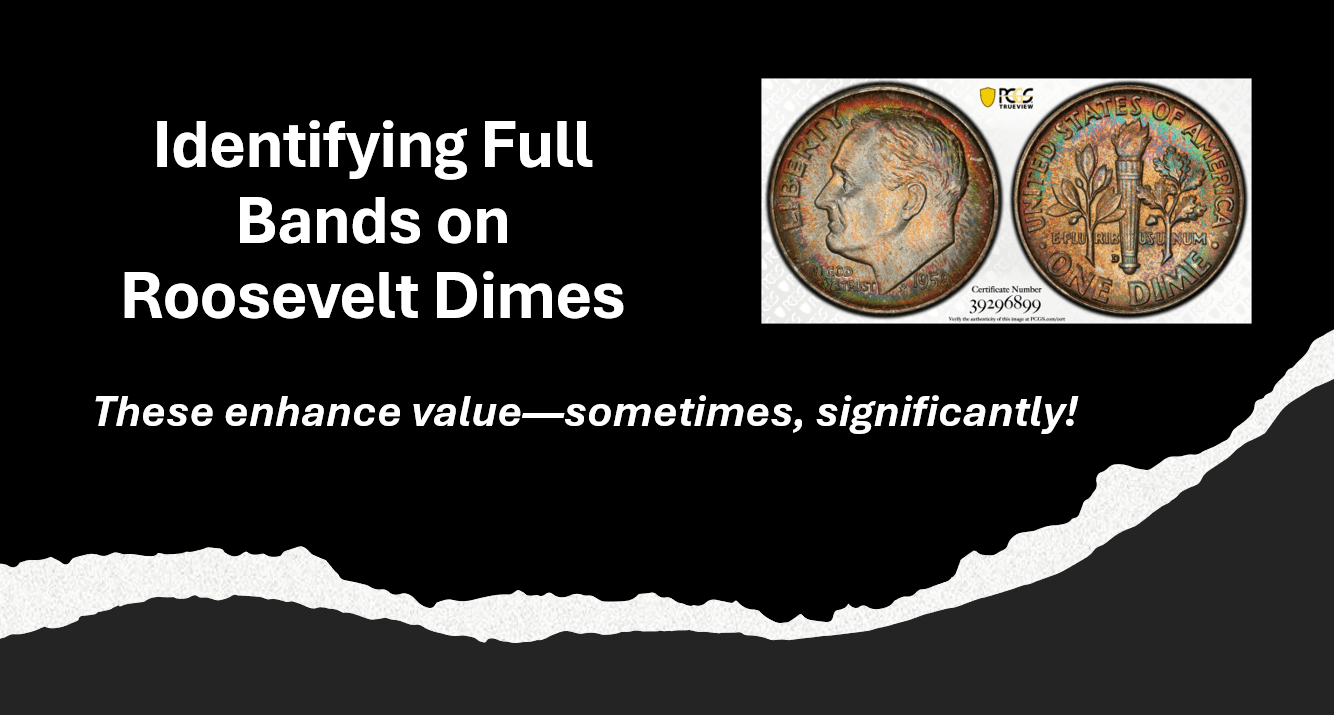
Identifying Full Bands on Roosevelt Dimes


The coin above, safe in my bank box, graded MS67FB, a high designation bringing a $50 premium due to strike, retailing at $130. (The lovely patina will bring hundreds more.) To earn the coveted full bands label, the coin must be a business strike, uncirculated with full separation minus any disruption (bagmark, cuts, scratch, etc.) on the upper and lower horizontal bands of the torch.

This equally lovely 1960-D Roosevelt did not earn the FB designation, coming in also at MS67. Do you see why it failed?


My 1960-D dime value is $55. A portion of the lower band shows a tiny break in the bands on the right. Otherwise it would be worth $375. Compare it now to the full bands designation of the 1958-D so that you can discern the subtle differences.


You want to seek full bands on all Roosevelt dimes. However, these may bring the highest premiums, according to PCGS: 1949-S, 1955-S, 1958, 1965, and 1994-D. To compare, an MS67 1949-D without full bands is worth $110 while with full bands is valued at $850.

The same premiums hold true for the full bands designation on Mercury dimes. You can read about that here.

If you like posts like this, subscribe so you can be informed whenever there is a new article or column.

Proxiblog also has thousands of followers on Facebook Coin Groups and other social media. To get the latest discussion and commentary, be sure to friend us by clicking here.

You can find more information about types, varieties, errors, grading, bidding and buying in Coin News Updated: The Essential Guide to Online Bidding. Please consider buying or gifting the work for a friend, as it underwrites this hobbyist blog. Thank you.

Identifying “full bands” on Mercury dimes


The Full Bands (FB) or Full Split Bands (FSB) designation refers to the two bands on the reverse torch. They should be split with lines without any break, an indication of a strong strike. Proof coins are assumed to have split bands. Business strikes, however, may not.

This is how PCGS defines Full Bands:

“The bands on a Mercury Dime are found within the fasces design element, serving as the main reverse device that resembles a bundle of sticks and an axe wrapped within vines of olive leaves. Binding all these elements together are the bands, which are shown as three sets of twin belts. The Full Bands designation is granted to Mercury Dimes in which the central (middle) set of bands shows a complete split in the middle.”

Here is an example of split bands from one of my dimes.


Mercury dimes with split bands command higher prices. For instance, an MS65 1927 dime retails for $175. One with the FB designation is worth $400 more.

Here’s the reverse of a 1927 dime being offered on HiBid. The seller states that this is full bands.


It’s somewhat difficult to tell from this photo without enlarging the photo, which I did with an app:


With the enlarged photo, I can tell this is not full bands. The left side is mushy with breaks in the lines.

The search for full bands in Mercury dimes is a great way to spend your hobby time rather than look for so-called errors that click-baiters hype on social media. Go through the series and identify years and mint marks that bring premiums. Others may not have that grading skill.

Case in point: In a recent HiBid auction, I spotted this 1945 dime being offered in a lower-tier slab. This is the holy grail of full bands in the series, worth $10,000 at MS63. At MS67, the coin retails for $65,000.

I looked at the photos and won the coin with a $120 bid.


The obverse of this coin actually may be MS67, although I think it will grade MS66:


Here’s the reverse:


I am sending the coin raw to PCGS and will inform you later about the grade. I don’t think it will earn full bands because the lines are slightly broken in the middle of the bands. Nevertheless, with a nearly complete full bands on this coin, it should sell for hundreds of dollars because of the demand for this coveted designation on the 1945-P coin.

If you like posts like this, subscribe so you can be informed whenever there is a new article or column.

Proxiblog also has hundreds of followers on Facebook Coin Groups. To get the latest discussion and commentary, be sure to friend us by clicking here.

You can find more information about types, varieties, errors, grading, bidding and buying in Coin News Updated: The Essential Guide to Online Bidding. Please consider buying or gifting the work for a friend, as it underwrites this hobbyist blog. Thank you.