Micro Morgan Dollars


Micro mintmarks are valuable and relatively easy to identify if you know how to compare them with their regular counterparts. In this post we will describe two desired ones in the Morgan Dollar series along with counterfeits that hobbyists may not immediately detect.

1899-O Micro O

The 1899-O Micro O’s mintmark is noticeably smaller than regular size mintmarks normally seen on Morgan dollars. Its size would fit well on a Quarter Dollar. Here is a comparison from PCGS CoinFacts:


The normal mintmark is oval shaped and the micro, circle shaped. The micro mintmark is closer to the ribbon of the laurel wreath and farther from the “D” and “O” of “Dollar.” The 1899-O Micro O is not rare, as thousands were released into circulation; however, because of the popularity of the Morgan series, is coveted and also included in registry sets.

If you are interested in VAM designations, which many collectors are, you can find this micro mintmark under several varieties, with popular ones being 4,5,6 and 31. (VAM stands for Van Allen-Mallis, the surnames of the two numismatists, who cataloged die varieties of Morgan and Peace silver dollars.)

Values of the 1899-O Micro O are in the thousands for mint state examples. Almost uncirculated examples retail in the high hundreds. But worn examples, which often are found in auctions and estate sales, sell for a few hundred dollars or less, depending on condition.

1903-S Micro S

The 1903-S Micro S Silver Dollar also has a noticeably tiny mintmark, again, what might be used on a Quarter Dollar. Speculation is the engraver at the Mint used the wrong punch and didn’t realize the error.

Again, the variety is easy to identify as the mintmark (similar font) is roughly about half size of a normal mintmark.


As with the 1899-O Micro O, this variety is relatively plentiful with hundreds slabbed by top third-party grading companies. The VAM 2 variety is especially desired.

Values, even in worn condition, are much higher than the 1899-O Micro O. The 1899-O had a mintage of 12,290,000; the 1903-S, 1,241,000. As such, even at G4, the retail for the 1903-S variety is about $100. Values rise substantially thereafter reaching a $1,000 at VF35 and soaring into tens of thousands in AU58 and higher.

Counterfeit Micro Mintmarks

Micro mintmarks 1896-O, 1900-O and 1902-O are not modern but counterfeited during the time that Morgan dollars were still being minted, making them difficult to detect for the novice collector.

PCGS has a brilliant article about these, which you can access by clicking here. Here is an illustration from that article, compliments PCGS:

PCGS notes that these contain identical linear marks, or lumps, created during the transfer process. A genuine coin would be used to create a working die, leaving lumps and other telltale signs.

Perhaps the most famous counterfeit micro O is the 1901-O Micro O, which many hobbyists actually collect. Like the 1896-O, 1900-O, and 1902-O varieties, these are high-quality fakes. PCGS states, “These fakes are notable for their deceptive similarity to genuine coins, being made of good silver and exhibiting sharp details, especially in higher-grade examples.”

If you like posts like this, please subscribe so you can be informed whenever there is a new article or column.

Proxiblog also has thousdans of followers on Facebook Coin Groups, YouTube and social media. To get the latest discussion and commentaries, click here.

You can find more information about errors and varieties as well as buying and bidding on coins in Coin News Updated: The Essential Guide to Online Bidding. Please consider purchasing the work for yourself or a friend, as it underwrites this hobbyist website. Thank you.

Online Bidding Basics


By Michael Bugeja

Every now and then we need to monitor the major online coin portals and share bidding basics.

Some general rules:

  1. Never bid on raw coins unless you are an expert grader, trust the seller, can view excellent photos, and can return the coin if unsatisfied.
  2. Never bid on coins in bottom-tier slabs unless you spot a mistake like a rare error or variation that isn’t listed on the label.
  3. Do not bid on raw coins on Live Auctioneers, HiBid or Proxibid unless (a) you are an expert grader, (b) have read the terms of service, and (c) can afford the buyer’s fee and shipping.
  4. If bidding on eBay, consider not wasting time on “Buy It Now” offers unless you need the coin or currency for your collection. (Note: If you find yourself in this situation on eBay, you may want to simply “watch” the coin [hit the “watch” tab] until the seller relists it and finally comes to his or her senses, dropping the price or going to “Make Offer” status.) You can always contact the seller and ask for a lower buy price.

Let’s focus now on eBay. Here’s why: eBay is a global commerce leader with a vast user base and a massive overall gross merchandise volume (GMV), including a substantial market for coins and collectibles, which drives a much higher sales volume than other venues. Live Auctioneers, HiBid and Proxibid are small in comparison, especially when it comes to coin sales. eBay has 134 million active buyers worldwide. Coin and collectible buyers account for $10 billion in annual sales.

We’ll begin with an example of “Buy It Now” on eBay concerning a common Morgan Dollar, 1878, 7 Tail Feathers, Reverse of 78. By the look of the coin, I give it a generous MS-63 grade (assuming there are no hidden flaws the photo doesn’t reveal). That means the retail price should be around $145. Instead, the seller is asking for the ridiculous price of $1,995.


If you know how to grade (I mean, really know how to grade) and want a coin or currency note for your collection, always check auction values rather than retail values. You can do that online via PCGS CoinFacts or Paper Money Values, which are free. Find the low and high auction prices for the coin or note and bid the low first.

You can bid as you like, of course, but my general rule for “Buy It Now / Make Offer” is to bid only on slabbed coins by top holdering companies (PCGS, NGC, ANACS, CAC and ICG).

You can score good values on eBay “Make Offer” lots if you know how to negotiate. Go through the same process as above, knowing retail and auction prices, and start with a low auction bid if you really want the coin or note. I only do this with lots that I need for my collection. To pay for them, I retrieve coins from my bank box so that I can afford the pricier items as illustrated here. For instance, I sold most of my Lincoln Wheat cents slabbed by PCGS to afford these two desired lots.

The first was a 1901 Buffalo note that is becoming increasingly difficult to acquire at lower than retail rates. Just as in coins with top holdering companies, I bid only on PCGS and PMG notes. Here is the lot that caught my interest, because it had good color and came with a “Make Offer” designation:


You’ll note that eBay states this lot sold for $1,199. It did NOT. That was the asking price. I bid $890, slightly below retail of $900, and wrote that I could buy the note in question at the same grade from my hometown coin shop, Chester’s Coins and Gifts, for $950. (And I usually get a discount because, well, I know the shop owner!) I also noted that all those other PMG 25 Buffalos were not selling at $950 but were being relisted.

I won the lot:


I had been looking for three years for a “round” $1 California fractional gold PCGS coin in an old green PCGS holder, as the “round” rather than “octagonal” $1 coins are difficult to find. Finally one appeared. But the asking price was way above retail:


Here’s the $2,000 retail price from PCGS at the time of purchase, 2017, for the coin in question:


In my offer of $1,625, I told the seller that the latest auction price was around $1,600. “Seems fair enough,” the seller stated, and I won the coin.


Once again, eBay’s record states the coin sold for the initial asking price. As in the 1901 Buffalo note, it decidedly did not.


If you like posts like this, subscribe to Proxiblog so you can be informed whenever there is a new article or column.

Proxiblog also has thousands of followers on Facebook Coin Groups, YouTube and other social media. To get the latest discussion and commentary, be sure to friend us by clicking here.

You can find more information about types, varieties, errors, grading, bidding and buying in Coin News Updated: The Essential Guide to Online Bidding. Please consider buying or gifting the work for a friend, as it underwrites this hobbyist blog. Thank you.

Family of Fake Indian Cents


By Jack D. Young

A recent counterfeit Indian Head Cent listed on eBay from a larger seller sparked my interest–to the extent that I decided to investigate it, especially since the coin was shared to several Facebook groups.

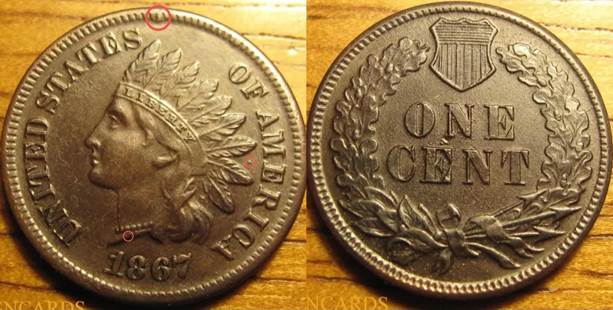
I discovered a rather large “Family” sharing a common obverse. A “Family” is code for counterfeits with common markers among various dates. Most notably, I viewed the deformed denticles at 12 o’clock on the obverse and a raised lump left of “M-E.” The 1867 pictured below is from that larger seller.


The above example also shared a depression in the neck. I recalled seeing this in an NGC article published about 2013 or thereabouts. That article didn’t include these “common marks” rather more of a description of the surfaces.


After browsing online for sometime it was clear this was a very large “Family” and not limited to a few dates. Most examples were either key or semi-key dates but it would be expected this could be seen on common date Indian Cents.

This listing includes the Key date 1877! Along with another 1908s and two semi-key dates including 1866 and 1870. All images highlight the lump on the field between the feathers as well as the deformed denticles.


Some pieces aren’t as deceptive as others but many of these were already in collections! Stay diligent when looking for new coins to add to your collection and research extensively.

If you like posts like this, you can read more articles on counterfeit coins by Jack D. Young, Jack Riley and Michael Bugeja at this URL. Also, please subscribe so you can be informed whenever there is a new article or column.

Proxiblog also has thousands of followers on Facebook Coin Groups, YouTube and social media. To get the latest discussion and commentaries, click here.

You can find more information about errors and varieties as well as buying and bidding on coins in Coin News Updated: The Essential Guide to Online Bidding. Please consider purchasing the work for yourself or a friend, as it underwrites this hobbyist website. Thank you.

Etsy’s Ripoff Replicas


Etsy, a major seller of coins, has house rules that prohibit fakes, and yet is one of the major distributors of counterfeits and replicas. That, in itself, is not the problem. Scam sellers on Facebook coin sites and online auctions purchase these replicas and then try to pass them off as authentic, hoping to bait new hobbyists who do not know any better.

Here’s an example:


Proxiblog catalogued keydate replicas and is sharing them here. Bookmark the URL and share this post whenever you see someone trying to pass off these items as genuine.


Proxiblog identifies these replicas every day across Facebook coin groups–to the extent that he regularly warns against sellers and scammers who claim these are genuine. Here’s a screenshot of a recent example:


If you like posts like this, you can read more articles on counterfeit coins by Jack Riley, Jack D. Young and Michael Bugeja at this URL. Also, please subscribe and be informed whenever there is a new article or column.

Proxiblog also has thousands of followers on Facebook Coin Groups, YouTube and social media. To get the latest discussion and commentary, be sure to friend us by clicking here.

You can find more information about errors and varieties as well as buying and bidding on coins in Coin News Updated: The Essential Guide to Online Bidding. Please consider purchasing the work for yourself or a friend, as it underwrites this hobbyist website. Thank you.

Several Suspicious 1804 “Large Cents”


By Jack D. Young

Before discussing those suspicious cents, a quick definition of an electrotype–a copy of a coin formed by depositing metal onto a mold using electricity. Electrotypes are not considered genuine coins, but rather reproductions. When offered in auctions, they are fake coins.

Here is an example as an acknowledged electrotype sold in a Goldberg 2006 auction:

Images courtesy Goldberg Auctioneers

In the time span from this auction until August 2017, there was another acknowledged example reportedly sold in two different eBay auctions in 2016:


On Aug 2, 2017 another example with many of the matching obverse marks sold on eBay as an electrotype:

eBay Aug 2, 2017 Listed Electrotype Example

During the same time frame as this listing another one was running with matching marks but listed as genuine:

eBay Aug 2017 Listed Genuine Example

 eBay Aug 2, 2017 Listed Electrotype Example      eBay Aug 2017 Listed Genuine Example

Comparison of the latest eBay example listed as genuine to the documented electrotype example from the Goldberg’s 2006 auction shows the same “circulation” marks:

    eBay Aug 2017 Listed Genuine Example             Goldberg 2006 Auction Example- Electrotype

Comparison of the reverse images between these two yields similar results:


Both examples show the same marks and what appear as casting “bubble”/ defects on the surface, “casting” serious doubt that listed example is a genuine 1804 large cent. I sent the seller a number of messages, but I was too late to have him stop the auction.

eBay messages with the author

At the same time another early copper collector (unidentified) was also asking questions:


The weight listed as “11.7 grams” is a red flag as the standard was 10.89! Electrotypes regularly weigh more than a genuine example as a result of the base metal used. So it sold:

Sold as genuine on eBay 2017

The main difference between this and the Goldberg example is this one sold for a whole lot more. And an edge view would have given it away; an in-hand inspection would have been interesting to see if it was oriented correctly to a genuine 1804 large cent.

A genuine example has the reverse rotated as noted in the lot description of the “finest known” example in a past Stack’s Bowers auction:

“This die state is traditionally known as ‘Sheldon-266c,’ with substantial cuds over RTY of LIBERTY and MERIC of AMERICA, the last of the three main die states. Clash marks are seen at Liberty’s profile and throat, as well as under her hair bow. Breen describes this state as his state IV. Genuine specimens show the distinctive die rotation typical of this variety, with the reverse aligned roughly 45 degrees counterclockwise of proper coin turn.”

The Stack’s example showing the rotation of all genuine examples (and the die breaks of the late state):

1804 S-266 Cent from the Pogue Collection. Image courtesy Stack’s Bowers.

So, now the twist! I had the opportunity to purchase an example at auction this month. That one showed a provenance back to 1987 with a couple of giants in early copper previously owning it.


Reviewing the images, I confirmed it matched the others with the many common “sister marks” and it became a “must have,” not just for my collection but for the research and history of this one.

So, I won the auction and having it in-hand allowed for more observations to document these!

Author’s example and some of the eye-catching common marks!

I had the opportunity to weigh my example; it weighed 12.10 grams versus the mint standard of 10.89 grams.

I also was able to take good images of the edge and evaluate the die rotation of this “copy” versus a genuine one as images earlier with the genuine example:

Proper Die Rotation for this electrotype

Electrotype Edge of this one

And the final “twist”–back to the example sold as genuine in 2017; I decided to ask the seller about it now. He apparently mistook me for the buyer and sent this response.

Well, maybe justice, as they say Karma is a “b**ch.”


If you like posts like this, please subscribe so you can be informed whenever there is a new article.

Proxiblog also has thousands of followers on Facebook Coin Groups, YouTube and social media. To get the latest discussion and commentaries, click here.

You can find more information about errors and varieties as well as buying and bidding on coins in Coin News Updated: The Essential Guide to Online Bidding. Please consider purchasing the work for yourself or a friend, as it underwrites this hobbyist website. Thank you.

1806 Counterfeits, the Gift that Keeps Giving!


By Jack D. Young

My friend and half cent guru Ed Fuhrman alerted me to this one on eBay. His PM stated “I think someone just posted one of the super fake 1806 C-1 half cents on eBay. Take a look.”

I did and they did.

I have actually written two articles about these fakes for these EAC’s Penny-Wise as well as a couple for Coin Week and now this one for Proxiblog.

The subject coin is interesting as one of the very deceptive group of counterfeits I have been chasing down the rabbit hole since late 2015. This was one we saw in the 1st group of certified genuine fakes from a known CN connected buyer and group of sellers operating out of College Station Texas; I have discussed this group in many previous articles…

The listing of the subject:

eBay listing- counterfeit 1806 C-1 half cent

Yep, I made an offer knowing what this is; I chose not to discuss it upfront with the seller as I didn’t want to influence him while considering my lower offer.

I quickly marked up the posted image of the reverse with four known counterfeit tells, or attribution points for these. Done from memory, this one is burned into my mind as I owned five examples at the time with four being in TPG holders as genuine. And 14 total examples documented to date.

Subject reverse marked with 4 major attribution points of the counterfeits

So, no doubt what this one is, it is the 1st I had seen in the wild in a couple of years! I anxiously waited to see how the seller would respond to my offer.


Not for the listed price, but a fair price for what it is! And then waited to actually have it in-hand so that I could message the seller and start a conversation:

Messages through eBay with the seller after the sale

Interesting he stated this example “is from a Boston area old, abandoned coin shop”; he later stated he purchased it from the cleaning lady who cleaned the basement and painted for the owners two or three years ago.

And a nice image of this one including the edge:

Combination image of this featured example

And in-hand the main reverse attribution points for these from my microscope:


So, a good time to add some details on these from one of my previous articles:


Interestingly, there are 2 “varieties of this reverse”; apparently the counterfeiters tried a repair!

And an image of the 1st die state of the common reverse:

Reverse image from my article draft

And what about the obverse?

Obverse image from my article draft

Just an amazing number of common marks including a couple of light scratches noted! These are seen across both reverse die states.

So this example became the 6th one in my mini-hoard- talk about deep into the rabbit hole! And just a side note, I had several examples sent out for XRF testing of the metal and found them to have high levels of zinc in them, the only ones to test with that result against all of the other early copper coins we tested. Maybe the counterfeiters melted some later date Lincolns in their mix for planchets?

I did leave positive feedback for the seller but did note the coin is counterfeit.


So, I thought this the end of the story, but NO, as my articles often take a twist at the end!

And again, it was Ed who sent me a late Friday night link and said I really would like this one:

eBay listing over the weekend

I pulled up the listing and was literally shocked at the posted images!

And the special NGC label; apparently “traderbea” is a premier shop on whatnot.

eBay listing images

Look familiar?


Great images posted show all the “details”! No question what this one is and it is certified genuine by the TPG.


A quick note to my contact at the TPG resulted in an amended on-line cert:


Certainly makes it harder to sell if anyone considering a purchase takes the time to look…

Contacting the seller and discussing the issues lead to an agreement on a purchase; he had a buy-back guaranty through the whatnot dealer and of course the TPG has an authenticity guaranty as well so it is on its way to join the “Dark Side Collection.” Digging deeper into the abyss, two in a week 😎!

And this one is recent and slipped past both an established coin dealer and a top tier TPG, and that just goes to show how deceptive they are. So maybe my 5th published article will help. …

Ended eBay listing


And I will have to update my image of the TPG certified examples in the collection!

Author’s image of 4 certified examples

If you like posts like this, you can read more articles on counterfeit coins by Jack Riley, Jack D. Young and Michael Bugeja at this URL. Also, please subscribe so you can be informed whenever there is a new article or column.

Proxiblog also has hundreds of followers on Facebook Coin Groups. To get the latest discussion and commentary, be sure to friend us by clicking here.

You can find more information about errors and varieties as well as buying and bidding on coins in Coin News Updated: The Essential Guide to Online Bidding. Please consider purchasing the work for yourself or a friend, as it underwrites this hobbyist website. Thank you.

Machine v. Hub Doubling


With the emphasis now on error coins, thanks in part to coin microscope sales and hyperbolic coin values on social media, it is important to know the difference between machine and hub doubling.

This is a tutorial.

Let’s start with a photo showing a machined v. hub doubled 1969-S cent. Both look significant. Only one is. Can you tell the difference? (We’ll return to these coins momentarily.)


Machine doubling, the above left photo, adds no or little value to coins. It happens when a die at the Mint begins to deteriorate and so may bounce during a strike, creating a flat shelf-like image. The date, device, lettering and mintmark can appear to be doubled.

Hub doubling, valuable, indicates a flaw in the die itself. Unlike machine doubling, which happens during a strike, someone at the Mint made an etching mistake. Mintmarks before 1989 were punched into the die; but this is distinct from hub doubling. We call these deviations “repunched mintmarks” (RPM). Hub doubling produces a raised, rounded impression that follows the flow of the date, lettering or device.

Let’s illustrate this again more closely with the 1969-S DDO cent, one of the most illusive coins, worth a bundle. It is ultra rare with PCGS holdering only 30+ coins. You can read about that here.

Clickbait social media says you can find one in pocket change. Oh, and you’ll need to buy a coin microscope for that. Fat chance.


New collectors who routinely consult social media for any number of topics often believe these hyped posts. Odds are you will never find a 1969-S DDO in rolls or pocket change. But you can find dozens of machined doubled ones on eBay and elsewhere masquerading as an authentic 1969-S DDO with sellers asking hundreds and thousands for a faux coin:


Let’s return to the images mentioned earlier and show distinctions between machine doubled and authentic doubled dies:

Machine Doubling, Left; Hub Doubling, Right

The machine doubled cent has a flat, shelf-like doubling. The doubling does not mirror the individual numbers but seem pushed to the right. The hub doubled cent has raised rounded digits that follow the contours of the numbers.

In addition to the ability to distinguish between machine and hub doubling, veteran collectors know how to identify replicas flooding the market from China. You can buy these fake ultra rarities on venues like Etsy for less than $30.


These replicas are purchased by scammers and then posted on eBay as the real deal. Now you have to compare devices with genuine coins. To do that, google a genuine one in a PCGS holder and compare doubled devices.


The obvious difference is the word “Liberty.” Take a closer look:


The doubling on the replica is mushy and below the original letters of “Liberty”; the doubling on the authentic coin is above “Liberty” with each letter mirroring the original and shifted to the right.

If you like posts like this, please subscribe so you can be informed whenever there is a new article or column.

Proxiblog also has thousands of followers on Facebook Coin Groups, YouTube and social media. To get the latest discussion and commentaries, click here.

You can find more information about errors and varieties as well as buying and bidding on coins in Coin News Updated: The Essential Guide to Online Bidding. Please consider purchasing the work for yourself or a friend, as it underwrites this hobbyist website. Thank you.

Fake Family, Type 2, Standing Liberty Quarters


By Jack Riley

With an ever growing amount of counterfeit coins being produced it can be a challenge to keep up with them. Tens of thousands of fake coins, replicas and copies flood the hobby market each month.

Numismatic News and other sources have reported these sobering results:

  • One factory along in China produces over 100,000 forged coins per month.
  • Annual figures of fakes range in the billions with entire cities or districts in China manufacturing them.
  • Flooding of fakes on eBay remains one of the biggest concerns.

The frenetic manufacturing rate now includes common 90% silver coinage to be counterfeit. Nothing is safe!

After a previous article of what one could call the “Spiked wing” counterfeit Standing Liberty quarters, a second family arose on different online venues.

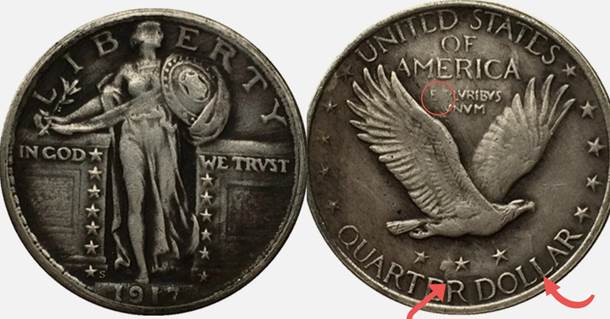
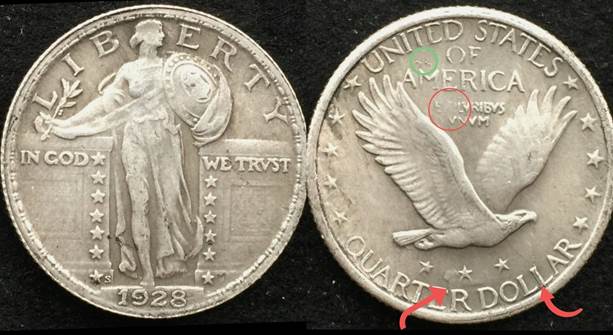
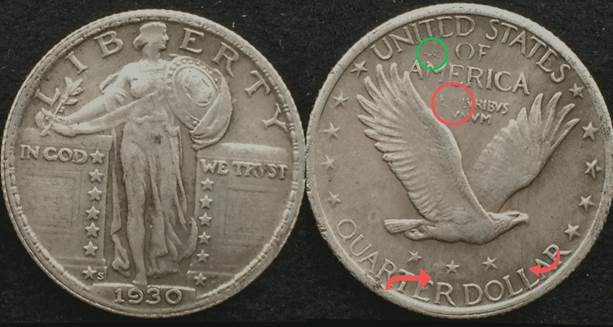
I have three images comparing this new “Family.” Two of which have a major casting flaws above “America” and will be highlighted in green since it isn’t seen on all examples. All markers highlighted in red have been on all examples seen as of the time of this article.

So to the Family! Three coins dated 1917, 1928, and 1930 showed up all sporting a San Francisco mintmark. Though this likely could be seen on any date/mintmark combination since the counterfeiters pay no mind to design changes or the series itself. First up is this 1917s Type 2 SLQ that shows a weak E-P highlighted in red as well as two cracks through “Quarter Dollar”.


Another seller offered two coins (1928s and 1930s) which share the same reverse but a different obverse as the 1917s. Additionally the raised lumps from a poor cast show on both of these examples.


It would seem a new “Family” surfaces regularly! Making it ever more important to be diligent in vetting who/where you purchase coins from and how you make that purchase, especial ly if buying on eBay, as counterfeit expert Jack D. Young has reported for Proxiblog.

Granted, even experienced hobbyists are scammed by purchasing counterfeits. As such, newer collectors should follow these general guidelines:

  1. If you are ready to bid hundreds of dollars on a coin, resist buying a raw one and shop for one holdered by PCGS, NGC, ANACS and CAC.
  2. Be especially careful when purchasing raw coins from eBay and other online venues. TAI bots cannot detect counterfeits, so you are on your own.
  3. Make sure the seller takes returns and has good reviews. Also, the number of positive reviews is a good indicator. If someone has 0 sales or even fewer than 100, do not take a chance.
  4. Weigh the coin and go to PCGS CoinFacts for the date and mintmark, checking your coin against weights and dimensions.
  5. Read this article about detecting counterfeits.

If you like posts like this, you can read more articles on counterfeit coins by Jack Riley, Jack D. Young and Michael Bugeja at this URL. Also, please subscribe so you can get our weekly newsletter and be informed whenever there is a new article or column.

Proxiblog also has thousands of followers on Facebook Coin Groups, YouTube and social media. To get the latest discussion and commentary, be sure to friend us by clicking here.

You can find more information about errors and varieties as well as buying and bidding on coins in Coin News Updated: The Essential Guide to Online Bidding. Please consider purchasing the work for yourself or a friend, as it underwrites this hobbyist website. Thank you.

1950 Quarter Over-Mintmarks


When it comes to errors and varieties by the U.S. Mint, there are two important considerations: how does the variation deviate from the original design and how did the variation happen?

Let’s dispense with the first question. Quarters produced in Denver should have a D mintmark and ones in San Francisco, the S mintmark. The Denver quarter should not have a D over S mintmark and the San Francisco quarter, S over D.


Many coin collectors believe that errors are the result of a glitch in the strike process, such as a die cud or chip. But sometimes human error is the cause.

In the case of the 1950 over mintmarks, the first human error occurred at the Philadelphia Mint. Up until 1994, the Philly facility manufactured all the dies of the branch mints. The Denver mint had asked for a certain number of dies, and the fulfillment was one die short. To complete the order, a mint employee in Denver decided to overpunch the die on an existing one, creating the variation. Later in the year the same thing happened at San Francisco, creating the other variety.

You can read more about this on the PCGS CoinFacts website.

Collectors quickly identified the error in 1950 and so kept many over mintmark examples. This means you still can buy uncirculated examples, usually in low mint state condition. More likely, if you are a roll collector, you will find these over mintmarks in worn conditions.

At EF 45, the D over S is worth $150. Retail prices increase to $265 at AU58 and then rise dramatically in uncirculated condition. A gem MS65 example sells for $3,260.

At EF 45, the S over D is worth $210. Retail prices increase to $265 at AU58 and then also rise in uncirculated condition. A gem MS65 example sells for $1,450.

If you are roll searching, you may get lucky and find one of these over mintmarks. But if you are planning to purchase one, buy ones holdered by PCGS or NGC.

Here’s a raw VF30 example from eBay. The photo doesn’t show the mintmark sufficiently to make a determination.


Instead of taking a chance on a raw coin like this, you can find many holdered examples for reasonable prices.


If you like posts like this, please subscribe so you can be informed whenever there is a new article or column.

Proxiblog also has thousands of followers on Facebook Coin Groups, YouTube and social media. To get the latest discussion and commentaries, click here.

You can find more information about errors and varieties as well as buying and bidding on coins in Coin News Updated: The Essential Guide to Online Bidding. Please consider purchasing the work for yourself or a friend, as it underwrites this hobbyist website. Thank you.

“NGC certified” Large Cents–NOT!


By Jack D. Young

I have written a number of articles on fake Morgan Dollars in fake PCGS holders but now the latest from China (CN) are counterfeit large cents in fake NGC holders!

I was alerted to three bad listings in a coin forum I frequent, with one already showing sold. All listed on the Bay, all had the standard eBay answer they were A-OK, but they are not OK.

In all listings the seller cut-off the cert number on the label of the fakes, but the genius 😎 left enough of the barcode to scan. And unlike the PCGS Morgan fake slabs, the barcodes do scan properly!

So, starting with the “1840,” I show the Bay listing, the cert for the genuine one, and a comparison of the CN counterfeit to the genuine example.

One note I would like to make, when NGC receives information that a cert of theirs has been compromised with a counterfeit, they “nuke” the cert with a note “possible counterfeit holder” which can help someone considering a purchase if they just take the time to look it up. The certs for these three have all been reported and nuked and these are the images I will use in this discussion.

Recent eBay listing of a counterfeit 1840 large cent

The following shows the updated NGC cert and the comparison of the slabbed image of the listed counterfeit and the genuine example.


Next, the “1844”; same seller shipping from China:

Recent eBay listing of a counterfeit 1844 large cent

1844 comparison image of counterfeit, left; genuine example, right

And “last,” the “1846.” This is the initial example shown sold from the coin forum discussion.

Recent eBay listing of a counterfeit 1846 large cent

And the updated cert and comparison to the genuine example; WOW, MS61???


All three showed sold, and all appear to have been removed from the Bay after the fact. The 1840 actually showed as:


Kudos to NGC for so quickly addressing the issue! As far as the coins themselves, the1844 and 1846 are from the “smashed dentils” obverse family, the 1840 “crescent chip obverse” family from my previous Coin Week article, “It’s a Jungle out There! Later Date Large Cent Counterfeits.”

But as usual for these articles there is a twist! Reviewing the seller for any new items revealed another one, this a bad 1855 in bad NGC slab…

Counterfeit ”1855” on the left, genuine example on the right

And another comparison shows these are not even close!


And one common good “tell” for these holders is the size of the prongs!

Going back to check on the seller resulted in this, “No longer registered user”:


“NRU’ed”, I went back to the sold items and although you can see them, they have ALL been removed when you actually click on the links. eBay apparently put the hurt on this seller after the fact. This “1857” would have been interesting to see as it stated PCGS!

Apparent sold and removed later large cent counterfeit from the same seller

What another strange “twist”! I have been a very loud critic of eBay over the last several months about their apparent lack of caring about the number of counterfeits currently allowed for sale there. AND the inability of having obvious bad counterfeits removed through their “new and improved” reporting process. This lead to my latest Live Coin Q&A podcast premiered May 27 at https://www.youtube.com/watch?v=57HwefhVn_k

It seems rather ironic after previously receiving responses like the following one on these fakes that the day after the podcast all of these including the active listings and the seller were removed!

eBay response to my report of the bad 1844 not NGC large cent

So ends another episode of my Facebook group, Fun with Fakes (FwF’s) and Proxiblog; it continues to be really hard to keep up with all the ways the counterfeiters are challenging the Hobby but we will continue to release content like this in an effort to help!